Are Hoverboards Still Popular? Which Is Better for You?
This post contains affiliate links. As an Amazon Associate, we earn from qualifying purchases.
Hoverboards are still sold and manufactured, but they are not mainstream. Their popularity collapsed after 2016 due to widespread fire hazards and recalls, and the market has since settled into a stable niche. Current sales are driven by cautious parents, gadget enthusiasts, and specific use cases like go-kart attachments, with the global market growing at a modest 6.7% CAGR. A hoverboard’s viability today depends entirely on its UL 2272 certification for electrical safety, an essential requirement that most pre-2017 models failed.
That certification is the line between a legitimate product and a fire hazard the CPSC considers defective. The shift from a viral trend to a regulated niche product means “popular” now describes a steady, informed trickle of purchases, not a cultural phenomenon. For a 2026 buyer, the question isn’t about popularity, it’s about whether a certified hoverboard fits a specific need better than the electric scooters and skateboards that now dominate the personal transport scene. Many people still ask, are hoverboards still popular, but the answer is more nuanced than a simple yes or no.
What follows is a breakdown of where the hoverboard market stands, the safety landscape that reshaped it, and a direct comparison with electric scooters to help you decide if one belongs in your garage.
Key Takeaways
- The hoverboard market is stable but niche, projected to grow at 6.7% annually, with double-wheel models holding a 67.3% market share.
- UL 2272 certification is mandatory. The U.S. CPSC considers any self-balancing scooter without this electrical systems standard to be defective.
- Recalls are ongoing. Major brands like Razor (Hovertrax 2.0) and DGL Group (Hover-1 Superfly) have issued significant recalls as recently as 2021 and 2022 for fire hazards and software flaws.
- They are banned from most public transit and many public spaces; over 60 airlines and more than 20 U.S. Colleges prohibit them.
- For most urban commuting, an electric scooter is a more practical choice; hoverboards excel as recreational toys or for specialized uses like drone attachments.
What Does ‘Popular’ Even Mean for Hoverboards in 2026?
Popularity has layers. In 2015, it meant viral videos, holiday sell-outs, and sidewalks clogged with riders. Today, it means a stable, specialized market segment. Industry analysts at market.us project a 6.7% compound annual growth rate for the hoverboard market, a sign of steady, not explosive, demand, which directly informs the are hoverboards still popular discussion.
The demographic has narrowed. Double-wheel models, favored for stability, command a 67.3% market share. This isn’t a device for the masses anymore; it’s a gadget for a specific user. Think of it like a unicycle. You can buy one, people still make them, but you don’t see them on every street corner. Their popularity timeline was a sharp spike, not a sustained plateau.
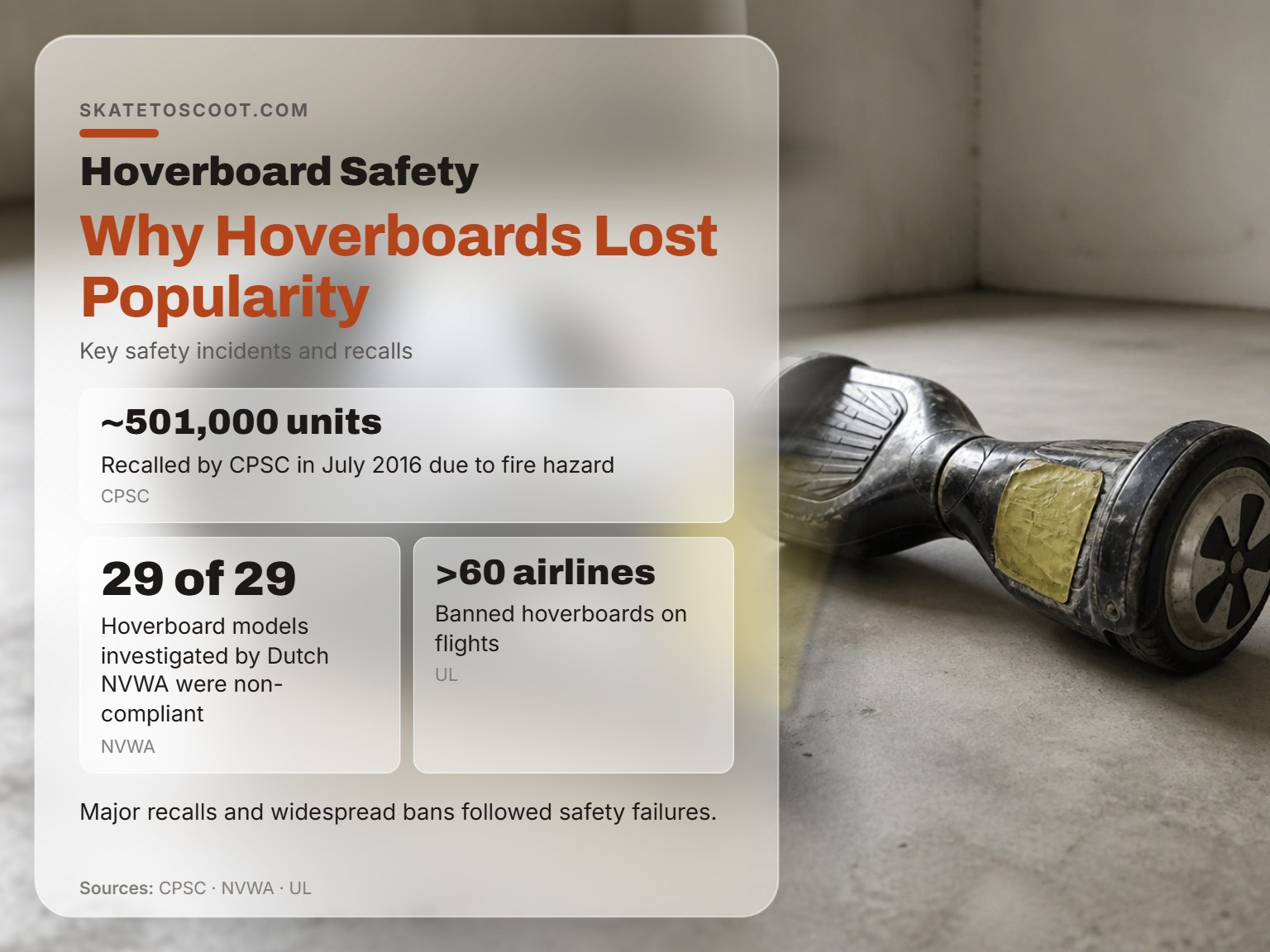
The cultural memory, however, is dominated by the collapse. From December 2015 to February 2016 alone, the CPSC received reports of 52 hoverboard fires causing over $2 million in property damage. That smell of burnt plastic and fear doesn’t just fade. It fundamentally reshaped the entire product category.
The U.S. Consumer Product Safety Commission (CPSC) considers self-balancing scooters that do not meet the UL 2272 electrical safety standard to be defective and can seek their recall.
The Safety Reckoning That Changed Everything
The peak popularity phase ended with a literal bang. By July 2016, the CPSC announced a recall of roughly 501,000 hoverboards from 10 different firms. The cause was consistent: lithium-ion battery packs overheating, sparking, smoking, catching fire, or exploding. The agency had at least 99 incident reports on file.
The response was a regulatory blitz. Retailers like Amazon and Target yanked them from shelves. More than 60 airlines banned them. Over 20 U.S. Colleges and universities barred them from campus. New York City’s MTA prohibited them on all public transit. This wasn’t a slow drift out of fashion; it was a product category being pulled from the mainstream over legitimate public safety fears.
The technical failures were systemic. A 2018 investigation by the Dutch NVWA looked at 29 hoverboard models available in Europe. The result was damning: all 29 failed essential safety requirements. Of those, 28 had a deficient charge control circuit (no protection against overcharging), 27 had wiring paths not free of sharp edges, and 27 lacked a sufficiently fire-resistant housing. This wasn’t one bad factory; it was an industry-wide engineering failure.
This history is why you can’t evaluate a modern hoverboard without understanding this hoverboard safety landscape. The standards that exist today were forged in that fire.
The UL 2272 Standard: Your Non-Negotiable Filter
In response to the crisis, UL published UL 2272, a “system-level” safety standard for the electrical systems of personal e-mobility devices. It became an accredited American National Standard (ANSI/CAN/UL 2272) by the end of 2016. This is the single most important spec for a buyer.
Unlike a standard that just tests a battery cell, UL 2272 evaluates the entire electrical system, how the battery, motor, charger, and wiring interact under stress. It’s the difference between checking a spark plug and testing a whole engine under load. The CPSC’s official stance is clear: any hoverboard without this certification is considered defective.
Common mistake: Buying a cheap, uncertified model from a third-party online marketplace. The CPSC recall for fire hazard in 2016 was so large partly because these platforms were flooded with non-compliant units. Always verify the UL 2272 mark on the product itself and its packaging before you consider anything else.
| Safety Checkpoint | What It Means | Red Flag |
|---|---|---|
| UL 2272 Mark | The entire electrical system has passed rigorous safety tests. | No mark, or a mark for a different standard (like UL 2271 for just the battery). |
| Retailer Reputation | Sold by established brands (Razor, Segway) or major retailers (Best Buy, Target). | Sold on generic e-commerce sites with no verifiable brand contact info. |
| Recall Check | The specific model has no open recalls on CPSC.gov. | A model name matching a recalled batch (e.g., Hover-1 Superfly 2020). |
Are They Still Being Made and Sold? (Yes, But Differently)
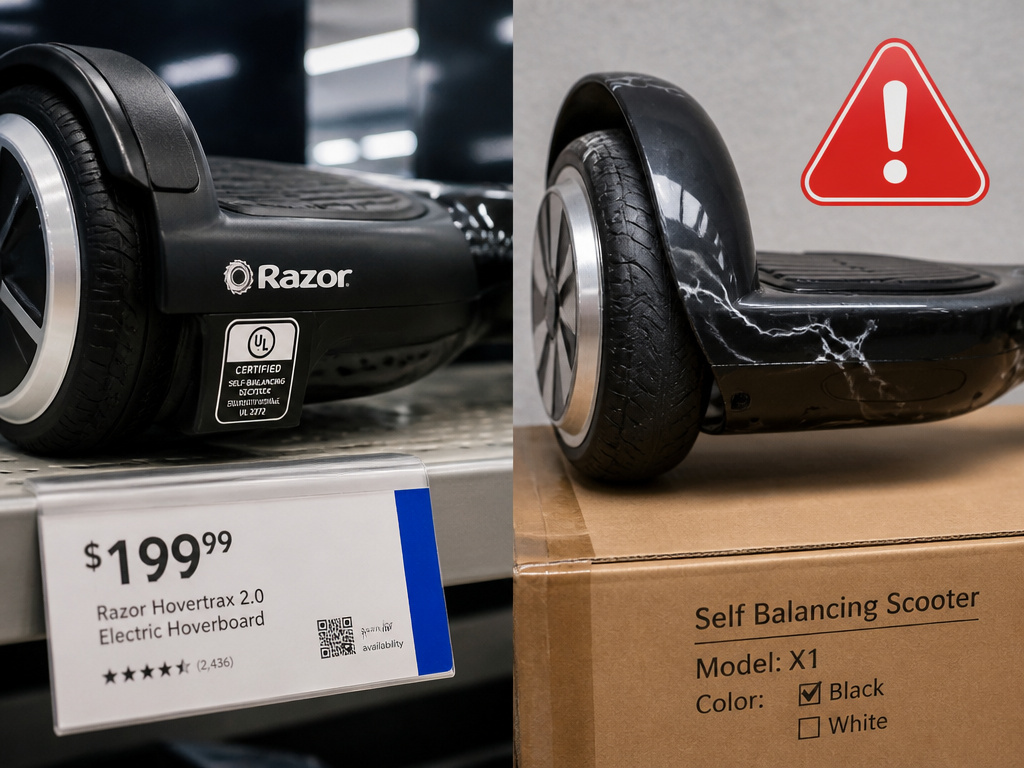
Manufacturing didn’t stop; it consolidated and improved under regulatory pressure. You can walk into a Best Buy or Target and find hoverboards from known brands like Razor and Segway. The key difference is that these are overwhelmingly UL 2272-certified models.
However, the supply chain is bifurcated. Legitimate, certified models coexist with uncertified units on third-party marketplaces. This is a critical point for any 2026 buyer: the place you buy is as important as the brand. The best hoverboard models today are those from companies with a track record of engaging with safety recalls, not hiding from them.
Recent recalls prove that safety is an ongoing process, not a one-time fix. Consider two major post-2020 recalls:
- Razor Hovertrax 2.0 (2021): Recall of approximately 237,300 GLW battery packs sold with boards made between September 2016 and August 2017. There were more than 20 reports of these packs overheating, smoking, or catching fire. Crucially, these battery packs were certified as compliant with ANSI/UL Standard 2271, a battery-specific standard. This shows that even certified components can fail when integrated into a full system, underscoring the need for the full-system UL 2272 check.
- Hover-1 Superfly (2022): Recall of about 93,000 units of the 2020 model due to a software flaw causing unintended momentum, linked to 29 incident reports and 4 minor injuries.
These actions show responsible manufacturers and regulators are still actively managing risk. When you read a detailed hoverboard review now, the first section should be about its safety certifications and recall history, not its top speed.
Hoverboard vs. Electric Scooter: Which Is Better for You?
This is the most practical question for a 2026 buyer, moving beyond the are hoverboards still popular headline. The electric scooter market exploded where hoverboards receded, and for good reason. Here is a comparison.
Where a hoverboard might still win:
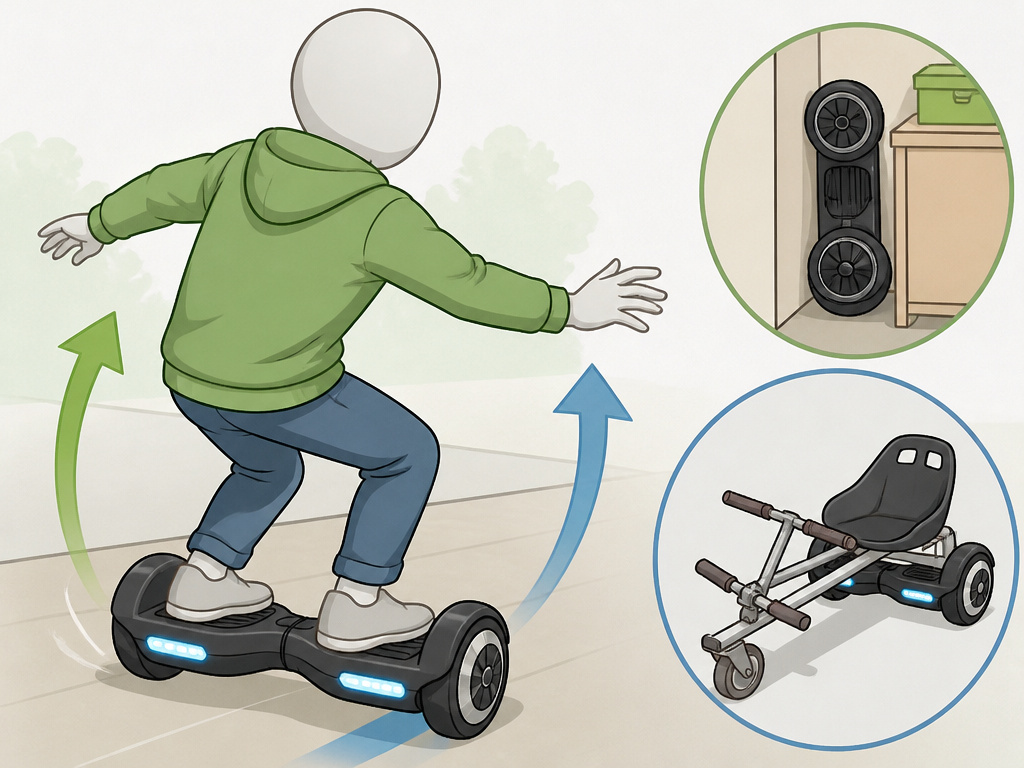
- The “Fun” Factor & Skill Expression: Riding a hoverboard is a balancing act. For a certain user, especially a teen or a gadget lover, the challenge and unique feel are the whole point. It’s a toy that rewards skill.
- Compact Storage: Their symmetrical, wheel-on-each-side design can be easier to tuck in a corner than a scooter with a long deck and stem.
- Specialized Uses: They are the go-to platform for modified projects like go-kart attachments or drone carriers because of their low, stable, dual-motor design.
Where an electric scooter is the better tool:
- Learning Curve: You can ride a basic e-scooter in minutes. A hoverboard requires a session or two of awkward wobbling and likely a few falls.
- Practical Commuting: Scooters have better range, higher speeds, hand-controlled braking, and a standing position that offers better visibility and control over uneven pavement.
- Public Perception & Legality: Scooters are widely integrated into city transportation networks. Hoverboards remain banned from most public transit and many sidewalks, as seen in Western Australia where they are prohibited on roads, pathways, and shared-use paths.
- Safety Posture: On a scooter, you’re facing forward, can step off easily, and have handlebars for control. On a hoverboard, a sudden stop or software glitch (like the Hover-1 Superfly’s unintended momentum) can throw you off balance backwards.
The part nobody mentions: For a child, the scooter is often safer simply because the learning curve is shorter and the bail-out instinct is more natural. A kid on a hoverboard is learning two things at once: balancing on the device and how to fall safely.
Your choice depends on the job. Need a last-mile commuter? The hoverboard vs scooter debate leans heavily toward the scooter. Buying a engaging, skill-based toy for a supervised backyard or park? A certified hoverboard could be a great fit.
Key Buying Considerations for a 2026 Hoverboard
If you’ve weighed the options and a hoverboard is the right choice, your shopping list is defined by safety and suitability.
- UL 2272 Certification: This is not a feature; it’s a prerequisite. Do not touch a model without this mark. The official hoverboard safety information from the CPSC hinges on this standard.
- Age and Size Appropriateness: Most boards have a maximum weight capacity of around 220 pounds. More importantly, consider maturity. Western Australia Consumer Protection recommends adults supervise the charging and use of hoverboards at all times. For a younger child, a non-motorized scooter or skateboard might build better foundational skills. The question of hoverboards for kids is less about age and more about the child’s coordination, judgment, and your willingness to supervise, as Western Australia Consumer Protection recommends adult supervision for charging and use.
- Intended Use & Specs:
- Speed & Range: Most travel 6-7 mph, with higher-end models offering 10-15 miles of range. Be realistic, this is for short trips and recreation.
- Wheel Size: 6.5-inch wheels hold a 62.9% market share because they offer a balance of portability and smoothness over minor cracks.
- Terrain: Standard hoverboards are for smooth, paved surfaces. “Off-road” models with larger, treaded tires exist but are a distinct (and pricier) category.
- Brand and Retailer: Stick to known brands sold through reputable retailers. This is your best defense against receiving an uncertified or recalled model. A legitimate company will have clear contact information and support channels.
- Local Laws: Before you buy, check your city and state regulations. Many localities adopted bans during the crisis and never repealed them. Know where you can legally ride.
Are hoverboards built to last like skateboards?
Hoverboards face durability challenges that traditional, non-motorized personal transport like skateboards and rollerblades do not. While a skateboard is a simple mechanical device, a hoverboard is a complex electronic product with a battery and electrical systems prone to failure. Safety investigations have revealed common manufacturing flaws, such as wiring paths not free of sharp edges and a lack of proper charge control circuits, which can lead to overheating and fire hazards. These inherent risks mean hoverboards require careful maintenance, supervised charging, and storage away from combustible materials. Unlike a skateboard that can sit in a garage for years and still be rideable, a hoverboard’s lifespan is tied to its battery health and electronic integrity, making it a less durable long-term investment.
Frequently Asked Questions
Why are hoverboards not popular anymore?
Their popularity collapsed due to a perfect storm of safety failures. The widespread fire hazards from substandard lithium-ion batteries led to massive recalls, airline bans, and negative media coverage. The cultural moment passed, and the market corrected, leaving only the safer, certified models for a more niche audience.
Are hoverboards still in style?
As a mainstream fashion accessory or must-have gadget, no. Their “style” is now purely functional or hobbyist. They have a certain retro-tech cachet, but you buy one for a specific purpose, fun, a gift, a project base, not for trendiness.
What is better than a hoverboard?
For most adults and commuters, an electric scooter is objectively better. It’s easier to learn, faster, more practical for carrying items, more stable, and more widely accepted in public spaces. For pure, skill-based fun, a traditional skateboard or scooter offers a similar thrill without the battery risks.
What age should a kid get a hoverboard?
There’s no magic number. It depends more on the child’s physical coordination, maturity, and ability to follow safety rules. Crucially, it depends on an adult’s commitment to supervision. The Dutch NVWA advises charging only when someone is nearby to intervene, and Western Australia Consumer Protection recommends adult supervision for both charging and use. If you’re not prepared for that level of oversight, the child is too young.
The Bottom Line
The reality for hoverboards in 2026 is this. They are a viable, stable niche product for a specific buyer. That buyer is someone who values the unique riding experience, has a safe place to use it, and does their homework.
Your first and last step is verifying the UL 2272 certification. Everything else is secondary. From there, match the specs to your real use: a 6.5-inch wheel model for smooth paths, a respected brand for support, and a clear understanding of your local laws.
For the vast majority of people asking if they’re still popular, the more useful question is whether they’re still practical. And for most, the answer is no. The electric scooter won that race. But if you’re in that niche, a parent with a responsible teen, a tinkerer with a project in mind, or someone who just loves the gadget, a certified hoverboard is a product you can buy with confidence today. Just charge it on a non-combustible surface, stay nearby while it powers up, and always wear a helmet. The era of careless popularity is over; the era of cautious, informed ownership is here.
