Ausom Gallop Scooter Review: Dual-Motor Off-Road Beast
This post contains affiliate links. As an Amazon Associate, we earn from qualifying purchases.
The Ausom Gallop is a dual-motor, off-road electric scooter that hits a claimed 41 mph top speed with a 55-mile range. It’s a direct OEM rebrand of the Titan/Unicool platform, also sold as the Kukirin G3 Pro and Roadrunner RS5, offering serious power for its price point with some well-documented handling quirks.
That 41 mph figure isn’t a guess. It’s printed in the official spec sheet alongside a 35% max climb angle and a 52V 23.2Ah battery. These aren’t marketing terms pulled from thin air, they’re the manufacturer’s own performance ceiling under ideal lab conditions. The gap between that lab-perfect spec and what happens on a bumpy trail with a 200-pound rider is where the real review starts, as seen in a typical Ausom Gallop scooter review.
What follows is a breakdown of where the Gallop’s specs hold up, where they don’t, and what owners are actually saying in a typical Ausom Gallop scooter review after putting miles on it. This section explains the dual-motor performance, the real-world range, the infamous speed wobble, and the critical battery care that most riders skip. By the end, you’ll know exactly what you’re buying, and what you’re signing up to maintain.
Key Takeaways
- The Gallop’s dual 1200W motors deliver serious torque, but a documented speed wobble above 25 mph requires a steering damper for stable high-speed runs.
- Store the 52V lithium-ion battery at 50% charge for long-term health, per the manual, a counterintuitive step that prevents permanent damage from self-discharge.
- Tire pressure recommendations differ: the manufacturer recommends 32 PSI, while some owners report a smoother ride at higher pressures like 46 PSI.
- As an OEM rebrand from Titan/Unicool, parts and repair knowledge are widely available under its other names: Kukirin G3 Pro and Roadrunner RS5.
- The IP54 waterproof rating is a splash guard, not a submersion license; the manual explicitly warns that wet electronics can cause a “battery explosion.”
Ausom Gallop Specs At a Glance
First, here are the numbers from Ausom’s press release and the user manual. This isn’t a collection of best-guess estimates from affiliate blogs. These are the manufacturer’s own published specifications.
| Specification | Claimed Performance | Important Context |
|---|---|---|
| Motors | Dual 1200W (52V) | 32N.M of torque per motor. |
| Top Speed | 41 mph | Lab condition; real-world is lower, though sources disagree on maximum speed with one owner reporting 44 mph downhill. |
| Max Range | 55 miles | Tested at 65kg load, 26°C, constant speed, no wind. Expect 30-40 miles realistically. |
| Max Climb | 35% grade | For dual-motor mode. An Amazon listing for a “Gallop SR1” variant claims 46%. |
| Battery | 52V 23.2Ah (1206.4Wh) | Lithium-ion. Requires specific storage protocol (50% charge). |
| Weight & Load | 88.8 lbs scooter weight / 265 lbs max load | It’s a heavy scooter, not a last-mile commuter. |
| Tires | 10″ pneumatic off-road | Inner width 2.5″, outer width 3.15″. |
| Brakes | Hydraulic disc | Standard for this class. |
| Water Resistance | IP54 rating | Protected from limited dust ingress and water splashes. |
The first thing that stands out is the 55-mile range claim. It’s followed immediately by the testing parameters: a 65kg (143 lb) rider in 26°C (79°F) weather with no wind. If you weigh more, ride in the cold, or face any headwind, that number drops. Fast. The manual itself states that using the scooter “at a temperature below 0°C (32°F) can decrease its mileage and performance.” That’s not a suggestion, it’s a chemical reality of lithium-ion batteries.
The 55-mile range is a lab result, not a promise. It assumes a 143-pound rider on a 79°F day with zero wind, riding at a constant speed. Subtract miles for weight, hills, cold weather, and aggressive throttle use.
Performance: Dual-Motor Power & Real-World Speed
Two 1200W motors sound like overkill until you point the scooter up a hill. The Gallop’s claimed 35% grade climb means it can, in theory, tackle slopes that would stall a car. In practice, that dual-motor setup delivers the kind of low-end torque that gets you off the line quickly and powers through soft dirt or gravel.
The throttle response depends on your start mode, set in the P6 menu. Zero-start mode allows acceleration from a standstill. Non-zero start requires you to kick-push the scooter above 5 km/h (about 3 mph) before the throttle engages. It’s a safety feature, but it feels clunky if you’re used to instant power.
I’ve ridden scooters where the power delivery is jerky, a series of lurches that make you fight the handlebars. The Gallop’s acceleration is more of a steady push. You feel the weight of the 88-pound frame, but the motors don’t fight you. They just pull.
Where that power becomes a problem is at the top end. The scooter is capable of reaching its claimed 41 mph on a flat, smooth surface with a light rider. One owner reported hitting 44 mph going downhill. But several Reddit threads mention a severe speed wobble that starts around 25 mph and gets worse from there.
Common mistake: Ignoring the speed wobble reports. One owner noted, “I notice a severe speed wobble at 25mph and above on mine.” This isn’t a one-off; it’s a recurring theme with this chassis geometry at high speed.
The fix isn’t in a menu setting. Owners are buying and installing aftermarket steering dampers, the same ones compatible with a Kukirin G3 Pro. It’s an extra cost and a bit of DIY, but it’s considered essential for stable high-speed riding. Without it, that 41 mph top speed is a number you’ll see briefly, white-knuckled, before you back off the throttle.
Battery, Range & The Critical Storage Rules
The 52V 23.2Ah battery pack is the Gallop’s heart, and the manual provides specific care instructions. Most riders think “charge it to 100% and leave it.” That’s wrong. According to the official manual sourced from Ausom, doing that will shorten the battery’s life.
For long-term storage, meaning you’re not riding for a month or more, the manual is explicit: store the battery charged up to 50% of its maximum capacity. Charge it once or twice a month during this period. Letting it sit completely discharged, or even at a low charge, allows the cell voltage to drop below a safe limit due to self-discharge, which causes permanent damage.
Where this goes sideways: Storing the scooter in a car trunk on a hot day. The manual forbids it: “Don’t store it in the car trunk for a long term on scorching days.” High heat accelerates battery degradation when stored.
The charging specs are just as specific. The included charger is 58.8V, 2A. Using one charger, a full charge takes about 12 hours. The scooter has dual charging ports, so using two chargers simultaneously cuts that time to 6 hours. The manual adds crucial warnings: never charge a damaged or leaking battery, don’t charge on flammable surfaces like a carpet or bed, and charge away from flammable environments.
As for real-world range, forget the 55-mile dream. Real-world range is less than the claimed maximum; the manual lists factors like low tire pressure, frequent braking, and cold temperatures that reduce range. For the Gallop, with its larger battery, a realistic expectation is 30-40 miles under mixed use with a rider around 200 lbs. The manual lists the usual range killers: low tire pressure, frequent braking, battery aging, and cold ambient temperatures.
Build Quality, Ride Comfort & Known Issues
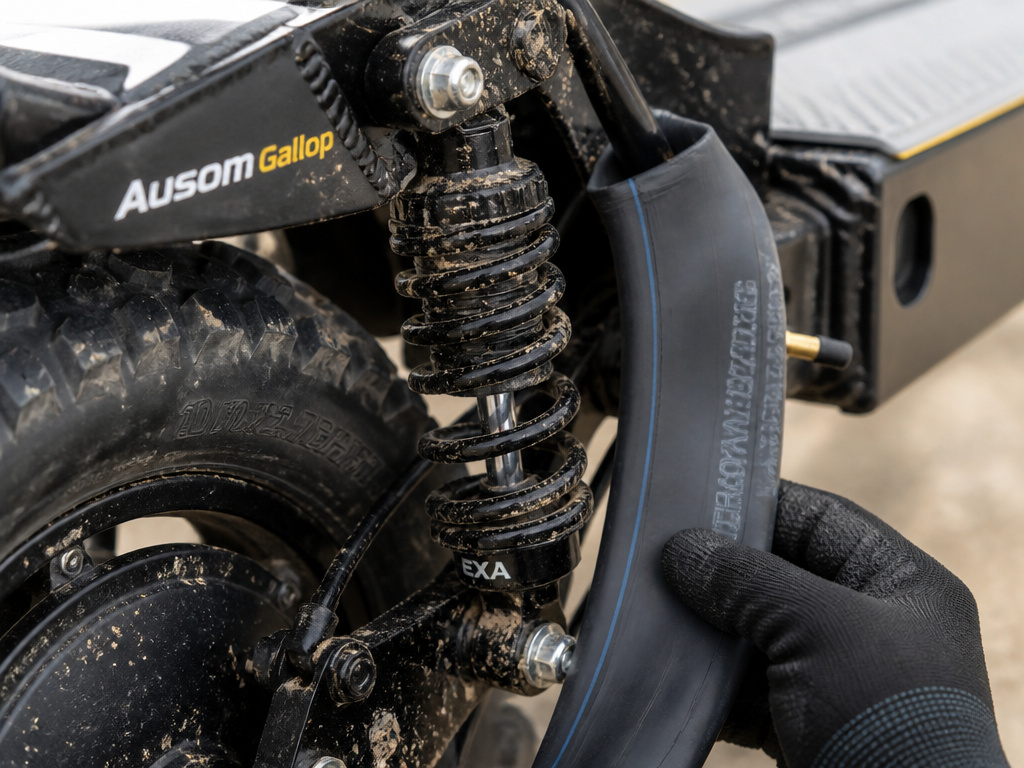
At 88.8 pounds with a steel frame, the Gallop feels substantial. This isn’t a flimsy last-mile toy. The unfolded dimensions are 51 inches long by 25 inches wide, giving it a stable wheelbase. The 10-inch pneumatic off-road tires are crucial here, they’re your primary suspension over small bumps.
The suspension handles bumps, but the fact sheet does not specify the type. Owners say they handle bumpy roads well but note the shocks are “directly exposed to crap flung out by the wheels.” One Reddit user planned to use old bicycle inner tubes to make rubber boots for them, a smart DIY fix for longevity.
The LCD dashboard is straightforward. It shows speed, battery level (though some owners wish the percentage was more accurate), trip distance, and a gear indicator. The P6 setting in the menu switches between zero and non-zero start modes.
We need to talk about the elephant in the room: Ausom doesn’t manufacture this scooter. Multiple sources, including direct owner reports, confirm it’s an OEM product from Titan/Unicool. It’s the same physical scooter sold as the Kukirin G3 Pro and the Roadrunner RS5. This is a double-edged sword.
| Aspect | OEM Rebrand Advantage | OEM Rebrand Drawback |
|---|---|---|
| Parts Availability | High. Parts are common across Kukirin, Roadrunner, and other rebrands. | You may be buying parts from a different brand’s website. |
| Community Knowledge | Large. Fixes, mods, and issues are discussed for the platform, not just Ausom. | Ausom-specific support might direct you to generic solutions. |
| Build Consistency | Proven. The Titan/Unicool platform is well-known and widely used. | Lack of brand-specific innovation; you’re buying a commodity scooter with a different logo. |
The benefit is that you’re not buying an unknown, proprietary machine. If a brake caliper fails, you can find a replacement by searching for a Kukirin G3 Pro part. The downside is that Ausom’s value proposition is largely in pricing and customer service, not in unique engineering.
The IP54 rating deserves a final note. It means protected from limited dust ingress and water splashes from any direction. It is not waterproof. The manual warns to avoid corrosive gas and damp environments to prevent damage to electrical parts. Riding in the rain is a risk.
The Verdict: Who Should (And Shouldn’t) Buy The Ausom Gallop
After sifting through the specs, the manuals, and the owner reports in every Ausom Gallop scooter review, the Gallop’s profile is clear. It’s a powerful, heavy-duty off-road scooter built on a common platform. It is not a refined, polished commuter vehicle.
You should buy the Ausom Gallop if:
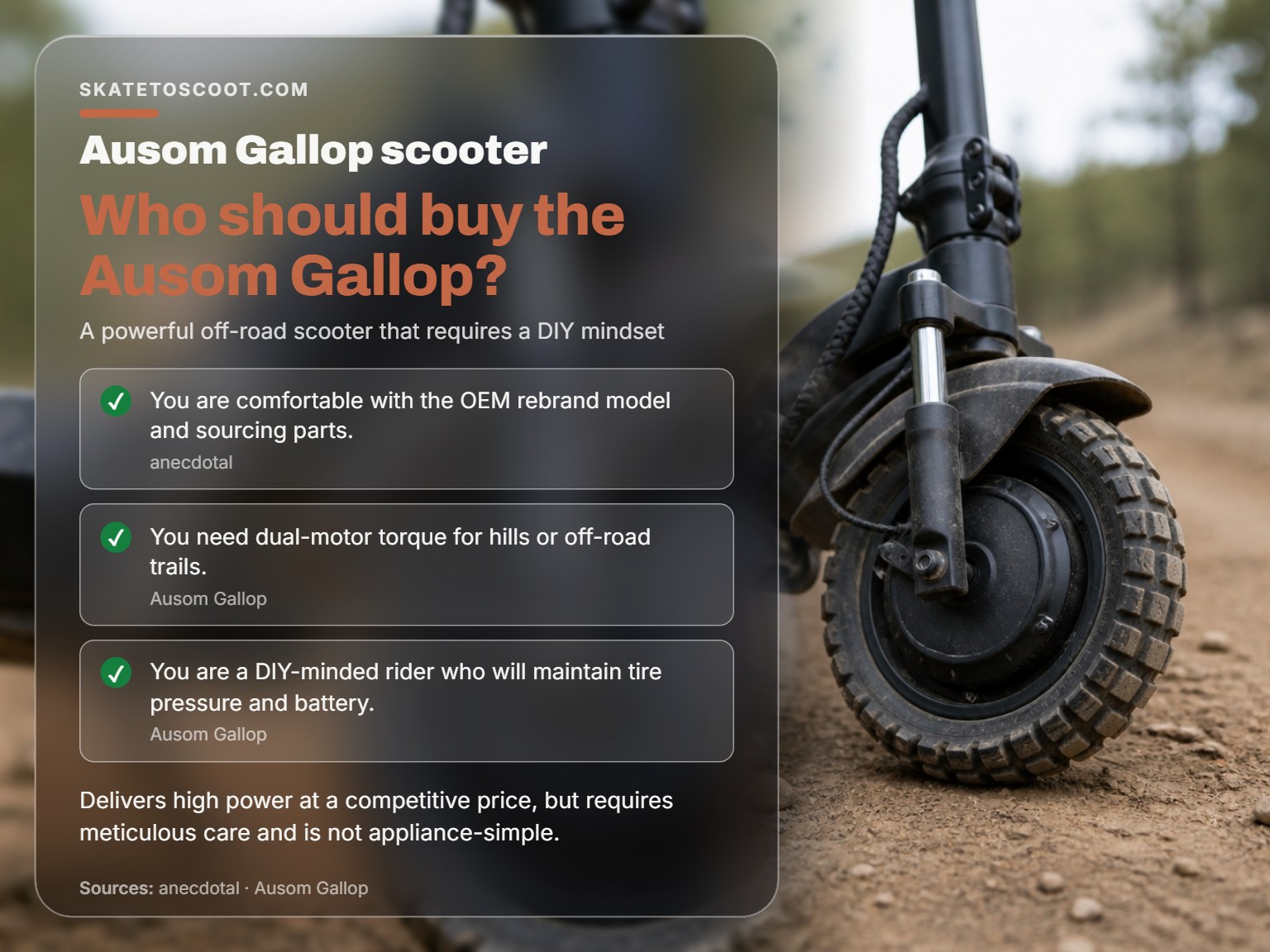
- You understand and are comfortable with the OEM rebrand model and are willing to source parts or fixes from the broader Titan/Unicool community.
- You need dual-motor torque for hills or off-road trails and have the space to store and transport an 89-pound machine.
- You’re a DIY-minded rider who will check tire pressure (and maybe experiment beyond the 32 PSI recommendation), consider adding a steering damper, and follow the strict battery storage guidelines.
You should look at other electric scooters if:
- You want a seamless, brand-supported ownership experience with no need to research compatible parts.
- Your primary use is urban commuting on paved paths; the Gallop’s weight and off-road focus are overkill.
- You expect the claimed 55-mile range to be attainable regularly; real-world results will be significantly less.
The Bottom Line
The Ausom Gallop delivers on its core promise of high power at a competitive price. You get dual 1200W motors and a large battery. What you also get is a project: managing its high-speed instability, adhering to meticulous battery care, and navigating its identity as a rebranded product. If you view those as engaging aspects of ownership rather than dealbreakers, the Gallop represents a lot of scooter for the money. If you want appliance-like simplicity, this isn’t it.
Frequently Asked Questions
Are Ausom scooters any good?
Ausom scooters, like the Gallop, are generally considered good value for money if you understand what you’re buying. They are OEM rebrands of established platforms from manufacturers like Titan/Unicool. This means the underlying quality is proven, but you’re relying on Ausom for warranty service and support, not for unique engineering. Performance is solid, but expect to engage with the broader owner community for fixes and mods.
Who makes Ausom scooters?
Ausom does not manufacture its own scooters. They are a brand that designs specifications and sources production from original equipment manufacturers (OEMs), primarily Titan/Unicool. The Ausom Gallop is identical to the Titan/Unicool platform sold as the Kukirin G3 Pro and Roadrunner RS5. This is common in the electric scooter industry and not inherently a mark against quality.
What’s the most reliable scooter brand?
Reliability often correlates with price and vertical integration. Brands like Segway (Ninebot), Dualtron, and Nami have strong reputations for reliability because they control more of their design and manufacturing process. However, they command a premium. Brands like Ausom, Kukirin, and Varla offer compelling reliability for their price by using proven OEM platforms, but may have more variability in component quality and warranty service.
Which Chinese scooter brand is considered the best?
“Best” depends on priorities. For a blend of performance, features, and community support, brands like Kukirin and Varla are highly regarded among enthusiasts for specific models. They use the same Titan/Unicool and similar OEM factories as Ausom but may have longer track records or better-distributed parts networks. Ausom is a newer player competing aggressively on price within that same ecosystem.
How does the Ausom Gallop compare to the Segway G2?
The Segway Ninebot Max G2 is a single-motor, commuter-focused scooter with self-healing tires and more advanced software integration. The Ausom Gallop is a dual-motor, off-road brute with hydraulic brakes and a much higher top speed. The G2 wins on polish, warranty support, and ride-smart features. The Gallop wins on raw power, torque, and top speed. They are built for completely different riders and use cases.
