Ausom Scooter Review: Which Should You Buy?
This post contains affiliate links. As an Amazon Associate, we earn from qualifying purchases.
An Ausom scooter review reveals a lineup built on aggressive value, with the L1 offering a large-battery commuter, the L2 Max delivering serious off-road power for under $1,000, and the K20 Pro packing dual-motor torque at a budget price. The catch is a consistent, significant gap between advertised and real-world range, long charge times, and a warranty that favors the frame over the battery.
The specs look great on paper, big batteries, high top speeds, dual motors at prices that embarrass the competition. But the real story is in the trade-offs. You’re buying performance per dollar, not polish. The build is functional, the ride is firm, and the company’s support structure is lean. For the right rider, someone who values raw capability over refinement and knows how to maintain their own gear, these scooters can be a fantastic deal.
What follows is a breakdown of three core models: the budget-focused L1, the off-road powerhouse L2 Max, and the torque-heavy K20 Pro. This review includes the real-world numbers reviewers actually got, the build quality you can expect, and the one question you must answer in an Ausom scooter review before clicking “buy.”
Key Takeaways
- Expect 30-50% less range than advertised; independent tests show the L2 Max manages just over 30 km under hard use versus a claimed 90 km.
- The Ausom warranty strongly favors the frame (2 years) over the battery (6 months), making long-term reliability a calculated risk.
- For pure off-road thrills under $1,000, the L2 Max Dual Motor is the default pick; its dual 1,000W motors hit 40+ mph and the chassis handles rough terrain confidently.
- Charge times are a genuine bottleneck, with the L1 taking up to 11 hours and the K20 Pro up to 9 hours on their included single chargers.
- There is no companion app for any Ausom model; all tuning and diagnostics happen through a cryptic on-display menu system.
The Ausom Lineup: L1, L2 Max, and K20 Pro Decoded
You see three scooters that look vaguely similar. A big deck, 10-inch tires, a chunky stem. The differences aren’t in the silhouette; they’re in the purpose. The L1 is your commuter workhorse. The L2 Max is your trail bruiser. The K20 Pro is your budget torque monster. They share a philosophy, big battery, bold claims, bare-bones smart features, but they’re built for different fights.
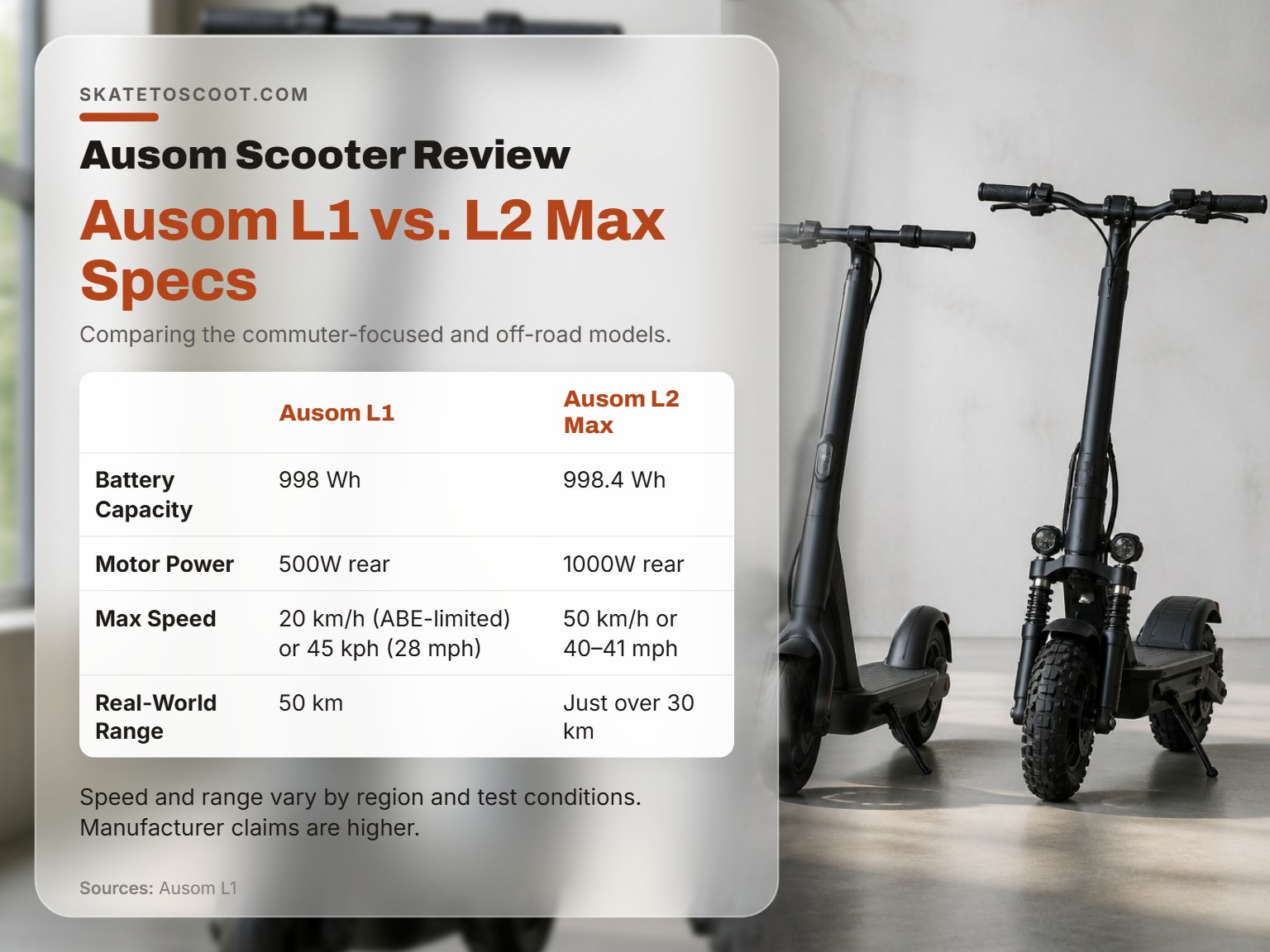
Here are the specifics. The L1 comes in a special ABE-certified version for Germany, limited to 20 km/h and requiring a license plate. The global version aims for a 28 mph (45 km/h) top speed. The L2 Max, with its 1000W rear motor (or dual 1000W motors in the “Dual Motor” variant), targets 50 km/h (about 31 mph) or 40+ mph, respectively. Then there’s the K20 Pro, which packs dual 1400W motors for a staggering 56 Nm of torque, pushing its top speed to 58 km/h.
The Ausom L1 (ABE version) carries a 998 Wh battery, a 500W rear motor, and a 20 km/h speed limit as tested by Notebookcheck. Its global counterpart, per Autoevolution, has a top speed of 28 mph (45 km/h).
The table below cuts through the marketing to show what each model is engineered to do.
| Model | Best For | Key Strength | Biggest Compromise |
|---|---|---|---|
| Ausom L1 | Budget-conscious commuters | Large 998 Wh battery, affordable price | Slow 11-hour charge, basic cable brakes |
| Ausom L2 Max | Off-road enthusiasts on a budget | Dual-motor power under $1,000, capable suspension | Very heavy (30 kg), not road-legal in many regions |
| Ausom K20 Pro | Riders who crave acceleration | Massive 56 Nm torque from dual 1400W motors | Very stiff suspension limits terrain, 9-hour charge |
The common thread? These are tools, not toys. The finish might not be showroom-perfect, and you won’t get an app to track your ride. What you get, as noted in every Ausom scooter review, is a simple, powerful machine that makes few promises it can’t keep, as long as you read the fine print on those promises.
The Real-World Range Reality Check
Ausom claims up to 90 km (56 miles) of range across its lineup. You will not get that. Not even close under normal riding conditions. This isn’t a slight against Ausom; it’s the reality of battery ratings. Manufacturers use perfect-world, lightweight-rider, eco-mode calculations. Real riders use throttle.
Independent tests are brutal and honest. Notebookcheck ran the L2 Max hard off-road and calculated a real-world range of just over 30 kilometers. They consumed 641 Wh over 20 km. That math doesn’t lie. For the L1, the same outlet measured 19.4 Wh/km, leading to a calculated 50 km range. An Autoevolution reviewer noted that with the K20 Pro’s dual motors active, using 80% of the battery yielded about 42 km of range. The pattern is clear: expect 30-50% of the advertised range if you’re riding with spirit.
Where this goes sideways: Planning a 25-mile trip on a claimed 56-mile range. At full throttle, the L2 Max will leave you walking long before your destination. Factor in hills, wind, or rider weight over 180 lbs, and that buffer vanishes faster.
So what kills the range? It’s not a faulty battery. It’s physics. Higher speeds demand exponentially more power. Dual-motor mode, while incredibly fun, can nearly halve your range compared to sipping along in Eco on a single motor. Your takeaway shouldn’t be “Ausom scooters have bad range.” It’s “their advertised range is a theoretical maximum, not a practical guide.” Plan your rides around the real numbers, not the dream ones.
Performance: Speed, Acceleration, and Hill Climb
This is where Ausom earns its keep. For the money, the acceleration and top speed are often class-leading. The jump from single to dual motors is the single most noticeable upgrade you can make in this lineup.
The L1’s motor is adequate. It’ll get you to 28 mph, which is plenty for city commuting. The L2 Max, especially in its dual-motor configuration, is a different beast. Reviewers consistently clock it at 40–41 mph. The K20 Pro, with its dual 1400W motors, is less about top-speed and more about raw, wheel-spinning torque, 56 Nm of it, to be exact.
Hill climb is a major differentiator. The L1 is rated for a 40% incline. The L2 Max claims a 46% climbing ability. The K20 Pro is rated for 33%. In practice, dual motors make hill climbing feel effortless where a single motor strains. If your daily route has serious inclines, the extra motor isn’t a luxury; it’s a necessity.
| Model | Motor Configuration | Tested Top Speed | Claimed Max Incline |
|---|---|---|---|
| Ausom L1 | 500W (ABE) / 800W (Global) | 20 km/h (ABE) / 28 mph | 40% |
| Ausom L2 Max | 1000W rear (or dual 1000W) | 50 km/h (Single) / 40-41 mph (Dual) | 46% |
| Ausom K20 Pro | Dual 1400W (2800W peak) | 58 km/h | 33% |
The acceleration curve matters too. The L1 builds speed steadily. The dual-motor L2 Max and K20 Pro shove you forward from a stop. That instant shove is useful in traffic, but it’s also a great way to surprise yourself if you’re not ready for it. Start in Eco mode.
Build Quality, Design, and Daily Usability
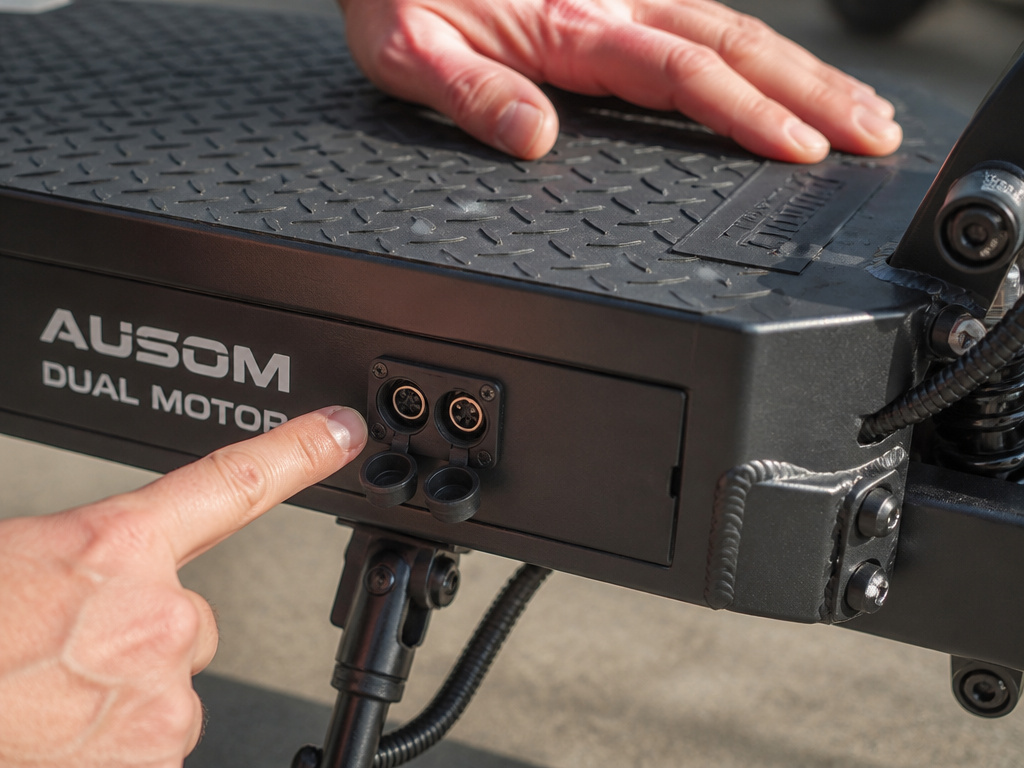
The frames are aluminum. They feel solid, sometimes too solid, the L2 Max weighs in at 30 kg. Folding it and carrying it up a flight of stairs is a workout. The welding and finish are utilitarian; you won’t find polished seams, but you also won’t find obvious weak points. Owners on forums like Reddit report surviving low-speed drops with little more than scrapes.
The decks are wide and covered in a grippy, diamond-patterned rubber. As you move up the lineup from the L1 to the DT2 Pro, the deck gets longer and the rear kicktail more pronounced. The L2 Max features dual charging ports, a small but critical design choice. Using two chargers simultaneously can cut the long recharge times significantly.
The integrated features are a mixed bag. The L2 Max has a clever, concealed AirTag holder in the handlebar, a thoughtful anti-theft touch. It also includes USB-A and USB-C ports for charging your phone. On the flip side, the headlights on all models are described as adequate for being seen, but insufficient for safely illuminating a dark path at speed. You’ll need an additional handlebar or helmet light for night riding.
The most notable absence? A companion app. Unlike many modern electric scooters, Ausom models have no smartphone connectivity for tracking rides, tuning performance parameters, or diagnostics. All settings are changed via a button sequence on the display, which reviewers describe as cryptic and menu-driven. For some, this simplicity is a bonus. For others, it feels like a missing piece.
Ride Quality, Comfort, and Safety
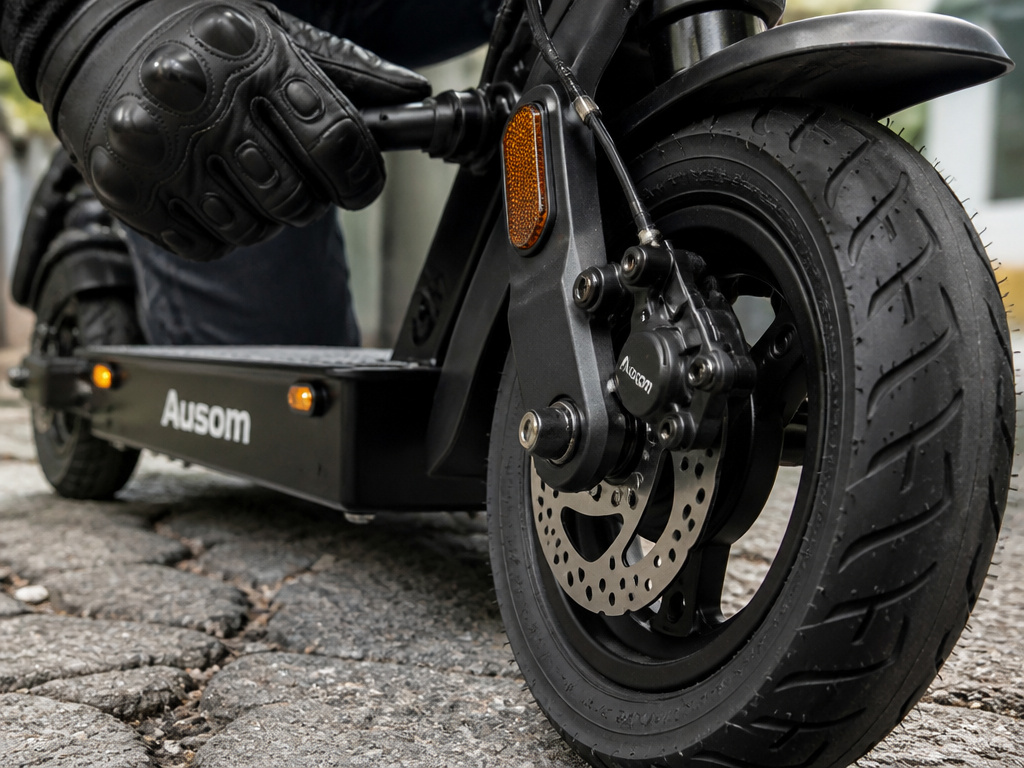
You feel everything. That’s the trade-off for a budget-focused, performance-oriented build. The suspension is present, spring shocks front and rear on most models, but it’s tuned for support, not plushness. It absorbs big bumps well enough to keep you in control off-road, but transmits smaller pavement cracks and cobblestones directly to your feet and hands.
The 10-inch, air-filled tires provide the primary cushioning. They’re great for off-road traction and soaking up impacts, but they also present a maintenance point: flats. The mechanical disc brakes (hydraulic on the higher-end DT2 Pro) are another point of attention. They offer strong stopping power but, as with all cable-actuated brakes, they require periodic adjustment as the pads wear. Hydraulic brakes, when available, are a worthwhile upgrade for maintenance-free consistency.
Comfort is relative to your expectations. If you’re coming from a scooter with no suspension, it’s a revelation. If you’re comparing it to a scooter with adjustable hydraulic suspension, it’s firm. For commutes under 30 minutes, it’s fine. For hour-long trail rides, your hands and feet will know they’ve been on an adventure.
Safety is where you cannot compromise. The brakes are capable, but your safety gear is essential. These scooters can reach car-like speeds. A full-face helmet, gloves, knee pads, and elbow pads are not overkill, they’re the baseline. The scooter’s bright tail light helps you be seen, but it doesn’t replace defensive riding. You are the smallest, most vulnerable vehicle on the road. Ride like it.
Ausom vs. The Competition
Ausom doesn’t exist in a vacuum. Its real value is only apparent when you stack it against other brands. The closest competitors are often other OEM-derived scooters from brands like Varla, Kaabo, and TurboAnt. The difference isn’t always in the hardware; it’s in the brand polish, customer service infrastructure, and sometimes, the price.
The Ausom L2 Max Dual Motor’s most direct competitor might be the Varla Eagle One Pro. Both offer dual-motor power and off-road chops. The Ausom undercuts it on price significantly, but Varla has a longer-established reputation and support network in the US. The trade-off is clear: pay more for brand security, or pay less and be prepared to be your own first line of support.
For the commuter-focused L1, competitors include the Niu KQi3 Pro. The Niu is more polished, has a better app, and is known for reliability. The L1 fights back with a larger battery and a lower price point. It’s a choice between refined ecosystem and raw battery capacity.
Common mistake: Choosing based solely on top speed and price. A cheaper, faster scooter is a bad deal if the company vanishes when you need a replacement battery or a proprietary part. Research how long the brand has been around and where you’ll source parts.
When reading other scooter reviews, pay less attention to the star rating and more to the long-term updates. Does anyone report owning the scooter for 1,000 miles? What broke first? For Ausom, early reports from owners on Reddit are cautiously positive, with some L2 Max Dual Motor owners reporting over 1,000 miles of trouble-free riding. That’s a concrete data point, but it’s still anecdotal. The warranty terms tell a more complete story.
Warranty, Support, and Long-Term Reliability
The warranty is your contract. Read it. Ausom’s policy, published on their site, is straightforward: the frame is covered for 2 years, the battery for 6 months. Everything else falls under a general warranty period, but the short battery coverage is the headline. Batteries are the most expensive consumable part of any e-scooter. A six-month warranty suggests you should expect the battery to last at least that long, but it places the long-term risk squarely on you.
Support is channel-based. You must contact the seller you bought from first, be it Ausom’s site, Amazon, or Walmart. This can add a layer of friction. The company also has a strict 14-day window to report any freight damage, complete with photographic evidence. This is standard but rigorous; unbox your scooter immediately and inspect it thoroughly.
Long-term reliability is the big question mark. The frames are stout, and the motors are simple hub designs known for durability. The potential failure points are the same as any scooter: battery degradation over hundreds of cycles, wear on mechanical parts like brakes and tires, and potential electronic glitches in the controller or display. The availability of replacement parts through Ausom is a positive sign, suggesting they intend to support their products.
Your experience will likely hinge on two things: how you maintain the scooter, and the luck of the draw with your specific battery cells. Performing basic maintenance, keeping tire pressure correct, adjusting brake cables, checking bolt tightness, will prevent most issues. The rest is a calculated risk inherent in buying value-focused hardware.
Ausom L2 Max vs DT2 Pro Comparison
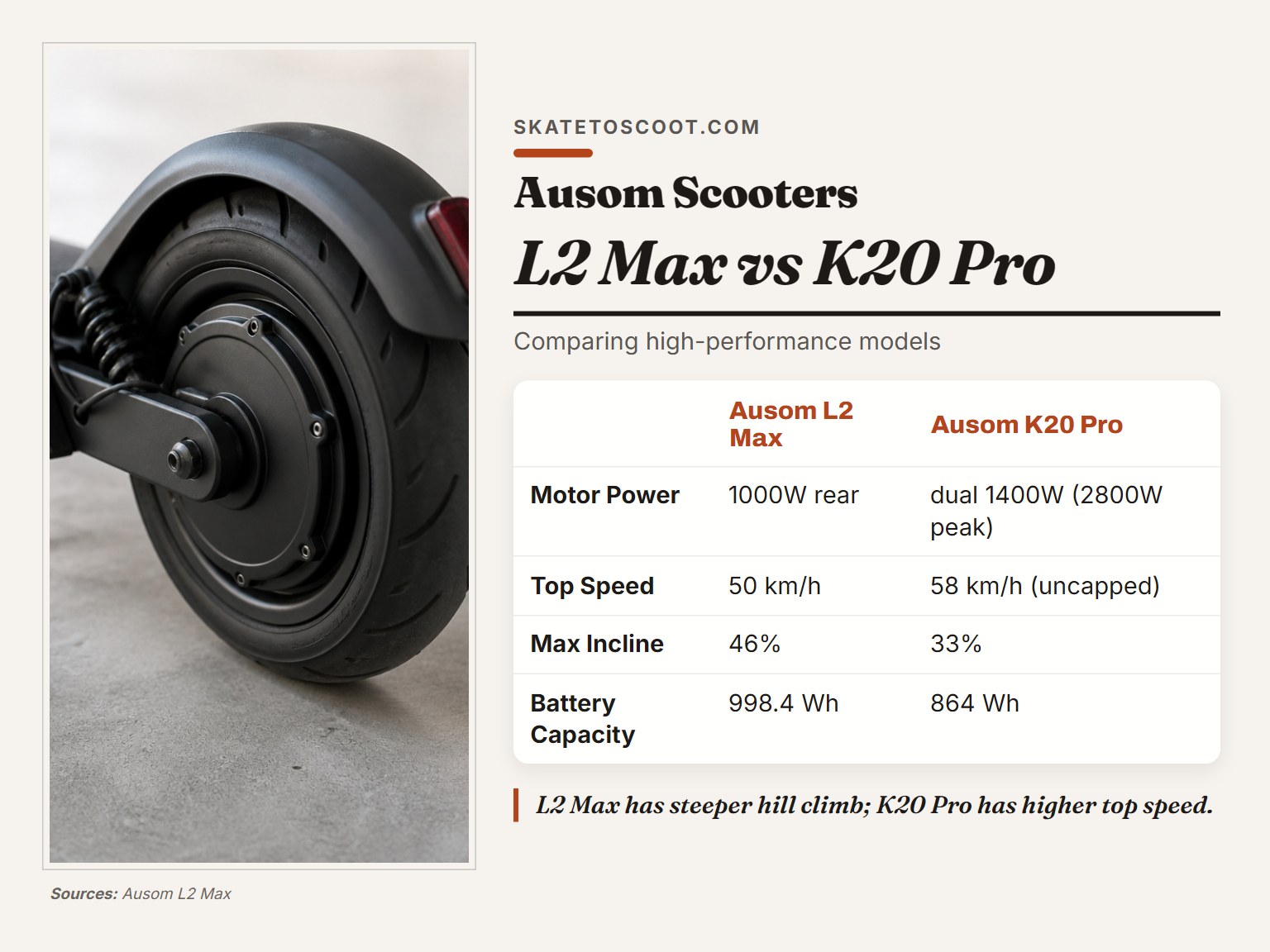
While the fact sheet doesn’t include details on a ‘DT2 Pro’ model, we can compare the L2 Max to other high-performance Ausom scooters to understand its place. The L2 Max, particularly in its dual-motor configuration, is built for off-road thrills with a top speed that can reach highway velocities. It packs a significant battery and features like dual charging ports for quicker refuels. Compared to a model like the K20 Pro, which also uses dual motors for immense torque, the L2 Max focuses more on raw speed and off-road capability, including a very steep hill climb rating. If you’re looking at high-power models, your choice hinges on whether you prioritize top-end speed for open paths or instant torque for steep urban hills.
Folding and Portability Weight
Ausom scooters are built around substantial batteries and motors, which adds to their heft. The L1 (29.23 kg), L2 Max (30 kg), and K20 Pro (30 kg) are solid but not lightweight machines. This weight impacts portability significantly. When folded, they are compact, but lifting one into a car trunk or carrying it up a flight of stairs requires considerable effort. For daily commuters who need to navigate public transit or store their scooter under a desk, this is a key practical consideration. The folding mechanism itself is typically a lever or latch near the base of the stem, designed for durability over speed, so allow a few extra seconds to securely fasten and release it.
Frequently Asked Questions
Are Ausom scooters good?
They are good at delivering high performance for a low price. The build is solid, the speeds are real, and the value is undeniable. Whether they are “good” for you depends on your tolerance for trade-offs like shorter real-world range, long charge times, and a leaner customer support experience compared to established brands.
Who makes Ausom scooters?
Ausom is a brand that designs and markets electric scooters. The scooters themselves are manufactured by OEM (Original Equipment Manufacturer) partners in China, a common practice in the industry. This means the underlying platforms are shared with other brands, but Ausom specifies its own components, tuning, and design touches.
What’s the most reliable scooter brand?
There’s no single answer, as reliability varies by model and year. Brands like Segway (Ninebot), Niu, and Xiaomi have established reputations for reliability in the commuter segment due to extensive testing and refined manufacturing. In the performance off-road segment, brands like Dualtron and Rion are known for durability at a premium price. Ausom is newer, so its long-term reliability track record is still being written by early adopters.
How fast does an Ausom scooter go?
It depends entirely on the model. The German ABE version of the L1 is limited to 20 km/h (12.4 mph). The global L1 can hit 28 mph (45 km/h). The L2 Max Single Motor reaches about 31 mph (50 km/h), while the L2 Max Dual Motor can hit 40-41 mph. The K20 Pro boasts a top speed of 58 km/h (36 mph).
Do Ausom scooters have a companion app?
No. As confirmed by multiple reviews, Ausom scooters do not currently offer any companion smartphone app for ride tracking, performance tuning, or diagnostics. All settings are adjusted through the button controls on the scooter’s display.
The Bottom Line
Ausom scooters are a compelling argument for value. You get a lot of motor, a big battery, and a sturdy frame for your money. But you pay for it in other ways: in waiting through long charge times, in managing expectations around range, and in accepting that you are somewhat on your own for long-term support.
If your priority is off-road power on a tight budget, the Ausom L2 Max Dual Motor is the obvious choice. It’s the benchmark for what $900 can buy in 2025. If you’re a commuter who values battery capacity above all else and can live with the slow charging, the L1 deserves a long look. And if neck-snapping torque is your drug, the K20 Pro delivers a hit that’s hard to match at its price.
Before you buy any of them, do one thing: read a few owner forums. Read the posts from people six months in. Their experiences, the squeaky brakes they fixed, the tire they replaced, the battery capacity they’re now seeing, that’s the real review. The specs get you interested, but the long-term logs tell you if you’ll still be riding in a year.
