Scooter Review: Performance, Specs, and Owner Insights
This post contains affiliate links. As an Amazon Associate, we earn from qualifying purchases.
A scooter review separates marketing from mechanics. The best models balance advertised specs with real-world durability, owner-reported performance, and the specific safety recalls and maintenance schedules buried in official manuals. For commuters, a single-motor scooter with a proven water-resistance rating often beats a dual-motor beast; for off-road enthusiasts, suspension and tire type decide the ride.
That gap between the brochure and the road is where your money disappears or lasts for years. The manuals and recall notices don’t lie, they list the exact failure points, temperature limits, and storage rules that turn a great first impression into a reliable long-term partner.
What follows is a breakdown of the specs that translate to street performance, the common failure modes owners actually report, and the manufacturer fine print that dictates your maintenance costs. We’ll ground everything in official documents, from NHTSA recalls to OEM service manuals, so you know what you’re buying beyond the top speed.
Key Takeaways
- Match motor configuration to your terrain. A single motor of sufficient power is adequate for most urban commutes; save dual 1000W motors for consistent hill climbing or off-road use, where the Apollo scooter review shows they excel.
- Advertised range is a best-case ceiling. Real-world range drops 30-50% due to hills, rider weight, and temperature, a scooter rated for 50 miles will deliver 25-35 miles for a 185 lb rider in a hilly city.
- Battery care is essential. Manufacturers provide different storage charge recommendations (e.g., Maxfun advises at least 75%, TVS iQube advises at least 30% SOC), but all manuals prohibit charging below 32°F (0°C) and warn that overheating triggers a 0.5-2 hour full system cooldown.
- Inspect official recall notices. The NHTSA 2022 safety recall report for the NIU MQiGT EVO shows 100% of a small batch had a firmware defect causing sudden power loss, a reminder that even new models can have systemic flaws.
- Throttle type is a comfort and control decision. A thumb lever offers precise, finger-tip control good for stop-and-go traffic, while a twist-grip provides a more intuitive, motorcycle-like acceleration that can cause hand fatigue on long rides.
The Scooter Specs That Actually Matter
Forget the sticker’s biggest number. The specs that determine your daily experience are torque, battery chemistry, and water resistance. A high top speed is useless if the scooter can’t pull you up your regular hill, and a giant battery rating means nothing if it degrades after one cold winter.
Torque, measured in Newton-meters (Nm), is the rotational force that gets you moving from a stop and up inclines. The TVS iQube 3.1 kWh, for example, has a rated torque of 33 Nm. That’s enough for a 10% grade with a rider at its max load. More powerful dual-motor setups, like the Maxfun 10’s dual 1000W motors, split this work between two wheels, offering better traction and hill-climbing power at the cost of complexity and energy use.
Technical Snapshot: Motor power (Watts) indicates potential speed; torque (Newton-meters) determines acceleration and hill-climbing ability. A scooter’s peak torque figure, like the TVS iQube’s 140 Nm, is only available in short bursts under optimal conditions; the continuous rated torque (33 Nm for the iQube) is the force you can consistently expect during a ride.
Battery voltage (V) and capacity (Ah) tell a more nuanced story than “range.” Higher voltage systems (52V is common in performance models) deliver more power to the motor efficiently. Capacity, like the Maxfun 10’s 52V 23Ah pack, indicates total energy storage. However, the cell quality is critical. Many high-end scooters now use Samsung or LG 21700 cylindrical cells, which are noted in communities like the review of Apollo scooters for better long-term durability and energy density than cheaper pouch cells.
| Spec | What It Means | Real-World Impact | Example Model (Spec) |
|---|---|---|---|
| Motor Torque (Nm) | Rotational force for acceleration & hills | Determines if you can climb your regular route without slowing to a crawl | TVS iQube 3.1 kWh (33 Nm rated) |
| Battery Voltage (V) | Electrical “pressure” driving the motor | Higher voltage (e.g., 52V vs. 36V) often means better performance under load | Maxfun 10 (52V) |
| Battery Cells | Quality & type of lithium-ion cells | Name-brand cells (Samsung, LG) typically offer longer lifespan and safer operation | Backfire M8 (Samsung 21700) |
| IP Rating | Ingress Protection against dust/water | An IP54 rating handles light rain; IPX7 allows temporary submersion | Segway Ninebot Max G3 (IPX5) |
Water resistance, indicated by the IP (Ingress Protection) rating, is binary: a scooter either survives your climate or it doesn’t. An IPX4 rating is fine for a sudden drizzle. For year-round commuters in rainy cities, IPX5 or higher is a must. Electronics and water are eternal enemies.
Real-World Performance vs. Marketing Claims
The brochure says “50 Mile Range.” Your commute says “25 miles before the battery icon blinks.” This isn’t dishonesty; it’s the physics every scooter review must account for. Advertised range is measured under laboratory conditions: a lightweight rider on a perfectly flat, smooth track at 70°F (22°C), going a steady 15 mph.
Your real world has hills, stoplights, wind, and your actual body weight. The Maxfun manual states performance is best at 70°F (22°C) and that using it below 32°F (0°C) decreases range significantly. At very low temperatures, range can be significantly reduced. That thermal reality applies to every lithium-ion battery on the market.
Where this goes sideways: Trusting the advertised range for daily trip planning. If your round-trip commute is 15 miles, you need a scooter whose real-world tested range, from owner reports, exceeds 20 miles to account for battery aging, cold days, and headwinds.
Acceleration and top speed also face real-world filters. A scooter rated for 28 mph might only hit that on a fresh battery going downhill. On the flat with a 75% charge, you might see 24 mph. Discussions about the Segway Ninebot Max G3 note that constantly riding at top speed in a city means you’ll spend more time accelerating from red lights than cruising, burning through your range faster for minimal time savings.
The controller and motor generate heat. Under sustained load, like a long, steep hill, they can overheat. The Maxfun manual is specific: the scooter stops working when overheated, requiring a 0.5-2 hour cooldown. After that, you may continue riding in eco/1st gear after 5-10 minutes. This thermal throttling is a built-in safety feature, not a defect, but it changes a performance scooter into a slow cruiser mid-ride if pushed too hard.
Safety, Maintenance, and The Fine Print
A scooter is a vehicle, not a toy. Its manual is a legal and technical document outlining how not to break it, or yourself. These warnings are born from failure analysis, like the Yamaha scooter recall report for a fuel pump defect, or the NIU MQiGT EVO recall for a motor firmware issue.
Before you start: The scooter’s electrical system carries high voltage. The Niu N1S service manual warns that high-voltage circuits can cause electric shock. The Invacare Cetus manual states it is strictly prohibited to disassemble and repair the scooter when it is powered on. Always power down and, if possible, disconnect the battery before any inspection.
Routine maintenance is less about complex repairs and more about vigilance.
Manufacturer storage guidelines reveal how seriously they take battery longevity, and where they disagree. This isn’t a minor detail; improper storage can kill a battery within a season.
| Manufacturer | Storage Charge | Storage Temperature | Check-Up Frequency |
|---|---|---|---|
| Maxfun | At least 75% charged | 15 to 30°C (59-86°F) | Charge once every three months |
| Razor (C35 SLA) | Fully charged | Not specified (avoid freezing) | Not specified |
| Invacare Scorpius | Charge and disconnect if parked >1 week | Matrix: <1 yr: -20°C to 20°C | Check charge periodically |
| TVS iQube | Charge to at least 30% SOC | Not specified | At least once every 15 days |
The TVS iQube manual adds several critical operational warnings that affect safety: never sit on the vehicle when it is supported by stands, always release the side stand fully before moving, and be aware of a reverse park assist mode that moves the vehicle backward when throttle is given. Overloading the utility box (max 10 kg) hampers stability and may lead to loss of control.
Throttles, Tires, and Ride Feel
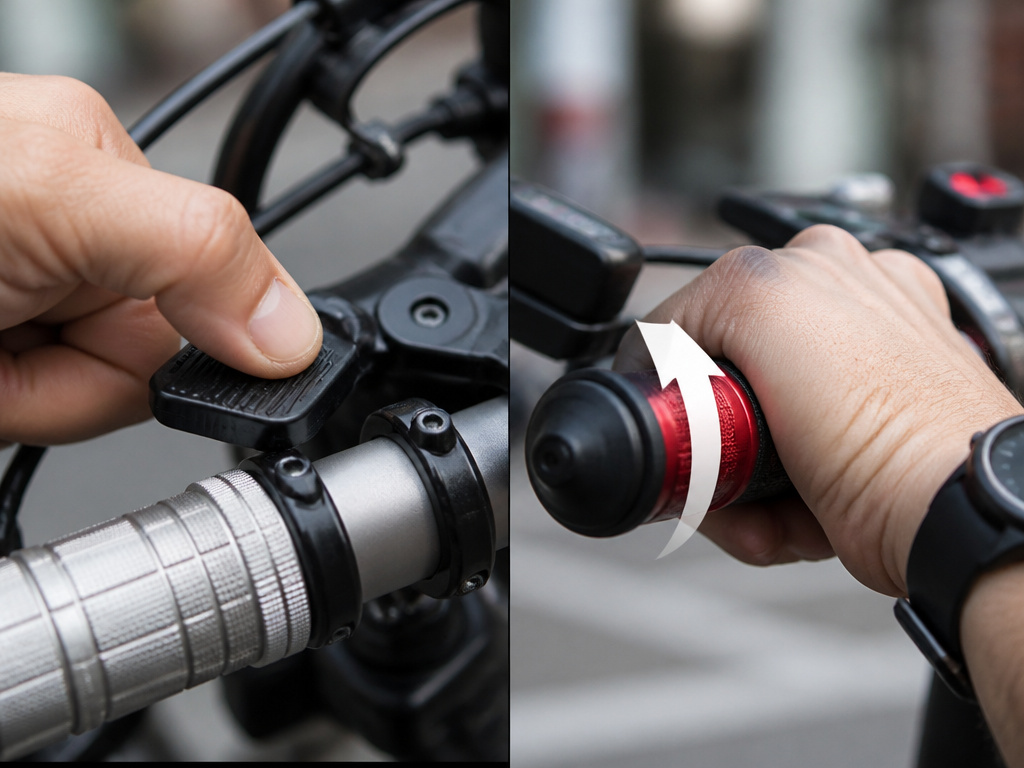
The connection between you and the scooter is through your hands and feet. Throttle type and tire choice dramatically alter comfort and control, topics often glossed over in favor of raw power stats.
Thumb vs. Twist Throttle: A thumb lever, like on many Segway and Xiaomi models, is operated by pressing a lever with your thumb. It allows you to keep a firm, full grip on the handlebar while modulating speed. It’s precise and reduces hand fatigue on long rides. A twist-grip throttle, common on higher-performance models like some Apollo or Dualtron scooters, works like a motorcycle: you rotate your entire wrist to accelerate. It feels more intuitive and powerful but can strain your wrist and carpal tunnel on longer journeys, and it requires you to loosen your grip to accelerate.
Tire Trade-Offs: Pneumatic (air-filled) tires offer superior shock absorption, making for a smoother ride over cracks and bumps. The trade-off is they can puncture. Solid or honeycomb tires are maintenance-free and puncture-proof but transmit far more vibration to the deck and your feet, leading to a harsher ride and more fatigue. Some performance electric scooters now use tubeless pneumatic tires with sealant as a middle ground.
Suspension is the final piece of the comfort puzzle. Basic spring or rubber suspension helps; dual hydraulic suspension transforms rough pavement. But it adds weight, cost, and maintenance. For a city with generally good roads, a pneumatic tire might be all the suspension you need. For broken pavement or light off-road use, proper suspension is required.
Long-Term Ownership: Reliability and Hidden Costs
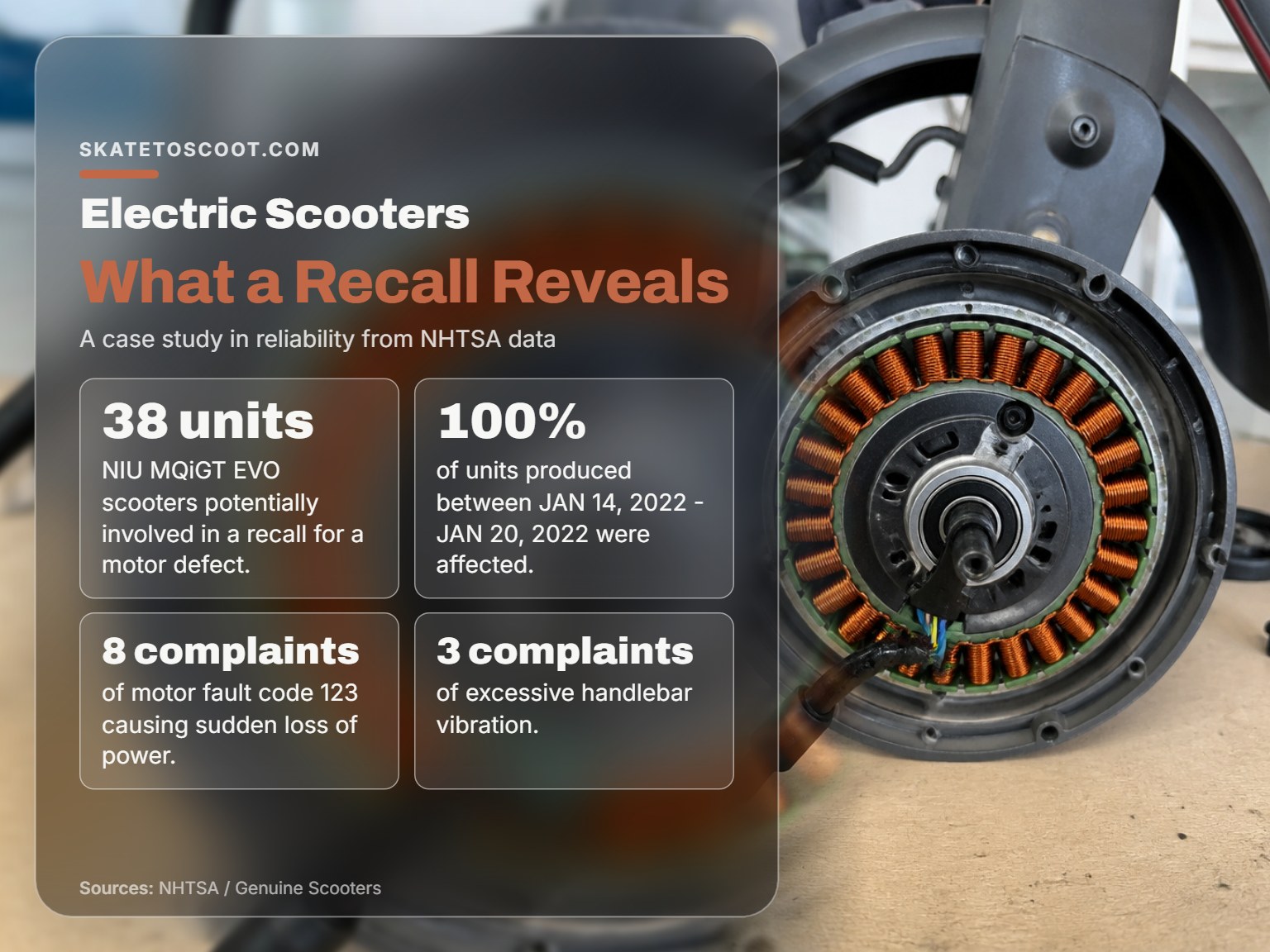
The true cost of a scooter isn’t the purchase price. It’s the cost over 2,000 miles. Reliability issues surface in owner forums and, definitively, in official recall notices. The NHTSA recall for 38 NIU MQiGT EVO units is a case study: a firmware bug in the motor (part number NIU-10201197) caused a fault code 123 and sudden loss of power in 8 reported cases, while 3 other complaints cited excessive handlebar vibration. Every single unit (100%) produced between JAN 14, 2022 – JAN 20, 2022 was affected.
The part nobody mentions: A recall doesn’t just fix a problem; it reveals a scooter’s support ecosystem. Genuine Scooters and NIU addressed the recall by providing a remedy for the defective motor. How a company handles a crisis tells you more than any pre-launch marketing.
Beyond catastrophic faults, wear parts dictate your ongoing budget and effort. Brake pads, tires, and tubes are consumables. Disc brakes last longer than drum brakes but cost more to replace. Solid tires never need replacing but might make you want to replace the scooter out of discomfort. The availability and cost of these parts for your specific model, be it a Razor A5 or a Segway scooter, is a crucial research step.
Battery replacement is the largest potential hidden cost. While quality cells can last for many charge cycles, extreme temperatures, complete discharges, and improper storage can significantly shorten battery lifespan. The manual’s care instructions aren’t suggestions; they are the blueprint for avoiding a costly battery replacement.
Best overall scooter
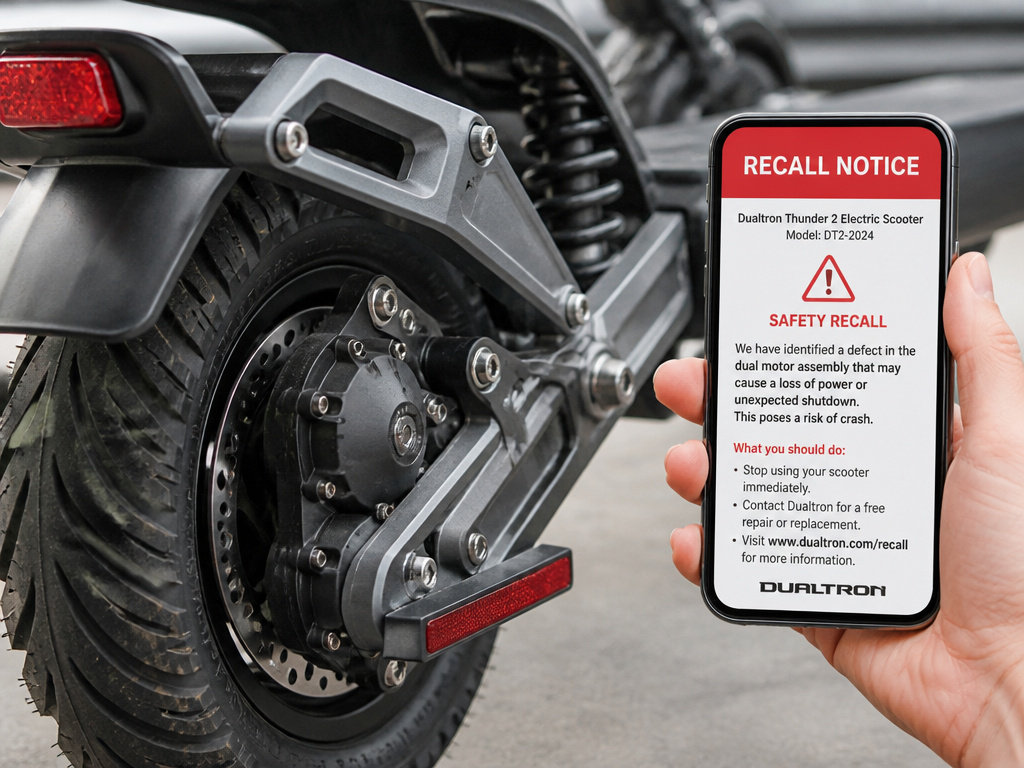
Choosing a top pick means balancing power with reliability. Look for a model with dual motors, paired with a high-capacity battery. The best overall scooter should have a robust build that can handle a maximum load without compromising stability. Be aware that even well-regarded models can have specific recalls; one scooter had a 100% defect rate in a small batch of units due to a faulty motor part, causing loss of power and excessive vibration. Always check for any active safety recalls before purchase.
Best scooter for commuting
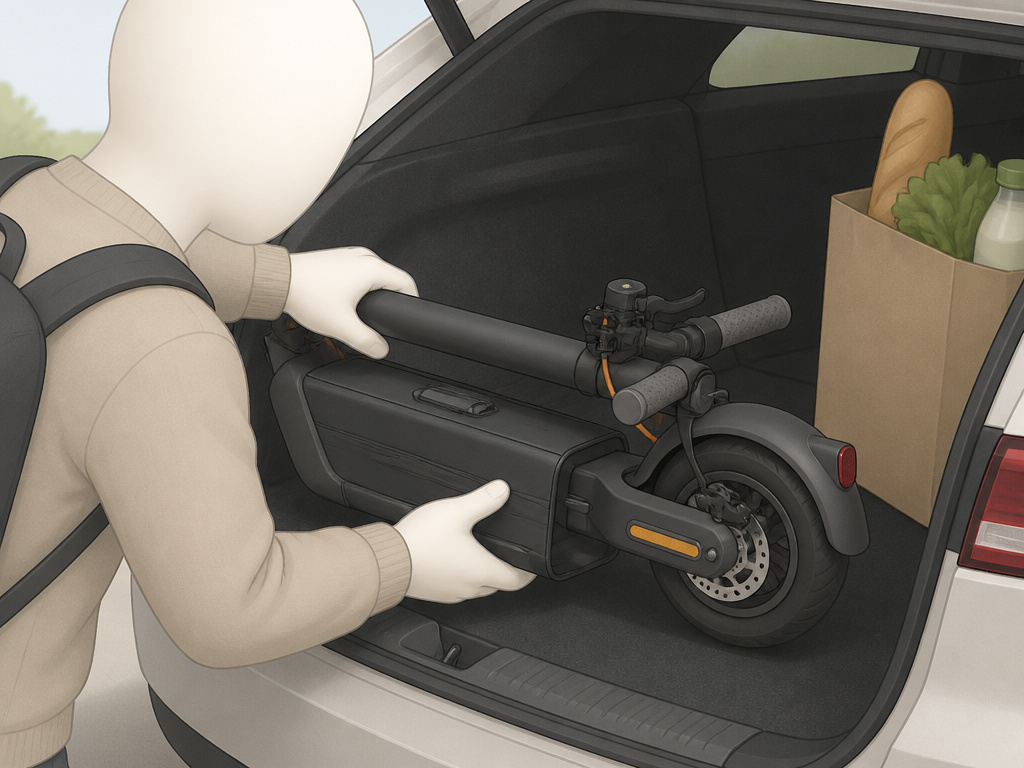
A great commuter scooter needs predictable range, practical storage, and a manageable folded size for mixed-mode transport. Look for a model with a utility box, and check its folded dimensions to ensure it fits in your trunk or office space. Battery maintenance is key for daily use; to preserve battery health, wait at least 30 minutes after a long ride before plugging in, and avoid leaving it charging for more than 12 hours. For consistent performance, park in a shaded area and avoid leaving the scooter in direct sunlight or damp conditions for extended periods.
Best scooter for beginners on a budget
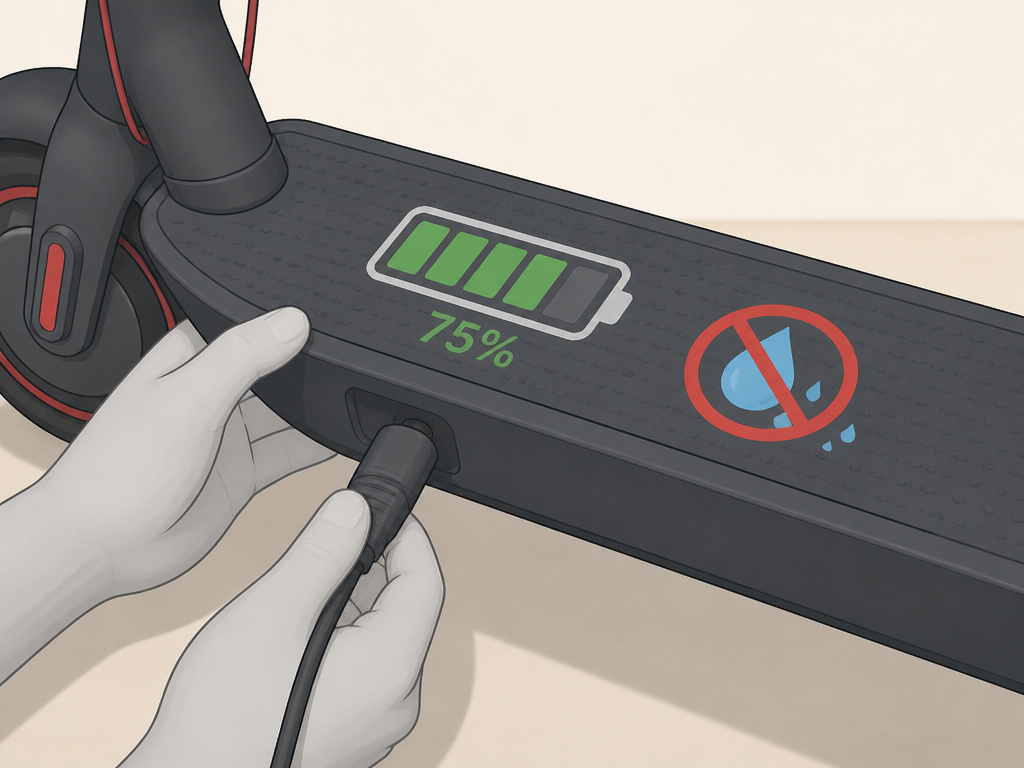
For your first scooter, focus on simplicity and low-maintenance ownership. Beginner-friendly models should have clear safety warnings, like never attempting repairs while the scooter is powered on due to high-voltage circuits. Look for a stable platform with a rated load capacity that fits your needs. Basic care is essential: store it with the battery at least 75% charged if you won’t use it for a week, and charge it fully once every three months for long-term storage. Avoid washing the entire scooter with water, as this can cause damage.
Frequently Asked Questions
What is the most reliable scooter brand?
Reliability is proven over time and volume. Brands like Segway (Ninebot) and Xiaomi have massive production volumes, meaning common issues are identified and addressed. However, newer brands like Apollo or Niu often incorporate more advanced technology, which can come with early-adopter risks, as seen in the NIU MQiGT EVO recall. There’s no single “most reliable” brand, it depends on the specific model and its production year. Researching individual model forums and checking the NHTSA recall database is more valuable than trusting a brand name.
How do I know if a scooter’s range will be enough for me?
Take the advertised range and cut it by 40% for a realistic estimate. Then, map your actual daily mileage. If your round-trip commute is 10 miles, you need a scooter with a real-world range of at least 14-15 miles to account for battery degradation over time, unexpected detours, and riding in less-than-ideal temperatures. Always buy for your longest regular trip, not your average one.
Are dual-motor scooters worth the extra money?
Only if your regular routes include sustained, steep hills, or you ride off-road on loose surfaces. Dual motors provide more torque and traction. For flat city commuting, a single motor is lighter, more energy-efficient, and less mechanically complex. The extra cost and weight of a dual-motor system are a poor trade-off if you don’t need the power.
What’s more important, water resistance rating or suspension?
This is entirely terrain-dependent. If you live in a very rainy climate and commute daily, an IPX5 or higher water resistance rating is critical to prevent electrical failure. If your roads are cracked and bumpy but relatively dry, suspension will make a bigger difference to your daily comfort and control.
How often does a scooter need maintenance?
Perform a pre-ride check before every use: tire pressure, brake lever function, and ensure all quick-releases are tight. Every few months, inspect and tighten critical bolts, especially on the folding mechanism, stem, and axles. Check brake pads for wear and examine motor cables for damage. Annually, or every 1,000 miles, a more thorough check by a knowledgeable person is wise to catch issues like bearing wear or frame stress you might miss.
The Bottom Line
Choosing a scooter isn’t about finding the highest number on a spec sheet. It’s about matching verified performance, documented durability, and granular manufacturer warnings to the specific demands of your body, your route, and your climate.
Ignore the generic “top 10” lists that don’t weight throttle type or IP ratings. Instead, start with your essential requirements: the minimum real-world range you need, the steepest hill you must climb, and whether you’ll ride in the rain. Then, read the manuals and recall notices for the models that fit. The difference between a satisfying purchase and a frustrating one often lies in the fine print you read before you buy, not the features you use after.
One final rule that applies to every model, from a Micro scooter to a high-performance Unagi electric scooter: the first upgrade you should make is a high-quality helmet. The second is understanding exactly what you’re riding.
