Unagi Electric Scooter Review: What the Tests Really Show
This post contains affiliate links. As an Amazon Associate, we earn from qualifying purchases.
The Unagi Model One is a premium, ultra-portable electric scooter built for short, smooth commutes where design and ease of carrying matter more than range or a plush ride. Its real-world performance, particularly range and hill climb, often falls significantly short of its claims, and its lack of suspension and reliance on electronic braking raise genuine safety questions for riders on anything but perfect pavement.
That gap between the sleek promise and the bumpy reality is where most buyers get surprised. The scooter excels at being light and looking good, but it asks you to trade away comfort, safety margins, and any hope of a long trip. Your decision hinges on whether you value portability and aesthetics over everything else, a point underscored by a typical Unagi electric scooter review.
What follows: a breakdown of the tested specs, the real-world experience from owners and reviewers, a clear look at the safety trade-offs, and a final verdict on who should, and who absolutely should not, consider an Unagi.
Key Takeaways
- Tested range is only 8–11 miles, roughly 70% of Unagi’s 15.5-mile claim, making it unsuitable for longer commutes.
- The dual-motor E500 model is essential for hills; the single-motor version cannot climb a 15% grade.
- No suspension and solid 7.5-inch tires create a harsh, potentially unsafe ride on cracked or uneven roads.
- The primary braking is electronic (regenerative), with only a basic rear fender brake as backup, a significant safety concern if power fails.
- The All-Access subscription at $69/month is the most risk-free way to test the scooter, given the 30-day return policy on purchases.
Performance: Specs vs. Real-World Tests
Unagi publishes clean numbers. Independent tests tell a messier, more honest story. The difference isn’t academic; it’s the critical gap highlighted in every Unagi electric scooter review between a scooter that works on paper and one that works in your city.
The dual-motor E500 is rated by Unagi for 800W instant power and 26N.m of torque, and a 15-degree hill climb. The single-motor E350 manages 350W and a 6-degree incline. On paper, the E500 looks capable. In an ERideHero test on a 15% grade, the dual-motor model climbed at about 10 mph. ERideHero found the single-motor version could not climb a 15% grade hill. If your route has any real incline, the single-motor models are non-starters.
Acceleration tells a similar tale. In an ERideHero test, a 170 lb rider hit 0-15 mph in 5.04 seconds in dual-motor mode. ERideHero found that activating a performance mode reduced the 0-15 mph time to 4.34 seconds. ERideHero recorded a 0-15 mph time of 7.75 seconds in single-motor mode. The extra $150 for the dual-motor version buys you a scooter that feels alive; the single-motor version feels anemic.
Common mistake: Choosing the single-motor model to save money in a hilly area. It lacks the torque for basic inclines, forcing you to walk it up slopes, which defeats the purpose.
| Performance Metric | Manufacturer Claim (E500) | Independent Test Result | Notes |
|---|---|---|---|
| Top Speed | 17-20 mph (region-locked) | 17.1 mph (regular), 19.6 mph (unlocked) | Unlocked mode voids warranty. |
| 0-15 MPH Acceleration | N/A | 5.04 seconds (dual-motor) | Single-motor time: 7.75 seconds. |
| Hill Climb (15% grade) | 15-degree capability | ~10 mph average (dual-motor); fails (single-motor) | ERideHero test, 170 lb rider. |
| Braking Distance (Dry) | ~13 ft (E500) | Not independently verified | Relies on electronic regenerative braking. |
The numbers that matter most live in the next section. The hill climb ability is just a preview.
Real-World Range vs. Manufacturer Claims
Unagi claims a 15.5-mile range for both the E350 and E500 under “optimum conditions.” In the real world, with a rider, hills, and stop-and-go traffic, that number is a fantasy. It’s the most consistent point of criticism across every objective Unagi electric scooter review.
In a controlled range test by ERideHero with a 170 lb rider, the scooter delivered 8.32 miles at an average speed of 14.7 mph, 9.33 miles at 12.6 mph, and a maximum of 11.12 miles at 10.4 mph. That’s about 71% of the advertised range. A RiderGuide test yielded a range of 8.5 miles.
This isn’t a minor discrepancy. It’s the difference between a viable commute and getting stranded.
The part nobody mentions: The “optimum conditions” for Unagi’s range claim likely mean a 110 lb rider on a perfectly flat, smooth track at low speed in a warm climate. Real urban commuting, with your weight, your backpack, and actual road gradients, cuts that range by a third or more.
The cause is simple physics. To stay ultra-portable, Sources disagree on the battery’s Ah rating: Unagi’s spec sheet lists 9.0Ah, while its Indiegogo manual for the Voyager model lists 10.0 Ah. Independent testing measured its effective capacity at 281 Watt-hours. That’s less capacity than many competitors in its class. You can’t cheat energy density. A smaller, lighter battery means less range. Full stop.
So who can live with 9 miles of range? Someone with a very short, one-way commute (under 4 miles) who can charge at their destination. Someone running errands in a dense downtown core. Anyone planning a longer joyride or a day of exploring should look at our picks for best electric scooters with larger batteries.
Portability & Design: The Core Appeal
This is where the Unagi justifies its price and its fans. The design is undeniably sleek, using materials like magnesium alloy for the handlebars and TORAY carbon fiber in the stem to cut weight. The dual-motor E500 weighs around 26.5 lbs according to ERideHero; a single-motor version is lighter. That’s light enough to carry with one hand, which is the whole point.
The one-click folding mechanism is arguably the best in the industry. You pull a latch and the stem folds down quickly. It’s intuitive and robust. This, combined with the weight, makes the Unagi a dream for multi-modal commuters who need to hop on a train or bus. It’s easier to live with than heavier Segway scooters or performance-focused Apollo electric scooters.
The deck, however, is only 5 inches wide. The deck is only 5 inches wide, which may feel narrow for some riders. The standing surface is a single piece of machined aluminum with a silicone grip top, it looks premium but offers minimal dampening.
The Ride: Where Comfort Meets Compromise
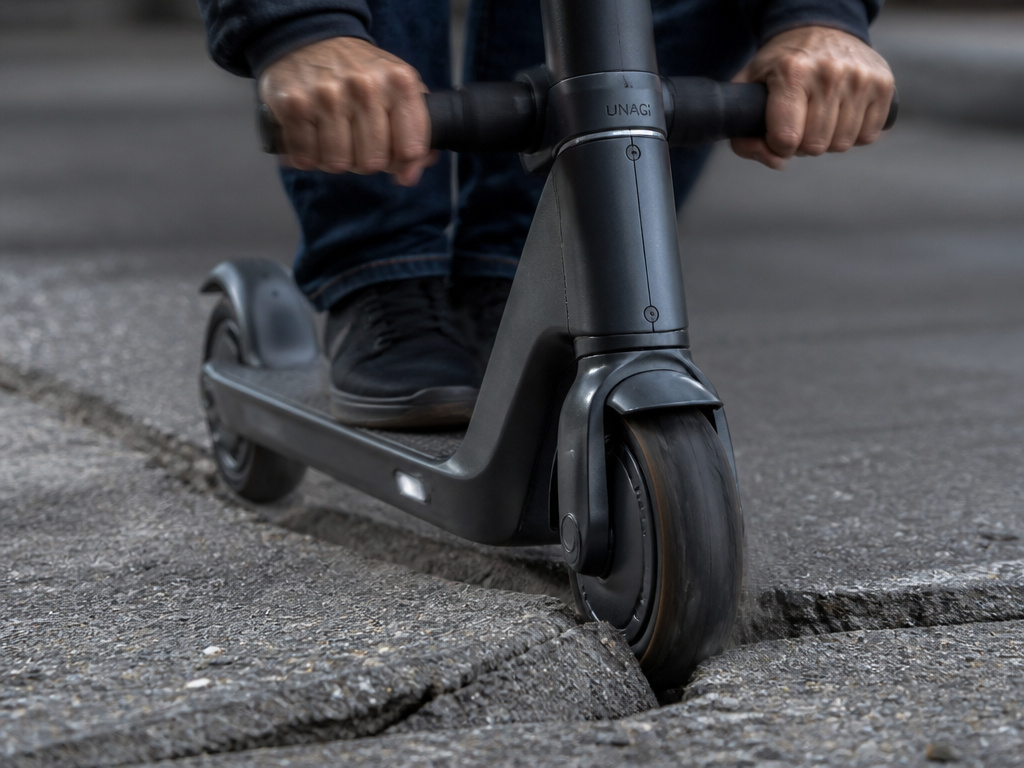
A scooter you can carry easily is great. A scooter that’s punishing to ride is not. The Unagi’s ride quality is its most controversial feature, directly resulting from its pursuit of low weight and low maintenance.
It uses 7.5-inch solid rubber tires. They are not air-filled, so they can’t go flat. To mitigate the harshness, Unagi designs the solid tires with some shock-absorbing properties. In practice, it’s a half-measure. On smooth, fresh asphalt, the ride is acceptable. The moment you hit a crack, a seam, or rough pavement, every vibration travels straight up the stem into your hands and knees. It’s not just uncomfortable; it’s fatiguing over a few miles.
There is no spring or hydraulic suspension. None. The scooter relies entirely on the slight give of those solid tires and the flex of your knees. For a detailed look at how proper suspension changes the experience, see our review of other top adult scooters.
Where this goes sideways: Hitting a pothole or a large crack with a small, solid tire. The tire can’t deform and roll over it. Instead, it can grab the edge and jerk the handlebars, potentially causing a loss of control. At 15+ mph, that’s a crash.
The control layout, conversely, is excellent. The thumb throttle is smooth and progressive, not jerky like cheaper scooters. The dashboard display is clear. The electronic horn is loud and useful. But these good details don’t cancel out the fundamental harshness of the platform. You feel every pebble.
Safety, Braking & Long-Term Reliability
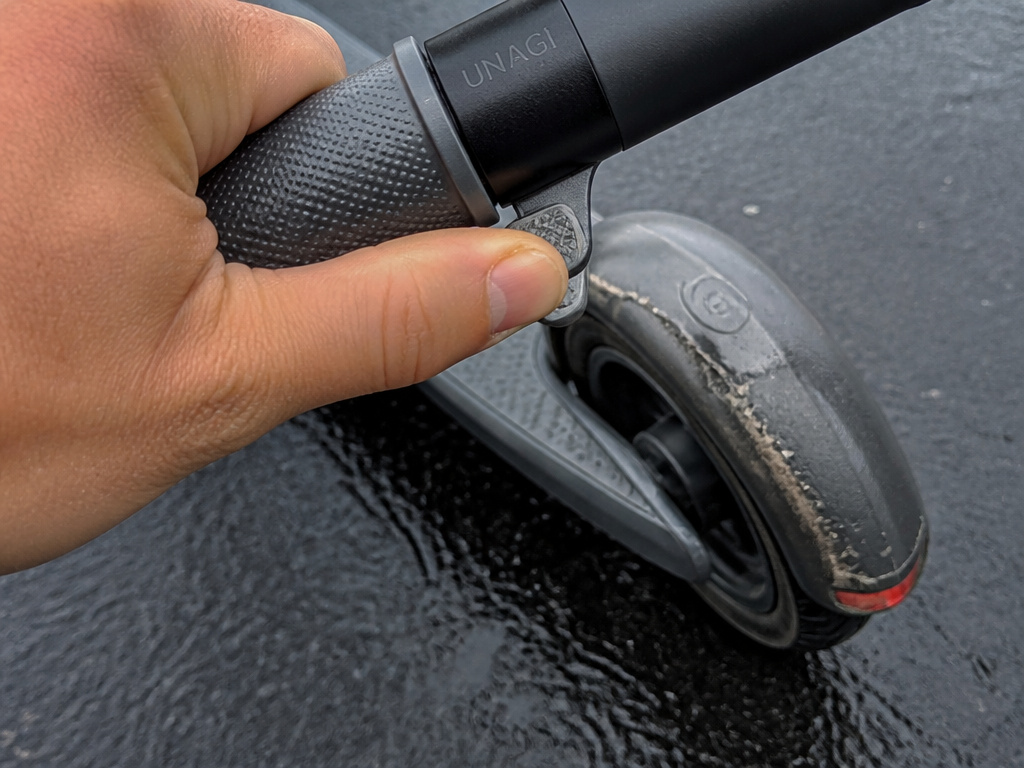
This is the section that shifts the Unagi from “a compromise” to “a hard no” for many riders. The safety concerns are not hypothetical; they are baked into the design choices.
Braking: The Unagi uses a dual electronic regenerative brake (E-ABS) activated by a thumb paddle. It’s smooth and requires no maintenance. The only physical backup is a rear fender brake, a stamp-down friction brake that wears the tire. If the scooter experiences a power cut-out, a rare but not unheard-of event in electric vehicles, your primary braking system is gone. The fender brake is insufficient for stopping safely at speed, especially on a decline or in wet conditions. This single-design decision is why many experienced riders deem it unsafe for general use.
Durability: Some users have reported durability issues over time. Some users theorize that the lack of suspension causes road shock to stress the frame. Unagi’s warranty covers defects for one year, but it explicitly excludes “misuse.” If you’re comparing durability, our review of NanRobot electric scooters shows a different approach to build.
Weather Resistance: Sources disagree on the water resistance rating: the Model One E500 is rated IP54, while the Voyager model is rated IPX4. It is not rated for rain, puddles, or any kind of submersion. The manual explicitly states this. Riding in the wet is a warranty-voiding risk.
Unagi All-Access Subscription: The Smarter Way to Try It

Paying $1,000+ for the Unagi Model One is a big commitment to a scooter with known flaws. Unagi’s subscription service, All-Access, is a compelling alternative. For $69 per month, you get a scooter, free shipping, and all repairs and maintenance covered. It includes the warranty.
If the scooter breaks or you simply don’t like it, you can return it. This model removes the financial risk and aligns with how many people actually use scooters, for a season or for a specific commute that might change. It also makes the Unagi’s limited range less of a permanent problem. The purchase option includes a 30-day return period, but the subscription is truly month-to-month.
Unagi Model One E250 vs E500: Which Should You Buy?
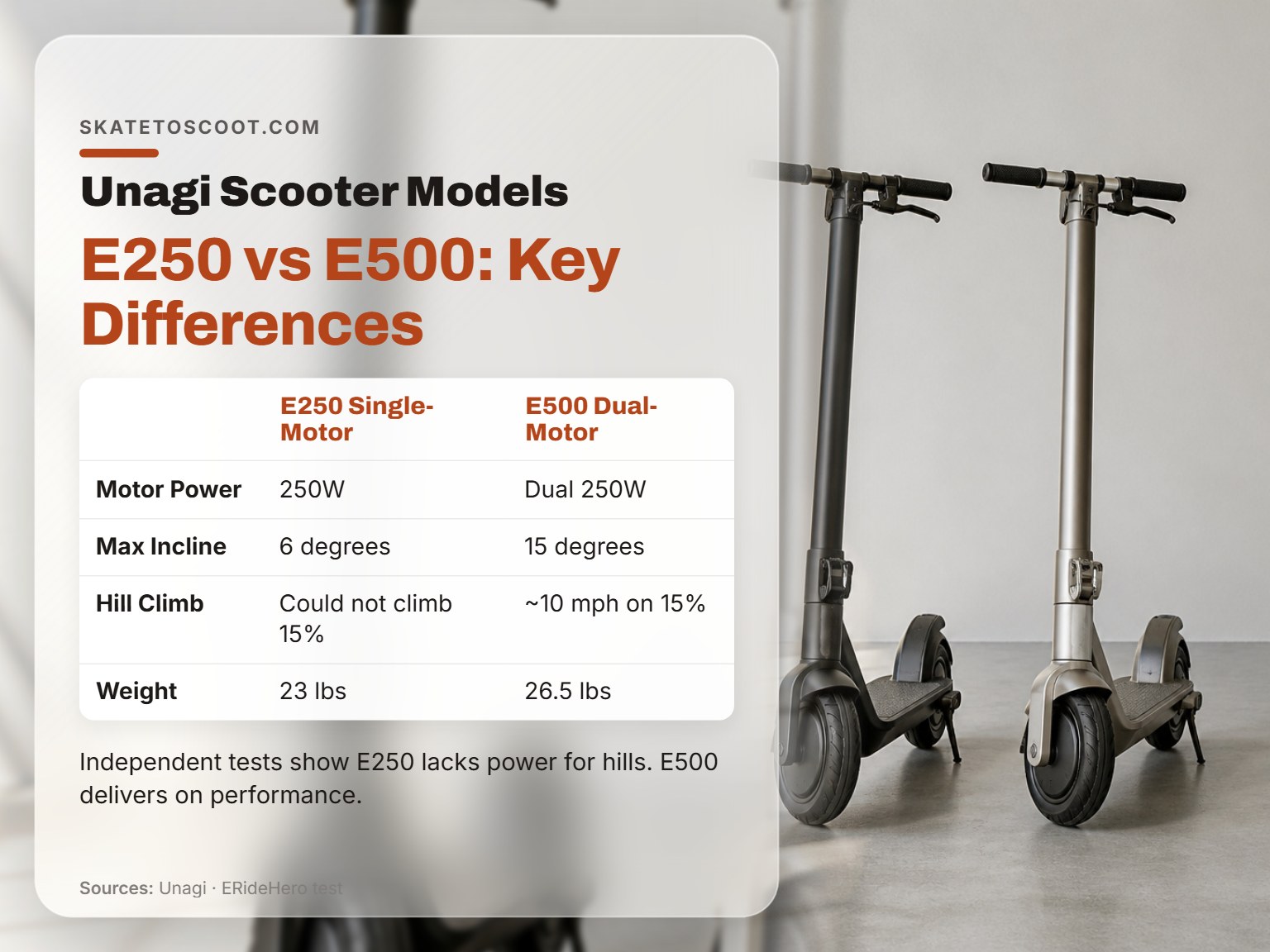
If you’ve read this far and are still considering an Unagi, the choice between models is straightforward. The performance gap is massive.
| Feature | Model One E250 (Single Motor) | Model One E500 (Dual Motor) | Verdict |
|---|---|---|---|
| Motor Power | 250W | 2 x 250W (500W total) | E500 wins. |
| E500 has double the grunt. | |||
| E500 is the only option for hills. | |||
| E250 is slightly more portable. | |||
| Best For | Absolutely flat, smooth pathways. | Urban commuting with mild hills. | The E500 is the only viable choice for most buyers. The E250’s performance is too limited to justify its price. |
The dual-motor model costs more, but the single-motor version has significantly less power. The dual-motor version is the only one that delivers on the “performance” part of Unagi’s promise. For a broader comparison against other brands, our electric scooter review hub has side-by-side analyses.
Final Verdict: Who Is the Unagi Model One For?
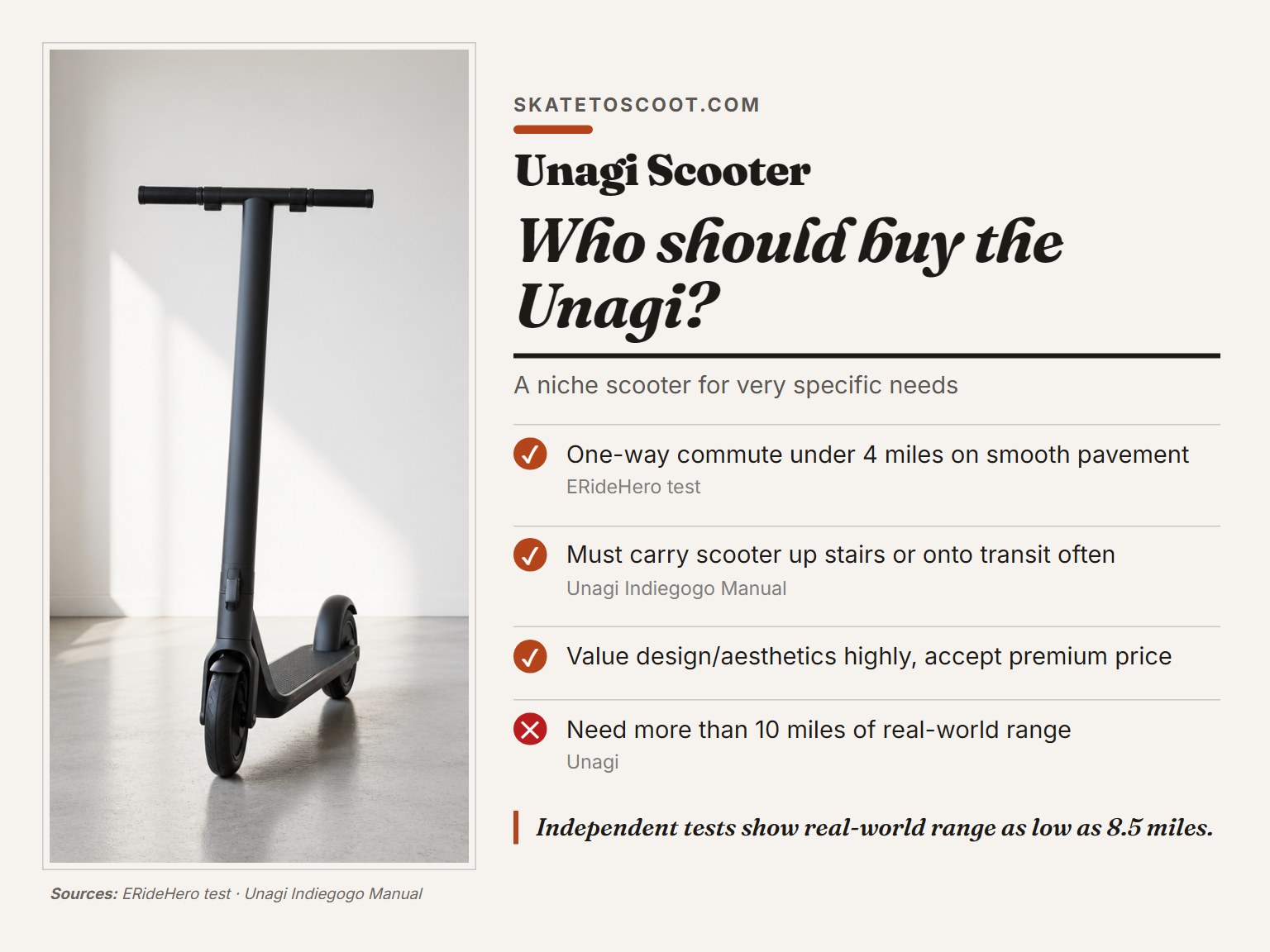
The Unagi Model One is a niche product. It is not a general-purpose electric scooter. It makes severe compromises in range, comfort, and safety to achieve its goals of light weight and sleek design.
Buy (or subscribe to) the Unagi Model One E500 if:
- Your one-way commute is under 4 miles on very smooth pavement.
- You must carry the scooter up stairs, onto public transit, or into an office frequently.
- You value design and aesthetics highly and are willing to pay a premium for them.
- You can charge the scooter at both ends of your trip.
- You understand and accept the risks of the braking system and solid tires.
Avoid the Unagi Model One entirely if:
- Your commute has hills, cracks, or rough roads.
- You need more than 10 miles of real-world range.
- Safety margins and a reliable physical brake are top priorities.
- You want a scooter for leisure rides or weekend exploration.
- You expect a comfortable, carver-like ride.
For everyone else, there are better, more versatile options. The landscape of other scooter models includes lighter commuter scooters with pneumatic tires and actual suspension that don’t force you to make such stark trade-offs. The Unagi is a proof of concept that portability can be king, but its reign is over a very small, very smooth kingdom.
Warranty / support / maintenance
The Unagi Model One comes with a standard one-year warranty from the date of purchase. If a malfunction occurs within the first three months, the company will provide a brand-new scooter as a replacement, excluding custom models. The warranty does not cover normal wear and tear on parts like tires and grips, nor does it cover accidental damage, misuse, off-road use, or water damage from full submersion. Storing the scooter for a long period with a battery that isn’t fully charged, which can damage the battery, will also void the warranty. Unagi also offers a 30-day return policy for any reason.
Frequently Asked Questions
Is the Unagi scooter good for commuting?
It can be, but only under specific conditions. If your commute is very short (under 4 miles), on perfectly smooth roads, and you can charge at your destination, the Unagi’s portability is a major advantage. For longer, hillier, or rougher commutes, its limited range and harsh ride make it a poor choice compared to other scooters for commuters.
How long does the Unagi scooter battery last?
The battery itself should last for several hundred charge cycles. The more pressing issue is range per charge. Real-world tests show between 8.5 and 11 miles, depending on rider weight, speed, and terrain. This necessitates frequent charging, often daily for commuters.
Can the Unagi scooter go up hills?
The dual-motor E500 model can handle moderate hills up to a 15% grade, albeit at reduced speed (around 10 mph). The single-motor E250 or E350 models lack the torque for meaningful hill climbing and will struggle or fail on any significant incline.
Is the Unagi scooter safe?
It has notable safety compromises. The lack of a reliable mechanical brake (it relies on electronic braking) is a significant concern in the event of a power failure. The small, solid tires also provide poor traction and shock absorption, making the scooter unstable and uncomfortable on uneven surfaces, which can increase crash risk.
What is the Unagi subscription service?
Unagi All-Access is a monthly rental program starting at $69/month. It includes the scooter, all maintenance, repairs, and warranty coverage. It’s an excellent, low-risk way to test the scooter for your needs without the large upfront cost of purchasing, and it directly addresses the scooter’s potential reliability issues.
