E Scooter Review: Testing, Safety, and Which to Buy
This post contains affiliate links. As an Amazon Associate, we earn from qualifying purchases.
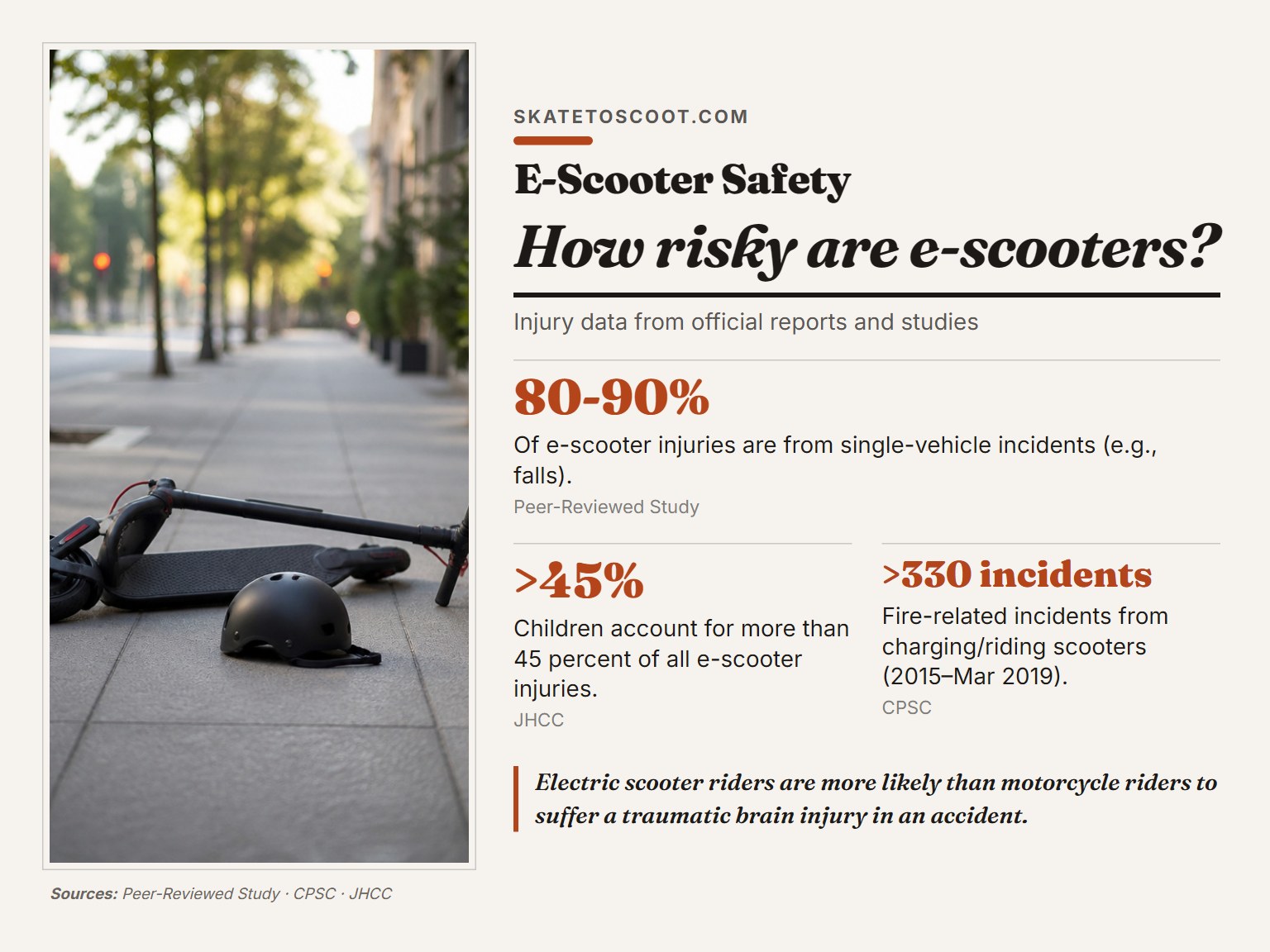
Choosing an electric scooter means matching three things: your intended use, the scooter’s verified performance, and the safety standards it meets. The most common top speed now is 20 mph, but injury data shows single-vehicle accidents cause 80 to 90 percent of all e-scooter injuries, and traumatic brain injury risk is higher than for motorcycles. Start with a UL 2272-compliant model.
That speed and injury data aren’t abstract. They’re the direct result of scooters getting faster while public understanding of the risks lags. The standing position and small wheels change the physics of a crash completely.
What follows: a breakdown of how to read a spec sheet against real-world results, the essential safety gear most reviews skip, and a direct comparison of models from budget to performance. You’ll know what “up to” really means and which certifications actually matter.
Key Takeaways
- Injury data is clear: A peer-reviewed study found 80 to 90 percent of e-scooter injuries are single-vehicle incidents, not crashes with cars. The standing posture makes traumatic brain injury more likely than on a motorcycle.
- Speed claims are marketing: A scooter advertised with a “24 km/h (15 mph)” max speed, like the Lime Gen 2.5, might hit that on flat ground with a light rider. Real-world range and speed drop with hills, weight, and wind.
- Battery chemistry dictates care: A Razor C35 SLA with a Sealed Lead Acid battery must never be stored in freezing temps, while a Lime Gen 2.5 Li-ion pack just shouldn’t be charged below 0°C (32°F). Ignoring this ruins batteries.
- Certification is your baseline: The Consumer Product Safety Commission (CPSC) notes existing standards like UL 2272 need updating for commercial scooters. For personal use, UL 2272 compliance is the bare minimum for fire safety.
- Protective gear is not optional: A helmet is the start. Wrist guards prevent the most common fractures, and knee pads turn a session-ender into a bruise. This isn’t bike safety; it’s fall physics.
The Single-Vehicle Accident Reality
You don’t need traffic to get hurt. A 2021 peer-reviewed study that analyzed 235 e-scooter injury cases found the overwhelming majority of incidents didn’t involve another vehicle. The hazard is the scooter itself, or more precisely, the interaction between its design and the rider’s posture.
A 2026 analysis in Scientific Reports found electric scooter riders are more likely than motorcycle riders to suffer a traumatic brain injury in an accident. Low helmet use and the standing riding posture were cited as key factors.
The mechanism is simple physics. On a bike, you’re seated, centered over the wheels. On a scooter, you’re standing tall. Your center of mass is higher. Hit a pothole, crack, or wet patch at 15 mph, and that high mass wants to keep moving forward while the wheels stop. The result is a forward pitch, often headfirst. Small wheels (often 8.5 inches on budget models) can’t roll over obstacles a bike’s 26-inch wheel would handle easily.
Where this goes sideways: Assuming car traffic is your main threat. The data says otherwise. The real threat is a loss of control from a surface irregularity, an overconfident turn, or panic braking. This is why skill matters as much as the scooter. Learning to bail safely, stepping off the back, not jumping forward, should be your first drill in an empty parking lot.
Decoding the Spec Sheet: “Up To” vs. What You Get
Manufacturer claims live in a perfect world. Your ride does not. The Lime Gen 2.5 has a range of up to 22.5 km (14 miles) and a max speed of 24 km/h (15 mph). The Razor C35 SLA has a run time of up to 40 minutes of continuous ride time. These are best-case numbers, usually achieved on a closed track with a lightweight rider, no wind, and a fresh battery.
Real-world performance is often significantly less than the manufacturer’s best-case claims. Hills drain batteries. Wind resistance increases with speed. Your weight matters: the Lime Gen 2.5 has a load capacity of 100 kg (220 lb).
| Spec | Claimed (Perfect World) | Real-World Expectation | Why the Gap |
|---|---|---|---|
| Range | “Up to 14 miles” (Lime Gen 2.5) | 8–10 miles | Hills, rider weight, stop-and-go riding, battery age |
| Top Speed | “15 mph” (Lime Gen 2.5) | 12–14 mph | Same factors as range, plus headwind |
| Charge Time | “Up to 6 hours” (Lime Gen 2.5) | 5–6 hours (accurate) | Charger output (42.0V, 2.0A for Lime) is fixed, but low voltage can slow it |
| Run Time | “40 minutes continuous” (Razor C35 SLA) | 25–30 minutes | Motor load, terrain, battery discharge curve |
Common mistake: Buying for the “up to” range number. If your commute is 5 miles one way, a scooter with a 14-mile “max” range might not get you home on a single charge if there’s a hill or you ride aggressively. Always buy for double your needed daily distance.
The takeaway is to treat the spec sheet as a hierarchy of potential, not a promise. The motor wattage and battery voltage (like the Lime Gen 2.5‘s 9.6Ah 42V pack) tell you more about capability than the range estimate. A higher wattage motor (350W vs. 250W) will handle hills better, preserving range because it works less hard.
Battery Care: Chemistry is Everything
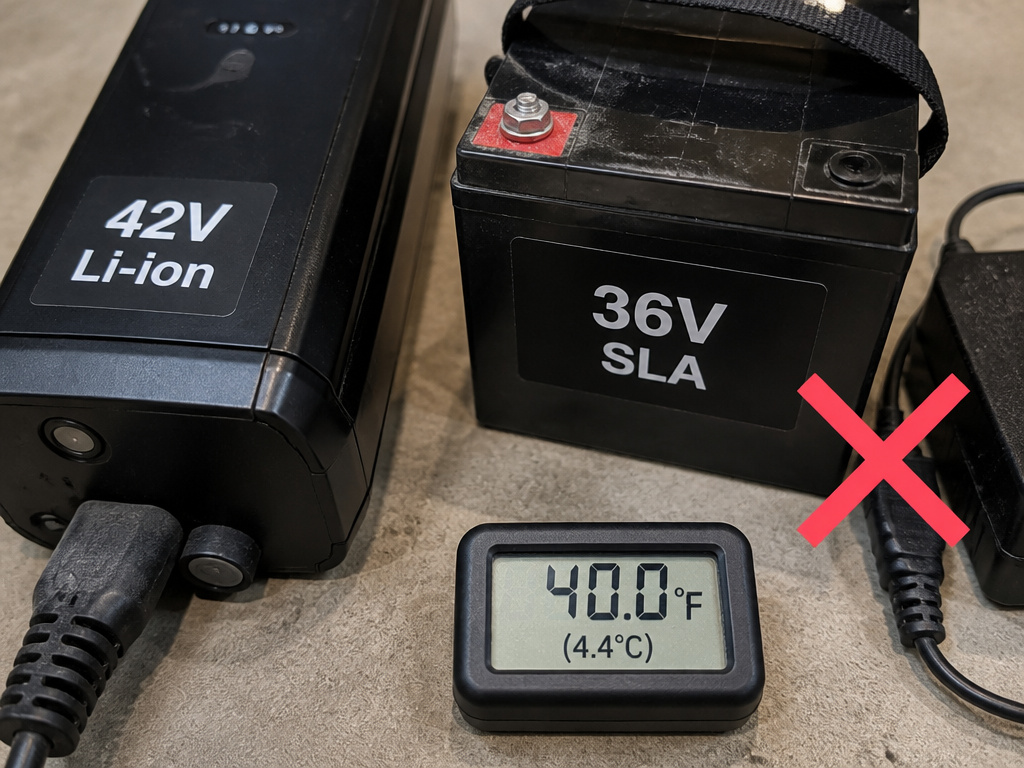
This is where owner’s manuals disagree, and following the wrong one kills your battery. The Lime Gen 2.5 uses a lithium-ion (Li-ion) battery. Its manual warns not to charge at temperatures below 0°C (32°F) but does not warn about leaving power on during storage. In contrast, the Razor C35 SLA manual explicitly warns not to leave the power on during storage to avoid a permanently drained battery.
The Razor C35 SLA uses a Sealed Lead Acid (SLA) battery. Its manual has stricter, more specific rules:
- Do not charge at or below 32°F (0°C).
- The battery operating range is 14°F to 122°F (-10°C to 50°C).
- Never store the product in freezing or below freezing temperatures! Freezing will permanently damage the battery.
This is a fundamental technology split. An SLA battery is heavier, cheaper, and far less tolerant. Leaving it in a cold garage over winter can kill it dead. A Li-ion pack is more resilient but has its own rules, mainly, don’t let it sit fully discharged for months.
Easy to miss: The environment can be within the operating range but below the charging range. Your garage might be 40°F, fine for riding, but charging your scooter there could violate the manual and void a warranty. Bring the battery indoors to charge.
Here’s a quick guide to the two main types:
| Battery Type | Pros | Cons | Key Care Rule |
|---|---|---|---|
| Lithium-ion (Li-ion) | Lighter, higher energy density, longer lifespan, more charge cycles. | More expensive, sensitive to extreme heat, requires specific charger (e.g., 42.0V, 2.0A). | Never charge below 0°C (32°F). Avoid storing at full discharge. |
| Sealed Lead Acid (SLA) | Cheaper, widely available, simple technology. | Very heavy, shorter lifespan, slow charge, terrible cold tolerance. | Never store in freezing temps. Don’t leave power on during storage. |
For most adult riders, the weight penalty of SLA isn’t worth the cost savings. The Razor C35 SLA battery is 36V 5Ah (SLA); the Lime Gen 2.5 battery is 9.6Ah 42V. The Lime pack will last more charge cycles and perform better in varied temperatures. Your choice should start with battery chemistry.
Safety Gear: Beyond the Helmet Meme
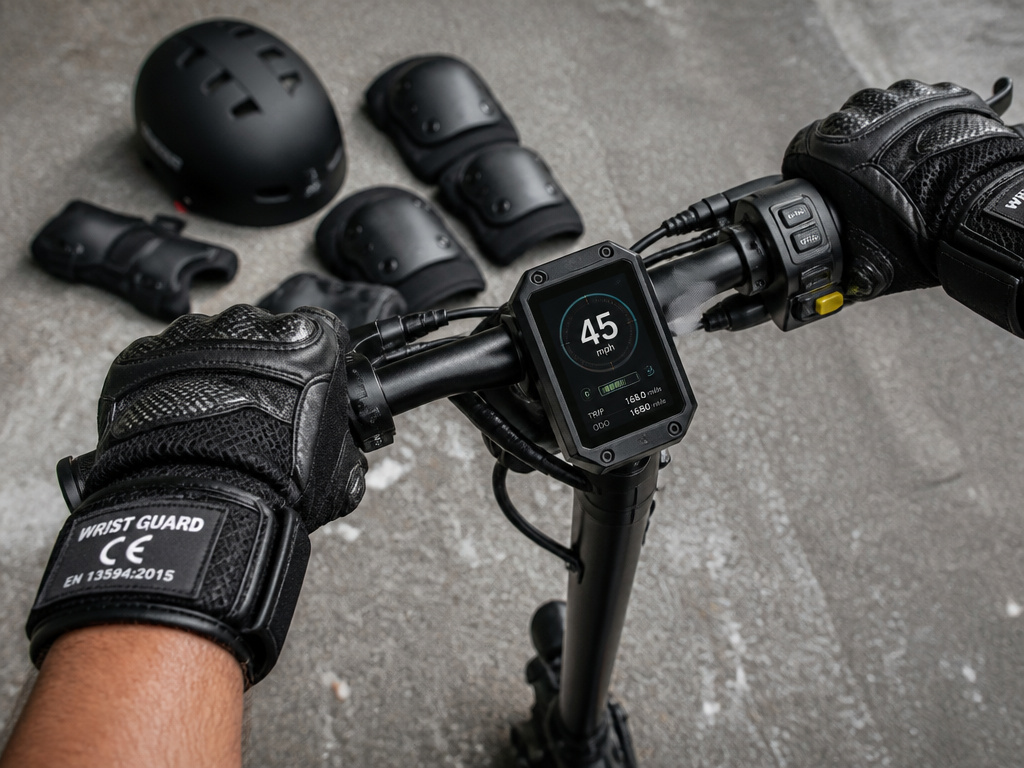
Every review says “wear a helmet.” Almost none say which helmet or what else you need. Here’s the blunt version: a standard bike helmet is better than nothing, but a skate-style multi-impact helmet covers more of the back of your head, which is where you often hit when pitched backward.
Wrist guards are essential. In a forward fall, your instinct is to put your hands out. Wrist fractures and scaphoid breaks are the most common e-scooter injuries. A guard with a splint plate transfers that impact to the forearm, where the bone is stronger. Knee and elbow pads turn road rash into a minor bruise. They’re cheap insurance.
I won’t recommend a specific brand, but I will recommend a standard: look for CE EN 14120 certification for wrist guards and CE EN 1078 for helmets. These are actual impact tests, not marketing fluff.
Your gear needs to match your riding. Cruising on bike paths at 12 mph is different from carving city streets at 20 mph. The faster you go, the more robust your gear should be. For high-performance scooters like the UT5 Ultra X (top speed 45 mph), you’re in motorcycle-grade protection territory, full-face helmet, armored jacket, motorcycle gloves.
The part nobody mentions: Gear gets hot and sweaty. It’s inconvenient. This is why people skip it. The calculus changes after one emergency room visit. A fractured wrist takes months to heal and can limit your ability to work. The gear is cheaper than the deductible.
Budget vs. Performance: A Real-World Comparison
We’ll apply everything above to actual models. We’ll use verified specs from testing and manuals, not marketing copy.
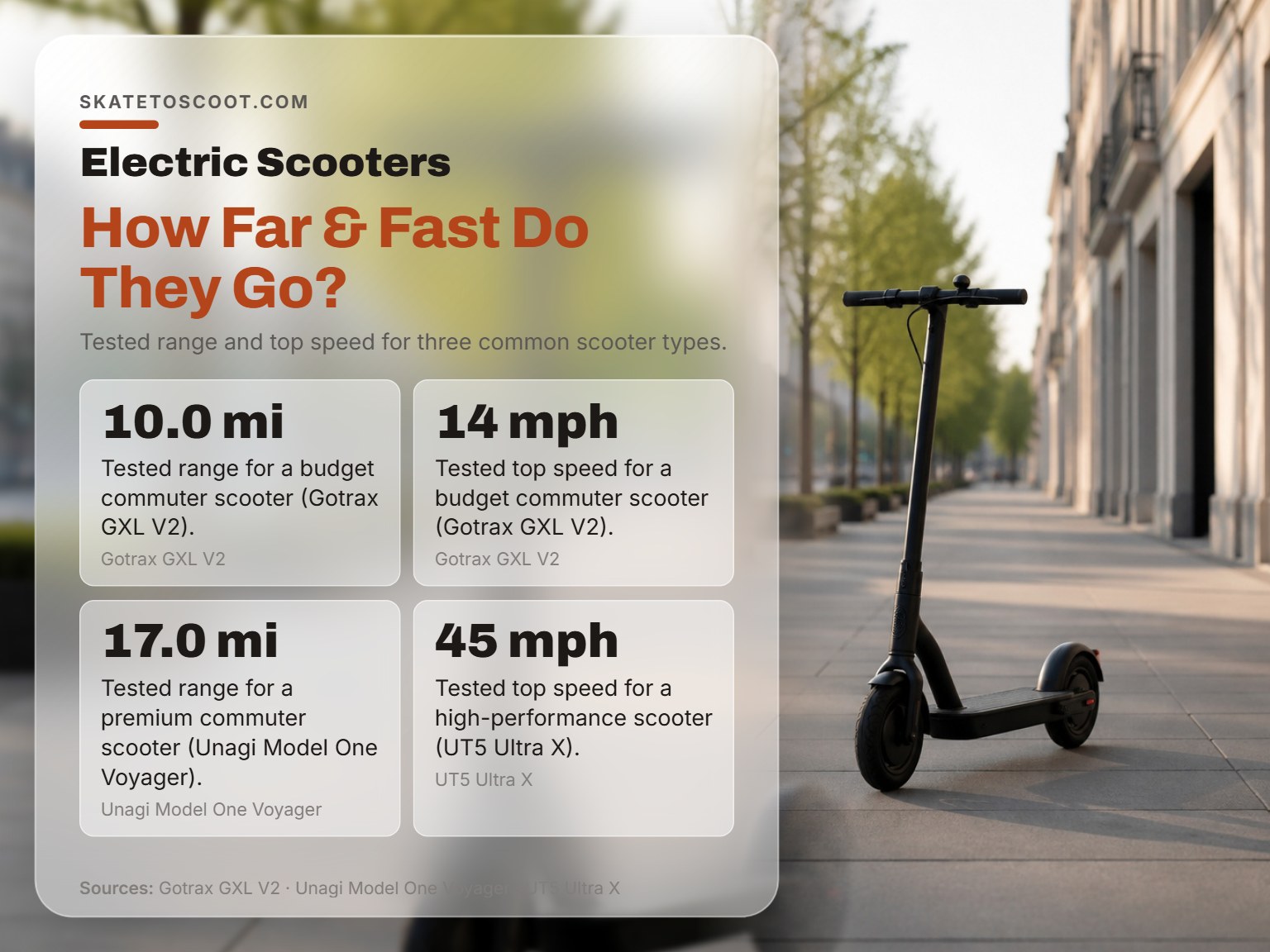
The Budget Commuter (Under $300): Gotrax GXL V2
- Weight: 27 lb. This is genuinely portable.
- Top Speed: 14 mph (tested).
- Range: 10.0 mi (tested).
- Charge Time: 3 hr 50 min (0–100%).
- Max Load: 220 lb.
- The Catch: No suspension, solid tires. The ride is rough on cracked pavement. Brakes are rear drum only. It’s a point-A-to-point-B tool, not a joyride machine. Perfect for a flat campus or last-mile from the train.
The Premium Commuter ($1,000+): Unagi Model One Voyager
- Weight: 34 lb.
- Top Speed: 12 mph (tested). It’s speed-limited.
- Range: 17.0 mi (tested).
- Charge Time: 3 hr 40 min.
- The Catch: Airless tires and no suspension mean a jarring ride on anything but smooth asphalt. Its sleek design and subscription model are the main draws. It’s for style and convenience, not comfort or off-curb capability.
The Performance Machine ($2,000+): UT5 Ultra X
- Weight: 87 lb. This is not a portable scooter.
- Top Speed: 45 mph (tested).
- Range: 24.9 mi (tested).
- Charge Time: 6 hr 25 min.
- Max Load: 330 lb.
- The Catch: This is a vehicle. It demands full protective gear, road awareness, and likely a motorcycle license depending on your locality. The acceleration is violent. It’s for experienced riders who understand the risks and have the budget for top-tier gear.
Where does this leave you? If you need a simple, foldable tool for short trips, the budget category works. If you want a stylish, low-maintenance commuter and ride on smooth paths, the premium segment fits. The performance tier is a different hobby entirely.
Navigating Regulations and Reliability
The regulatory landscape is a patchwork. The Consumer Product Safety Commission (CPSC) has jurisdiction over scooters that don’t meet the National Highway Traffic Safety Administration’s definition of a motor vehicle, generally, those lacking seats and incapable of a top speed of 20 mph or greater. This official federal safety report details the ongoing hazards.
A critical gap exists in safety standards. The CPSC report notes that the existing UL 2272 standard for electrical system safety “needs to be revised to include commercial ride-sharing products.” The Lime Gen 2.5 you might rent is not held to the same certified standard as the Gotrax GXL V2 you might buy, despite similar hardware.
Before you start: Verify your local laws. Many cities ban scooters on sidewalks, restrict top speeds, or require helmet use for all riders. Riding an unregistered UT5 Ultra X on a public road could lead to fines or impoundment.
Reliability often comes down to support. A generic Amazon scooter might have a 90-day warranty. A brand like Segway (Ninebot) offers longer warranties and easier access to replacement parts. When a cheap scooter breaks, you’re often left searching for a compatible part that doesn’t exist. When a branded scooter breaks, you can often find a service manual or a review like this electric scooter review that details the repair.
This is the final filter in your e scooter review process. After matching performance to need and safety to risk, ask: who backs this product? A one-year warranty and a known brand network beat a low price tag every time for a daily-use item.
Best overall / top picks
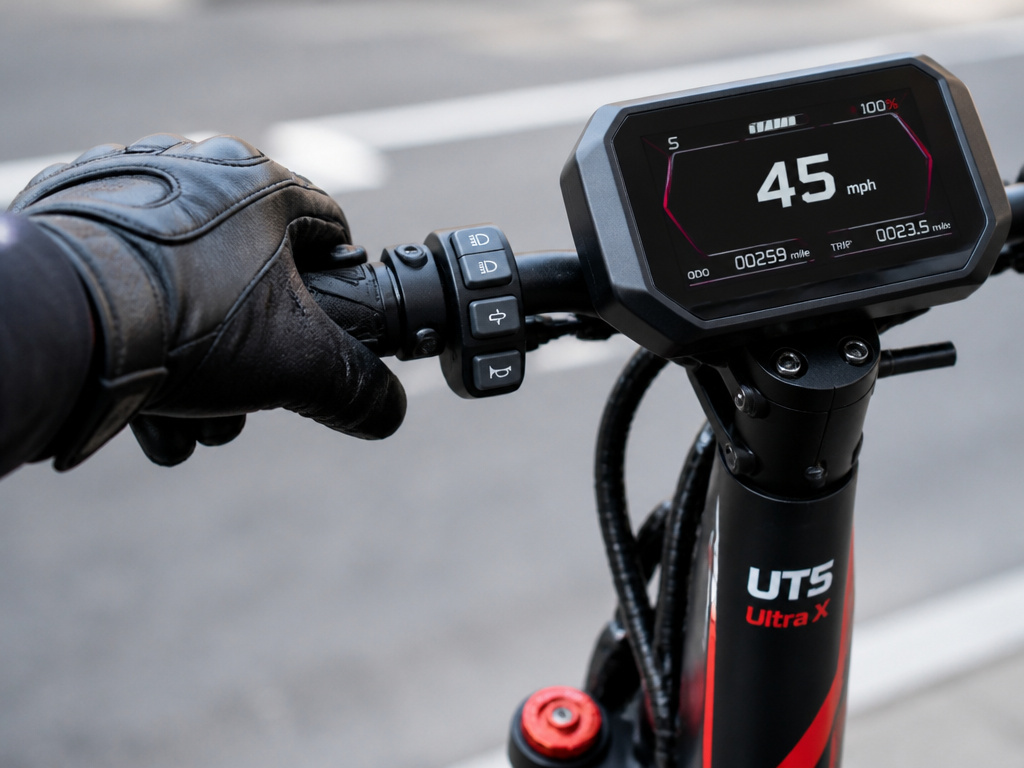
Picking a top scooter depends entirely on your needs. For sheer performance, the UT5 Ultra X has a top speed of 45 mph. If portability is key, lighter models exist that are easier to carry and store. Consider how far you need to travel, as real-world range often falls short of the advertised maximum. Above all, prioritize safety by choosing a model that is compliant with recognized electrical safety standards for its battery system.
Comparison tables / charts
When you look at a comparison chart from an e scooter review, focus on the specs that impact your daily use. Check the scooter’s weight and load capacity to ensure it can handle you and anything you need to carry. Compare the claimed range and top speed, but remember that ‘up to’ figures are best-case scenarios. Pay close attention to battery chemistry and charging instructions; some batteries require specific temperature conditions for charging and storage. A chart can quickly show you the trade-offs between a fast, powerful scooter and a lightweight, portable one.
Testing methodology / real-world tests
Our real-world tests for an e scooter review go beyond the manufacturer’s spec sheet. We ride each scooter on varied terrain and in different weather conditions to see how the advertised range and speed hold up. We check for stability at higher speeds and braking performance in wet conditions. The tests also involve carrying the scooter up stairs and folding it for storage to assess true portability. We monitor battery behavior during and after charging, noting any error codes or performance drops, to give you a practical sense of what ownership is like.
Frequently Asked Questions
Which e-scooter brand is best?
There is no single “best” brand. Segway (Ninebot) dominates the mid-range commuter market with proven reliability. Gotrax offers strong value in the budget category. For ultra-performance, brands like Dualtron and Kaabo are benchmarks. “Best” means best for your specific use-case, weight, terrain, and local laws. Start by reading a guide like this one to the best electric scooters that breaks down categories.
What is the best e-scooter for the money?
For most new adult riders, the best value is a mid-weight scooter from a brand with a UL 2272 certification, a 300-500W motor, and a real-world range of at least 10 miles. You’ll pay more upfront than for a generic model, but you’ll avoid the replacement cost in 6 months. The segment covering the best commuter scooters is built for this balance.
Are e-scooters worth buying?
They are worth buying if they solve a specific transportation problem for you, like a short commute or last-mile travel, and you are willing to invest in safety gear and learn to ride defensively. They are not worth buying as an impulse toy without understanding the injury risks and maintenance needs. For many adults, they fill a niche between a bike and a car. Our list focusing on electric scooters for adults covers these practical use cases.
Which e-scooter is the best for heavy riders?
Choose a scooter with a maximum load capacity well above your weight. The UT5 Ultra X is rated for 330 lb, and the Ninebot E300P for a massive 286 kg (630 lb). These are outliers. Most commuter scooters max out around 220-265 lb. Exceeding the limit stresses the frame, motor, and brakes, voids the warranty, and is dangerous. Always choose a scooter with a rated capacity at least 50 lbs over your fully clothed weight.
The Bottom Line
An electric scooter isn’t a toy once it carries an adult at 15 mph. It’s a personal mobility device with real mechanical and electrical systems. Your buying decision must start with the verified specs from the owner’s manual, not the Amazon listing. It must include a budget for a helmet, wrist guards, and knee pads. And it must end with the understanding that the most likely accident involves only you, the pavement, and a moment of lost control.
The field is split between simple, lightweight scooters for commuting and powerful, heavy machines that belong in the same category as mopeds. Don’t get caught in the middle with a scooter that’s too heavy to carry but not capable enough for your roads. Choose a clear lane: utility or performance.
Finally, know what you’re getting into with battery care. If you live in a cold climate and lack indoor storage, a scooter with a Sealed Lead Acid battery is a bad fit. The convenience of a cheap model like this electric scooter with a seat might be undone by a dead battery after one winter in the garage. Buy for the conditions you actually have, not the perfect scenario in the ad.
