Apollo Scooter Review: Build Quality and Safety
This post contains affiliate links. As an Amazon Associate, we earn from qualifying purchases.
An Apollo scooter review must weigh performance specs against a documented recall history, with the Go offering dual-motor agility at 46 lbs, the City hitting 32 mph before a stem-weld recall, and the Phantom delivering high speed alongside a bolt-replacement campaign.
That split defines the brand. You get capable hardware, often praised for its ride feel and features, paired with specific, mandated maintenance that changes the ownership experience. Ignoring the recall side of the sheet is how riders get hurt; ignoring the performance side is how you miss a scooter that could fit your commute perfectly.
What follows: a breakdown of the three main models (Go, City, Phantom), their verified performance from independent tests, the exact steps for the two active recalls, and where Apollo’s warranty and support actually stand.
Key Takeaways
- The Apollo Go is a 46 lb dual-motor scooter with a 28 mph top speed and a real-world range of 15–24 miles depending on riding mode; its 540 Wh battery charges in about 7.5 hours.
- The Apollo City 2024 is under a mandatory recall for stem weld cracks; units sold from June 2024 through April 2025 require a stem replacement that must be performed by a Level 2 Certified Shop.
- The Apollo Phantom recall mandates replacing the original A2-70 stainless steel stem bolt with a Grade 12.9 steel bolt, torqued to 40–50 Nm, with preventative maintenance required every 500 km.
- Apollo scooters do not support battery upgrades and do not currently offer charge limit settings in their firmware, per the manufacturer’s support pages.
- The return policy is strict: 14 days from delivery, only if the scooter has not been ridden and is in its original box, incurring a $50 restocking fee plus return shipping and a 3% processing fee.
Build Quality and Safety: The Recall Record
You cannot talk about Apollo without starting here. It’s not a vague reputation thing. It’s two specific, dated recalls with published injury counts and mandated fixes.
The U.S. Consumer Product Safety Commission (CPSC) announced the Apollo City 2024 recall on July 24, 2025. The firm received 10 reports of weld cracking on the scooter’s stem. Four riders came off the scooter because of it; one reported abrasions. If your serial number falls between 4202240300001 to 4202240301236 or 4202240400001 to 4202240400764, you must stop riding immediately.
Where this goes sideways: Attempting a DIY stem replacement on a recalled Apollo City 2024. The official remedy requires the work be done by a Level 2 Certified Shop. Apollo’s recall page states units received after February 3, 2025, already have the updated stem, but if yours is in the affected range, you must contact them for a shop referral or a shipped repair arrangement.
The older, but still active, recall is for the Apollo Phantom (V1, V2, and 60V models). The CPSC Phantom scooter recall was announced August 31, 2023. The issue is a single stem bolt that can come loose, causing the front suspension and wheel assembly to separate. The firm received seven reports of bolt breakage leading to detachment, resulting in three injuries (bruising, cuts, abrasions).
The fix is precise. You must identify which bolt you have. The original is an A2-70 Stainless Steel Bolt. The replacement is a Grade 12.9 Steel Bolt. If you have the A2-70 bolt, you cannot ride until it’s replaced. Apollo sends the Grade 12.9 bolt to the original invoice address. Once installed, or if you already have the 12.9 bolt, you must perform preventative maintenance every 500 km: tightening it to 40–50 Nm with a torque wrench.
| Recall | Model | Hazard | Reported Incidents | Mandatory Fix |
|---|---|---|---|---|
| 2025 | Apollo City 2024 | Stem weld crack | 10 reports, 4 falls, 1 injury | Stem replacement by Level 2 Certified Shop |
| 2023 | Apollo Phantom (V1/V2/60V) | Stem bolt loosening/breakage | 7 reports, 3 injuries | Replace A2-70 bolt with Grade 12.9 bolt; torque to 40–50 Nm every 500 km |
That 40–50 Nm specification isn’t a suggestion. A torque wrench is essential for this job. Under-torque, and the bolt can work loose again. Over-torque, and you risk stripping threads or fatiguing the bolt. It’s the kind of precise, mechanical upkeep that separates a toy from a vehicle.
Performance and Ride: What the Specs Actually Deliver
Past the safety bulletins, Apollo scooters earn their reviews on performance, a key focus of any Apollo scooter review. The numbers from independent testers tell a clearer story than marketing copy.
Apollo Go (2024)
The Go is the lightweight contender. At 46 lbs, it’s a dual-motor scooter you can realistically carry up a flight of stairs. Electrek’s Apollo scooter review pinned its top speed at 28 mph (45 km/h). The real-world range, however, depends entirely on how you ride. ERideHero’s testing broke it down:
- Speed Priority Mode: 15.4 miles at an average speed of 19.8 mph.
- Regular Mode: 19.8 miles at 15.2 mph.
- Range Priority Mode: 23.7 miles at 12.1 mph.
The dual motors give it surprising grunt. ERideHero’s hill climb test had it complete a 250-foot, 8% grade in 10.1 seconds. On an extreme 17% grade, it maintained 12 mph—top of its class for scooters under 50 lbs. The regen braking is a standout; the left thumb paddle controls braking intensity, and many testers found they rarely needed the mechanical drum brake.
Apollo City 2024 (Recalled Model)
Before the recall, this was a 32 mph dual-motor commuter. That speed is still its claim, but until the stem is replaced by a certified shop, that performance is irrelevant. It’s a stark reminder that top-tier specs mean nothing if the fundamental structure isn’t sound.
Apollo Phantom
This is the performance line. The battery is substantial: a 52V 30Ah pack rated at 1,560 Wh, charged by a 58.8V 5A charger in about 6 hours. This is the scooter that gets called “the Cybertruck of electric scooters” in reviews—a lot of power and a distinct, polarizing design. Its performance, however, is forever linked to the stem bolt maintenance schedule.
The Apollo Go vs. City vs. Phantom Trade-Offs
Choosing between these models isn’t just about budget. It’s about matching a scooter’s physical reality to your daily use case.
The Apollo Go is for the urban rider who needs to carry their ride. The 46 lb weight and foldable design make it viable for mixed-mode commutes (scooter + train + walk). The dual motors handle moderate hills, and the 20-mile real-world range covers most round-trip city commutes. The trade-off is a smaller battery (540 Wh) and less top-end speed than its siblings.
The Apollo City (post-recall repair) targets the pure commuter who wants a balance of speed (32 mph) and features like a headlight, taillight, and turn signals. Its value hinges entirely on the successful completion of the stem recall.
The Apollo Phantom is for the rider who prioritizes speed and range above all else, and is willing to adopt a rigorous mechanical maintenance routine. The 500 km bolt check isn’t a casual glance; it’s a torque-wrench procedure.
| Model | Best For | Key Trade-Off |
|---|---|---|
| Apollo Go | Lightweight, carry-able urban commuting | Lower top speed (28 mph), shorter range at high speed |
| Apollo City | Balanced commuter with higher speed (32 mph) | Heavier (72 lbs), currently entangled in a mandatory recall |
| Apollo Phantom | Maximum performance, speed, and range | Requires disciplined, tool-based stem bolt maintenance every 500 km |
For most city dwellers with stairs and limited storage, the Apollo Go makes the most sense. The performance is sufficient, and the weight keeps it practical.
Range, Battery, and Charging: The Fine Print
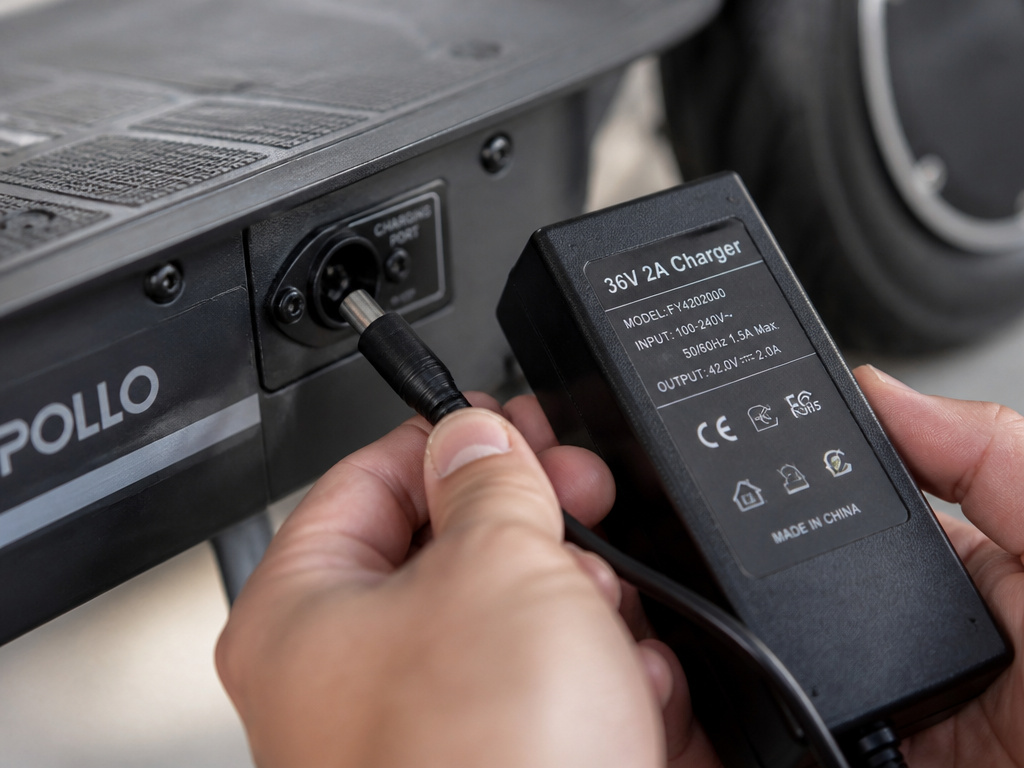
Apollo’s official specs give you a ceiling. The real-world numbers from testers give you the floor you’ll actually live on.
The Apollo Go’s 540 Wh battery (36V 15Ah) charges in about 7.5 hours with its standard 36V 2A charger, according to Apollo Scooters’ support page. As the ERideHero range tests show, you’ll only approach the max advertised range if you ride in Range Priority mode at around 12 mph. Crank it up to near its 28 mph top speed, and expect that range to nearly halve.
The Apollo Pro’s 1,560 Wh battery is a different beast, but it comes with a firm limitation straight from the manufacturer’s support page: Apollo scooters do not support battery upgrades. The scooter’s components are designed to work together, and the battery is not compatible with other packs. What you buy is what you have for the scooter’s life.
Another common feature request is also a dead end: Apollo scooters do not currently support charge limit settings. You cannot set the charger to stop at 80% to prolong battery longevity. The advice from Apollo is simply to unplug the scooter once it’s fully charged.
Common mistake: Comparing scooter range using only the manufacturer’s “up to” figure. Independent tests like ERideHero’s three-mode range analysis show how speed dramatically cuts into distance. A 36-mile claim can be a 15-mile reality if you use the performance you paid for.
Ownership Experience: Warranty, Support, and Returns

This is where forum complaints crystallize. Apollo’s policies are clearly written, but they are strict.
Warranty: Apollo offers a limited component warranty—either 1-Year or 2-Year, depending on the specific product variant you purchase. More significantly, eligible models (Go, City, Explore) purchased after March 25, 2025, come with a Lifetime Frame Warranty for the original owner. This covers the frame against manufacturing defects indefinitely, a strong commitment on paper.
Returns: The policy is tight. You have 14 days from delivery to return a scooter, but only if it has not been ridden and is returned in its original box. If you’ve taken it for a spin, the return window slams shut. Even if you qualify, returns incur a $50 restocking fee, you pay return shipping, and Apollo deducts a 3% payment processing fee. It’s a policy that heavily favors the seller.
Support: This is the murkiest area. The official government recall documentation shows Apollo cooperating with the CPSC on remedies. However, community reports on Reddit describe a wide spectrum of experiences, from praised resolutions to stories of unresponsive service, particularly concerning parts availability for out-of-warranty repairs not related to recalls.
When considering any Apollo Ghost or other model, factor in that your local support options might be limited to certified shops, not a widespread dealer network.
Portability, Braking, and Real-World Usability
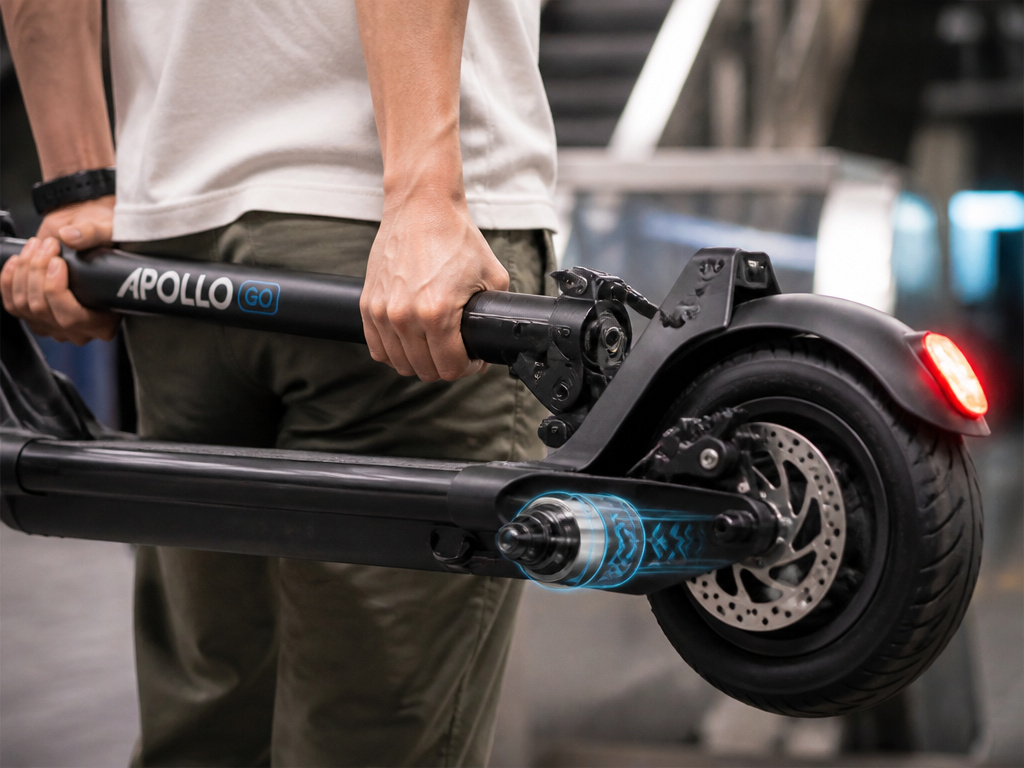
A spec sheet lists features. Riding a scooter reveals what those features actually do.
Portability: The 46 lb Apollo Go is the clear winner here. If your commute ends with carrying your scooter, the weight difference is a daily physical burden.
Braking: Apollo leans heavily on regenerative braking paired with mechanical brakes. On the Go, the regen braking system is effective. The Phantom uses a more traditional dual-disc setup. The important note isn’t the hardware; it’s that Apollo’s regen system is consistently reviewed as well-tuned and predictable, which is not a given on all electric scooters.
Lights and Visibility: Most Apollo models are well-equipped here. The Go, for instance, includes a headlight, a brake-activated taillight, and integrated turn signals.
Long-Term Reliability and Common Issues
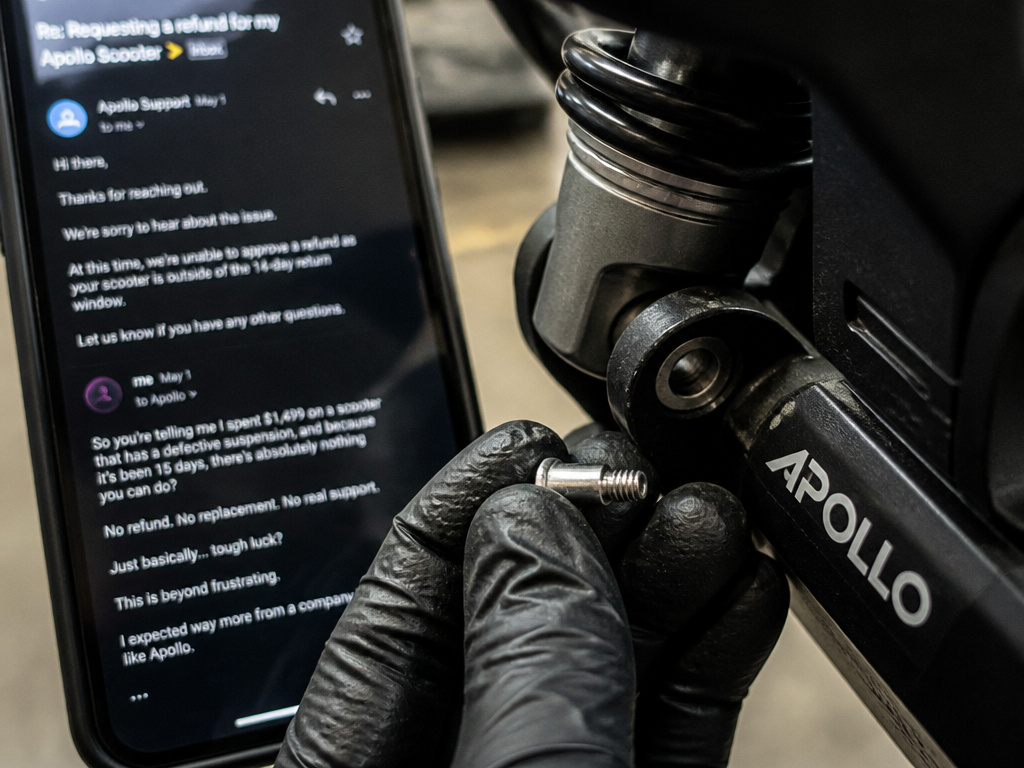
Beyond the recalls, long-term ownership threads highlight patterns.
The Phantom’s issue is the bolt, full stop. These aren’t defects; they’re the realities of maintaining a high-performance machine with many moving parts.
The most common gripe across models isn’t a part failure—it’s customer service inconsistency. When things go smoothly, owners praise the support. When a part is backordered or a warranty claim is contested, the experience can turn frustrating quickly. Your reliability may depend less on the scooter’s build and more on your proximity to a competent, Apollo-certified repair shop.
Frequently Asked Questions
Is Apollo scooter a good brand?
Apollo is a legitimate brand that produces capable, performance-oriented scooters with good design and features. However, “good” must be qualified by its active recall history and the mandatory, specific maintenance required on some models. They are good if you are a diligent owner who will follow recall remedies and maintenance schedules to the letter.
Is Apollo or Segway better?
It’s a use-case decision. Segway (specifically the Ninebot Max series) is often praised for bulletproof reliability and water resistance with less outright performance. Apollo scooters typically offer more power, speed, and features for the price, but demand more owner involvement in maintenance and come with a more complex safety history. For a “set it and forget it” commuter, Segway often wins. For a rider who values performance and doesn’t mind mechanical upkeep, Apollo is compelling.
What’s the most reliable scooter brand?
There is no single “most reliable” brand. Segway’s Ninebot Max G2 has a reputation for durability with fewer severe safety incidents. Brands like NIU also score highly for reliability in community sentiment analysis. Apollo’s reliability is model-specific and heavily influenced by adherence to recall fixes and maintenance. For a detailed look at alternatives, our scooter reviews page compares many brands.
Can I upgrade the battery on my Apollo scooter?
No. According to Apollo’s official support page, battery upgrades are not possible. The company states the scooter’s components are designed to work together, and the battery is not compatible with other packs.
Before You Go
The math on an Apollo scooter is different from other brands. You’re not just buying a set of specs; you’re buying into a specific set of responsibilities.
If you choose an Apollo City 2024, your first task isn’t riding—it’s checking the serial number against the recall list and contacting Apollo for a certified shop appointment. If you choose a Phantom, your purchase includes buying a torque wrench and setting a calendar reminder for every 500 km.
The Apollo Go sidesteps the major structural recalls but still requires you to trust in the company’s support should a non-recall issue arise. For the rider who accepts those terms, the performance and design can be excellent. For the rider who wants a truly appliance-like, zero-maintenance experience, other brands in our electric scooters coverage might be a safer bet.
Ultimately, an Apollo scooter is for the informed enthusiast, not the passive consumer. You get the speed and features because you’re willing to do the reading and the wrenching. Ignore either half of that equation at your own risk.
