Backfire Skateboard Review: Which Model Fits You?
This post contains affiliate links. As an Amazon Associate, we earn from qualifying purchases.
A Backfire skateboard review finds a brand offering strong performance and value, with the Zealot S2 delivering a tested 25.7-mile range and 30.8 mph top speed. Reliability has been tested by real-world recalls, and the 6-month warranty is a solid baseline for a budget-friendly brand.
The gap between advertised specs and real-world use is where most backfire skateboard review articles stop. Backfire’s own data shows a battery loses about 30% capacity after 300-500 full cycles. That’s not a defect; it’s chemistry. A review should tell you what happens after the first month of hype, when the board lives in your closet or gets ridden hard.
What follows: a breakdown of Backfire’s tested performance, a clear look at their two motor types, the real cost of ownership beyond the purchase price, and which of their dozen models actually fits a new rider versus someone chasing speed.
Key Takeaways
- The Backfire Zealot S2 hit a tested 25.7-mile range at 15 mph and a 30.8 mph average top speed, validating its advertised performance.
- Backfire’s 6-month warranty covers complete boards, but parts bought separately only get 90 days, read the fine print before buying spares.
- For long-term storage (over 2 months), charge the battery to 50%-60% and top it up once a month to prevent deep discharge damage.
- Hub motors (on G-series, Ranger) offer a quieter, lower-maintenance ride, while belt drives (on Zealot series) provide more torque and easier wheel swaps.
- Two documented truck recalls, for the Zealot S in 2021 and Zealot S2 in 2023, show Backfire addressing manufacturing flaws, with replacement rates around 1%.
Backfire Zealot S2: Tested Performance
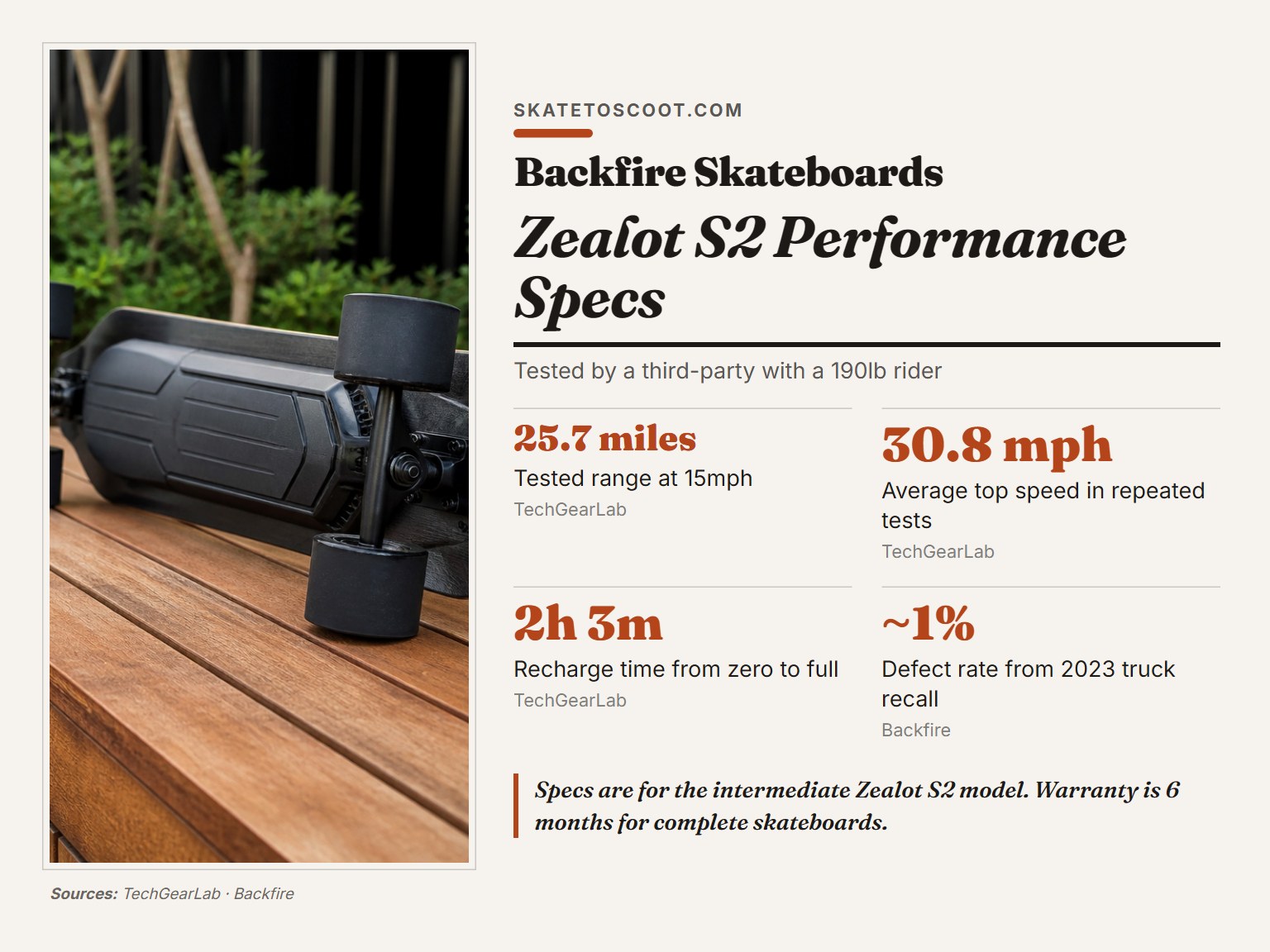
The Backfire Zealot S2 uses two 875-watt belt-driven motors and a 403Wh Samsung 40T battery pack. In instrumented testing, it achieved 25.7 miles of range at 15 mph and recharged in 2 hours 3 minutes. Its average top speed was 30.8 mph.
That performance comes with a physical reality new riders often miss. The brakes, however, can be dialed down to a smooth, beginner-friendly gentleness. The board’s power is something you can adapt to over time.
Hub Motors vs. Belt Drive: The Backfire Choice
Your ride feel and maintenance routine are decided here. Backfire uses both systems, and they serve different riders.
Hub motors are built into the rear wheels. Models like the G3, G2 Black, and the all-terrain Ranger X2 use them. The ride is quieter, you mostly hear wheel noise, and there’s no external drivetrain to maintain. The trade-off is that replacing the urethane sleeve on the motor is a specific task, and you generally have less raw torque for hill climbing than a comparable belt system. The Backfire electric skateboard lineup is built on this reliable, simple tech.
Belt-drive motors, used on the Zealot series, are separate from the wheel. They use a polyurethane belt to transfer power. This design also makes swapping wheels for different sizes or compounds straightforward. The cost is more maintenance, belts wear and need replacement, and a distinct, higher-pitched whirring sound under acceleration.
| Motor Type | Best For | Key Trade-Off |
|---|---|---|
| Hub Motors (G3, Ranger) | Commuters, riders wanting low noise & minimal maintenance | Less torque for steep hills; motorized wheel replacement is more involved |
| Belt Drive (Zealot S2, X) | Riders seeking max torque, hill climbing, and easy wheel customization | Belts wear and need replacing; system is louder and has more moving parts |
The choice isn’t about which is better, but which problem you want. If you ride city streets and want a set-it-and-forget-it experience, a hub motor board like the Backfire G3 is the default. If you face big hills, want to fine-tune your ride with different wheels, or just enjoy the visceral feel of a direct drivetrain, the belt-driven Zealot S2 is worth the extra attention.
Build Quality, Design, and Where It’s Been Tested
Backfire’s design language is consistent. You get a clean, minimalist deck that often lights up with purple LED strips on the higher-end models. The decks are typically a maple composite, with carbon fiber offered on premium versions like the G3 Plus. It’s a look that doesn’t scream “gadget,” which many riders prefer.
The build quality is generally good for the price segment, but the real test comes from the field, not the factory. Backfire has had to publicly address two specific component failures, which ironically bolsters their credibility.
In April 2021, Backfire issued a “massive quality concern” notice for Zealot S truck baseplates after six reported failures. Production halted, and free replacements were shipped. Later, in 2023, a recall was issued for certain Zealot S2 rear truck hangers after the supplier’s manufacturing process flaw was caught. Backfire stated the defect rate from warranty claims was “around 1%.”
Where this goes sideways: Ignoring a recall notice. If your board’s serial number matches an affected batch (like E1058139-8238 for the 2023 Zealot S2 recall), the replacement part is free. Riding on a known-defective truck hanger is how a small crack turns into a sudden, dangerous failure mid-ride.
These aren’t hidden scandals; they’re published service bulletins on Backfire’s official blog. A company that documents its flaws and fixes them is often more trustworthy long-term than one that never admits a problem. It’s a point often missed in a standard electric skateboard review.
Real-World Range vs. Advertised (It Depends on You)
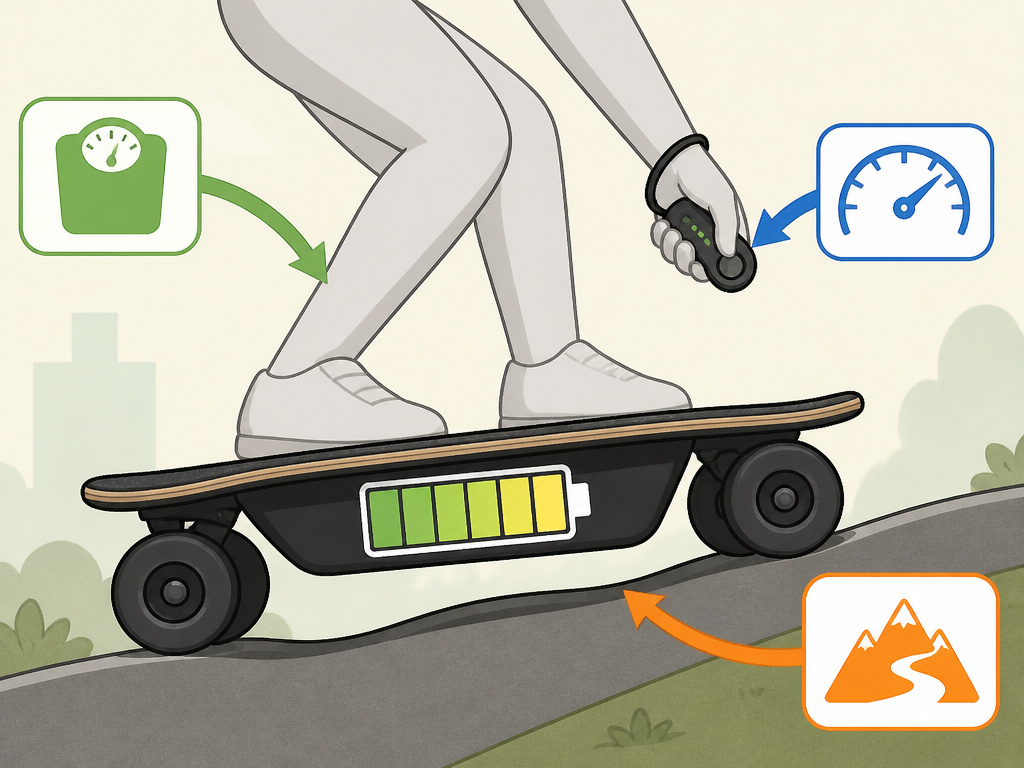
The Zealot S2’s tested 25.7-mile range is a great data point, but it’s a best-case scenario: 190-pound rider, 15 mph constant speed, flat ground. Your mileage will literally vary.
The biggest factors are your weight, riding style, and terrain. A lighter rider on eco mode on a bike path will exceed that number. A heavier rider using sport mode on hilly streets might see 15-18 miles. Backfire’s own FAQ states the battery is rated for 500 deep cycles, and after 300-500 full cycles, capacity drops to approximately 70%. That’s the long-term cost: after a year or two of daily use, your 25-mile range board becomes an 18-mile range board.
For storage, Backfire gives specific, firm advice: if the board won’t be used for over two months, charge the battery to 50%-60% and charge it once a month. Letting a lithium battery sit completely empty for months is a sure way to kill it permanently.
Water Resistance, Warranty, and Real Ownership Costs
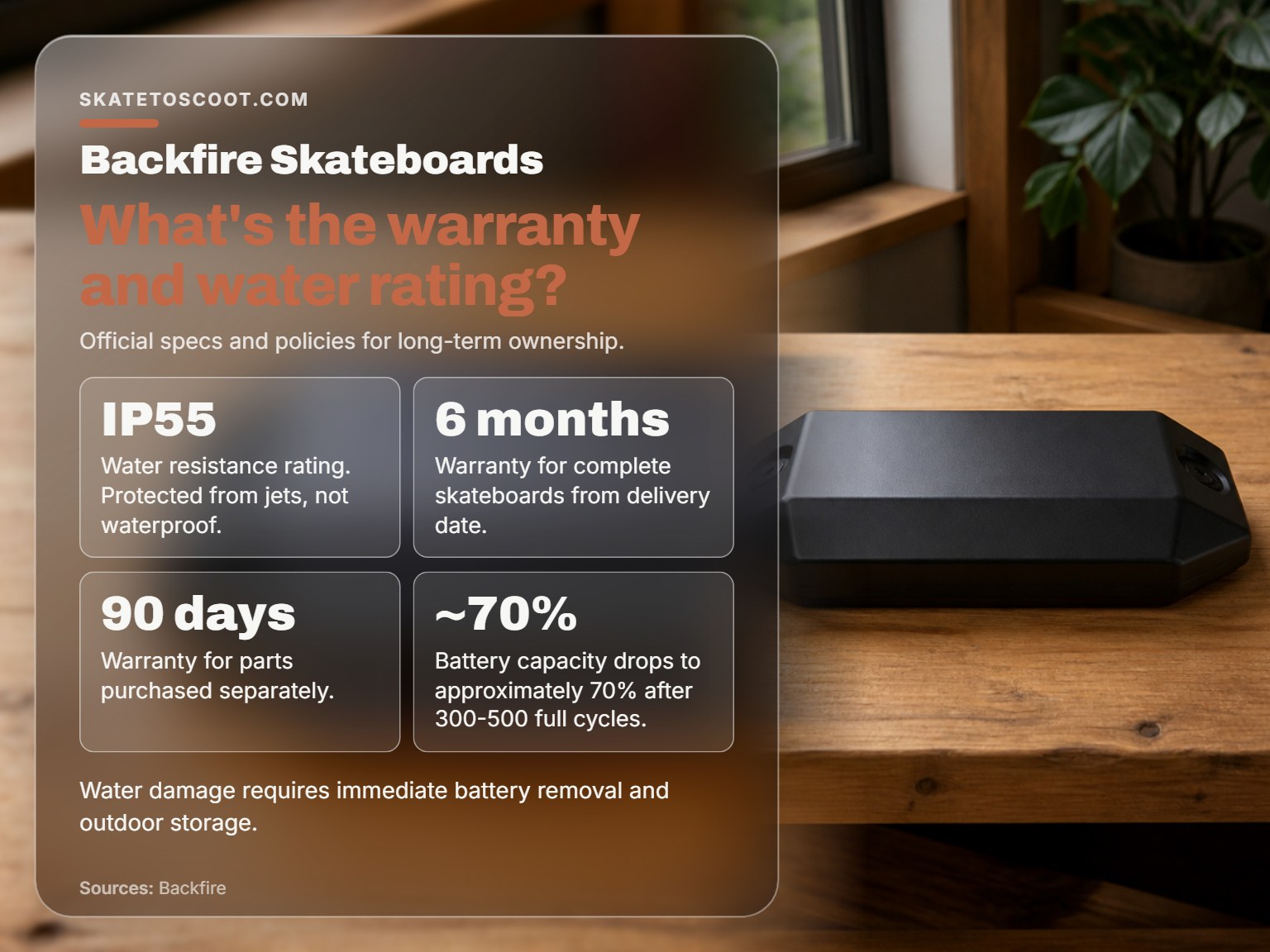
Backfire rates its boards at IP55. This means they’re protected against low-pressure water jets from any direction, but they are not waterproof. You can ride on damp pavement or through a puddle, but don’t ride in heavy rain or through deep standing water.
Speaking of warranty, here’s the breakdown straight from the policy:
- Complete skateboards: 6 months (180 days) from delivery.
- Parts purchased separately: 90 days.
- Coverage is voided by unauthorized modifications, using non-Backfire parts, or buying from an unauthorized reseller.
The part nobody mentions: The water damage protocol. If you suspect water got inside, Backfire’s policy says to remove the battery, check for moisture, do NOT charge or use it, store it outdoors in a fire-resistant place, and do NOT ship it for service. This emergency procedure overrides standard troubleshooting.
The real cost of ownership isn’t just the board’s price. The real cost of ownership includes future replacement parts like the battery, belts, or hub motor sleeves. Compared to some premium brands, these parts are reasonably priced and often in stock, which matters more two years into ownership than a flashy remote.
Beginner vs. Intermediate: Which Backfire Model Fits?
With over a dozen models, the choice can paralyze a new buyer. The lineup breaks down into clear tiers.
For Beginners: You want a manageable, predictable ride. The Backfire G2 Black or the Backfire Era are common starting points for beginners. These are the boards that belong on any best skateboards for beginners list for electric options.
For Intermediate Riders: You’ve got the basics down and want more speed, range, or comfort. This is where the Backfire G3 (or G3 Plus) and the Zealot S2 sit. The G3 offers a smoother, more refined version of the beginner experience with a customized Hobbywing ESC. The Zealot S2, as we’ve seen, brings belt-drive performance. You’re choosing between refined comfort (G3) and raw capability (Zealot S2).
For Specific Needs: The Backfire Ranger X2 and X5 are all-terrain machines with big, air-filled tires for dirt paths and rough pavement. They’re heavy and specialized, not general-purpose commuters.
If you’re comparing brands, a common backfire skateboard review question is how they stack up against a key competitor like Meepo. Both offer compelling value. Backfire often wins on perceived build quality and customer service accessibility, while Meepo can sometimes edge ahead on pure specs per dollar. It’s worth reading a dedicated Meepo electric skateboard review to see where their models land.
Specific Model Reviews (e.g., Zealot S2, G3, Ranger X2)
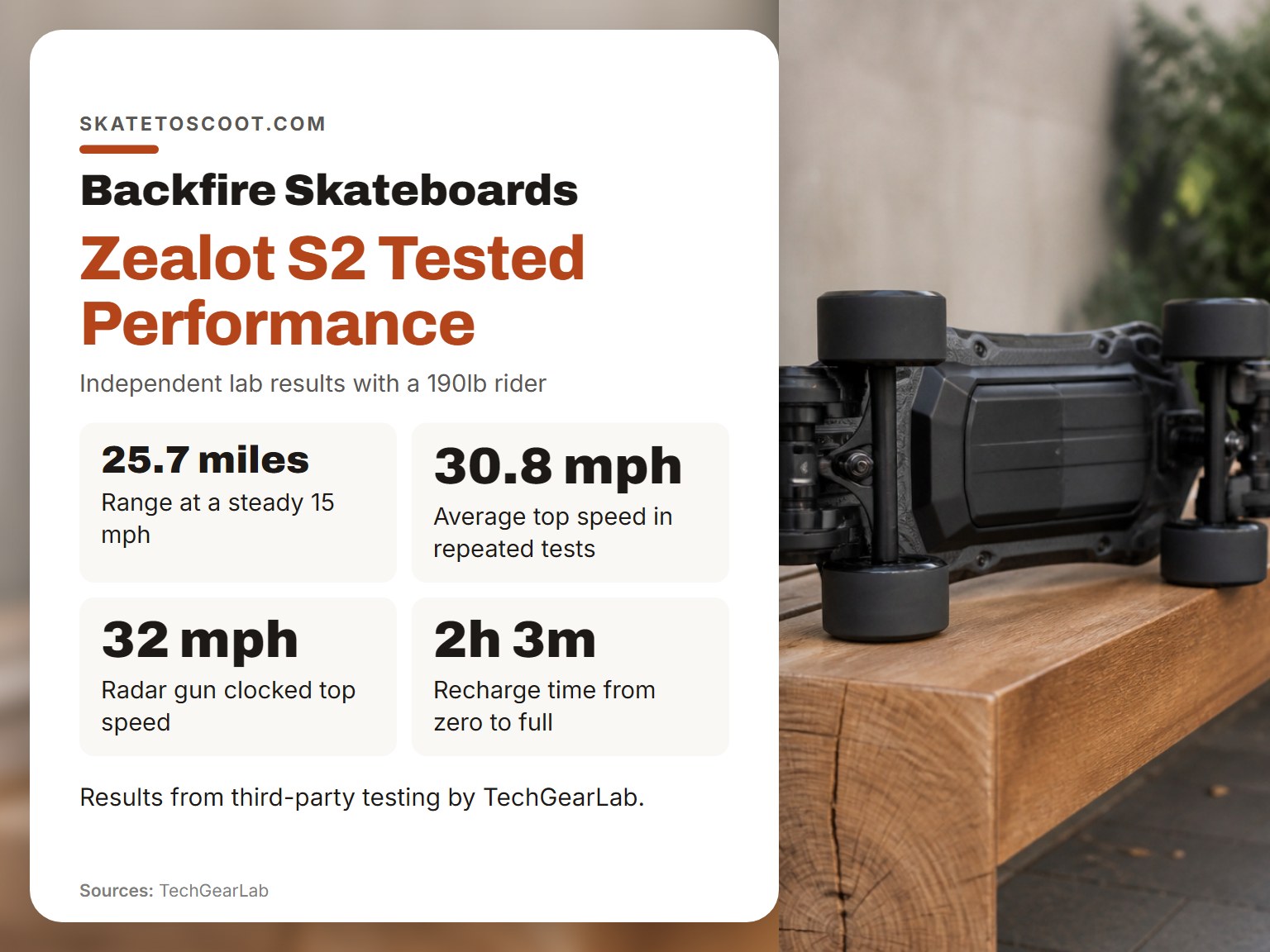
Third-party testing from TechGearLab gives us hard numbers where marketing copy usually lives. With a 190-pound rider, the Zealot S2 delivered 25.7 miles of range cruising at a steady 15 mph. Its average top speed across repeated runs was 30.8 mph, with a radar gun catching it at 32 mph. The board recharged from empty in 2 hours and 3 minutes. Elsewhere, the Backfire G3 uses a customized Hobbywing ESC and was seen hitting 27 mph during a review. The all-terrain Ranger X2 has a turning radius of 2 meters (6.5 feet).
Remote Control & Features
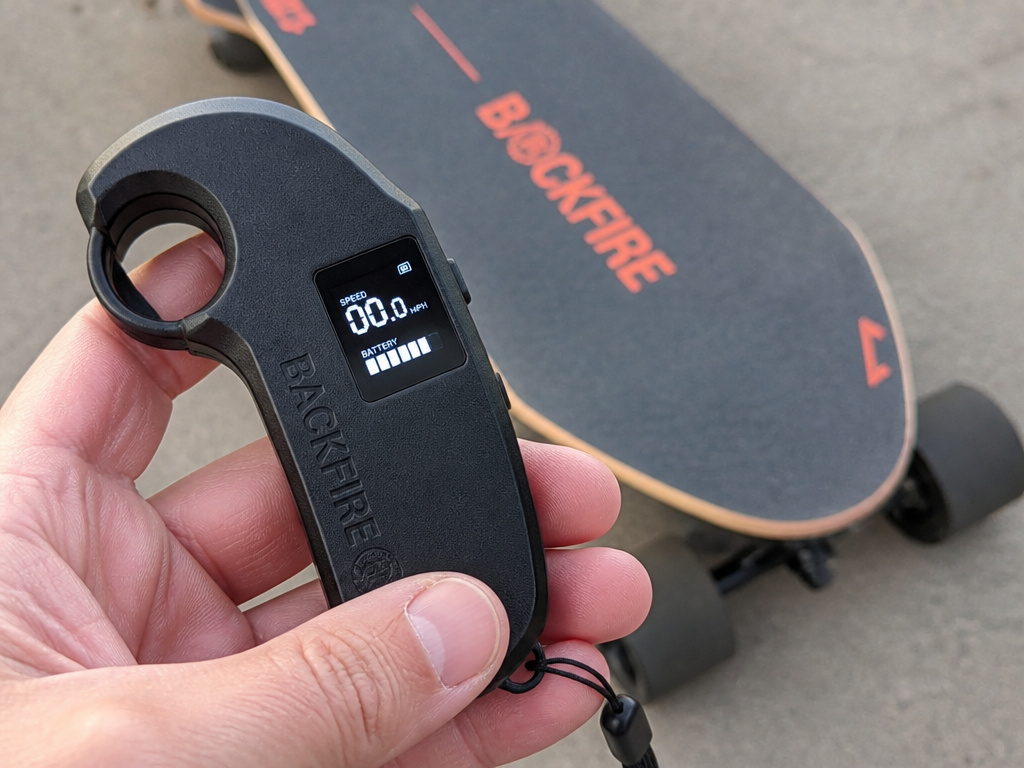
Backfire’s remote is your command center, displaying speed, battery level, and riding mode. The interface is straightforward, letting you switch between acceleration profiles for a smoother start or a more aggressive launch. Practical advice from the manufacturer is key here: always wear protective gear and a helmet. Children under 14 must be supervised. The boards carry a water resistance rating, but you should never charge the battery if the board or remote is wet. Avoid unauthorized modifications, as these will void your warranty immediately.
Customer Service & Support Experience
Backfire offers a six-month warranty on complete boards from the date of receipt, with a shorter warranty for parts purchased separately. This warranty only applies to new boards bought from their official channels. The company has a history of addressing specific component issues, having issued notices for truck baseplates and a recall for rear truck hangers where the defect rate was low. For support, they provide clear emergency procedures, such as what to do if you suspect water has gotten inside the battery. Do not open any cases yourself; contact their tech support first for direction.
Frequently Asked Questions
Are Backfire skateboards good?
Yes, for the price. Backfire boards consistently deliver performance that meets or exceeds their advertised specs, as seen in third-party tests. They offer a balance of speed, range, and build quality, though they have faced specific component recalls that the company addressed publicly.
Is Backfire or Meepo better?
There’s no universal winner. Backfire is often praised for its customer service and refined ride feel, particularly with its Hobbywing ESC. Meepo can offer more raw power and range for the same money. The best choice depends on whether you prioritize a polished experience (Backfire) or maximum specs per dollar (Meepo).
How fast does a Backfire electric skateboard go?
It varies by model. The Zealot S2 has been tested at an average of 30.8 mph. The G3 reached about 27 mph in reviewer testing. Always check third-party tests, as real-world top speed is often 1-3 mph under the marketed number.
Are Backfire boards waterproof?
No. Backfire boards have a water resistance rating of IP55, meaning they can handle light spray and wet roads but are not submersible or rated for heavy rain. Water damage is not covered under warranty.
The Bottom Line
A Backfire skateboard is a solid entry into electric skating, especially if you value a company that documents its mistakes and fixes them. The Zealot S2 is the performance benchmark, the G3 is the comfort pick, and the beginner models are legitimately good first boards.
One rule most reviews skip: if you buy a Backfire, register it and check their official blog for service bulletins. The two truck recalls affected a tiny percentage of boards, but if yours is one of them, the free fix is a click away. That’s the difference between a brand that sells you a product and one that supports the thing you now own.
For most new riders, the path is simple. Start with a hub-motor model like the G2 Black or Era. Learn the basics, see how much you actually ride, and wear your protective gear. The speed and thrill of the Zealot will still be there in a year if you want it.
