Burton Custom Snowboard Review: Who Should Buy It?
This post contains affiliate links. As an Amazon Associate, we earn from qualifying purchases.
The Burton Custom Camber is a versatile, high-performing all-mountain snowboard that excels on groomers and in the air, but demands more effort in powder and on hardpack. With a traditional camber profile, a medium-stiff flex, and Burton’s premium tech like the Super Fly II 700G core and Frostbite edges, it scored an impressive 89.8/100 in Snowboarding Profiles’ testing, ranking 3rd out of 30 all-mountain boards. It’s best suited for solid intermediate to expert riders who prioritize pop, carving, and a lively, aggressive feel over effortless float or maximum edge grip.
That score—89.8 out of 100—isn’t just a number. It’s a quantified verdict from a detailed, weighted scoring system that pits the Custom against its direct competitors, as often detailed in a Burton Custom snowboard review. When the average score for 30 all-mountain boards was 85.1, the Custom’s near-90 puts it in the top tier. But a high score doesn’t mean it’s perfect for everyone. The breakdown reveals where it shines and where you’ll be working harder.
What follows is a breakdown of that score, the technology behind it, and the real-world trade-offs you make when you choose this iconic board. This review examines its standout carving and jump performance, its debated edge hold, the powder workaround, and the critical difference between this and the stiffer Burton Custom X. By the end, you’ll know if the Custom’s legendary status is earned or just legacy.
Key Takeaways
- The Burton Custom Camber scored 89.8/100 in Snowboarding Profiles’ testing, ranking 3rd out of 30 all-mountain boards, but its performance is highly terrain-specific.
- For optimal performance, match your size carefully: the 162cm model recommends a rider weight of 180-260+ lbs, a huge range that can force a compromise.
- Its traditional camber with 11mm of arch delivers explosive pop and precise carving, but requires active riding and good technique to avoid catching edges.
- In powder, it scored just 2.5/5; you’ll need to set your bindings back from the default 12.5mm stance setback to improve float, or accept a leg burn.
- The board’s edge hold on hard snow is a point of contention among reviewers, with some finding Frostbite edges lacking compared to modern competitors.
The 89.8/100 Score and What It Means
We’ll examine this step by step. Snowboarding Profiles’ 89.8 score is a weighted total from 11 performance categories. Looking at the breakdown tells you exactly what this board is built for.
The Custom aced Jumps (4.5/5). These numbers paint a picture of a responsive, stable, and agile deck for aggressive all-mountain riding. It’s a turning machine that loves to get airborne. Where the number drops is telling: Powder (2.5/5) and Rails (3/5). This board is a groomer and side-hit weapon, not designed as a deep pow slayer or a jib specialist.
The Burton Custom Camber 156cm model features a Traditional Camber profile with 11mm of arch, a 252mm Waist Width, a 1195mm Effective Edge, and a 7.8m Sidecut Radius. Its Directional Twin shape has a 12.5mm (0.5″) stance setback and uses Burton’s Channel mount system.
This technical snapshot explains the performance. The 11mm of camber is substantial, storing energy for that top-tier pop. The 7.8m sidecut radius is versatile, allowing for both quick turns and longer, laid-out carves. The 12.5mm setback is minimal—enough to feel a hint of directionality but not enough to transform the board in powder. That’s the spec sheet reality behind the high score.
| Performance Factor | Rating (/5) | Weighting | Weighted Score |
|---|---|---|---|
| Jumps | 4.5 | 10 | 9/10 |
| Carving | 4 | 10 | 8/10 |
| Turns | 4 | 10 | 8/10 |
| Powder | 2.5 | 15 | 7.5/15 |
| Rails | 3 | 5 | 3/5 |
The table makes the trade-off crystal clear. You’re buying a board that dominates in four key areas but makes concessions in others. If your home mountain is a park with groomer laps, this weighting is perfect. If it’s a deep snow destination, that 2.5 for powder should give you serious pause.
Breaking Down the Custom’s “Do-It-All” Claim
Burton markets the Custom as the versatile, iconic all-mountain board. The one-board quiver. Some reviewers agree, with caveats. Others call that claim outdated. We’ll examine where it holds up and where it stretches the truth.
Snowboarding Profiles says it “would make a great one-board-quiver for those who don’t see a lot of deep powder or feel like they are willing to make that extra effort on powder days.” That’s a qualified yes. Sources disagree on its suitability as a one-board quiver: The Good Ride review says it is not the one-board quiver it used to be, while a Burton Custom snowboard review from Snowboarding Profiles says it would make a great one-board-quiver for those who don’t see a lot of deep powder or are willing to make extra effort.
One point often overlooked is that a true “do-it-all” board in 2025 often has some rocker in the nose for better float and more aggressive edge tech for hard snow. The Custom’s pure camber and traditional sidecut mean it excels in a specific, aggressive style. It can do everything, but it won’t do everything easily. For charging, carving, and hitting jumps, it’s phenomenal. For surfing deep snow or lazy cruising, it’s not the tool for the job.
Where this goes sideways: Choosing the Custom as your only board for a deep-snow resort like Jackson Hole or Whistler. You’ll spend powder days fighting for float and wishing you had a more dedicated powder shape by lunchtime.
This discrepancy is the heart of the board’s identity. It’s not a jack-of-all-trades; it’s a master of a specific, energetic, on-piste style. Trusting the process with this board means playing to its strengths, not hoping it’ll cover its weaknesses.
Where the Custom Falls Short (Powder and Edge Hold)
Two performance aspects generate the most debate: float in deep snow and grip on icy hardpack. Both are worth examining closely because they’re where you’ll feel the board’s limits.
Powder Performance: The 2.5/5 Reality
The weighted score of 2.5/5 for powder isn’t a guess. It reflects a real physical shortcoming. The Directional Twin shape has only a 12.5mm stance setback. That’s half an inch. In practice, that’s not enough to naturally lift the nose in deep snow like a true directional powder board would. Riders report needing to lean back, manually, to keep the nose up, leading to what Snowboarding Profiles politely calls “that back leg burn.”
Owners who love it in powder have a workaround. One rider on a 162W reported it “floated amazingly well in up to 20 inches of pow…with no additional stance set back.” But this is the exception, and it likely comes down to their size and riding style. The rule is: if you see regular deep days, plan to set your bindings back further than the default inserts, or choose a different board from the list of best all-mountain freeride snowboards.
The Edge Hold Debate
This is a fascinating split. Burton’s Frostbite Edges are a 1/2mm extension meant to grip in variable snow. Burton says they “hold when the snow turns sketchy.” Sources disagree on its edge hold performance: The Good Ride review finds its grip lacking compared to other boards, while a Burton Custom snowboard review from Burton claims its Frostbite Edges “hold when the snow turns sketchy.”
I’ve seen this common mistake a hundred times: a rider blames their technique when it’s actually their gear holding them back on firm days. The consensus from critical reviewers is that while the Custom holds an edge, it’s not class-leading on bulletproof ice. If you ride mostly in the Northeast or on early-morning firm corduroy, boards with more pronounced edge tech (like magnetraction or serrated edges) might inspire more confidence. For most other conditions, the Custom’s edge hold is perfectly adequate, but it’s not its superpower.
Sizing the Custom: It’s About Weight, Not Height
The most practical mistake you can make is sizing this board by height. The spec sheet doesn’t care how tall you are. It cares how much you weigh and what size your boots are.
The sizing chart reveals a potential issue. The jumps between recommended weight ranges are significant. Look at the 150cm vs. The 162cm: * 150cm: 120-180 lbs * 162cm: 180-260+ lbs
That’s a huge gap. If you weigh 175 lbs, you’re in a no-man’s land. Size down to the 156cm, and you’re at the top of its range, which might make the board feel a bit soft and squirrely at speed. Size up to the 162cm, and you’re at the very bottom, which could make the board feel like a tank, requiring more effort to maneuver. This is where the Custom can feel “cumbersome,” as one Reddit rider put it about their oversized 166W.
| Length (cm) | Waist Width (mm) | Rec Rider Weight (lbs) | Best For |
|---|---|---|---|
| 156 | 252 | 150-200 | Standard boot sizes (US 8-10), agile riding |
| 162 | N/A | 180-260+ | Heavier riders, bigger boots (US 10.5+), high-speed stability |
Boot Size Matters More Than You Think
A 252mm waist on the 156cm is on the narrower side. If you have a US size 10.5 boot or larger, you risk toe and heel drag on deep carves. This is where the Wide (W) versions come in. Wide (W) versions provide more space for bigger boots without having to jump up to a much longer length. Always choose based on your weight first, then your boot size to select standard or wide. Don’t just grab your height and run with it.
Custom vs. Custom X: Choosing Your Weapon
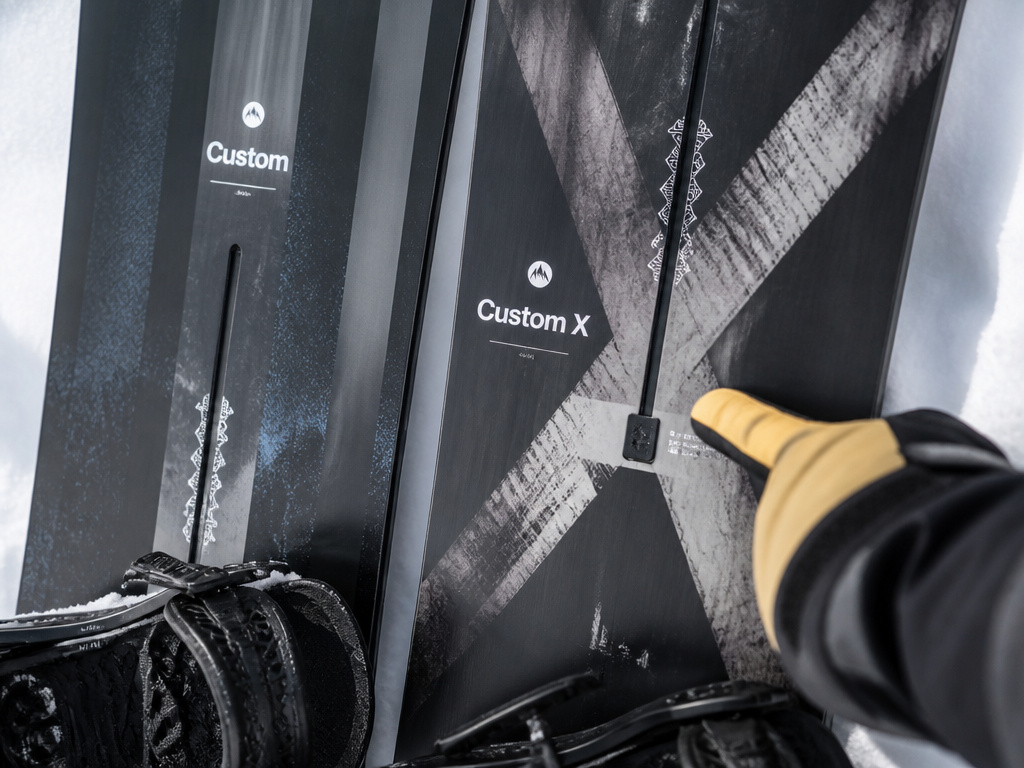
The names are confusingly similar, but the rides are distinct. Understanding the difference will save you from buying the wrong tool for your job.
The Burton Custom X is the harder-charging, stiffer sibling. It uses a lighter Dragonfly 600G core and more carbon for what Burton calls “the ultimate in lightweight responsiveness.” It’s rated a 9/10 for all-mountain by Burton, but it’s universally described as a board for experts who want maximum power and precision. The Manual’s reviewer called it “the perfect snowboard,” but cautioned it’s “not a snowboard for beginners.” Reddit consensus is stark: “If you need to ask, get custom. If you know what you are after, get custom X.”
Common mistake: Buying the Custom X because it’s the “pro model” or “higher performance.” If you’re not riding aggressively 90% of the time, its stiffness will feel punishing and limit your fun. It’s a specialized tool.
Here’s a quick comparison:
| Feature | Burton Custom Camber | Burton Custom X |
|---|---|---|
| Core | Super Fly II 700G | Dragonfly 600G |
| Flex | Medium bordering on mid-stiff (6.5/10) | Stiff & Aggressive |
| Best For | Aggressive all-mountain, daily driver | Expert charging, competition-level carving |
| Powder (Burton Rating) | N/A | 7/10 |
| Key Trait | Versatile, energetic, accessible performance | Maximum power, precision, and high-speed stability |
For most advanced-intermediate to expert riders looking for a daily driver that can still rip, the Custom Camber is the smarter, more forgiving choice. The Custom X is for the rider whose default mode is “charge.” If you’re still exploring the rest of the Burton snowboard lineup, the regular Custom is almost always the better place to start.
Who Should (and Shouldn’t) Buy the Burton Custom
Here is some straight talk. The Burton Custom Camber isn’t for everyone, and that’s okay. Its high score reflects excellence within its designed purpose.
Buy the Burton Custom Camber if:
- You’re a solid intermediate to expert rider with good edge control.
- Your favorite days are spent carving groomers, hitting side hits, and lapping the park’s medium-to-large jumps.
- You value lively pop and a precise, energetic feel over effortless surfing.
- You want a premium, proven board from a top brand and are willing to work a bit in deeper snow.
- You’re looking at other high-performing camber snowboards and want the iconic benchmark.
Avoid the Burton Custom Camber if:
- You’re a beginner or low-intermediate. Its camber and medium-stiff flex will feel catchy and demanding. Look at dedicated beginner Burton snowboards like the Burton Ripcord instead.
- Deep powder performance is your top priority. That 2.5/5 score is a real warning.
- You ride primarily on ice coast hardpack and want the absolute best edge hold. Other boards specialize in this.
- You prefer a loose, surfy, buttery feel. The Custom is about precision and energy, not slushy playfulness.
One final, grounded observation: It’s a cosmetic issue, not a performance one, but it’s a small frustration on a board at this price point. Consider it a badge of use.
How does the Burton Custom compare to other boards?
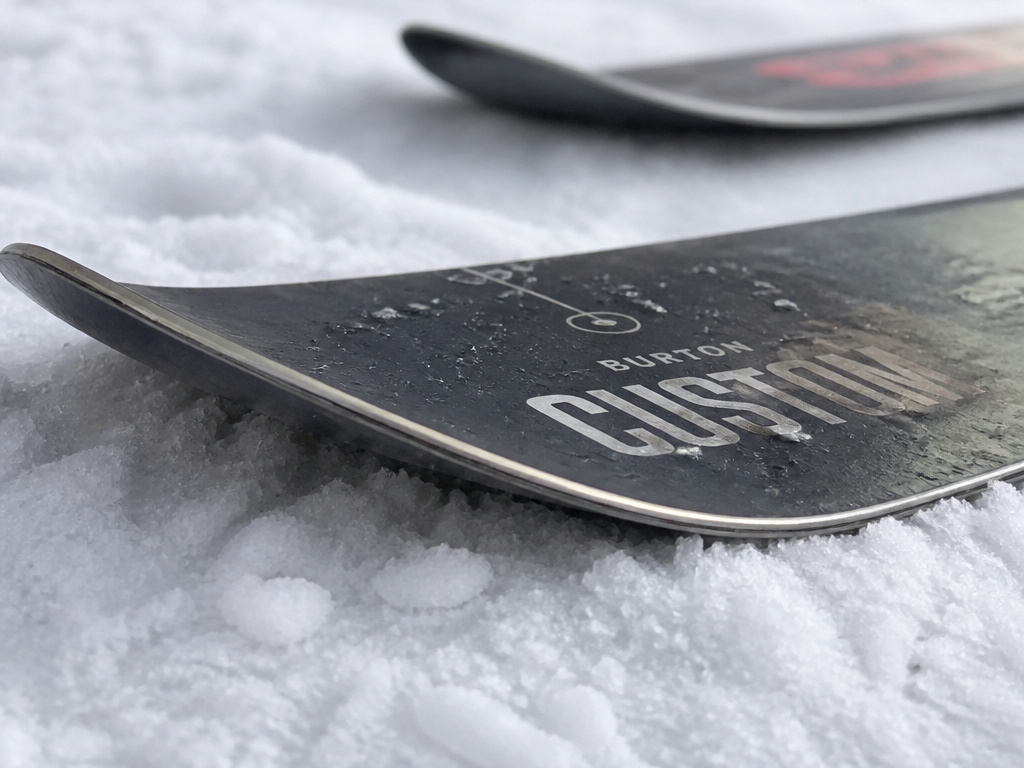
The Burton Custom Camber is a versatile all-mountain board with a medium flex. It sits in a distinct spot compared to its stiffer sibling, the Custom X, which is built for higher speeds and more aggressive riding. While the Custom is designed as a do-it-all option, some reviews note it may lack the extreme edge grip and deep powder float found on other modern all-mountain boards. Its traditional camber and directional twin shape prioritize precise carving and park performance over effortless powder surfing. When comparing boards, consider if you prioritize a balanced, playful feel across the mountain or a more specialized performance in specific conditions like deep snow or ultra-hardpack.
What is the overall rating for the Burton Custom?
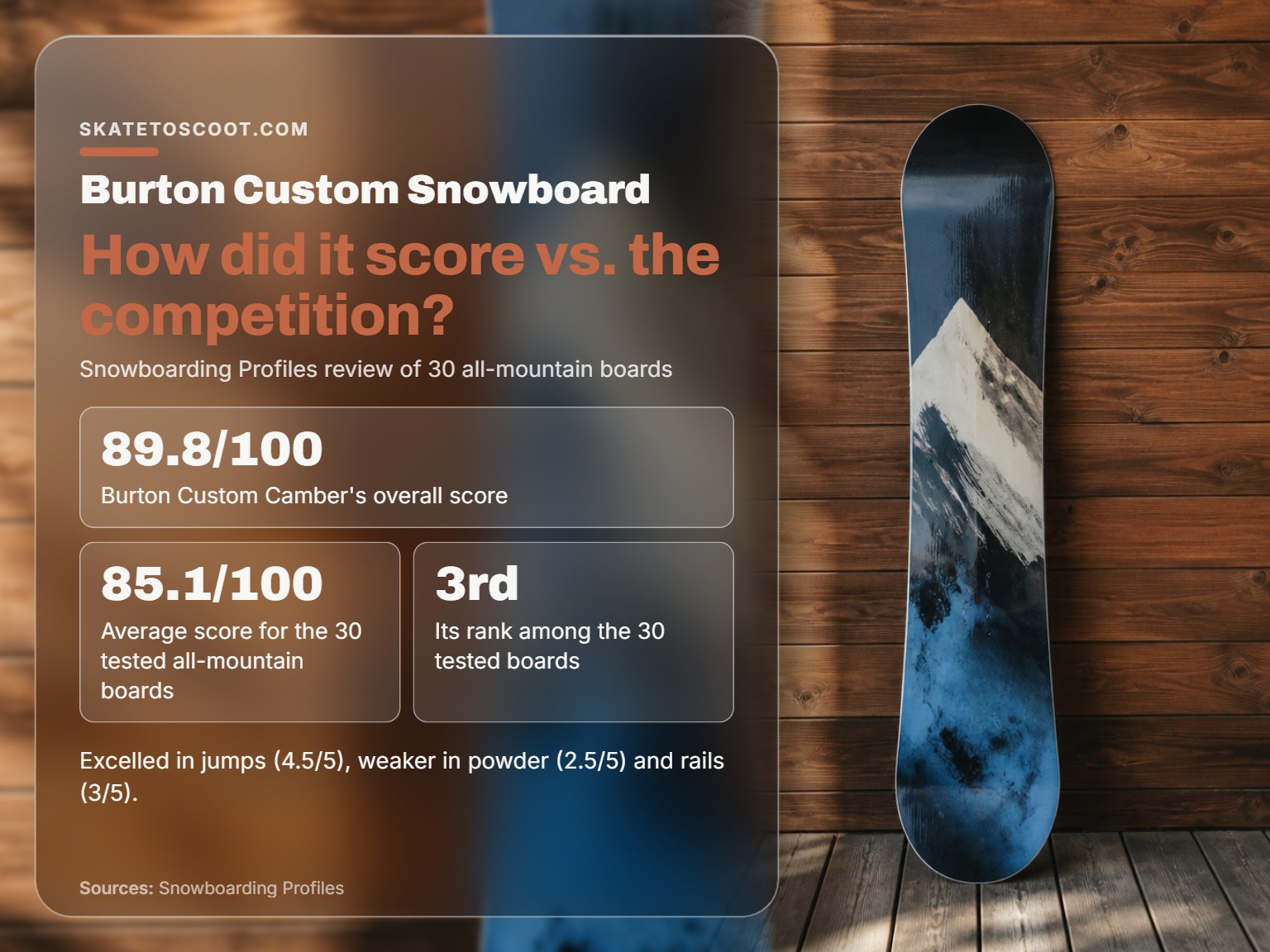
In a recent review that scored 30 all-mountain snowboards, the Burton Custom Camber received a score of 89.8 out of 100. The average score for the group was 85.1, placing the Custom significantly above the middle of the pack. This score ranked it 3rd overall among the tested boards. The score is a weighted composite from multiple performance categories. It excelled in areas like jump performance but scored lower for powder and rail performance. This indicates the board is a high-performing all-mountain tool, particularly for carving and freestyle, but has trade-offs in very deep snow or on jib-specific features.
Frequently Asked Questions
Is the Burton Custom a good snowboard?
Yes, the Burton Custom Camber is a very good snowboard for its intended rider. It scored 89.8/100 in independent testing, ranking 3rd out of 30 all-mountain boards. It excels in carving, jumps, and aggressive all-mountain riding. However, “good” depends on your needs; it’s not ideal for beginners or riders who prioritize deep powder performance.
Is the Burton Custom good for buttering?
It’s acceptable but not great. The traditional camber and medium-stiff flex require more effort to press into butters compared to softer, more flexible park boards. It’s capable, but it won’t feel as loose or playful as a dedicated jib board.
Is the Burton Custom a stiff board?
It has a medium flex rating (4-7/10) but a flex feel on snow that borders on mid-stiff (6.5/10). This means it feels stiffer when riding than its number suggests. It’s responsive and powerful, not overly stiff, but it’s certainly not a soft, forgiving board.
How does the Burton Custom compare to the Flying V version?
The Custom Camber has traditional camber underfoot for maximum pop and edge precision. The Custom Flying V uses Burton’s hybrid rocker-camber-rocker profile, which is more forgiving, easier to turn, and better in powder but sacrifices some pop and carving precision. The Camber is for aggressive riders; the Flying V is often better for intermediate riders or those who want a looser, more versatile feel.
What bindings pair well with the Burton Custom?
The board’s Channel system works with all major bindings. For a responsive, high-performance match that complements the Custom’s aggressive nature, stiffer bindings like the Burton Cartel X or Union Force are excellent choices. Softer bindings can be used to dampen the ride slightly if you want a bit more forgiveness.
The Bottom Line
The Burton Custom Camber earns its legendary status for a specific rider profile. Its near-90 score reflects top-tier performance in carving, jumps, and aggressive all-mountain versatility. You’re buying proven camber energy, premium Burton construction, and a board that rewards good technique.
But you’re also buying its limitations. You must be willing to work for float on powder days, and you should temper expectations for ultimate edge hold on the iciest days. Its sizing requires careful attention to weight and boot size, not height.
For the aggressive intermediate to expert rider who lives for groomer laps, side hits, and park jumps, the Custom remains a benchmark. It’s a thrilling, energetic ride. For those whose priorities lie elsewhere—deep powder, beginner forgiveness, or the very latest edge-tech—there are other boards among the best snowboards that might fit better. The Custom doesn’t try to be everything. It tries to be exceptionally good at what it does best, and by that measure, it overwhelmingly succeeds.
