Burton Custom X Snowboard Review: Is It Worth It?
This post contains affiliate links. As an Amazon Associate, we earn from qualifying purchases.
The Burton Custom X is a stiff, fully cambered directional twin built for aggressive, high-speed carving and big airs. It’s not light or forgiving, demands precise technique, and suits advanced to expert riders who charge hard; beginners and casual intermediates will find it exhausting and intimidating.
That 12.5mm stance setback and traditional camber profile aren’t suggestions. They’re the board’s operating instructions. Ignore them, and you get the heel-edge washout and instability forum users keep reporting. Follow them, and you get a level of precision that makes other boards feel vague, a key point in any Burton Custom X snowboard review.
What follows is a breakdown of where this reputation comes from, what the specs actually mean for your ride, and the one setup mistake that turns a legendary charger into a frustrating sled, based on a typical Burton Custom X snowboard review. We’ll look at the hard data on flex and weight, the real difference between the camber and Flying V models, and who should, and definitely should not, consider adding a Custom X to their quiver.
Key Takeaways
- The Burton Custom X is built around a Dragonfly 600G Core and 45° Carbon Highlights for a stiff, responsive, and powerful ride that excels at high speeds.
- Size for your weight, not your height. The recommended rider weight ranges are strict; going outside them (especially too light) makes the board feel dead or uncontrollable.
- The 12.5mm stance setback is critical for stability. Setting it up as a true twin, as some riders do to facilitate switch riding, can cause heel-edge washout.
- This is an advanced-to-expert board. Most intermediate riders will find it “hard work,” and it is categorically not for beginners.
- The Flying V (hybrid rocker) model is a completely different, more forgiving board with reported durability issues in hard snow, don’t confuse it with the camber version.
Who Is the Burton Custom X Really For?
You don’t choose the Custom X. It chooses you. The board’s personality is so pronounced that it acts as a filter.
It’s for the rider who looks at a groomer and sees a race course, not a sidewalk. The one who would rather lay down a trench so deep it requires a warning sign than do a single butter. It’s for the advanced or expert who has outgrown boards that chatter at speed, who wants a tool that matches their commitment, and who understands that power comes from precision, not just stiffness.
I’d feel comfortable recommending this board to serious intermediate riders who want more performance. The Manual
Not for beginners and even intermediate riders are likely to find it hard work. This is still for advanced to expert riders, IMO. SnowboardingProfiles.com
See the disagreement in a typical Burton Custom X snowboard review? The Manual says ‘I’d feel comfortable recommending this board to serious intermediate riders who want more performance,’ while SnowboardingProfiles.com says ‘Not for beginners and even intermediate riders are likely to find it hard work.’ If you’re an intermediate, a board like the Burton Custom or even the more accessible Burton Ripcord is a smarter progression step. The Custom X rewards aggression you’ve already mastered. It doesn’t teach it to you.
Where this goes sideways: Riders who buy it for the name or the prestige, hoping it will make them a better charger. It won’t. It amplifies the skills you bring to it. Bring hesitation, and it will punish you with catchy, unforgiving camber. Bring power without precision, and that stiff tail will buck you.
Specs & Construction: What “Pro-Caliber” Actually Means
The marketing says “pro-caliber.” The spec sheet tells you how. This isn’t just a stiff board; it’s a specific recipe of materials engineered for one thing: transmitting energy from your legs to the snow with zero loss.
The core is Burton’s Dragonfly 600G Core with Multizone EGD™. Over that sits 45° Carbon Highlights High Voltage fiberglass. The 45-degree bias is key, it provides torsional rigidity for quick edge-to-edge response while allowing some twist for steering, unlike a 0/90 layup that would be a pure death plank.
The base is a Sintered WFO base. It’s harder, more porous, and faster than an extruded base, but it demands regular waxing to maintain that speed. The edges are Frostbite Edges, which are serrated near the contact points to grip on ice. The board uses Burton’s The Channel® mounting system, which is compatible with all major bindings but requires bindings with compatible disc systems.
| Component | Specification | Why It Matters |
|---|---|---|
| Core | Dragonfly 600G with Multizone EGD™ | Lightweight stiffness; EGD reinforces contact points for pop. |
| Fiberglass | 45° Carbon Highlights High Voltage | Responsive, snappy torsional flex without being unforgiving. |
| Base | Sintered WFO | High-speed, durable, but requires frequent waxing. |
| Profile | Traditional Camber | Maximum edge hold, pop, and precision. Demanding. |
| Shape | Directional Twin | Twin feel between feet, longer nose for float. |
| Mounting | The Channel® | Infinite stance width adjustability. |
A note on the 2024 model: Burton made the topsheet thinner to reduce weight.
Flex & Feel: Stiff, But How Stiff?
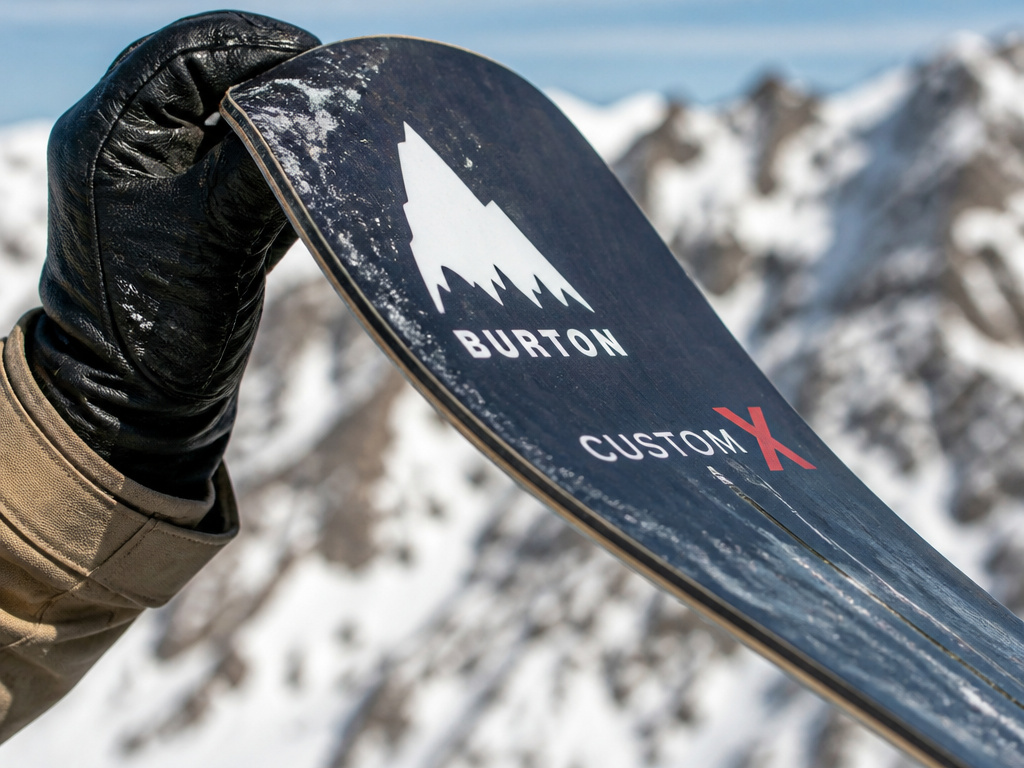
Here’s where reading the spec sheet fails you. Burton lists the flex simply as “Twin.” That’s useless. Real-world testing and retailer standards paint the real picture.
SnowboardingProfiles.com rated its on-snow feel as Stiff (8/10). They note that Burton’s own rating is “Medium-Stiff (6-9/10).” The retail site evo.com standardizes flex ratings across brands: 1-2 is Soft, 3-5 is Medium, 6-8 is Stiff, 9-10 is Very Stiff.
But feel is subjective. Forum users have reported varying perceptions of its flex. Context is everything. If you’re coming from soft, rockered park boards, the Custom X will feel like a 2×4. If you’re used to dedicated freeride planks, it might feel lively and poppy.
The pop debate is even more split. The Manual describes the board as having ‘carbon-fueled snap,’ while a forum user states: ‘The only negative I see with this board its pop. This part was really disappointing… It just doesn’t have nearly the amount of pop I anticipated.’
Performance Breakdown: Carving, Speed, and Park
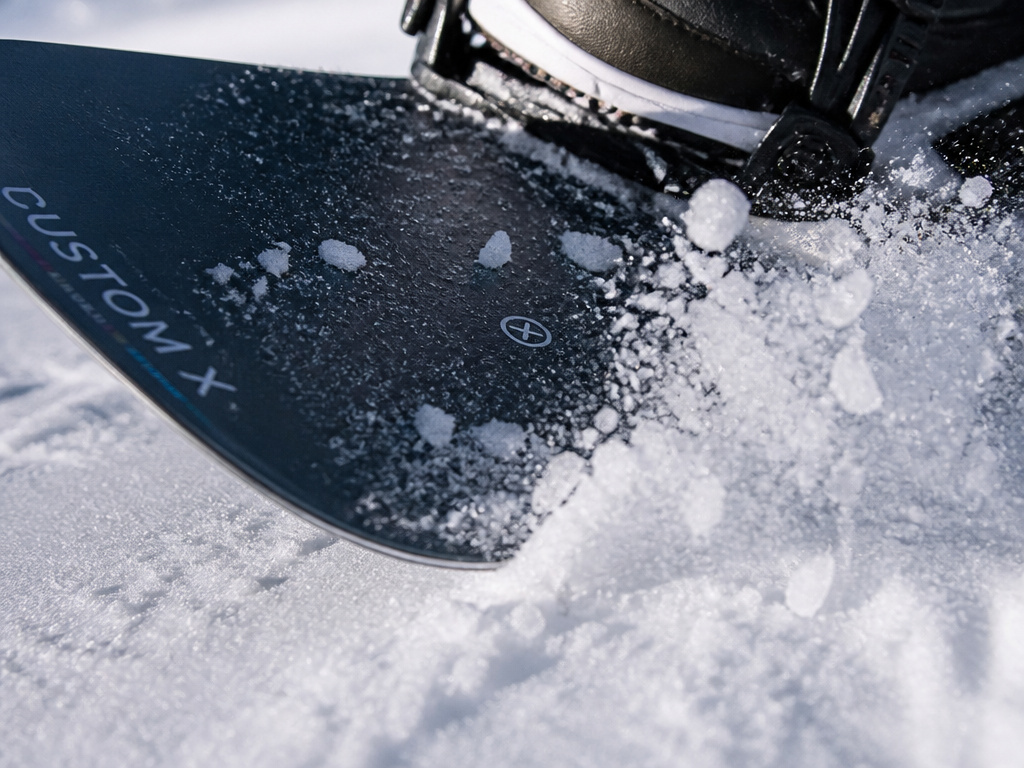
The Custom X has a clear hierarchy of talents. It’s a specialist that can dabble in other areas, not a true jack-of-all-trades.
Carving & High-Speed Stability
This is its masterpiece. The combination of full camber, stiff flex, and Frostbite Edges creates a rail-like connection to the snow. When you commit to a carve, the board holds a line with terrifying stability. It’s the reason the board has its legendary status. You can push against it with everything you have, and it pushes back, holding you firm.
That stability extends to blasting through chop, crud, and variable snow. The board doesn’t chatter or get deflected. It goes where you point it. For pure, adrenaline-fueled groomer ripping, few boards in the all-mountain freeride category match it.
Playfulness & Freestyle
Can you ride switch? Yes. The directional twin shape makes it feasible. Is it ideal? No. The 12.5mm setback means the effective edge is slightly behind you when riding switch, which feels off.
Can you butter? Technically, yes. One reviewer noted success with a front-side, switch tail press. But it requires massive effort, and your foot often lifts off the snow because the balance point is so far out toward the contact points. You buy a camber snowboard like this for power, not for pressing.
It’s incredibly stable for big kickers and the pipe. For jibs and technical rails, its stiffness and catchiness are a liability. A dedicated park board is a better, safer choice.
Powder Performance
The directional twin shape with its longer nose provides some float. But the traditional camber wants to sink the tail, and there’s no taper to lift the nose.
Sizing & Setup: Getting It Wrong Is Easy
This is the most practical section of the review. Mess up your size or stance, and you’ll hate a board you should love.
Sizing Chart & Weight Ranges
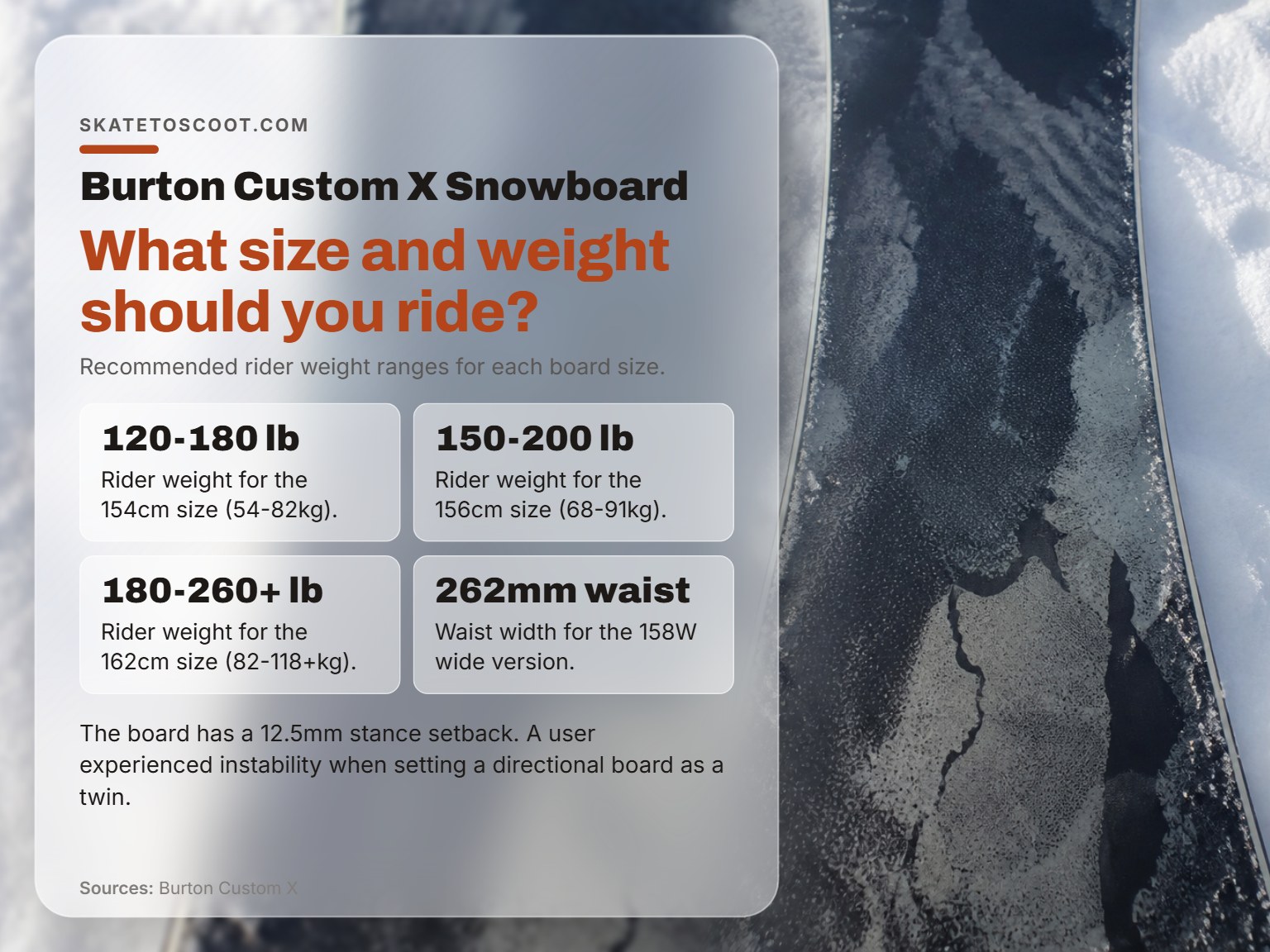
The board is sensitive to rider weight. The recommended weight ranges for each size are strict; don’t eyeball it.
| Length (cm) | Waist Width (mm) | Rec Rider Weight (lb) | Rec Rider Weight (kg) |
|---|---|---|---|
| 154 | 250 | 120-180 | 54-82 |
| 156 | 252 | 150-200 | 68-91 |
| 158W | 262 | 150-200 | 68-91 |
| 162 | 256 | 180-260+ | 82-118+ |
The “W” (Wide) versions exist at 158cm and 162cm, with a 166cm option also available as a wide board. If you have larger boots, you should be looking at the Wide versions to prevent booting out during deep carves. The 158W, for example, has a 262mm waist.
The Critical Stance Setback
The board has a 12.5mm setback stance. This isn’t a suggestion. The sidecut and flex are tuned around this balance point. A forum user who experienced constant heel-edge washout finally guessed: “The only thing I can think of is my set as a possible cause. I have been setting the directional boards as twins. I like to ride switch. Could that be the reason?“
Yes. That is almost certainly the reason. Setting a directional board as a twin shifts your weight forward, away from the designed sweet spot, and can ruin edge hold. If you ride switch 50% of the time, this is the wrong board. If you charge forward 95% of the time and want a stable platform, use the setback.
Binding Compatibility
The Channel® system is “compatible with all major bindings,” but you need bindings that offer a Channel-compatible disc. Most major brands (Union, Rome, Fix, Nidecker) sell these discs separately or include them. Burton’s own EST bindings are designed specifically for The Channel and are the most integrated option. Don’t assume your old bindings will work, check for the correct hardware first.
The Flying V Question: A Different Beast
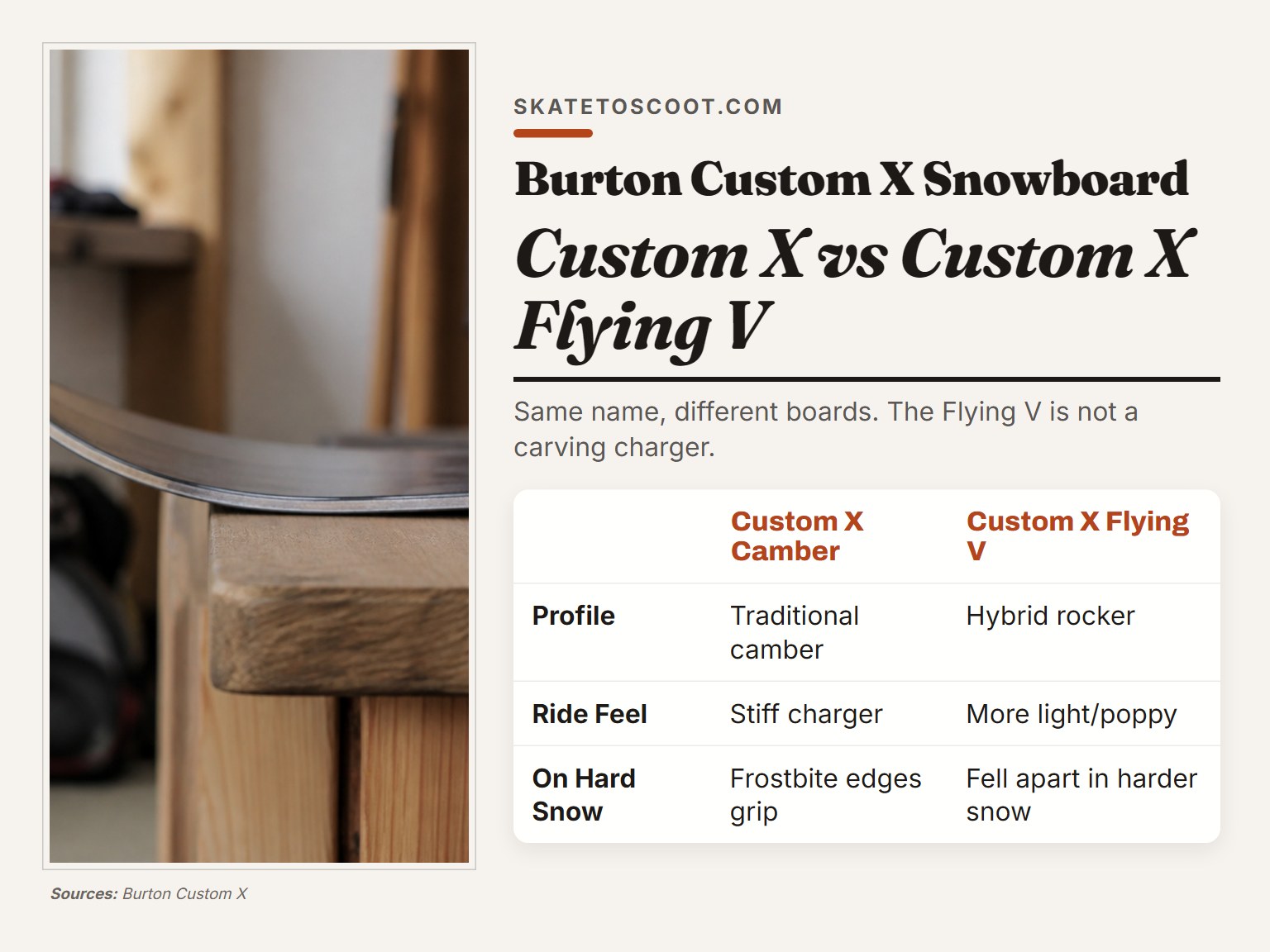
There is a Burton Custom X Flying V. The name is misleading. It’s a different board.
The Flying V is a hybrid rocker (rocker between the feet, camber toward the tip/tail) model. Reviews describe it as “more light/poppy” but also note it “fell apart in harder snow.” The Flying V profile is inherently less grippy and stable on firm snow than traditional camber. It’s designed for a more playful, catch-free ride with better powder float.
Buying the Flying V expecting the legendary carving performance of the Custom X camber is a guaranteed disappointment. They share a name and a target audience in spirit only. If you want a charger, get the camber. If you want a more forgiving all-mountain board with a catchy name, look at the standard Burton Custom or other Flying V boards.
Common Issues & Long-Term Reliability
No board is perfect. The Custom X’s intensity means its failures are memorable.
A dated but notable report: a user of a 2014 Burton Custom X reported “longitudinal cracks in the tip topsheet within a year, leading to separation from the base.” Modern construction may have changed, but it highlights that high-stress boards can have high-stress failures.
The more common issue is rider error: choosing the wrong size, ignoring the stance setback, or lacking the skill to drive the board. These manifest as “the board feels hooky,” “I keep washing out,” or “it’s too much work.” The board comes with a 3-year warranty.
Its weight is another point of contention. The Manual highlights the board’s light core and reduced weight, while a forum user states ‘this is not a light board. Its not heavy either… Its just nothing to write home about.’ Independent testing of a 156cm model put it at 2720 grams, which at 16.79g/cm is lighter than the ~400-board average of 18.64g/cm tested by SnowboardingProfiles.
Custom X vs. The Competition
Where does it sit among other best Burton snowboards and aggressive all-mountain tools?
- Vs. The Burton Custom: The Custom is its more accessible sibling. Softer flex, same general shape. The Custom is a true quiver-of-one for advanced riders; the Custom X is a specialist tool for experts who want to amplify aggression.
- Vs. Other Stiff Chargers (Jones Flagship, Yes. Pick Your Line, Rossignol Krypto): The Custom X distinguishes itself with its directional twin shape and The Channel system. It’s more switch-friendly than a fully directional freeride board but may not have the same float or powder optimization. It’s a matter of prioritizing pure carving versatility vs. Dedicated freeride performance.
Frequently Asked Questions
Is the Burton Custom X worth it?
If you are an advanced or expert rider who lives for high-speed carving, stability in chop, and powerful pop off every lip, yes, it’s worth every penny. It’s a precision instrument. If you’re an intermediate, a casual rider, or someone who spends half their day in the park or off-piste, there are better, more forgiving, and less expensive all-mountain freeride boards that will bring you more joy.
What is the difference between Burton Custom and Custom X?
The Custom X is stiffer, has more carbon in the layup (45° Carbon Highlights vs. Standard fiberglass), and uses a higher-grade sintered base. The Custom is more versatile and forgiving, suited to a wider range of advanced riders. The X is for experts who want to maximize performance in specific conditions.
Is Burton Custom X too stiff?
For its target audience, expert chargers, it is not too stiff; it’s perfectly tuned. For anyone else, yes, it is too stiff. It requires strong legs and refined technique to bend effectively. If you have to ask this question, you are likely not the target rider.
Who is the Burton Custom X for?
It is for the expert-level rider who prioritizes aggressive carving, high-speed stability, and powerful pop above all else. It’s for someone who has mastered board control and wants a tool that matches their intensity, not one that compensates for a lack of it.
Before You Go
The Burton Custom X isn’t a mystery. Its personality is written in camber, carbon, and a 12.5mm setback.
Just remember to size by the weight chart and respect the stance setback.
