Can You Get a DUI on a Scooter? Penalties and How to Fight
This post contains affiliate links. As an Amazon Associate, we earn from qualifying purchases.
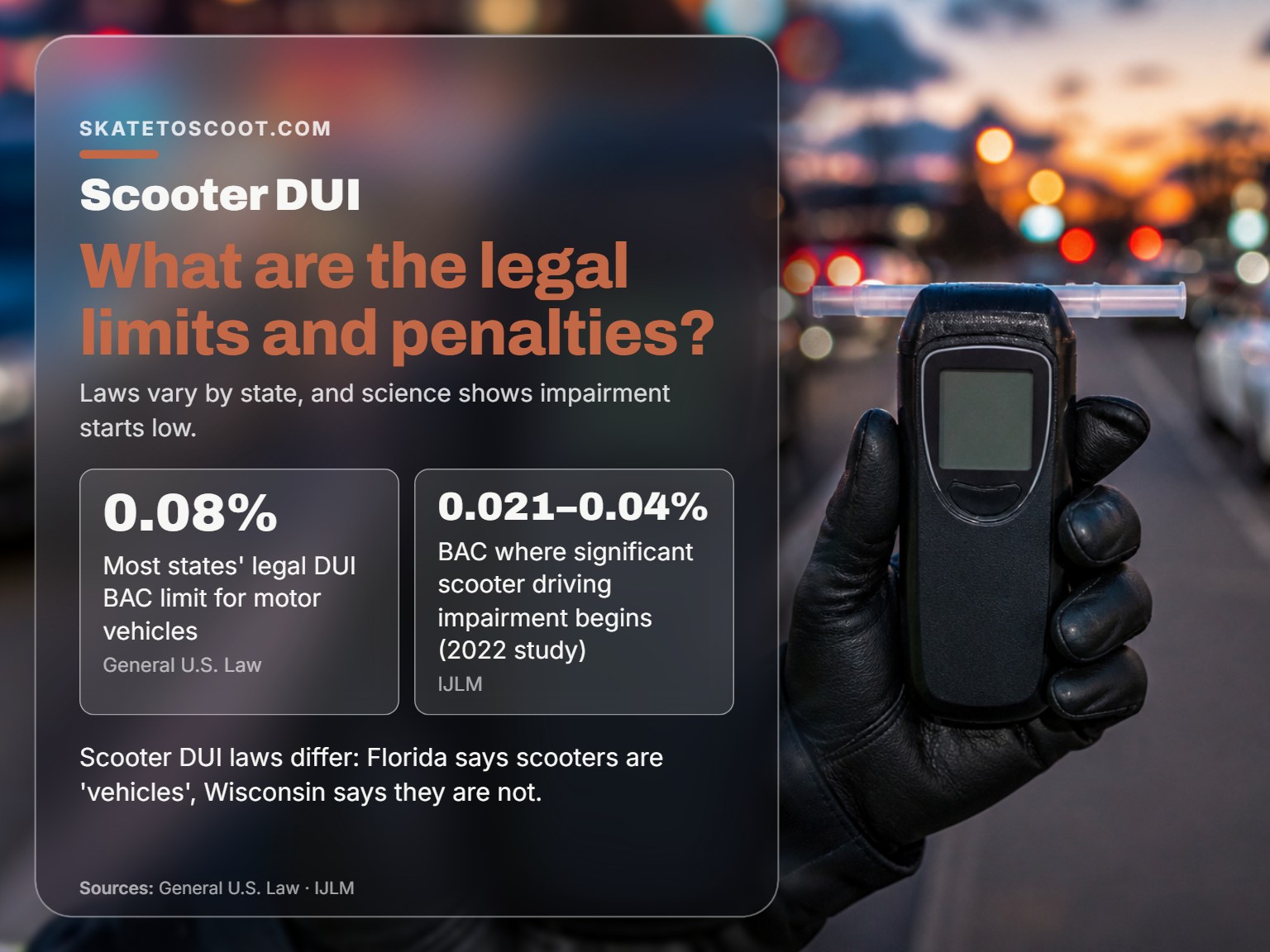
Yes, you can get a DUI on a motorized scooter in most U.S. States. The charge hinges on whether your state’s law defines an electric scooter as a “vehicle” or “motor vehicle.” In states like California, Florida, and Maryland, the definition is broad enough to include scooters, carrying penalties like fines up to $250 in California and jail time. A few states, like Wisconsin, explicitly exclude electric scooters from these definitions, creating a legal loophole.
That definitional patchwork is the entire game behind the can you get a dui on a scooter question. A cop isn’t pulling you over for wobbling a little on a Bird scooter at 10 PM because they hate fun. They’re doing it because the state legislature wrote a statute fifty years ago that says “any device” used for transport counts, and a prosecutor can use that to argue you were in control of a vehicle. The legal risk isn’t about the scooter; it’s about how your local law reads.
What follows: a breakdown of which states treat a scooter like a car for DUI purposes, the specific penalties on the books, what the science says about actual impairment, and the immediate, practical steps to take if those blue lights flash behind you on your ride home.
Key Takeaways
- The core legal question is your state’s definition of “vehicle.” In states with broad definitions (CA, FL, MD), a scooter DUI is enforceable, while in states like Wisconsin, statutes explicitly exclude electric scooters, creating a legal exemption.
- Penalties can mirror standard DUIs in some states, including potential jail time and driver’s license suspension, but specific fines vary by state.
- A 2022 peer-reviewed study found significant driving impairment on e-scooters at BAC levels as low as 0.021%–0.04%, far below the common 0.08% legal limit.
- If stopped, you are not required to perform field sobriety tests, but refusing a breathalyzer can trigger automatic penalties if you hold a driver’s license.
- A scooter DUI conviction can increase your car insurance rates for years and may require you to file an SR-22 form as a high-risk driver.
The State-by-State Patchwork (and the Wisconsin Exception)
The law doesn’t see a scooter. It sees words on a page written long before the Lime app existed. Your liability turns entirely on whether your state’s DUI statute uses the term “motor vehicle” or the more expansive “vehicle.”
In states like California, the law is unambiguous. California vehicle code section 21221.5 makes it unlawful to operate a motorized scooter on a highway while under the influence, with a conviction punishable by a fine of not more than $250. Florida law, via a 2003 Attorney General opinion, states motorized scooters are not exempt from the definition of “vehicle,” making a DUI on a skateboard or scooter possible under Florida Statute 316.193. Maryland’s Transportation Code §11-176 defines a vehicle as “any device in, on, or by which any individual or property is or might be transported,” a net wide enough to catch e-scooters.
Then there’s Wisconsin. Wisconsin Statutes §340.01(35) and (74) explicitly exclude electric scooters from the definitions of both “vehicle” and “motor vehicle.” This creates a genuine exemption. If you’re riding a scooter impaired in Milwaukee, you might catch a public intoxication charge, but the specific DUI statute likely doesn’t apply.
Where this goes sideways: Assuming “vehicle” means only cars and trucks. In legal terms, a “device” for transport can be interpreted to include a motorized scooter, a hoverboard DUI, or even a riding lawn mower, depending on the statute’s wording and judicial interpretation.
This patchwork means you must know your local law when you consider can you get a dui on a scooter. Relying on a friend’s experience in another state is a direct path to a courtroom.
| State | Statute / Authority | Classification for DUI | Key Takeaway |
|---|---|---|---|
| California | Vehicle Code §21221.5 | Motorized Scooter | Explicitly prohibited; fine up to $250. |
| Florida | Attorney General Opinion 2003-44 | Vehicle | Broad “any device” definition includes scooters. |
| Maryland | Transportation Code §11-176 | Vehicle | “Any device” language creates DUI liability. |
| Wisconsin | Statutes §340.01(35) & (74) | NOT a Vehicle/Motor Vehicle | Explicit exclusion creates a legal loophole. |
Motorized vs. Non-Motorized: Where the Law Draws the Line
This is the bright line that changes everything. The presence of a motor is the switch that flips a device from a simple conveyance into a potential “motor vehicle” under the law.
Devices propelled solely by human power—a kick scooter, a standard bicycle, rollerblade DUI scenarios—typically fall outside “motor vehicle” DUI statutes. You could still be charged with public intoxication or reckless endangerment if you’re causing a hazard, but the specific, severe penalties of a DUI (license suspension, mandatory ignition interlock) usually don’t apply. The legal theory is that the operator is the engine.
Add a motor, and the analysis shifts. An electric scooter, an e-bike using its throttle, a moped—these are now self-propelled. They fit into the “motor vehicle” category in states that use that term. This is why the motor vehicle classification question is the first one a defense attorney examines. If the device can be excluded from that classification, the DUI charge may not stick.
The rental scooter loophole deserves a frank discussion. Many riders assume that because they don’t own the scooter and aren’t a “driver” in the traditional sense, the rules are different. They aren’t. The law cares about who is in control of the vehicle, not who holds the title. If you’re weaving a rental scooter, you are operating a motorized device. The rental agreement you clicked through likely has a clause prohibiting impaired operation, but the police aren’t enforcing Bird’s terms of service—they’re enforcing state law.
Penalties: It’s Not Just a Slap on the Wrist
The consequences of a scooter DUI conviction are, in most states, virtually identical to those for a car DUI. This is the part that shocks most people. You weren’t driving a two-ton vehicle, so why would you face the same penalties? Because the statute doesn’t distinguish between types of vehicles; it only defines the offense.
Take Maryland’s penalties as a concrete example. In Maryland, for a first-time DUI (BAC of 0.08% or higher), the penalties include up to one year in jail and a maximum fine of $1,000. For a DWI (BAC between 0.07% and 0.08%), penalties include up to 60 days in jail and a $500 fine. For the lesser charge of DWI (BAC between 0.07% and 0.08%), penalties are still severe: up to 60 days in jail and a $500 fine.
These penalties attach to you, the driver, not the vehicle. That means:
- License Suspension: Your driving privileges for a car can be suspended, even though you were on a scooter.
- Ignition Interlock Device (IID): You may be required to install an IID in your personal car as a condition of getting your license back.
- Criminal Record: A DUI is a misdemeanor criminal offense that will appear on background checks.
- Insurance Hikes: Your auto insurance rates will increase significantly as you are now classified as a high-risk driver. You may also need to file an SR-22 certificate, a form proving you carry high-risk insurance.
A conviction of a violation of this section shall be punished by a fine of not more than two hundred fifty dollars ($250).
The financial hit extends far beyond the court fine. The combined cost of fines, legal fees, IID installation and monitoring, high-risk insurance premiums, and missed work can be substantial. Calling it a “scooter ticket” massively undersells the stakes.
The Science of Impairment: You’re Worse Off Than You Think
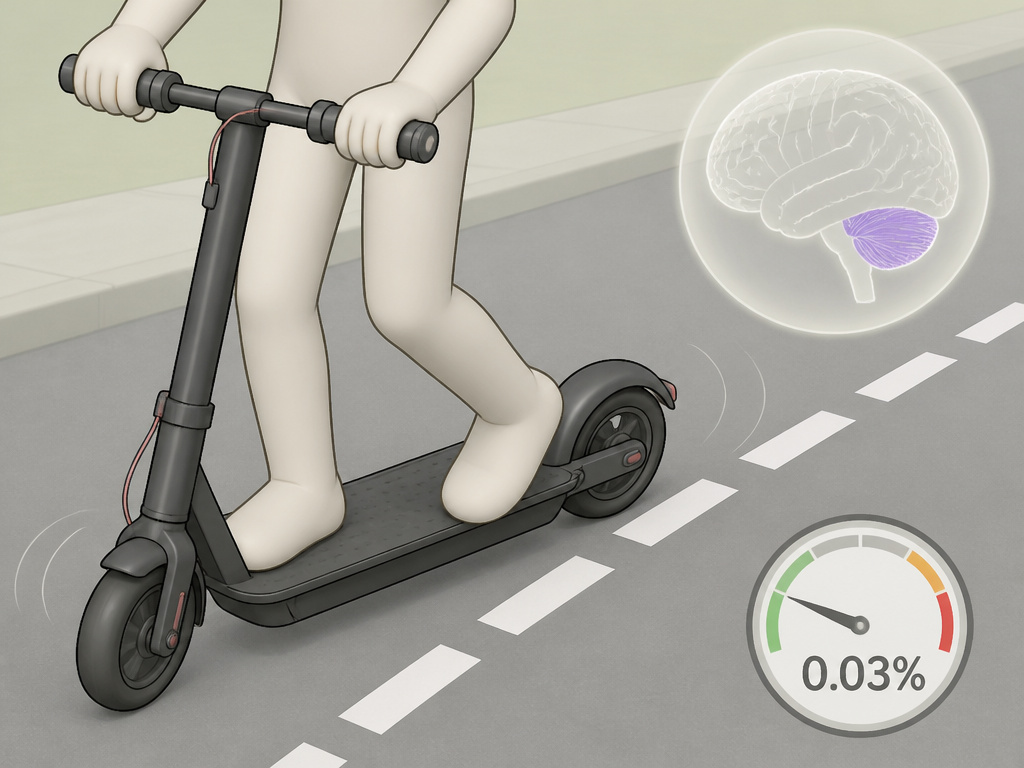
The legal limit for a “per se” DUI in most states is 0.08% BAC. Your body doesn’t care about the law. A 2022 German study published in the International Journal of Legal Medicine provides a stark, non-commodity insight into real-world impairment. Researchers used Tier ES 400B scooters (limited to 20 km/h or 12.4 mph) and tested subjects at various BAC levels.
The study found significant driving performance deterioration at BACs of 0.21–0.40 g/kg. Translated to the standard BAC percentage used in the U.S., that’s approximately 0.021% to 0.04%—a quarter to half of the common 0.08% legal limit. At these low levels, riders exhibited measurable deficits in reaction time, balance, and path deviation.
This creates a dangerous gap. You might feel “fine to ride” and be well under the legal limit, but the alcohol impairment e-scooter study suggests your operational safety is already compromised. The wobble a cop notices might not be you being careless; it might be the first observable sign of impairment that a breathalyzer would later confirm is still “legal.”
The mechanism is straightforward. Alcohol affects your cerebellum, the part of the brain governing balance and fine motor coordination. Standing upright on a narrow platform traveling at 15 mph demands constant micro-adjustments. Even a slight delay or over-correction in those adjustments leads to the weaving, the missed turns, and the slow reaction to obstacles that get you pulled over or cause a crash.
What Happens If You’re Stopped?
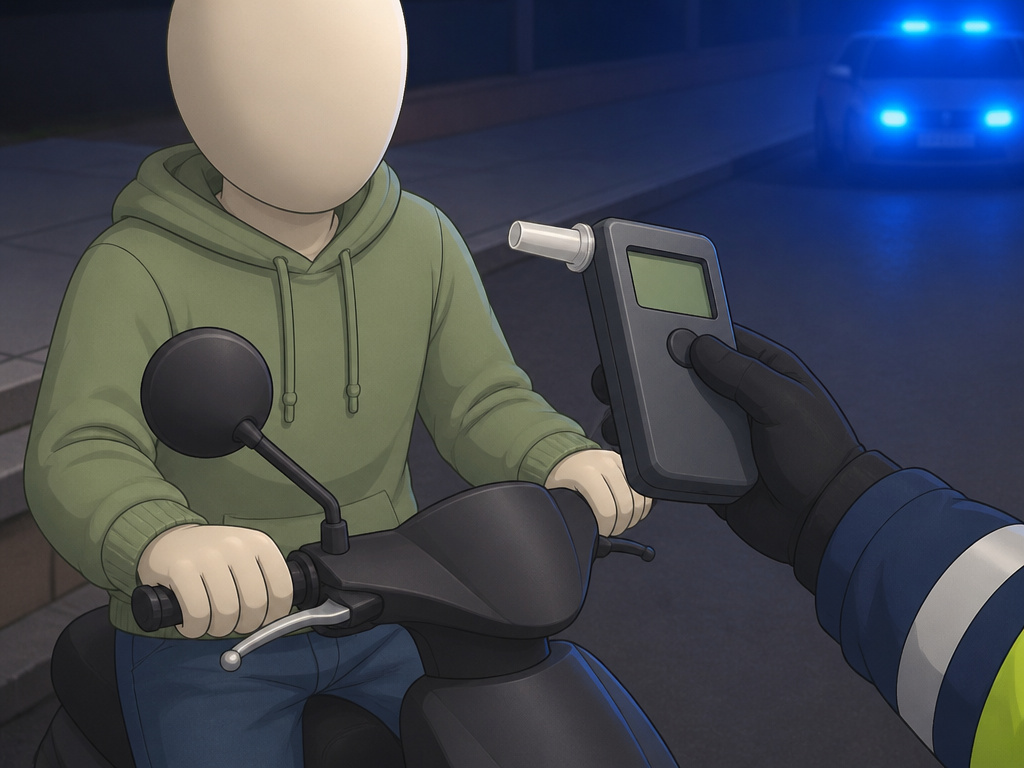
Seeing those blue lights in your mirror while on a scooter is a uniquely stressful experience. Your actions in the next few minutes matter. Here’s a blunt, step-by-step breakdown of the process and your rights.
- Pull Over Safely. Signal, move to the right, and stop in a well-lit area if possible. Turn off the scooter. Keep your hands visible.
- Be Polite and Provide ID. You are generally required to identify yourself. Answer basic questions (name, address). You are not required to answer questions about where you’ve been or what you’ve had to drink.
- Field Sobriety Tests Are Optional. The officer may ask you to perform tests (walk-and-turn, one-leg stand, horizontal gaze nystagmus). These are voluntary. Politely decline. These tests are designed for failure, even for sober people on an uneven surface, and provide evidence against you.
- The Breathalyzer Decision. This is the critical juncture. In all states with “implied consent” laws, which is most of them, holding a driver’s license means you have consented to chemical testing (breath, blood, urine) if arrested for DUI. Refusing a test after an arrest typically triggers an automatic driver’s license suspension, often longer than a DUI suspension. If you don’t have a driver’s license, the calculus changes, but refusal can still be used as evidence of guilt in court.
- You Will Be Arrested. If the officer has probable cause, you will be arrested, handcuffed, and taken for a formal chemical test. Your scooter may be impounded.
Common mistake: Arguing with the officer at the scene about whether a DUI on a scooter is possible. That’s a legal argument for your lawyer and the judge, not the sidewalk. Your goal is to not give the prosecution any extra evidence.
Do you need a license to operate an e-scooter? Often not. But that lack of a licensing requirement doesn’t shield you from DUI penalties that affect a driver’s license you do hold for a car. The systems are separate but connected.
Other Charges and How to Fight a Scooter DUI
A DUI is often the primary charge, but it’s rarely the only one on the table. Prosecutors can stack additional charges based on your behavior.
- Public Intoxication: A lesser charge that applies if you’re a danger to yourself or others or are causing a disturbance.
- Reckless Endangerment: If your riding was dangerously erratic, putting others at risk.
- Disorderly Conduct: A catch-all for causing a public disturbance.
- Obstructing Traffic: If you were riding in a manner that disrupted the normal flow of vehicle or pedestrian traffic.
A skilled defense attorney will attack the case on multiple fronts. The first and strongest defense is challenging the initial stop: did the officer have a legal justification to pull you over? If not, all evidence gathered after the stop may be thrown out.
Next, they’ll scrutinize the scooter DUI legal resource and the device itself. Was it truly a “motor vehicle” under your state’s law? Could its speed or power fall below a statutory threshold? They’ll also challenge the administration and accuracy of any chemical tests and the officer’s observations.
In some cases, as noted in the Maryland research, police and prosecutors use discretion. For a first-time, low-BAC offense with no accident, they might offer a plea to a public intoxication charge instead of a full DUI. This is why hiring an attorney familiar with local courts is crucial—they know what deals are possible.
Is a scooter DUI the same as a car DUI?
The legal consequences of a DUI on a scooter can be just as severe as one in a car, depending entirely on state law. In states like Florida and Maryland, a motorized scooter is considered a ‘vehicle’ under DUI statutes, meaning you face the same charges. This can include potential jail time and fines, though specific BAC limits and fine amounts vary by state. However, in states like Wisconsin, the law explicitly excludes electric scooters from the definition of a ‘motor vehicle,’ creating a legal loophole. The core difference isn’t about the danger you pose, but about how your state’s legal code defines the machine you’re riding.
Frequently Asked Questions
Can you get a DUI on a Lime or Bird scooter?
Yes. Rental scooters are still motorized scooters. Your liability is based on state law governing the operation of motor vehicles or vehicles, not who owns the scooter. The rental agreement prohibits impaired operation, but you are subject to criminal law, not just a breach of contract.
What’s the difference between a DUI and public intoxication on a scooter?
DUI is a traffic offense related to operating a vehicle while impaired. It carries severe penalties like license suspension and jail time. Public intoxication is a general ordinance violation for being drunk and disruptive in public, usually resulting in a fine and maybe a night in jail. An officer may charge the latter if the circumstances or local policy make a full longboard DUI prosecution unlikely.
Do you need a driver’s license to get a scooter DUI?
No. The DUI charge is against you as the operator. However, if you do have a driver’s license, a conviction will result in its suspension. The penalties attach to your driving privilege, not your ownership of the vehicle you were caught on.
Can you get a DUI on a scooter for drugs (not alcohol)?
Absolutely. DUI laws cover impairment by any drug, illegal or prescription, that affects your ability to operate a vehicle safely. An officer trained as a Drug Recognition Expert (DRE) can perform an evaluation, and a blood test can be used as evidence of drug presence.
Is a scooter DUI cheaper or easier to fight than a car DUI?
No. The legal process, potential penalties, and defense strategies are essentially identical. The prosecution must prove the same elements: you were in control of a vehicle (as defined by law) and you were impaired. The only potential difference is the defense argument over whether the scooter qualifies as a vehicle, which is a legal motion your attorney would file.
Before You Go
The most important number isn’t 0.08. It’s your state’s statute number. Look it up before you ever consider riding a motorized scooter after drinking. The legal risk is real, structured, and carries long-term consequences that reshape your finances and your record.
If you take away one action from this, make it this: know that field sobriety tests are a choice. You can say no. Your decision on the breathalyzer is more complex and ties directly to your driver’s license, but those roadside balance tests are purely voluntary evidence-gathering. Your safety and the safety of others is the priority, but so is understanding the system you’re entering when those lights flash. The law, as written, often doesn’t see a difference between a sedan and a scooter. Make sure you do.
