iScooter Review: The Bottom Line on Reliability
This post contains affiliate links. As an Amazon Associate, we earn from qualifying purchases.
An iScooter review must start with the manuals, not the marketing. The brand offers a wide range of electric scooters, from the compact i12 to the powerful DX5, with specs that look competitive on paper. Real-world performance, however, hinges on specific model details, adherence to strict operational limits, and a clear-eyed look at the company’s warranty and support policies.
The manuals reveal a brand that sets precise, often strict, boundaries. You are buying a device with clear environmental, weight, and maintenance rules. Ignore them, and you void the warranty or break the scooter. This review breaks down those rules, compares key models, and tells you what to expect after the first 500 miles.
What follows: verified specs from official PDFs, a direct comparison of five core models, the warranty and support reality, and the maintenance quirks that decide long-term reliability.
Key Takeaways
- Check the manual first. iScooter sets specific, fixed limits like a 120 kg max load and -2°C to 35°C operating temperature that vary by model.
- Range claims are optimistic. Anecdotal reports show real-world range is often 60-70% of advertised figures, heavily dependent on rider weight and terrain.
- Storage advice contradicts common wisdom. The i10 Pro manual says charge every other month for long-term storage, conflicting with the standard “store at 40-60% charge” rule.
- Water resistance is minimal. Most models are not waterproof, and water damage is explicitly excluded from warranty coverage.
- Support is document-dependent. Having your official manual PDF ready is crucial for troubleshooting and warranty claims, as error codes and procedures are model-specific.
The iScooter i10 Pro: Specs and Real-World Performance
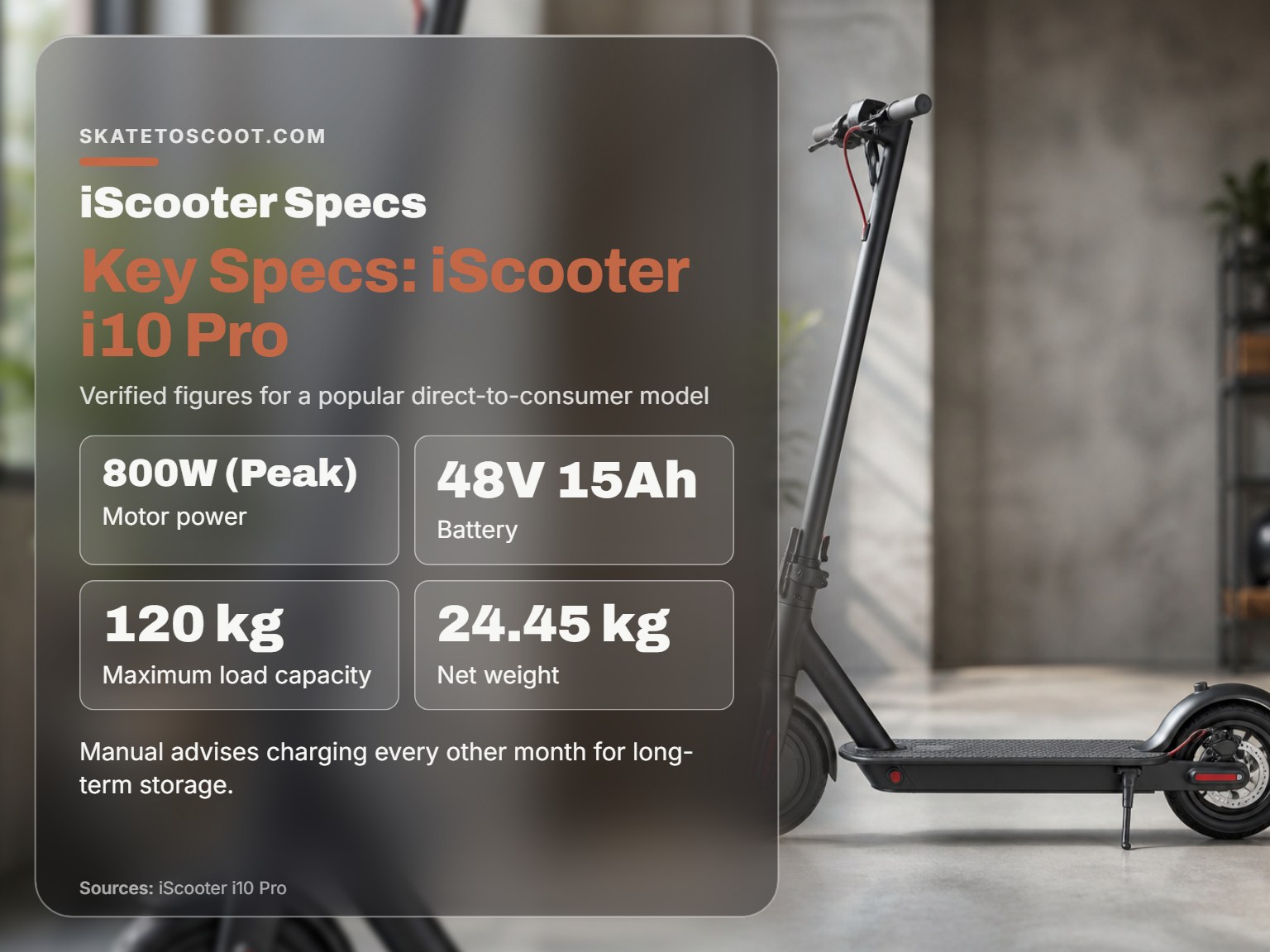
The iScooter i10 Pro is a common entry point, and its manual is a masterclass in specific limitations. According to the official document, it weighs 24.45 kg, supports a 120 kg max load, and packs a 48V 15Ah battery with an 800W peak motor.
That last line about altitude isn’t a suggestion—it’s a hard stop. Operating above 2,000 metres likely strains the motor and battery management system in thin air. The operating temperature window is equally strict: -2°C to 35°C. Take it out in temperatures below -2°C or above 35°C, and you’re outside its designed parameters.
They praised the electromagnetic brake but called the suspension travel modest. Another owner reported tire wear issues, noting the stock tires wore to the wear indicators quickly and were only rated for 30 PSI according to a user report. They swapped them for 55 PSI-rated tires, a simple upgrade that improved durability.
This isn’t necessarily a defect; it’s the reality of a compact, air-cooled motor working hard. Just don’t expect to drag-race it up long hills repeatedly.
iScooter i12, DX5, F7, and iX4: A Model Comparison
Beyond the i10 Pro, the iScooter lineup fragments into distinct models for different riders. Comparing them side-by-side shows where the trade-offs lie.
| Model | Best For | Key Spec | Critical Limitation |
|---|---|---|---|
| iScooter i12 | Short, casual commutes | 15 mph top speed, 18-21 mile range | Not waterproof; age 14+ only |
| iScooter DX5 | Power & cargo hauling | 35 mph, 150 kg max load, 1500W motor | Non-foldable; 45.9 kg weight |
| iScooter F7 | All-weather commuting | IPX4 water resistance, 1000W motor | Heavier at 30.25 kg |
| iScooter iX4 | Balanced performance | 150 kg max load, 54.6V 2A charger | Manual recommends 70% of max load (84 kg) |
This is a scooter you ride from a garage, not one you carry onto a train.
The iScooter iX4 manual contains a unique, cautious note: “For the best riding experience, 70% of the maximum load is recommended.” Since its max load is 150 kg, that’s a recommended 105 kg rider weight. No other iScooter manual gives this 70% figure, suggesting its frame or suspension might be tuned differently. It’s a spec worth remembering if you’re near the limit.
When comparing these to other brands, it’s useful to look at our broader scooter reviews and a specific iscooter review for context on performance tiers.
Warranty, Support, and the “Chinese Company” Question
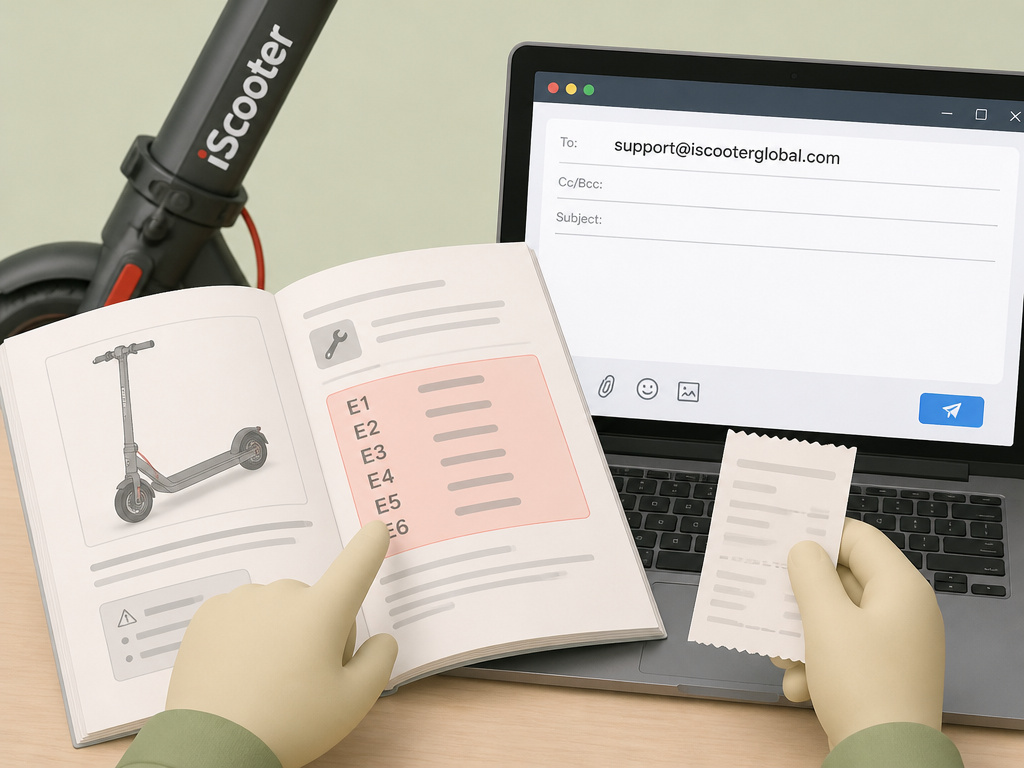
The real texture is in the warranty exclusions, which are explicitly listed in manuals. Physical damage from “negligent care and extreme riding” is also not covered.
Support appears to be primarily email-driven ([email protected]). Forum anecdotes suggest having your proof of purchase and referencing your specific manual is critical. The manuals include error code lists (like the one for motor overheating at 100°C on the i10 Pro), so quoting those in a support ticket is your fastest path to a diagnosis.
Where this goes sideways: Assuming generic scooter advice applies. IScooter’s long-term storage instruction for the i10 Pro is “charge every other month,” which directly conflicts with the near-universal lithium-ion advice to store at a 40-60% state of charge. Following the wrong one could void a battery claim.
The company’s origin is frequently asked. IScooter Global Ltd. Appears to be a UK-registered company that designs, sources, and distributes electric scooters, with manufacturing almost certainly in China. This is the standard model for many direct-to-consumer electric vehicle brands. It doesn’t inherently indicate lower quality, but it does mean parts sourcing and repair documentation may require coordination with the distributor, not a local shop. For a look at another brand with a similar profile, see our review of Isinwheel scooters or a dedicated iscooter review.
Safety, Maintenance, and Long-Term Ownership Realities
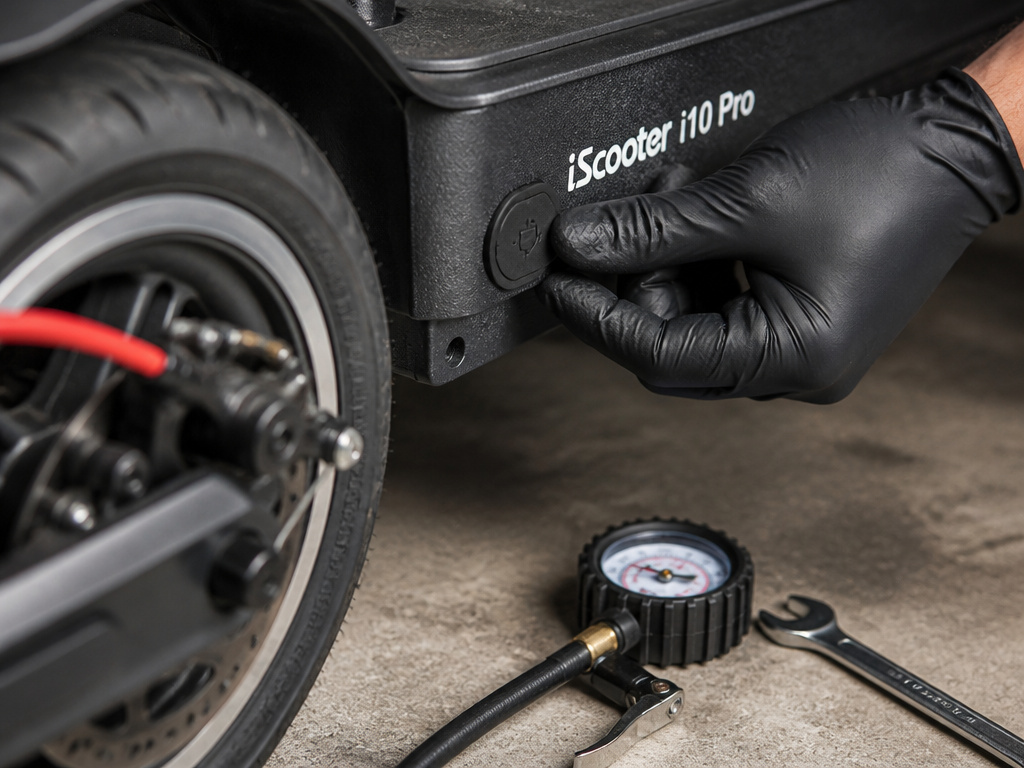
Safety starts with the manual’s warnings, which are more detailed than most. Pre-ride checks are mandatory: tire pressure (check your manual for the recommended PSI), brake function, and ensuring all bolts are tight. The i10 Pro manual warns to keep the charging port closed when not charging and to never charge if the port is wet or damaged—a specific point of failure many overlook.
Maintenance is where long-term costs reveal themselves. Tires are a consumable. One i10 Max owner reported a high cost for OEM tires before finding cheaper aftermarket equivalents.
This goes beyond “store indoors.” If you live in a tropical climate, leaving the scooter in a non-air-conditioned garage could be a genuine risk.
For long-term storage, you face a contradiction. The i10 Pro manual says charge every other month, while common generic lithium-ion advice is to store at a partial charge (40-60%). I’d follow the manual for warranty compliance, but it highlights a potential design quirk in their battery management system.
iScooter vs. Other Brands: How It Stacks Up
Stacking iScooter against giants like Segway or Ninebot isn’t a fair fight on brand reputation or local service networks. Segway wins there. The comparison is more apt against other direct-to-consumer value brands like Hiboy or TurboAnt.
IScooter’s advantage is often specs-per-dollar. An 800W motor scooter for a mid-tier price is attractive. The disadvantage is support latency and part availability. You’re dealing with a central support email, not a local dealer. This makes a detailed, model-specific manual your most important tool. For example, knowing the error codes for your iScooter i10 model is more useful than generic troubleshooting.
When comparing, ask: is the extra $200 for a Segway buying me peace of mind via a local service network? For a casual rider, maybe not.
Easy to miss: Model confusion. An “iScooter i10” could be a 36V/42V marketed model or a true 48V i10 Pro. An “i8” could be different from an “i8M.” Always confirm the exact model name and check its specific manual before assuming performance or compatibility.
Frequently Asked Questions
Is iScooter a reliable brand?
Reliability is model-dependent and tied closely to adhering to the manual’s limits. The i10 Pro and F7 have reports of solid medium-term use (500-1000 km), while the i12 has more complaints about basic components. The brand is reliable if you treat it as a precision device with strict rules, not a toy you can abuse. Their 12-month warranty is standard, but exclusions for water and physical damage are broad.
Is iScooter a Chinese company?
IScooter Global Ltd. Is a UK-registered company that designs and markets electric scooters. The manufacturing, like most consumer electronics and electric vehicles in this price segment, is based in China. This is a common structure and doesn’t automatically mean lower quality, but it does centralize parts and support logistics.
Which is better, iScooter or Segway?
Segway (and its parent Ninebot) is better for build quality consistency, widespread brand recognition, and a more established service network. IScooter often beats Segway on paper specs for the same price. Choose Segway for maximum “it just works” reliability and local support. Choose an iScooter model like the iScooter iX4 if you prioritize raw power and range per dollar and are comfortable with self-service and email-based support.
What are the most common problems with iScooters?
Based on manual warnings and user reports: premature tire wear (stick to 30-35 PSI), motor overheating on sustained climbs (watch for the 100°C error code), battery range falling short of claims (factor a 30% buffer), and support delays for parts. Water damage is also a frequent point of failure and is warranty-excluded.
How do I get the best range from my iScooter?
Keep tire pressure at the recommended PSI (often 30-35, check your manual). Use eco mode if available. Avoid constant top-speed runs, as this heats the motor and drains the battery fastest. Maintain a smooth riding style, using the electromagnetic brake for gentle slowing instead of hard mechanical braking. Finally, store and charge it within the stated temperature ranges (-2°C to 35°C for the i10 Pro) to preserve battery health.
The Bottom Line
IScooter sells capable scooters with aggressive specs at competitive prices. The catch is in the footnotes. You are buying a device with an official rulebook, the manual, that contains strict limits on weight, temperature, altitude, and maintenance. Follow those rules, and models like the i10 Pro or F7 can deliver solid value.
Ignore them, and you’ll join the forum threads listing breakdowns. Your first step before buying any model, be it the iScooter i9 or the iScooter i14, is to find and read its specific manual. That document, not the marketing page, tells you exactly what you’re getting into. It’s the difference between a scooter that lasts a season and one that lasts for years.
