Isinwheel Scooter Review: UK Safety Recall Explained
This post contains affiliate links. As an Amazon Associate, we earn from qualifying purchases.
An Isinwheel scooter is a budget-friendly electric scooter with a mixed reputation. Key models like the GT2 and S10 Max offer competitive specs on paper, but a 2021 UK government recall for a fire hazard on the E9T model, inconsistent real-world performance, and reports of difficult customer service mean you should weigh the low price against the potential for a frustrating ownership experience.
That recall notice from Bromley Council isn’t just a historical footnote. It’s a documented, specific failure mode where sharp edges on folding handlebars sheared wiring and caused a fire. When a manufacturer’s design leads to a government-issued safety alert, it sets a precedent that colors every other claim they make about durability and safety, a crucial context for any isinwheel scooter review.
What follows is a breakdown of that recall, a side-by-side look at where Isinwheel’s specs meet the real world, and a frank summary of what it’s actually like to own one based on warranty fine print and owner forums.
Key Takeaways
- A 2021 UK government recall for the Isinwheel E9T cited a fire hazard from sheared wiring, a specific design flaw that questions overall build quality.
- Manufacturer range claims are based on a 70kg rider on flat ground in Eco mode; real-world tests and owner reports frequently show 25-40% less distance.
- Isinwheel’s warranty and return policies are notably restrictive, with short defect-reporting windows (30 days) and restocking fees of up to 30% for opened returns.
- Parts availability and DIY repair are common concerns, with some owners reporting difficulty sourcing specific components like folding hooks directly from the company.
- For the price, these scooters can be capable commuters, but they demand a willingness to perform basic maintenance and manage support expectations.
The UK Safety Recall That Changes Everything
In January 2021, the UK’s Office for Product Safety and Standards issued recall notice 2012-0081 for the Isinwheel E9T model. The London Borough of Bromley published the official e-scooter defect notification, which stated the product presented a “serious risk of fire.” The specific hazard: “The folding handlebars with sharp edges can shear the wiring, causing the circuit to combust and catch fire.”
This isn’t a vague warning about generic battery safety. It’s a documented mechanical failure where a design element, the folding mechanism, directly caused an electrical short. The scooter was also supplied with its JETECH-branded lithium-ion battery connected and fully charged.
Where this goes sideways: Treating a government-issued safety recall as an isolated incident. This was a specific, preventable design flaw that passed initial quality checks. It signals that cost-cutting on components like wire routing and insulation can have real consequences.
The recall is a fixed point in Isinwheel’s history. It doesn’t mean every scooter they make is unsafe, but it does establish that their engineering and quality control have, at least once, failed to a degree that required regulatory intervention. When you’re comparing an isinwheel scooter review to others, a clean safety record is a baseline. Isinwheel’s record has this mark on it.
Decoding the Specs: Model-by-Model Breakdown
Isinwheel sells several models, each with its own focus. The specs look good on a product page, but the devil is in the details, and sometimes in the contradictions between models.
| Model | Claimed Top Speed | Claimed Max Range | Key Specs & Notes |
|---|---|---|---|
| GT2 (Off-Road) | 28 mph | 37 miles | IPX5 waterproof rating. Unlocks speed via button press. 11-inch pneumatic tires. |
| S10 Max | 25 mph | 37 miles | 1000W peak motor. Suspension noted as stiff by owners. |
| X1 | Not specified | Not specified | IPX4 water resistance. Not for use above 2000m elevation. 500W nominal motor. |
| E9T (Recalled) | Not specified | Not specified | Recall: Fire hazard from sheared wiring in folding handlebars. |
The takeaway here is variety. The GT2 is their off-road-flavored option with larger tires, while the S10 Max and X1 are more traditional commuter designs. But specs are a starting point, not a guarantee.
The Warranty and Return Policy Fine Print
Isinwheel’s support pages present a layered and sometimes conflicting warranty structure. This isn’t unusual for direct-to-consumer brands, but it requires close reading.
- Standard Warranty: Sources disagree on the warranty period. Isinwheel UK Support states a 1-year warranty for scooters. The global Isinwheel Support FAQ details a 6-month warranty for the battery, charger, wheels, hub motor, and control board, with 12 months for other components.
- Defect Reporting Window: You have 30 days from delivery to report a confirmed defect for a return, exchange, or repair. The X1 manual reiterates this, noting a Return Merchandise Authorization (RMA) must be requested within that 30-day window.
- Return Costs: For non-defective returns, it’s costly. An unopened return may incur shipping up to 15% of the price. Opened with under 10 miles ridden? A 20% restocking fee plus shipping. Over 10 miles? That jumps to 30%. This heavily discourages trial periods.
If your primary concern is a no-hassle return or a long, detailed warranty, other brands or retailers with more favorable policies may be a better fit than an isinwheel scooter review suggests. The terms are there, but they’re built to protect the company first.
Real-World Performance vs. Manufacturer Specs
Isinwheel’s official range claims are based on a “70kg rider at 25 degrees Celsius on a stable surface” riding in Eco mode, as per their UK support page. The GT2 FAQ uses a 160 lbs rider under the same conditions. These are idealized lab tests.
Owner reports consistently show real-world range is lower than the manufacturer’s claims. More telling are discussions about the S10 Max, where owners note the speedometer can be inaccurate, meaning the odometer, and thus range calculation, may also be inaccurate. Your actual range depends entirely on your weight, terrain, speed, and temperature.
Speed claims are more reliable but come with a caveat. The GT2 is reportedly programmed with a 15 mph limit in some regions to comply with local laws, requiring you to “press the ‘M’ button five times” to access its full 28 mph potential. This isn’t hidden, but it’s an extra step that isn’t always clear at purchase.
Common mistake: Taking the “max range” number as a commuting guarantee. If your daily round-trip is close to the scooter’s maximum claimed range, you should plan for a mid-day charge, especially if there are hills.
The performance is there for the price. A GT2 that hits its claimed top speed and offers a useful real-world range is a capable machine. But you have to view the specs through the lens of best-case-scenario marketing, not a binding contract.
What Owners Say About Reliability and Support
Forums like r/ElectricScooters are filled with first-hand accounts that paint a picture of the actual ownership experience. The consensus isn’t universally negative, but it highlights clear patterns.
The Good: Many owners are happy with their purchase for the price. They cite good power, acceptable range, and a feeling of getting a capable scooter without spending thousands. Posts titled “Got an Isinwheel GT 2, I like it” are common, with users praising the speed and stability compared to entry-level models from brands like Xiaomi.
The Bad: Customer service is the most frequent complaint. Threads detail drawn-out processes for returns, with requests for repeated video evidence and reluctance to provide prepaid shipping labels. One user titled a post “Beware returns for Isinwheel Scooters,” describing a struggle that involved PayPal disputes and a bank chargeback before a resolution.
The Ugly: Parts and long-term durability raise questions. Some users report Isinwheel support being unable to ship specific replacement parts like folding hooks, forcing DIY fixes. Others note that while the scooter works initially, the overall feel may not hold up to daily abuse over years. When comparing Isinwheel scooters to more established brands, the latter often win on proven longevity and parts ecosystems.
I learned this the hard way with a different brand of budget skate: a great first week doesn’t predict year two. The things that fail are never the headline specs, it’s the latch on the folding mechanism, the waterproofing around a wire grommet, the availability of a proprietary brake pad. Isinwheel owner discussions suggest they are not immune to this rule.
Isinwheel vs. The Competition: Where It Fits
Isinwheel exists in a crowded space of direct-to-consumer electric scooters. Brands like TurboAnt, Segway (Ninebot), and even store brands from Amazon offer similar price-to-spec ratios.
| Consideration | Isinwheel | Established Brands (e.g., Segway) | Ultra-Budget Brands |
|---|---|---|---|
| Price | Competitive, mid-low budget. | Higher. | Similar or slightly lower. |
| Specs on Paper | Often very good for the price. | Can be more conservative. | Often inflated. |
| Real-World Performance | Generally meets basic spec claims with noted discrepancies. | Typically matches or exceeds claims. | Frequently falls short. |
| Support & Warranty | Mixed reports; restrictive policies. | Generally more structured and reliable. | Often minimal to non-existent. |
| Parts Availability | Spotty based on owner reports. | Usually good through official channels. | Very difficult. |
| Best For | The handy commuter willing to accept support risk for max specs per dollar. | The commuter prioritizing reliability and peace of mind. | The absolute lowest-cost experiment. |
If your priority is squeezing every bit of speed and range from your budget and you’re comfortable with potential support hurdles, Isinwheel is a contender. If you value a smoother ownership experience and easier repairs, spending more on a brand with a stronger track record like Segway, or considering a reviewed competitor like iScooter, is the wiser path. It’s the classic trade-off: specs now versus potential hassle later.
Battery Care and Contradictory Advice
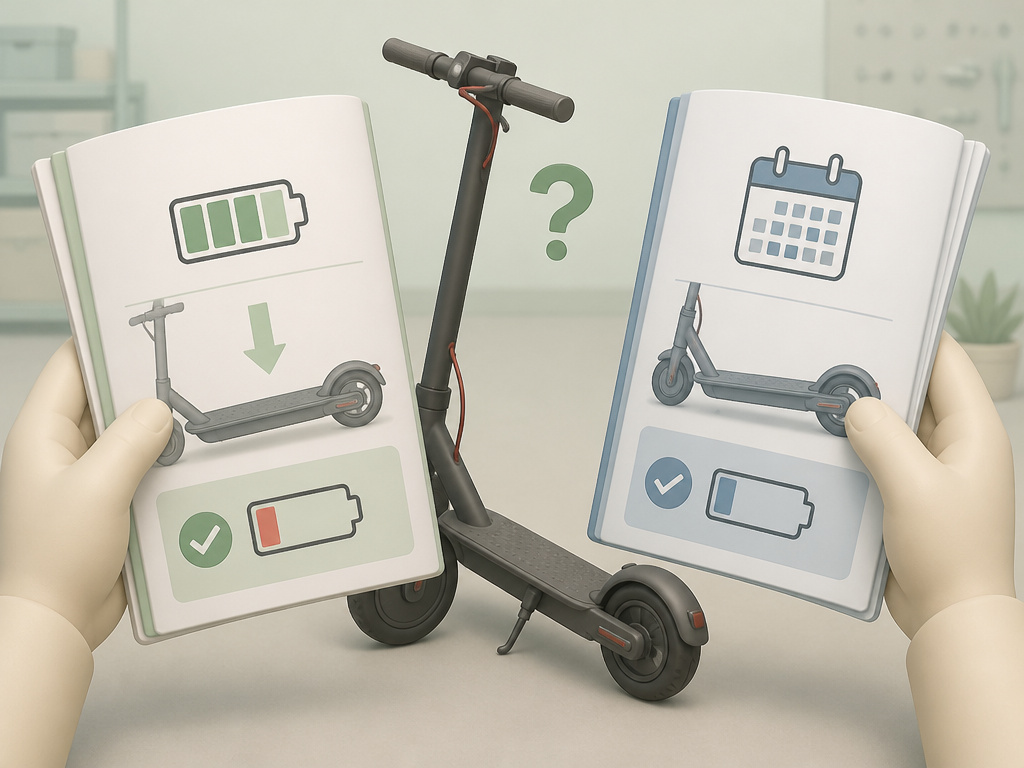
Here’s a clear example of where Isinwheel’s own documentation sends mixed signals. It’s a small detail that speaks to broader communication issues.
The X1 manual states: “In daily use, try to recharge the scooter after completely exhausting the battery.” This suggests deep discharge cycles. The S10 Pro manual advises: “Charge the scooter every other month to preserve the battery during storage.” This advises regular top-ups to prevent deep discharge.
Isinwheel’s own documentation gives different advice: the X1 manual states ‘In daily use, try to recharge the scooter after completely exhausting the battery,’ while the S10 Pro manual advises ‘Charge the scooter every other month to preserve the battery during storage.’
This extends to water resistance. The GT2 is listed as IPX5, while the X1 is IPX4. IPX5 can handle water jets from a nozzle, while IPX4 is only protection against splashes from all directions. Neither is fully waterproof, and Isinwheel explicitly says not to submerge them. But the difference matters if you’re frequently caught in rain.
Frequently Asked Questions
Is Isinwheel a good scooter brand?
It’s a budget brand with clear trade-offs. Their scooters can offer excellent performance for the price, as seen in models like the GT2. However, a past safety recall, mixed customer service reports, and restrictive return policies mean “good” depends on your risk tolerance and handiness. They are not a “set and forget” brand.
What is the most reliable electric scooter brand?
Reliability is often tied to price and brand maturity. Established brands like Segway (Ninebot), Niu, and higher-end makers like Dualtron have stronger reputations for long-term durability and support. They typically cost more upfront. Reliability is about consistent performance over years, not just peak specs at unboxing.
How fast does the Isinwheel scooter go?
It depends on the model. The GT2 and S10 Max are commonly reported to hit 28 mph and 25 mph respectively on flat ground, which owners generally confirm. Be aware that some regions may have the GT2 software-limited to 15 mph, requiring a button sequence to reach full speed.
Can you trust Isinwheel’s range claims?
You should plan for less. Their claims are based on ideal conditions: a light rider (70kg/160lbs), flat ground, moderate temperature, and the most efficient riding mode. Real-world factors like hills, wind, colder weather, and heavier riders will reduce range by 25% or more. Use the claimed range as a maximum possible benchmark, not a daily minimum.
Before You Go
If you’re still considering an Isinwheel, let the recall be your final filter. It’s not just about one bad model; it’s a case study in how a design oversight can become a critical failure. Can the company that let that happen be trusted to have perfected its current models? Maybe. But that’s the risk you’re accepting for the lower price.
Your first step shouldn’t be clicking “buy.” It should be reading the exact warranty and return policy for your region on Isinwheel’s official site. Then, search for “[your model] + repair” or “[your model] + replacement part” on forums. What you find there, the DIY fixes, the parts searches, the successful and failed support tickets, is the most honest review of Isinwheel electric scooters you’ll get. The specs get you in the door, but that research tells you what life is like once you’re inside.
