How to Charge an Electric Scooter Battery Without a Charger
This post contains affiliate links. As an Amazon Associate, we earn from qualifying purchases.
You can charge an electric scooter battery without its original charger by using a compatible universal charger, a high-capacity power bank, or a car inverter, but only if you match the battery’s voltage and polarity exactly. Getting either wrong causes instant, severe damage or fire. This isn’t a casual fix. It’s an emergency procedure where the margin for error is zero.
The stakes are high. The manuals aren’t exaggerating. The Niu N1S service manual explicitly warns that using non-original chargers “will cause irrecoverable damages to the battery.” Community forums and YouTube videos might show workarounds for how to charge an electric scooter battery without a charger, but they contradict manufacturer warnings, such as the Niu N1S manual which states non-original chargers cause ‘irrecoverable damages.’ What follows is a breakdown of the verified methods, the essential safety checks, and the specific scenarios where each option might, or might not, be worth the immense risk.
Key Takeaways
- Voltage matching is essential. Connecting a 36V scooter to a 60V source causes instant battery damage and fire risk.
- Stop charging immediately if the battery shows swelling, leaks, or smells. A damaged lithium-ion battery is a volatile fire hazard.
- Manufacturers disagree on the ideal storage charge: the Niu N1S manual prohibits storage below approximately 50% capacity, while the PURE eTryst X manual recommends 40% SOC.
- Universal chargers with adjustable voltage/current are the safest alternative, but you must verify polarity and use a multimeter.
- Constant monitoring is mandatory. Never leave an improvised charging setup unattended, even for a few minutes.
Can You Charge an Electric Scooter Without the Original Charger?
The original charger isn’t just a plug; it’s a matched component that communicates with the scooter’s Battery Management System (BMS). The BMS regulates cell voltage, prevents overcharging, and manages temperature. A generic power source bypasses these protections.
Before you start: Direct contact with high-voltage DC can cause severe injury or fatality. Incorrect voltage/current damages cells, leading to overheating, swelling, or failure, which can result in fire or explosion. These methods void manufacturer warranties.
The community often clashes with manufacturer edicts. You’ll see a YouTube video suggesting a laptop charger, while the Niu N1S scooter service manual states non-original chargers cause “irrecoverable damages.” This disconnect is the core of your decision. Are you willing to accept full liability for a several-hundred-dollar battery, and the physical danger, for a temporary charge?
The Critical Specs You Must Know First
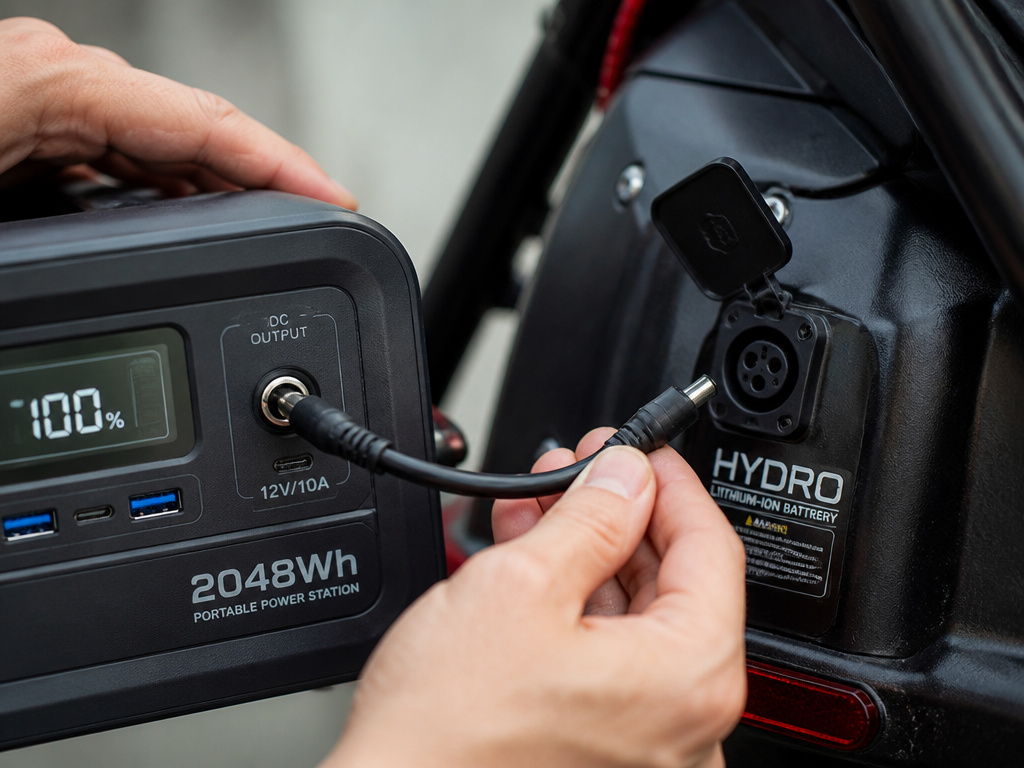
You cannot proceed blindly. You need three numbers: voltage (V), amperage (A), and the connector polarity. These are printed on your scooter’s battery pack, the original charger, or in the official manual.
For example, the Niu N1S uses a 60V battery with a rated capacity of 20Ah-30Ah. Its dedicated charger outputs 69.7V, 3-4A. A universal charger must be set to these exact specs. A power bank or laptop charger must meet or exceed the voltage; amperage determines charging speed.
| Scooter Model | Battery Voltage | Charger Output | Critical OEM Warning |
|---|---|---|---|
| Niu N1S | 60V | 69.7V, 3-4A | Non-original chargers cause “irrecoverable damages.” |
| PURE eTryst X | (Check your manual) | (Check your manual) | Requires a 45-min cooldown post-ride before charging. |
| Generic 36V Scooter | 36V | (Check your manual) | Always use a charger made for your scooter’s battery. |
Finding these specs is your first step. If your battery shows swelling, leaking, physical dents, or a strong chemical odor, stop. This indicates a failing battery that is unsafe to charge by any means. Similarly, a charge port with bent pins, loose housing, or a melted appearance means you have a wiring problem that must be resolved first.
Method 1: Using a Universal Charger
This is the most controlled alternative method. An adjustable DC power supply or universal lithium charger allows you to set the exact voltage and current. It mimics the original charger’s function, though it may not communicate with the BMS.
You need a unit that can output a voltage slightly higher than your battery’s rated voltage (for example, the Niu N1S’s 60V battery requires ~69.7V). The amperage can usually be set to 2A or 3A for a slower, safer charge.
Step-by-Step Guide:
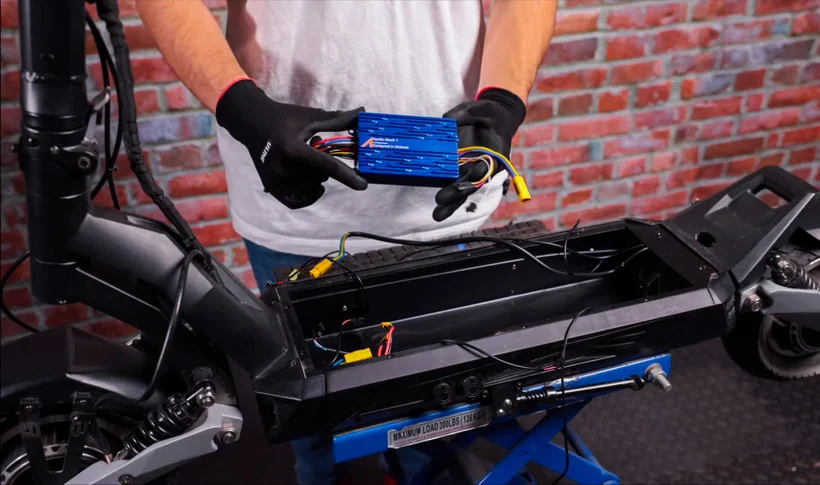
- Identify and Set Parameters: Confirm your battery’s voltage and the required charging voltage. Set the universal charger to that exact voltage and a conservative amperage (e.g., 2A).
- Verify Polarity: This is where fires start. Use a multimeter to confirm the positive (+) and negative (-) pins on your scooter’s charge port. Match them perfectly to the charger’s clips.
- Connect and Monitor: Attach the clips securely. Turn on the charger. Do not walk away. Watch for excessive heat from the battery or charger.
- Stop at Full Charge: Most universal chargers don’t auto-stop. Monitor the voltage; when it reaches the battery’s full charge voltage (e.g., 42V for a 36V pack), disconnect immediately.
Where this goes sideways: Assuming polarity without testing. Reversed polarity causes an instant short circuit, can destroy the BMS, and may ignite the battery within seconds. A multimeter is not optional.
This method for how to charge an electric scooter battery without a charger is fundamentally a charger repair stand-in. If the charger light on your original unit stays green and doesn’t charge, a universal charger can help diagnose if the problem is the charger or the scooter itself.
Method 2: Using a High-Capacity Power Bank
This method for how to charge an electric scooter battery without a charger is popular in forums but is riddled with “ifs.” It only works if your scooter has a DC input port that accepts your power bank’s voltage, typically 12V, 16V, or 20V. Most scooters do not.
The idea is to use a power bank with a DC output, but an anecdotal source notes this will only work if your scooter has a compatible USB charging port. You must have a cable that bridges from the power bank’s output to your scooter’s charge port, with perfect voltage and polarity matching.
Limitations are severe:
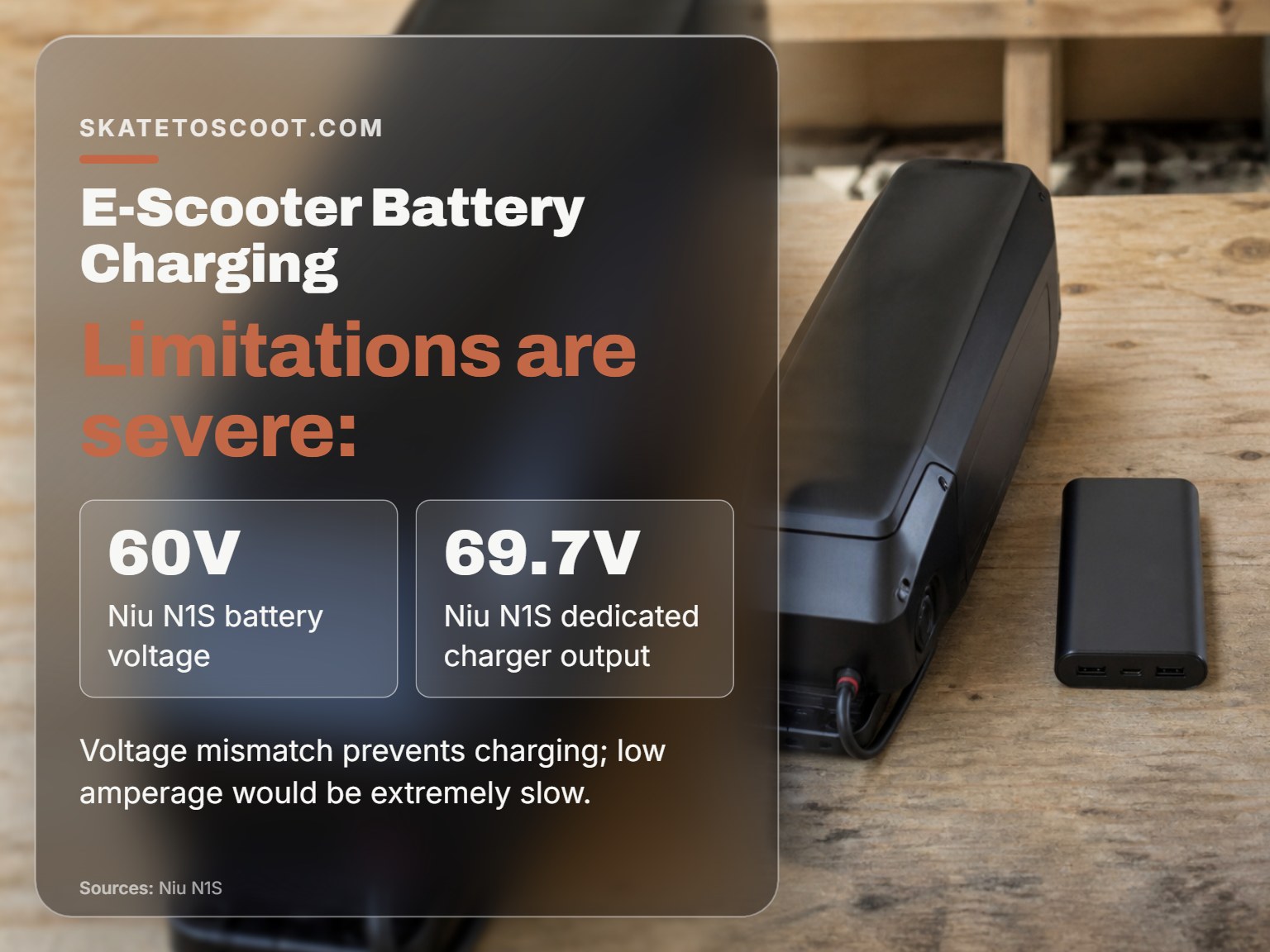
- Voltage Mismatch: A power bank’s 20V output cannot charge a 36V or 60V battery directly. It will do nothing at best.
- Low Amperage: Even if voltage matches, power banks output low current (2A-4A), leading to extremely slow charging and potential overheating of the power bank itself.
- No BMS Communication: It’s a dumb power source, offering no overcharge protection.
If your scooter won’t turn on and you suspect a completely dead battery, a power bank likely lacks the voltage to initiate the BMS. This method is best viewed as a last-resort trickle charge for smaller battery packs, under constant watch.
Method 3: Using a Car Battery and Inverter
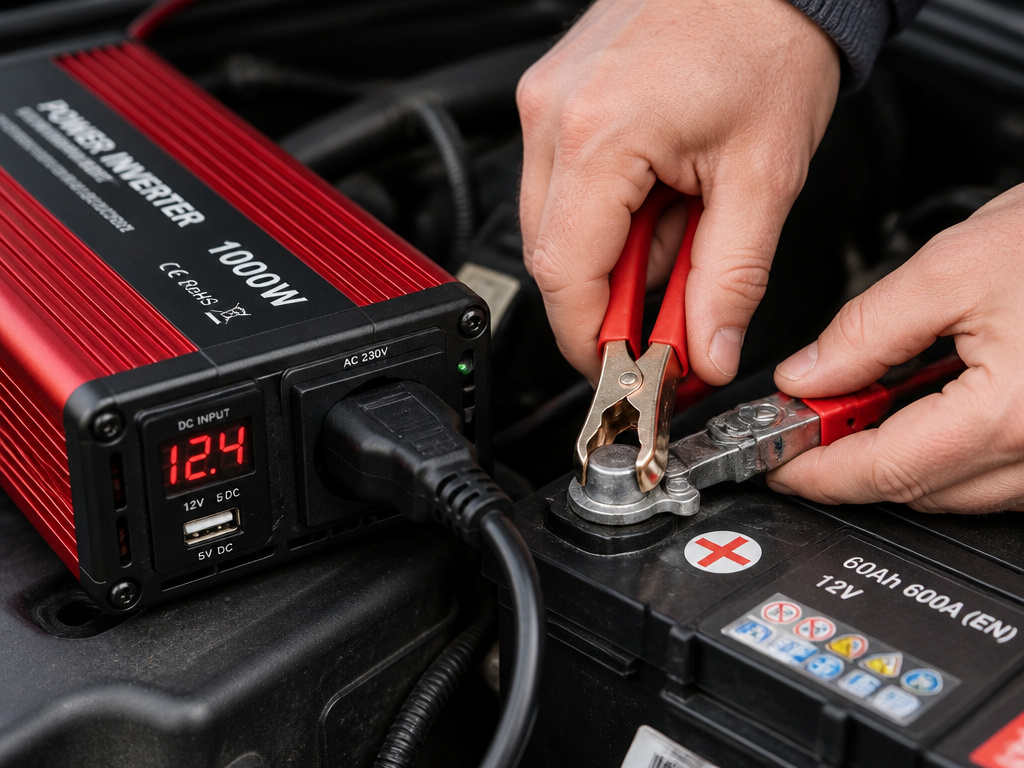
This is an on-the-road emergency option. You use a car’s 12V battery paired with a power inverter (which converts 12V DC to 110V/220V AC), then plug your original scooter charger into the inverter.
Why this is safer: You’re using your OEM charger, which preserves the BMS communication and correct voltage/amperage.
Steps:
- Ensure the car is in a well-ventilated area and turned off.
- Connect the power inverter directly to the car battery terminals (clamp red to +, black to -).
- Plug your scooter’s original charger into the inverter, then into the scooter.
- Monitor the car battery voltage. Inverters draw significant power and can drain a car battery quickly if the engine isn’t running.
Common mistake: Running the car engine to charge the scooter. This can cause voltage spikes from the alternator that may damage the inverter or the scooter’s charger.
This method is effective but requires owning an inverter rated for more watts than your charger consumes.
What the Manuals Say That Most Guides Miss
OEM manuals contain model-specific quirks that generic articles overlook. These aren’t just suggestions; they’re born from failure analysis.
- The 45-Minute Cooldown: The PURE eTryst X manual mandates waiting 45 minutes after a long ride before charging. A hot battery accepts a charge poorly, accelerating cell degradation.
- The Humidity Sticker: The Waydoo Subnado manual includes a humidity-sensing sticker that turns from white to red to indicate moisture. If it’s red, you must dry the port with a cotton swab before charging. If seawater was present, you must clean it with alcohol first. Ignoring this leads to internal corrosion.
- The 24-Hour Rule: The Niu manual says to stop charging if the red lamp hasn’t turned green after 24 hours.
- The Storage Conflict: For long-term storage, the PURE eTryst X says 40% State of Charge (SOC). The Niu N1S says storing below approximately 50% capacity is “strictly prohibited.” This is why you consult your manual.
These specifics transform a generic warning into a actionable procedure. They also highlight why a one-size-fits-all YouTube tutorial can be dangerously incomplete.
When to Stop and Call a Professional
Your willingness to experiment should have hard limits. Recognizing these limits is what separates a cautious user from a statistic.
| Symptom | Likely Cause | Action |
|---|---|---|
| Battery swelling or leaking | Internal cell failure | Stop immediately. Isolate the battery outdoors. Do not charge. |
| Burning smell from battery or port | Short circuit / overheating | Disconnect power. Let cool completely. Inspect for faulty wiring. |
| Charger or battery becomes hot | Overcurrent / failing BMS | Unplug. Feel the heat. If it’s too hot to touch, it’s failing. |
| No activity with any method | Deep discharge / BMS lockout | May require a specialist to jump-start the BMS. |
A professional has the tools, like a specialized BMS tester or spot welder, to safely diagnose and repair issues you can’t.
Can I Charge My Scooter Battery Directly with Wires or a Bench Power Supply?
Technically, yes. Practically, it’s a high-risk maneuver that voids warranties and places the entire burden of safety on you. Voltage matching is absolutely critical; a mismatch can cause severe damage, overheating, or fire. Connector polarity is also absolutely vital, as a reversal causes instant severe damage or a short circuit. If you proceed, you must use an adjustable power supply and set it correctly. Never leave the battery unattended during this process. Manufacturer manuals explicitly warn that using non-original chargers causes irrecoverable damage to the battery and nullifies coverage. This method bypasses the scooter’s built-in safety systems.
Frequently Asked Questions
Can I use a laptop charger to charge my scooter?
Only if the laptop charger’s output voltage exactly matches your scooter battery’s required charging voltage and the connector polarity matches. This is extremely rare. Most laptop chargers output a voltage (e.g., 20V) that is insufficient for 36V or 60V scooters. Attempting to combine multiple chargers is complex and dangerous.
How can I find my scooter’s charging specs?
Check the label on the battery pack itself, the output rating on your original charger, or the official user/service manual. Searching online for “[Your Scooter Model] service manual” often yields a PDF with these critical details.
Is it safe to charge a scooter battery with a power bank?
Generally, no. Most power banks output 5V (USB) or up to 20V (DC), which is too low for most scooter batteries. Even with voltage-matched DC output, power banks may overheat during prolonged use.
What should I do if my charger is lost?
The safest and most recommended path is to purchase an official replacement charger from your scooter’s manufacturer or an authorized dealer. This guarantees compatibility and preserves your warranty. All alternative methods are riskier stopgaps.
Why do manufacturers warn against non-OEM chargers?
Original chargers are engineered to work with the specific BMS and battery chemistry in your scooter. Third-party chargers may have voltage ripple, inaccurate cutoff points, or different communication protocols that can overstress cells, leading to reduced lifespan, capacity loss, or thermal runaway.
Before You Go
Here is a final step-by-step summary. Charging without the original charger is an emergency drill, not a daily habit. The universal charger method is the most reliable because it gives you control. The power bank method is fraught with compatibility walls. The car inverter method works but needs extra gear.
If you take one action after reading this, make it this: find and record your scooter’s exact voltage and polarity. Write it on a label and stick it to the battery. That knowledge is your first and best tool.
And if you see swelling, smell burning, or feel unsure, stop. Walk away from the project and either seek a professional or buy the correct charger. The mechanics here aren’t like tweaking a skate truck; the cost of a misstep is measured in safety, not just scraped knees. Your fundamentals are your foundation, and in this case, the fundamental is respecting the raw power stored in that battery pack.
