Razor E Scooter Review: Who Is It Actually For?
This post contains affiliate links. As an Amazon Associate, we earn from qualifying purchases.
Razor electric scooters are a mixed bag: the newer E Prime III is a competent, well-built option for light adult use with a real-world range of about 10 miles, while the older E-series models like the E200 are slow, outdated toys best suited for young kids.
That verdict isn’t based on marketing claims. It comes from piecing together the official manuals, independent test results from Consumer Reports, and a trail of government recall notices that stretches back nearly two decades. The gap between Razor’s brand recognition and its actual engineering is the story, a reality starkly revealed in any thorough Razor e scooter review.
What follows: a breakdown of who each model is actually for, the hard numbers on speed and range you can trust, the safety history you need to know, and a clear verdict on whether any Razor scooter belongs in your garage.
Key Takeaways
- The Razor E Prime III is the only current model worth considering for light adult commuting, with a 36V lithium-ion battery and a real-world range of about 10 miles per independent review.
- The Razor E200, tested by Consumer Reports, uses a lead-acid battery and chain drive, resulting in poor range, a 12 mph top speed, and a 154-pound weight limit that makes it strictly a kids’ toy.
- Razor has a documented history of structural recalls, including handlebar welds on the E300 (2005, 2007) and downtube separation on the Icon (2024), always check the CPSC recall database before buying used.
- For regular adult commuting, some enthusiasts in online communities recommend a minimum 350W motor, a benchmark many Razor scooters don’t meet, while official sources specify weight limits and age recommendations.
- Real-world range is highly dependent on rider weight and terrain; the manufacturer’s “up to 15 miles” claim for the E Prime III dropped to just over 10 miles in a review test involving city streets and mild inclines.
The Razor Lineup: From Kids’ Toy to Light Commuter
Not all Razor electric scooters are created equal. The brand’s lineup includes models like the underpowered E200 and the more capable E Prime III, which is designed for light commuting. Understanding the specs is the only way to avoid buying a scooter that dies on its first hill.
The E Prime III represents Razor’s current flagship. Its manual lists a 36V nominal voltage and a 5.2Ah nominal capacity for its lithium-ion battery. It has a stated weight limit of 220 lb (100 kg) and a powered top speed of approximately 18 mph (29 km/h). A razor e scooter review test managed a little over 10 miles on a charge. That’s the performance ceiling for the brand.
Then you have models like the E200, tested by Consumer Reports. It’s powered by a lead-acid battery and a noisy chain drive, has a 154-pound weight capacity, and a top speed of just 12 mph. It did not have a foldable handlebar. This isn’t a commuter vehicle; it’s a motorized toy with severe limitations. Other commuter scooters in the same Consumer Reports test had 220-pound capacities and topped out at 15.5 mph.
Where this goes sideways: Assuming “Razor” means a unified quality standard. The E200 and E Prime III are different products separated by a decade of technology. Buying based on brand name alone gets you the wrong tool for the job.
The motor engagement rule is consistent across the E Prime III and PowerCore E100 manuals: the scooter must be moving at least 3 mph (5 km/h) before the motor kicks in. It’s a safety feature, but it means you need a solid kick-off every time you start from a standstill, no throttle-only launches.
| Model | Battery Tech | Top Speed | Weight Capacity | Best For |
|---|---|---|---|---|
| E Prime III | 36V Lithium-ion | ~18 mph | 220 lb | Light adult commuting, campus travel |
| E200 (per CR) | Lead-Acid | 12 mph | 154 lb | Young teenagers on flat paths |
| Commuter Scooters (Avg.) | Lithium-ion | 15.5 mph | 220 lb | Regular adult use |
The takeaway is blunt. If you’re over 160 pounds and need to cover more than a couple of flat blocks, your only Razor option is the E Prime III. Everything else in the lineup is built for a lighter, younger rider with lower expectations.
The Real-World Ride: Performance, Range & Comfort
Spec sheets promise; the road delivers. Here’s what actually happens when you ride a Razor scooter, based on the few hands-on reviews that pushed them beyond a parking lot test.
Acceleration is modest. One reviewer noted the E Prime III “accelerates decently quickly, though you aren’t going to win any drag races.” That’s the theme. The motor provides steady push, not neck-snapping torque. It’s fine for getting up to speed on a bike lane, but merging with city traffic feels ambitious. The 3 mph kick-start requirement means every stop sign or red light resets you to a manual push-off. You feel that delay on a route with frequent stops.
Range is the most exaggerated spec. The E Prime III is quoted for “up to 15 miles.” A real-world test across city sidewalks, with not all flat land, yielded a little over 10 miles. That’s a one-third drop from the claim, which is typical for electric scooters. The reviewer added a crucial caveat: “If you’re driving uphill on grass, you’ll be able to run the battery out under an hour.” Terrain and rider weight demolish the ideal range.
The 36V, 5.2Ah lithium-ion pack in the E Prime III is competent. The lead-acid battery in something like an E200 is a relic. It’s heavier, loses capacity faster, and suffers from severe voltage sag, the scooter slows down as the battery drains, a problem modern lithium packs mitigate.
Ride quality is a trade-off. The E Prime III uses a combination of tires, with a pneumatic front tire and a solid rear tire according to some reviews, though the manual does not specify. The solid rear tire never goes flat, a maintenance win. The trade-off is harshness. One tester found the ride reasonably smooth for small imperfections, but noted the lack of suspension transmits road vibrations. Another review was more direct: “the lack of suspension and rigid tires means that all the bumps are transferred up through the scooter to the rider.” Your feet and knees become the suspension. On rough pavement, you’ll know it.
Is it comfortable enough? For a 10-minute jaunt across campus, yes. For a 30-minute daily commute on city streets, probably not. The deck is low and stable, which helps confidence in turns, but the rigid ride wears on you. It’s a vehicle for efficient point-to-point travel, not leisurely cruising.
Build Quality, Durability & The “Toy” Reputation
Razor is caught between its past and its present. It built its name on indestructible kick scooters for kids. Translating that into reliable electric mobility for adults is a different engineering challenge, and the community’s perception hasn’t fully caught up.
The newer models like the E Prime III get positive marks. Reviewers state it “definitely feels well made and properly put together” and that Razor “delivered a high quality piece of machine.” The aluminum frame is solid. The folding mechanism is simple and robust. There’s a sense of legitimate product design here.
The older E-series and the experience of long-term owners tell a different story. Forum threads are filled with frustration. One owner of three PowerCore E100s lamented, “Troubleshooting and maintaining these scooters is such a pain in the ass.” Another simply called them “toys. Junk.” While some enthusiast communities advise stepping up to a different brand for regular adult use, an independent razor e scooter review of the E Prime III praises its build quality for its intended light use. A common recommendation is “Don’t get anything with less than a 350w motor,” a threshold most Razor scooters don’t meet.
The parts and support ecosystem is a mixed bag. Razor’s support site offers a library of part replacement guides for everything from brake levers to control modules. That’s a plus for the DIY-inclined. The downside is that you might need them. One Reddit user described a cycle of “buying and returning every possible replacement part” to diagnose faults.
Common mistake: Treating a Razor scooter like a car. It’s a light electric vehicle with plastic connectors, thin wiring, and small mechanical parts. Forcing a repair, overtightening a bolt, or ignoring strange noises accelerates wear. Gentle handling and preventative maintenance aren’t optional.
The “toy” label sticks because of performance limits and some materials choices. But for its intended use, short, casual trips on smooth pavement, the build quality of the flagship model is adequate. It’s not a tank, but it’s not tissue paper either. The real test is how it holds up after 100 charge cycles and a few minor bumps, and long-term data there is thin.
Safety First: A History of Recalls & Critical Warnings
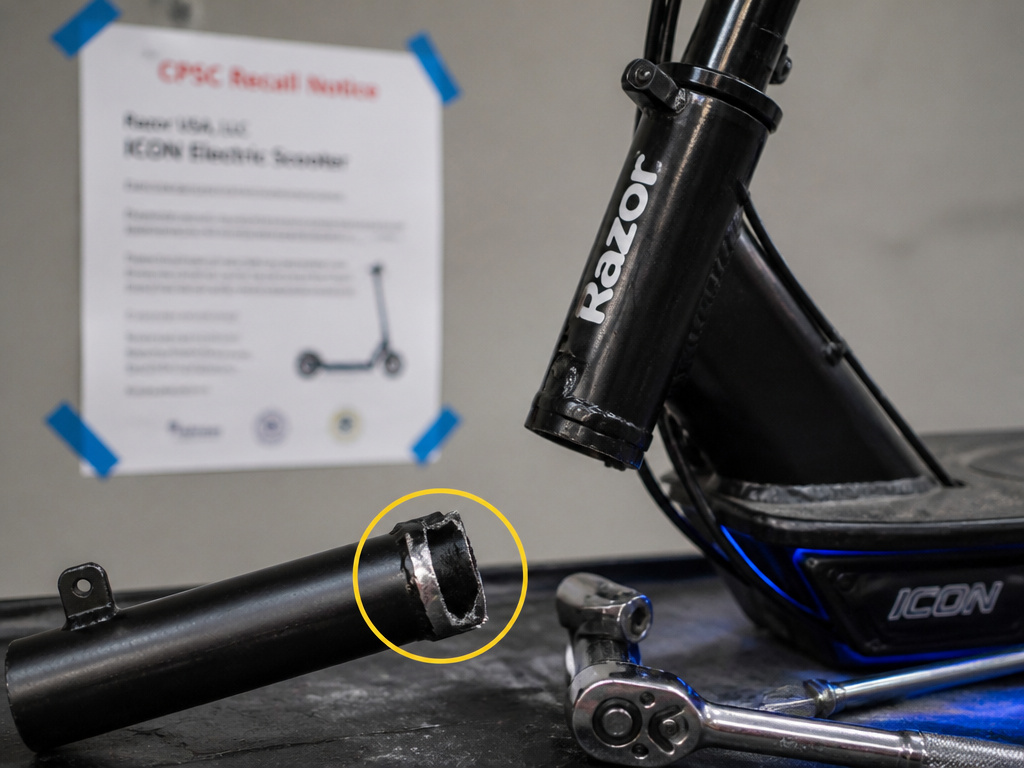
Safety isn’t an abstract concern with Razor. It’s documented in official government recalls that provide an essential layer of due diligence. Ignoring this history is how riders get hurt.
The U.S. Consumer Product Safety Commission (CPSC) has issued multiple recalls for Razor electric scooters over structural failures. The hazard is consistent: a weld breaks, leading to a detachment that causes loss of control.
- June 14, 2005: Razor recalled about 246,000 E200/E300 series scooters (models E300, E300S, E200, E200S) for handlebar weld failure. Models E100 and E125 were explicitly not included.
- October 5, 2007: A second recall for the same issue involved about 20,000 E300 scooters. Razor reported 25 incidents and 3 minor injuries at the time. Recalled units had barcodes beginning in 100620-03 through -09.
- July 25, 2024: A new failure mode emerged with the Razor Icon. The recall involved about 7,300 scooters due to downtube separation, with 34 incidents and 2 injuries (bruising) reported.
The remedy for the 2024 Icon recall is specific and tiered. Consumers with proof of purchase on or after March 11, 2023 get a full refund. All others get a choice of a $700 coupon or a $300 refund. The notice also mandates proper disposal: “Lithium-ion batteries should be disposed of in accordance with any local and state ordinances… Do not throw this battery in the trash.“
Before you start: Always check the CPSC recall database using your scooter’s model number before riding a used Razor. A free repair kit could prevent a catastrophic failure. This isn’t scare talk; it’s the lesson from 25 incidents in 2007 alone.
The manuals themselves are strict. The E Prime III manual states riders should be 18 years or older and always wear an approved safety helmet, elbow pads, and kneepads. It’s intended for use on flat, dry surfaces like pavement and explicitly warns: Do not ride your product in mud, ice, puddles or water.
One easily missed warning is thermal. The E Prime III has an operating temperature range of -20°C to 65°C (-4°F to 149°F), but its charge temperature range is only 0°C to 45°C (32°F to 113°F). The manual is absolute: Do not charge at or below 32°F (0°C). Leaving a cold scooter in an unheated garage overnight and plugging it in can damage the battery.
The safety posture is clear. Razor designs for ideal conditions and assumes protective gear. Deviating from that, riding in wet weather, skipping the helmet, buying a used model without checking for recalls, stacks risk against you.
Who Is a Razor Electric Scooter Actually For?
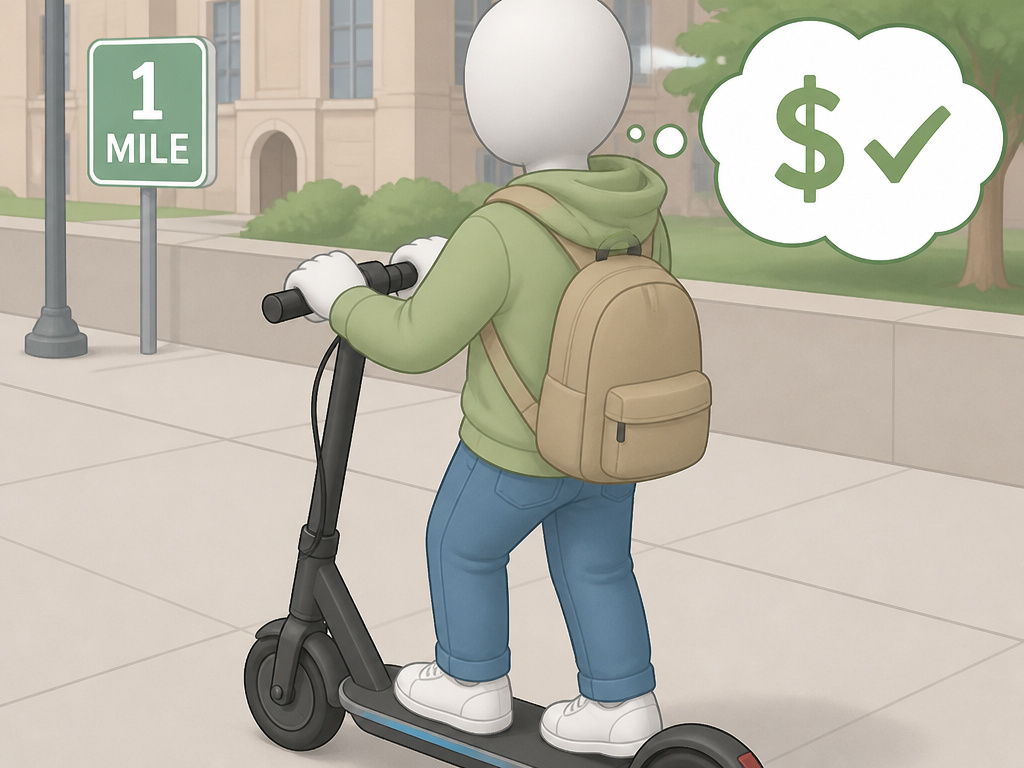
This is the decision point. After all the specs, reviews, and recalls, which person walks away happy with their purchase?
The Razor scooter fits you if:
- You need a simple, last-mile solution for a short, flat campus or urban commute.
- Your budget is tight, and the ~$400 range for an E Prime III is your ceiling.
- You weigh under 220 pounds and your daily round-trip is under 10 miles.
- You value brand recognition and the availability of official replacement parts over the latest performance.
- You are buying for a teenager and want a supervised, low-speed option (models like the E200).
Look elsewhere if:
- Your commute has hills, rough roads, or requires merging with traffic.
- You need a range over 12 miles or plan to use it daily for years.
- You are a heavier rider or need to carry a backpack with gear.
- Your budget can stretch to $500-$700, where more capable commuter scooters from brands like Segway begin.
- You want a quiet, smooth, hassle-free experience, the chain drive on older models and the solid tires create noise and vibration.
For the first group, the E Prime III is a defensible choice. It’s the one Razor model that feels like a legitimate, if basic, adult vehicle. For everyone in the second group, buying a Razor means compromising on a core need, power, range, comfort, or longevity. The online enthusiast communities are harsh for a reason; they’ve seen the compromises lead to frustration.
The brand’s own best Razor electric scooter page will highlight the E Prime III, and for good reason. It’s the only model in the current lineup that doesn’t feel like a time capsule from the early 2000s. When researching Razor scooter speed, you’ll see the stark gap between the E Prime III’s 18 mph and the E200’s 12 mph, a gap that represents two different product philosophies.
Maintenance, Charging & Long-Term Ownership
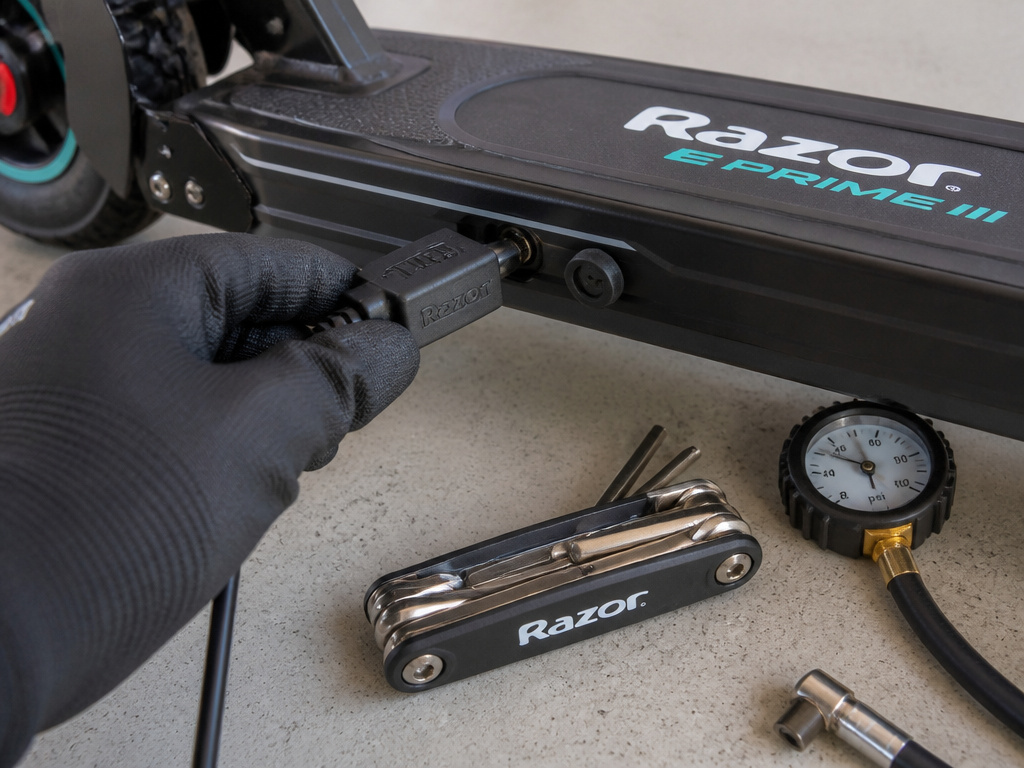
Owning a Razor scooter isn’t a set-and-forget proposition. The manual provides a framework, but real-world upkeep determines its lifespan.
Charging is the first ritual. The E Prime III uses a proprietary charger, and the manual is emphatic: Use only with the recommended charger. Unplug it when not in use. The 0°C to 45°C (32°F to 113°F) charge temperature limit is critical. Let the scooter reach room temperature before plugging it in after a winter ride. A full charge cycle is several hours, so plan accordingly. For other models, knowing how to charge a Razor scooter correctly is essential to preserving the battery, especially the older lead-acid types.
Tire maintenance is straightforward but important. The front pneumatic tire needs occasional pressure checks. The rear solid tire will wear flat spots over time, the manual tells you to check that the rear wheel is “free of flat spots from wear.” When the solid tire is done, replacing it is a job involving wrenches and patience, but you can follow Razor’s own guides.
The controller module and throttle are common failure points based on owner reports. The symptoms are clear: the power light turns on, but the scooter doesn’t move when you press the throttle. Diagnosis often means swapping parts, which is why access to those part replacement guides is a lifeline.
The brake is a simple cable-actuated brake that requires periodic adjustment. It needs periodic adjustment as the cable stretches. The manual instructs you to check that the “brake and lights are functioning properly” before every use. A soft brake is a dangerous brake.
Long-term, the battery is the consumable. Lithium-ion packs like the one in the E Prime III degrade with each charge cycle. After a few years, you might notice the range dropping from 10 miles to 7, then 5. Replacement batteries are a consumable part that will need to be replaced after several years of use. This is the hidden math of ownership: the upfront Razor scooter price is only part of the story.
If you can handle basic mechanical tasks and are comfortable with a multi-tool, you can keep a Razor running. If the thought of diagnosing an electrical fault makes you anxious, factor in the cost of a local repair shop, if you can find one that will work on it.
Razor model comparison: E90, E100, E200, and Power Core
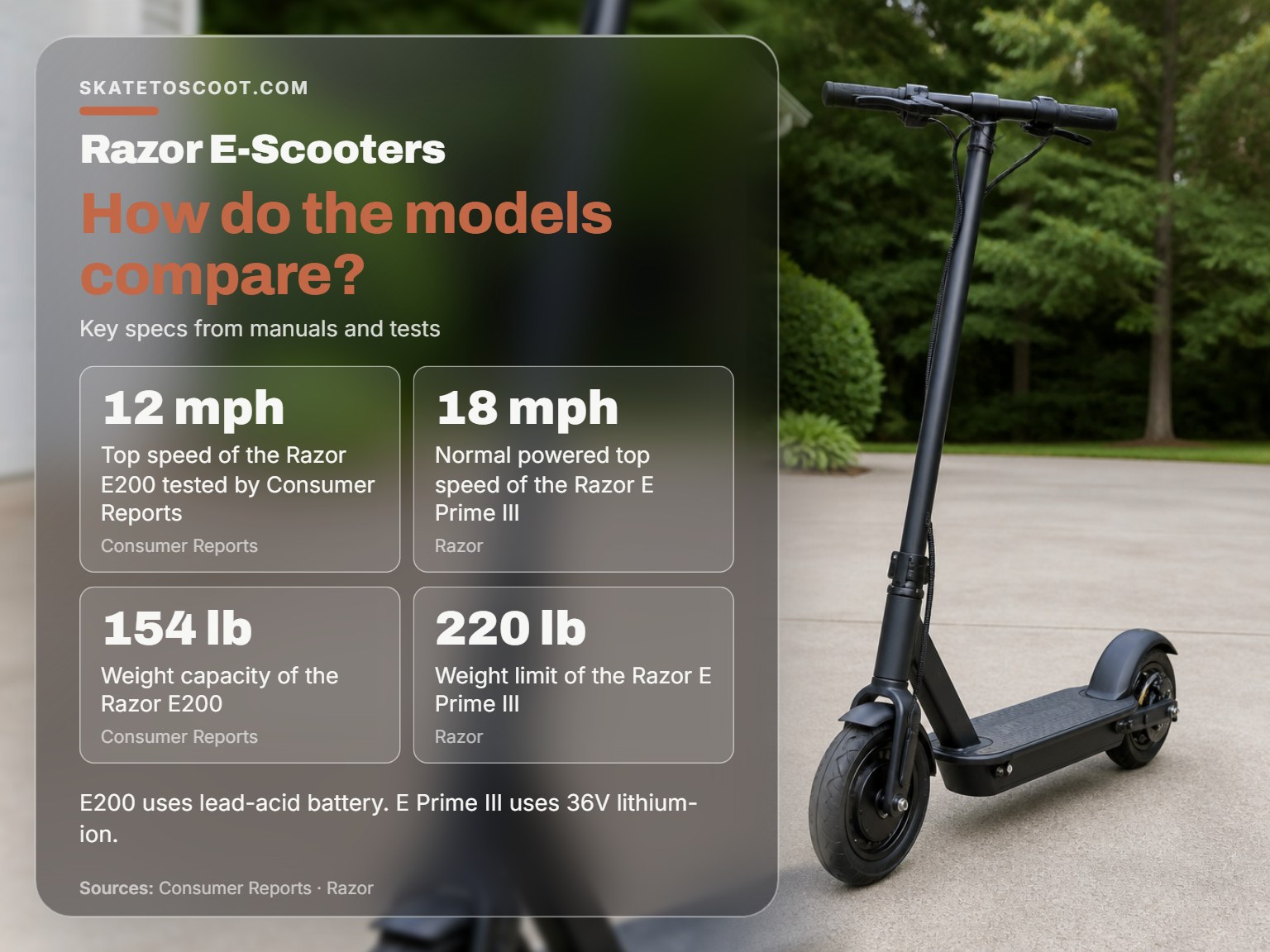
Razor’s lineup serves different riders. The E200, tested by Consumer Reports, hits a top speed of 12 mph and uses a lead-acid battery with a chain drive. It has a weight capacity of 154 pounds and its handlebars do not fold. The Power Core E100 shares a key feature with higher-end models like the E Prime III: its motor only engages once you’re moving at least 3 mph, a safety push-start. Older E200 and E300 models were subject to major recalls for handlebar weld failures, while models like the E100 and E125 were not included in those recalls, highlighting build differences across generations.
Assembly and setup for a Razor scooter
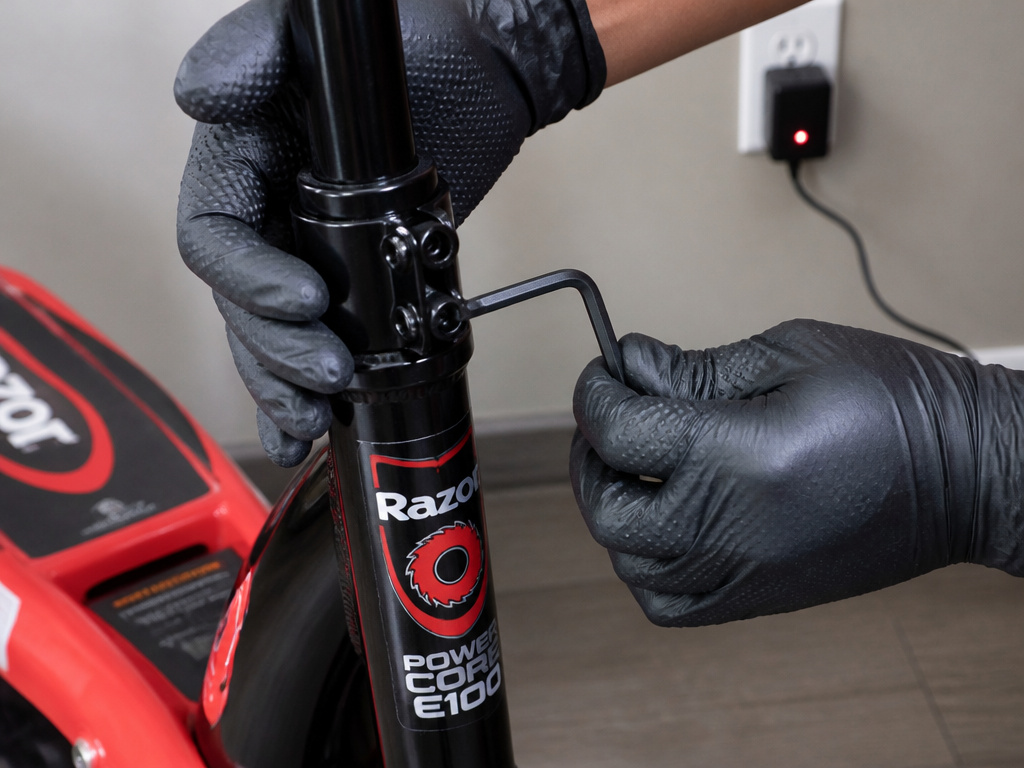
Unboxing a new Razor scooter typically requires minimal assembly. For models like the Power Core E100, the manufacturer estimates setup can take up to 10 minutes. This usually involves basic assembly steps like attaching the handlebars. Before the first ride, a full initial charge is critical. For some models like the PowerCore E100, the initial charge time is 12 hours, and the manual specifies to continue charging even if the light turns green. Always use only the charger that came with the scooter and ensure you charge in a temperature range of 0°C to 45°C (32°F to 113°F), never at or below freezing. Once assembled and charged, you’re ready for a test ride on a flat, dry surface.
Frequently Asked Questions
Are Razor electric scooters good?
It depends on the model and your needs. The Razor E Prime III is a good, basic scooter for light adult use on flat terrain. Older models like the E200 are not good for regular adult commuting; they are underpowered toys best for young teenagers. The brand has a mixed reputation due to this wide quality gap and a history of safety recalls.
Is Razor a good brand for scooters?
Razor is a good brand for kick scooters and entry-level electric scooters for kids. For serious adult electric scooters, it is not considered a top-tier brand. Enthusiasts and reviewers often point to better value and performance from brands like Segway, Xiaomi, or Gotrax in the same price range. Razor’s strength is brand recognition and widespread retail availability, not the latest engineering.
How long does a Razor e-scooter last?
There is no single answer. With proper care, avoiding crashes, regular charging, and storage in a dry, temperate place, the mechanical parts of a Razor scooter could last for years. The battery is the weak point. A lithium-ion battery in an E Prime III might provide reasonable range for 2-3 years of regular use before needing replacement. Lead-acid batteries in older models degrade much faster. Build quality issues, as seen in the recalls, can also cut a scooter’s life short.
Can adults ride Razor electric scooters?
Yes, but only specific models. The Razor E Prime III has a weight limit of 220 lb (100 kg) and is intended for riders 18 and older. Some reviews specifically call out its suitability for adult commuters. Other models, like the E200 with a 154-pound limit, are too small and underpowered for most adults. For a broader selection, you can look at our guide on the best Razor scooter for adults.
What is the best Razor electric scooter?
The best Razor electric scooter currently available is the E Prime III. It features a modern 36V lithium-ion battery, a top speed of about 18 mph, a 220 lb weight capacity, and a design that feels solidly built. It is the only model in the lineup that meets the basic needs of an adult rider for short-distance travel.
The Bottom Line
To be honest. The Razor E Prime III is a competent tool for a specific job: short, flat, urban hops. It’s not exciting, but it works. Every other Razor electric scooter is a compromise that most adults will regret.
The data forces a narrow recommendation. If your use case fits neatly inside the E Prime III’s specs, and you’ve checked the CPSC site to ensure your unit isn’t subject to a recall, you’ll likely be satisfied. You’ll also understand why the broader electric scooter reviews landscape is dominated by other brands.
For anyone else, the compromises add up. The dated technology, the rigid ride, the safety history, and the enthusiast community’s near-universal dismissal for regular use are too many red flags to ignore. Your money and your safety are better served by a scooter built from the ground up for adults, not a toy brand’s interpretation of one.
