How Fast Does a Razor Electric Scooter Go? Key Factors
This post contains affiliate links. As an Amazon Associate, we earn from qualifying purchases.
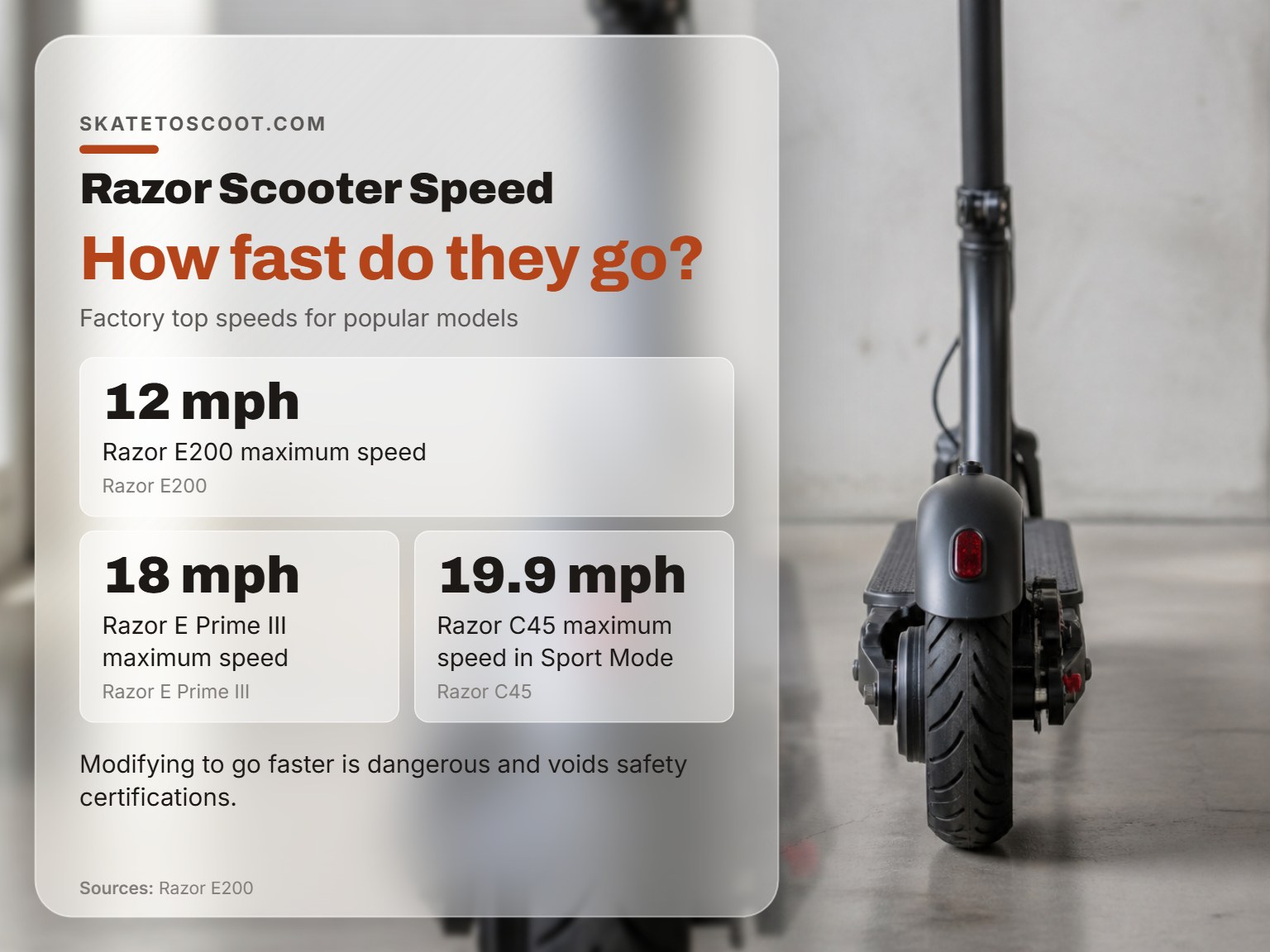
Razor electric scooter speeds range from 12 mph to 19.9 mph, depending on the model. The Razor C45 hits 19.9 mph, the E Prime III reaches 18 mph, and models like the E200 and Raven top out at 12 mph. These are manufacturer-stated maximums under ideal conditions; real-world speed is always lower.
That 19.9 mph figure for the C45 is a hard ceiling printed in the spec sheet. It’s not an average or an estimate, it’s the fastest the motor and controller are programmed to go on a flat surface in Sport Mode. This directly answers the question of how fast does a Razor electric scooter go in this model.
What follows: a breakdown of five key models by their verified specs, the three factors that drop your real speed below the advertised number, and the one legal limit that overrides everything else, even if your scooter could go faster, which is the ultimate answer to how fast does a Razor electric scooter go.
Key Takeaways
- Razor scooter speeds span 12 to 19.9 mph, with the C45 as the fastest and the E200/Raven as the slowest in the mainstream lineup.
- You must kick-start to at least 3 mph (5 km/h) before the motor engages on most models, a safety feature that prevents sudden, uncontrolled acceleration from a standstill.
- Rider weight and terrain reduce advertised speed. A rider near the scooter’s weight limit on an incline will not hit its advertised top speed.
- Lithium-ion batteries (C45, E Prime III) hold voltage better under load than sealed lead-acid (E200), which means less speed drop-off as the battery drains.
- Local laws often cap operational speed below a scooter’s capability. In New York State, for example, the law defines an electric scooter as having a maximum speed of no more than twenty miles per hour, but it is illegal to operate one in excess of fifteen miles per hour.
Razor Model Speed Comparison: C45, E Prime III, E200, Raven
You have four main lanes in the current Razor lineup, each with a different performance envelope. The difference isn’t just speed, it’s motor type, battery chemistry, and intended rider age. A quick glance tells you which scooter fits which job.
Comparing a 450-watt hub-drive scooter to a 200-watt chain-drive model is like comparing a road bike to a beach cruiser when you ask how fast does a Razor electric scooter go. They’re built for different purposes. The table below pulls numbers straight from Razor’s official product pages and manuals.
| Model | Max Advertised Speed | Motor & Drive | Battery | Key Rider Fit |
|---|---|---|---|---|
| Razor C45 | 19.9 mph (32 km/h) | 450W brushless hub motor | 46.8V lithium-ion | Teens & adults; longest range, fastest speed. |
| Razor E Prime III | 18 mph (29 km/h) | 250W brushless hub motor | 36V, 5.2Ah lithium-ion | Adults & older teens; commuter-style, 15-mile range. |
| Razor E200 | 12 mph (19 km/h) | 200W chain-driven motor | 24V sealed lead-acid | Older kids & teens; classic Razor design, lower cost. |
| Razor Raven | 12 mph (19 km/h) | 170W brushless hub motor | Not specified (lithium-ion assumed) | Younger riders; lightweight, compact frame. |
The C45 is the performance pick. Its 450-watt brushless hub motor and 46.8V lithium-ion battery are built for sustained speed. The E Prime III trades some top speed for a more polished commuter design and a rated 15-mile range. For a detailed look at how these models stack up beyond speed, our Razor scooter comparison breaks down weight limits, features, and real-world use cases.
The E200 and Raven sit in the 12 mph bracket, but their engineering differs. The E200 uses a chain drive, which is simpler but can be louder and requires more maintenance than a hub motor. The Raven’s 170-watt hub motor is lighter and quieter, better suited for a younger rider’s first electric scooter. If you’re looking for the absolute best option in this category, our guide to the best Razor electric scooter dives deeper.
The 3-5 mph Kick-Start Rule Nobody Mentions
Your scooter won’t just go when you press the throttle. Every Razor manual I’ve read includes a specific line: the scooter “must be moving at least 3 mph (5 km/h) before the motor will engage.” This isn’t a glitch. It’s a deliberate safety feature to prevent a sudden, uncontrollable lurch if the throttle is accidentally pressed while standing still.
You have to kick-start it like a traditional scooter first. Get a rolling start, then press the throttle. The motor will catch, and you’re off. Skip this step, and you’ll just hear a faint whirring sound as the motor spins helplessly, no movement.
The part nobody mentions: This kick-start requirement means your scooter’s true “zero to top speed” time includes a human-powered push. On a slight uphill, if you don’t get a solid push past 3 mph, the motor may struggle to engage properly, leaving you kicking again.
This design protects the motor and controller from the high current draw of starting under a full load from zero RPMs. It’s a smart bit of engineering that extends the scooter’s life, but it’s the first thing new riders get wrong. They stand still, twist the throttle, hear a noise, and think the scooter is broken. It’s not. You just need a running start.
What Affects Your Real-World Speed?
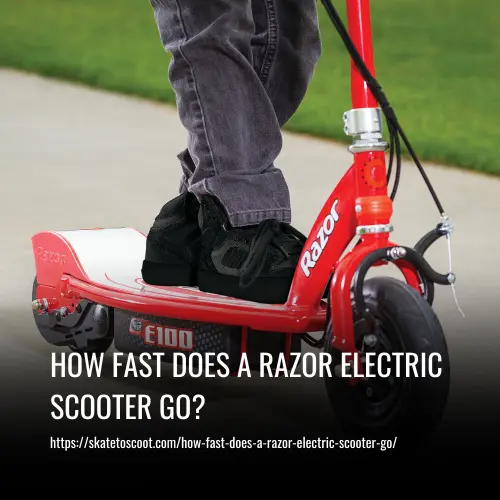
Advertised speed is a lab number. Your speed is what happens on your driveway, with your weight, on your battery’s current charge. Three things pull it down every time.
1. Rider Weight. This is the biggest factor. The E Prime III manual lists a 220 lb (100 kg) weight limit. The motor has to work harder to accelerate and maintain speed as you approach that limit. A 120 lb rider will hit a higher top speed on the same scooter than a 200 lb rider. The effect isn’t linear; approaching or exceeding the scooter’s weight limit will reduce its top speed, especially on an incline. For a broader look at how weight and other variables affect all scooters, see our general guide on electric scooter speeds.
2. Terrain and Incline. A “paved level surface” is the test condition for all advertised speeds. Add a slight hill, and your speed drops immediately. The manual for the E Prime III states its “normal powered top speed… Can be affected by conditions, such as rider weight, inclines and battery charge level.” Even a slight incline will reduce your speed.
3. Battery Charge and Chemistry. A full battery provides full voltage. A half-drained battery provides less. This is where battery type matters dramatically. Lithium-ion batteries (like in the C45 and E Prime III) maintain a more stable voltage as they drain. Sealed lead-acid batteries (like in the E200) see a more pronounced voltage sag under load. A sealed lead-acid battery (like in the E200) experiences more voltage sag under load than a lithium-ion battery (like in the C45), which can affect speed as the battery drains.
The Legal vs. Mechanical Speed Edge Case
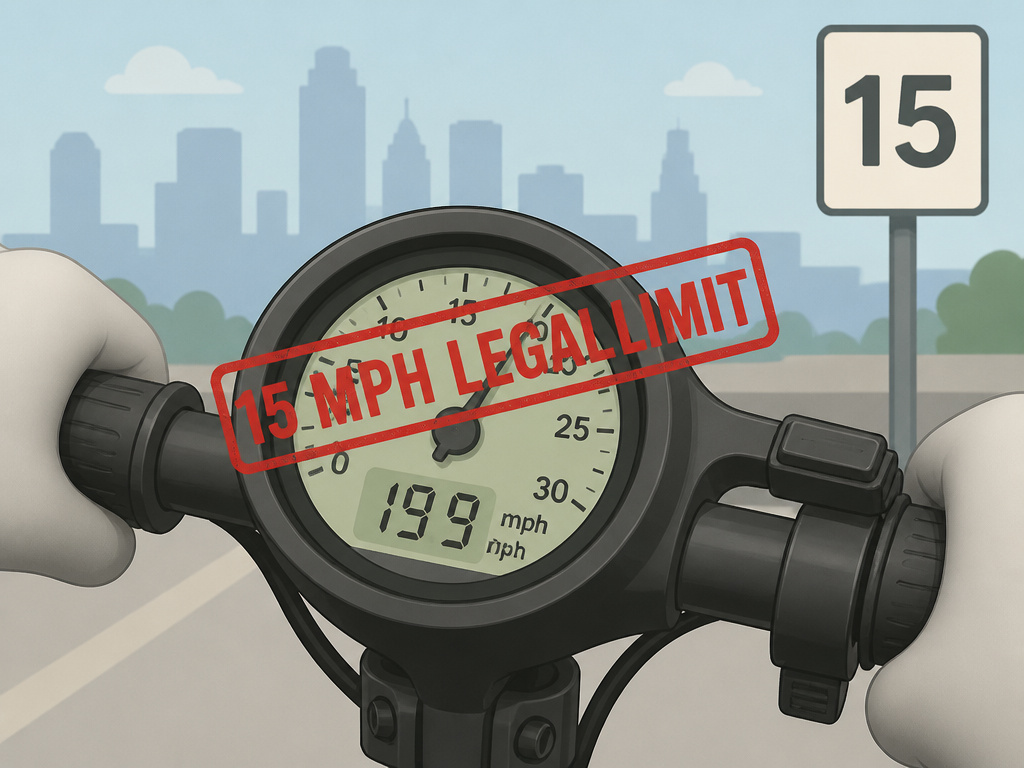
Your scooter can mechanically go 19.9 mph. That doesn’t mean you can legally ride it at that speed. This is the edge case that most buying guides ignore, and it’s where you can get a ticket.
Take New York State. The NY DMV electric scooter regulations define an electric scooter as a device with a “maximum speed of no more than twenty miles per hour.” But in the next breath, they state: “It is illegal to operate an electric scooter… In excess of fifteen miles per hour.” So a Razor C45, sold as a 19.9 mph scooter, is legal to own but illegal to operate at its full capability in New York.
Where this goes sideways: You buy the fastest scooter for your commute, only to find your local laws cap speed at 15 mph. Your 19.9 mph scooter is now a liability, not an advantage.
This isn’t just a New York quirk. Cities and states across the U.S. Are implementing similar caps, often between 15 and 20 mph. Always check your local ordinances before deciding which model’s top speed is right for you. The mechanical limit and the legal limit are two different numbers, and the lower one wins.
Can You Make a Razor Scooter Go Faster?
The forums are full of it. Someone asking how to squeeze 20 mph out of an E200. The short answer is: you can, but you shouldn’t. The longer answer involves understanding why these scooters are built to a price and a safety standard.
Modification usually means swapping the motor, controller, and battery. On a chain-drive model like the E200, this might be theoretically possible for a hobbyist with electrical skills. Modifications that drastically increase power are dangerous on a frame not designed for it. However, the consensus among experienced modifiers is clear: “It’s a cheap Razor which is not worth modding.” The cost and risk outweigh the benefit. For those still curious about the process, we explore the topic in our article on how to make a scooter faster.
Common mistake: Upgrading the battery without upgrading the motor and controller. This can overload the stock electrical system, leading to melted wires, controller failure, or in worst cases, a battery fire.
The factory speed is also tied to certification. Modifying a scooter’s electrical system may void safety certifications and create a hazard. This is a critical safety standard for the drive system and battery. Any modification voids that certification and any related product liability. You’re on your own.
If you need more speed, buy a scooter designed for it from the start. The engineering, brakes, and frame are matched to the higher performance. Jumping from a 12 mph E200 to an 18 mph E Prime III is a smarter, safer upgrade than trying to hack the E200 to 15 mph. If your target is around the 20 mph mark, looking at models specifically designed for that pace, like those in our list of the best 20 mph electric scooters, is the responsible path.
Safety Gear and Practices at Speed

Speed multiplies risk. Razor’s manuals are uncompromising on this, and they should be. The instructions for the E100 and E Prime III are nearly identical on the fundamentals: wear a helmet, wear closed-toe shoes, don’t ride at night, and don’t ride on wet surfaces.
The faster your scooter goes, the less room for error you have. The risk of injury increases with speed. The E Prime III manual explicitly warns, “Do not touch the brakes or motor on your scooter when in use or immediately after riding, as these parts can become very hot.” That’s a specific, physical consequence of the energy required for higher speeds.
Here’s a quick pre-ride checklist, adapted from the manuals:
- Helmet: Always. Always. A long-sleeved shirt and pants are recommended.
- Shoes: Lace-up athletic shoes. “NEVER RIDE BAREFOOTED OR IN SANDALS.”
- Brake Check: Squeeze the lever before riding. It should engage smoothly and stop the scooter.
- Tire Pressure: Check it. A soft tire increases rolling resistance and lowers your top speed.
- Clear Path: Ride on “flat, dry surfaces… Without loose debris.” Avoid sand, gravel, and wet pavement.
Ignoring these turns a fun ride into a preventable accident. The manual for the E100 puts it bluntly: “Prolonged exposure to UV rays, rain and the elements may damage the enclosure materials, store indoors when not in use.” A scooter left outside won’t just look bad; its plastic can become brittle, its connectors can corrode, and its performance, including its ability to maintain top speed, will degrade.
How fast are specific Razor scooter models?
Different Razor models are built for different speeds. The E200 model has a maximum speed of 12 mph. The E Prime III reaches a normal powered top speed of approximately 18 mph. The C45 model can go up to 19.9 mph when set to its Sport Mode. These speeds are the factory maximums under ideal conditions. The motor type and battery power vary between these models, which directly influences their top performance. Always check the official specifications for the exact model you own or are considering.
Do age and weight affect scooter speed?
Manufacturer recommendations on age and weight are crucial for safety and performance. For example, the Razor E Prime III manual recommends that children under the age of 18 not be permitted to use it. Exceeding the stated weight limit can strain the motor and battery, reducing speed and range. Heavier riders may find the scooter accelerates more slowly and has a shorter ride time. Always follow the age guidelines and do not exceed the posted weight limit to ensure the scooter operates as intended and lasts longer.
Frequently Asked Questions
Which Razor scooter goes 80 mph?
None. Razor does not manufacture any electric scooter that goes 80 mph. Their fastest consumer model, the C45, has a maximum speed of 19.9 mph. Claims of 80 mph would refer to heavily modified, custom-built electric scooters or other brands’ high-performance models, which are in a completely different category of vehicle.
Is 20 mph on a scooter fast?
Yes, 20 mph is fast for a personal electric scooter. It’s roughly the speed of a city cyclist. At this speed, reaction time is critical, full safety gear is essential, and you must ride defensively. For context, many local laws set the maximum legal operating speed for scooters between 15 and 20 mph because beyond that, the risk of serious injury in a crash increases significantly.
How fast can a Razor E300 go?
The research provided does not include current specifications for an E300 model. The research provided does not include specifications for an E300 model. However, for accurate, current specs on any Razor model, always refer to the official Razor.com product page or the owner’s manual, as details can change between model years.
Why does my Razor scooter feel slower than advertised?
Three likely reasons: weight, battery, and terrain. If you’re near the scooter’s weight limit, your speed will be lower. If the battery is not fully charged or is aging, voltage sag reduces power. If you’re riding on anything other than a perfectly flat, smooth surface, you’re fighting incline and rolling resistance. Also, remember the kick-start rule, if you’re not pushing the scooter to at least 3 mph (5 km/h), the motor may not engage fully.
Can I use a Razor scooter on the road?
It depends entirely on your local laws. In many jurisdictions, electric scooters are allowed on bike lanes and roads with speed limits under 25-35 mph, but they are prohibited on sidewalks. Some states, like New York, have specific statutes governing their use. You must check with your city’s transportation department or local DMV. Never assume it’s legal, fines for riding in the wrong place can be steep.
Before You Go
The number on the box is a best-case scenario, not a promise. A Razor C45 will only hit 19.9 mph with a light rider, a full battery, on a flat lab floor. Your driveway, your weight, and your local speed limit form the real ceiling.
If you’re buying for a teenager who just wants to zip around the neighborhood, a 12 mph E200 or Raven is plenty, and it keeps them within most legal limits. If you’re an adult commuter looking for the fastest, most capable Razor, the C45 is your pick, but ride it with the understanding that 15 mph might be the law. For a full evaluation of these options, our detailed Razor scooter review can help finalize your decision.
One rule I’ve learned from coaching: control beats speed every time. Master the scooter you have at 12 mph before you wish for 20. The right technique, braking, turning, weight distribution, makes any ride safer and more fun, regardless of the number on the speedometer.
