Can You Put Longboard Trucks on a Cruiser? Step-by-Step
This post contains affiliate links. As an Amazon Associate, we earn from qualifying purchases.
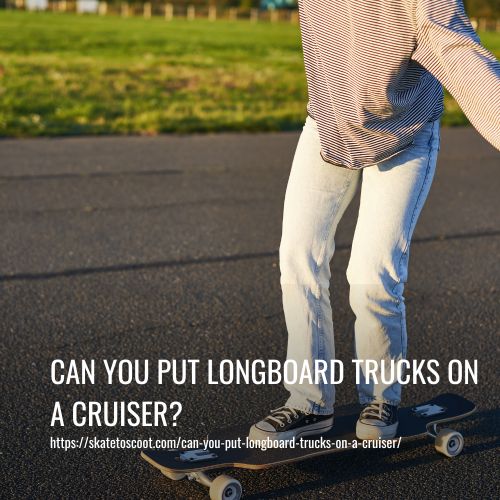
Yes, you can physically mount longboard trucks on a cruiser deck, but it requires checking three things: bolt pattern compatibility, truck axle width, and the kingpin direction. This turns your board into a hybrid setup, raising the ride height and shifting the feel from quick tricks to stable cruising.
The physical swap is the easy part. The real question is whether you’ll like what you’ve built. A cruiser with longboard trucks handles differently, it’s taller, leans deeper, and rolls over cracks your old setup would have bucked on. That stability comes at the cost of pop and the quick-twitch response you use for street tricks. Before you start, you might ask, can you put longboard trucks on a cruiser?
What follows is a step-by-step guide to the swap, the tools you’ll need, and what to expect from the new ride. We’ll also break down where the guides disagree, specifically on whether Reverse Kingpin trucks are ideal for a small cruiser, so you can make an informed choice, not just follow a generic tutorial.
Key Takeaways
- Check your deck’s bolt pattern first. An “Old School” pattern (2.5″ x 1.625″) limits your truck choices more than a “New School” (2.125″ x 1.625″) or double-drilled deck.
- Match the axle width to your deck width. The rule is to keep the difference under 1/4 inch. A 150mm truck fits an 8.5″ or narrower deck; 180mm fits wider decks.
- You will almost certainly need riser pads. Longboard trucks and larger wheels raise the deck. For 58mm wheels, start with 1/4″ risers; for 71mm wheels, you may need 1/2″ or 3/4″.
- Reverse Kingpin (RKP) trucks face outward. When mounting them, the kingpin bolt should point away from the center of the board, the opposite of standard skateboard trucks.
- This swap creates a dedicated cruiser. The higher ride height and different steering geometry make ollies and flip tricks much harder, if not impossible.
The Physical Compatibility Check (Bolt Patterns)
Before you buy anything, flip your cruiser deck over. You’re looking for the holes where the trucks bolt on. There are two standards, and they are not interchangeable without a drill.
The “Old School” pattern measures 2.5 inches lengthwise and 1.625 inches widthwise. The “New School” pattern is 2.125 inches by 1.625 inches. Some decks have both sets of holes, a 6 or 8-hole pattern, which gives you options for wheelbase adjustment.
A deck with only an Old School pattern limits you to using vintage street trucks or certain longboard trucks. This is the first physical compatibility edge case. If your deck has these and your chosen trucks don’t, you’re drilling new holes.
Most modern street and cruiser decks use the New School pattern. Many longboard trucks are drilled for it, but not all. Brands like Gullwing and certain Independent models (like the 159 and 169) are double-drilled for both patterns. Paris trucks typically use the New School spacing. Your first job is to lay the truck baseplate over your deck’s holes. If they line up, you’re golden. If not, you’re either picking a different truck or reaching for a power drill, which brings its own risks of splintering the ply or weakening the deck.
TL;DR: New School pattern (2.125″ x 1.625″) is the modern standard. Old School (2.5″ x 1.625″) is a compatibility hurdle. Check before you buy.
Truck Width: Matching Your Deck
Truck width isn’t about looks; it’s about stability and wheelbite. Tactics recommends the axle width be as close to the deck width as possible, with a difference of less than 1/4″. However, sources disagree on the ideal width: SkatePro states 150mm fits best with most cruisers, while Ridingboards ties width to deck size.
Get this wrong, and you’ll either have wheels sticking out awkwardly, increasing the chance of catching a curb, or wheels tucked too far under, where the deck can bite into them during a deep carve.
| Deck Width | Recommended Truck Axle Width | Common Use Case |
|---|---|---|
| 8.5″ or narrower | 150mm (approx. 5.9″) | Carving, transportation, freestyle |
| Wider than 8.5″ | 180mm (approx. 7.1″) | Downhill, freeride |
Sources provide different recommendations: SkatePro states 150mm fits best with most cruisers, while Ridingboards recommends 150mm for decks 8.5″ or narrower and 180mm for wider decks. A 150mm truck on an 8.0″ deck will have some deck overhang, which may be within the recommended tolerance of less than 1/4″ difference. That’s within tolerance. A 180mm truck on that same deck would have the wheels protruding nearly an inch, a setup that feels clumsy for carving and makes speed wobbles more likely.
There’s also a clever exception. SkatePro sells a “Standard Forged Longboard Truck” with a replaceable axle-system. The same hanger can run 160mm, 170mm, or 180mm axle widths with extra axles sold separately. It’s a 40-degree baseplate model intended for cruiser, race, and freeride setups. That’s a solid option if you’re experimenting and want to dial in the width later.
The Kingpin Debate: RKP vs. SKP for a Cruiser
This is where the sources don’t agree, and your choice dictates the entire character of your build.
Standard Kingpin (SKP) trucks are the traditional skateboard design. The kingpin faces inward, toward the board’s center. They sit lower and, according to Tactics, are “ideal for smaller longboard cruisers” because of that low ride height and smaller size.
Sources disagree on which truck type is ideal for a cruiser, a core part of the can you put longboard trucks on a cruiser question. Tactics states Standard Kingpin (SKP) trucks are ideal for smaller cruisers and RKP trucks aren’t ideal for smaller cruisers with kicktails. Boardcoast calls RKP trucks the most common choice. SkatePro says there are no set rules and you can use either. Yocaher notes smaller boards sometimes benefit from conventional skateboard trucks for urban settings.
Common mistake: Assuming all “longboard trucks” are the same. RKP and SKP are fundamentally different designs. Putting a tall, stable RKP truck on a short, kicktailed cruiser deck creates a mismatched feel, it’s like putting truck tires on a sports car.
My take? If your cruiser deck has a wheelbase under 20 inches and you’re mostly commuting on city streets, an SKP truck (or a quality “cruiser” truck) will feel more natural. It’ll be lower, easier to push, and preserve some pop. If you have a longer deck, plan to carve hills, or simply want maximum stability, then RKP is your choice. Just know you’re committing to a pure cruiser role.
Tools and Parts You’ll Need
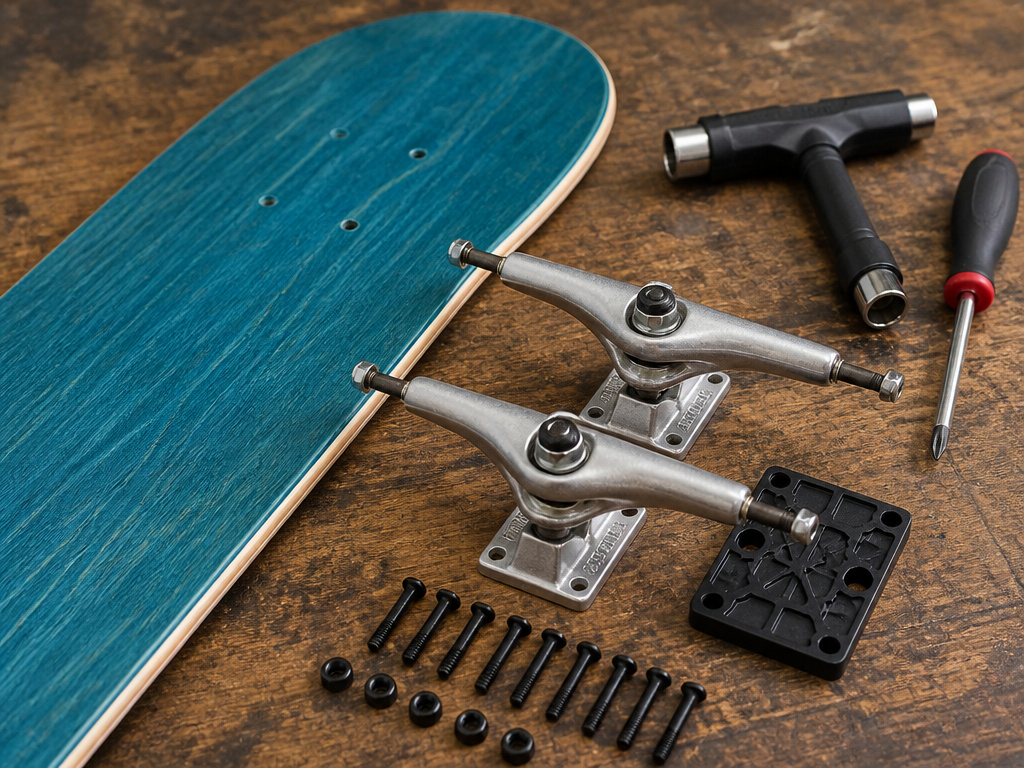
Gathering the right parts before you start saves a trip to the shop mid-project. Here’s your checklist:
- The Trucks. Your chosen RKP or SKP set, width-matched to your deck.
- Riser Pads. You will likely need these. For 58mm street-style wheels, start with 1/4″ risers. For larger longboard wheels (e.g., 71mm), you may need 1/2″ or 3/4″ risers to prevent wheelbite. Hard risers are more durable; soft shock pads dampen vibration but compress.
- Hardware. Longer bolts. Your standard skate hardware won’t be long enough once you add riser pads. Get 1.5″ or 2″ mounting bolts.
- Wheels. You can use your existing cruiser wheels, but this is a prime chance to go bigger for a smoother ride. Just remember, bigger wheels need taller risers.
- Tools. A 3/8″ or 1/2″ skate tool (for the kingpin and axle nuts), a Phillips-head screwdriver, and possibly a drill with a 1/4″ bit if you need to modify hole patterns.
Having everything laid out means you can complete the swap in one focused session instead of running around looking for longer bolts.
Step-by-Step Installation Guide
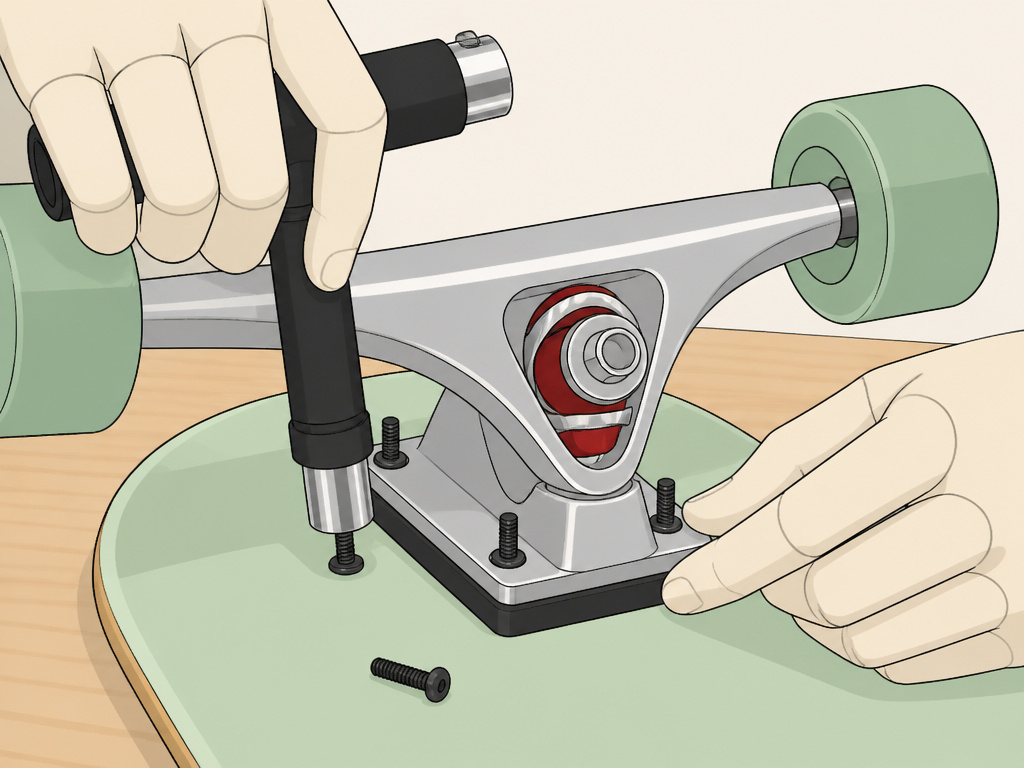
Follow this sequence. Rushing leads to cross-threaded bolts or trucks mounted backwards.
- Remove the Old Trucks. Use your skate tool to loosen the axle nuts and remove the wheels, then unscrew the four mounting bolts. Set the old trucks aside.
- Test Fit the New Trucks. Without any hardware, place the new truck’s baseplate over the deck’s mounting holes. Verify the holes align. If they don’t, stop. You must decide to drill new holes (carefully, with a pilot hole) or choose different trucks.
- Install Riser Pads. If using risers, place them over the mounting holes. They often have a small nipple that fits into the deck hole to prevent slipping.
- Orient the Trucks Correctly. This is critical. For Reverse Kingpin (RKP) trucks, the kingpin must face outward, away from the board’s center. For Standard Kingpin (SKP) trucks, the kingpin faces inward. Getting this wrong completely reverses the intended steering geometry.
- Insert Hardware and Hand-Tighten. Put your longer mounting bolts through the truck baseplate, riser, and into the deck. Start all four bolts by hand to avoid cross-threading.
- Secure the Trucks. Using your screwdriver and skate tool, tighten the bolts firmly in a star pattern. Don’t crank them with all your might, you can strip the wood or crack the riser. Snug is secure.
- Mount Wheels and Bearings. Put your bearings and spacers into your wheels, slide them onto the axles, and secure with the axle nuts. Leave a tiny bit of wiggle, the wheel should spin freely without side-to-side play.
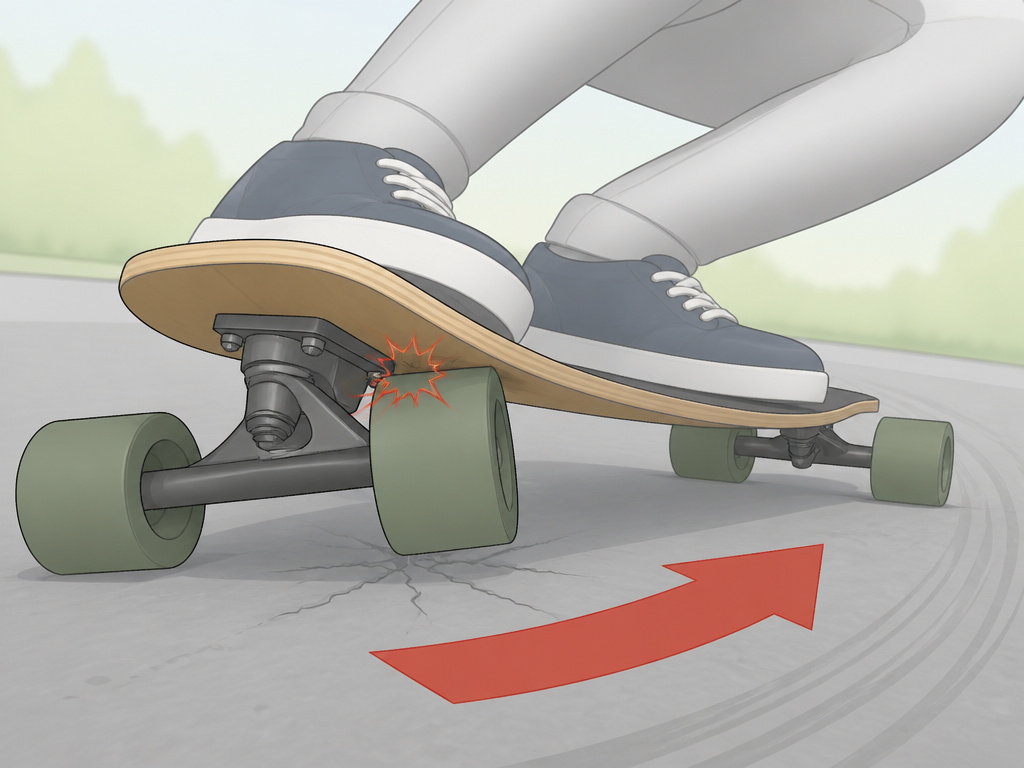
- Check for Wheelbite. Before you ride, lean on the board heavily in both directions. Listen and look. If the wheel touches the deck, you need taller riser pads. This is essential for safety.
How the Ride Changes (And What You Lose)
The swap is done. Now you have a hybrid. Be clear about what that means.
You gain stability and smoothness. The longer lever arm of an RKP truck, especially, gives you a deeper, more progressive lean. It carves like a dream and rolls over pebbles and cracks that would have stopped your old setup cold. The ride is calmer, more suited for distance.
You lose pop and trick capability. The increased ride height from the trucks and risers moves your center of gravity up. Ollies become a physics problem. That higher pivot point also changes how the board flicks for kickflips or heelflips. The board is now a dedicated cruiser.
Where this goes sideways: Not adding riser pads for larger wheels. The deck bites the wheel during a hard turn, locking it up and sending you over the front. This happens at low speed, and the pavement is unforgiving.
The turning feel is different, too. SKP trucks are twitchier; RKP trucks require more commitment to initiate a turn but hold a line better. This is where bushing tuning becomes your best friend. A set of softer, barrel-shaped bushings can make an RKP truck turn quicker for city navigation, while harder bushings will stabilize it for hills.
Tuning Your Hybrid Setup
Your work isn’t over after the bolts are tight. This is where you dial in the feel.
- Bushings are your tuning knobs. Most stock bushings come in a medium durometer. If the truck feels too stiff and unresponsive, swap in a softer bushing set. If you’re getting speed wobbles or it feels too divey, try harder bushings. Our guide on choosing longboard bushings breaks this down further.
- Kingpin tightness is key. Loosen the kingpin nut a quarter-turn at a time. The truck should rebound on its own when you lean the deck and let go. If it doesn’t, it’s too tight. If it feels sloppy and vague, tighten it slightly.
- Wheelbase adjustment. If your deck has multiple hole patterns, moving the trucks closer together shortens the wheelbase for quicker turns. Moving them apart lengthens it for stability. Each shift changes where the wheel sits relative to the deck’s curve, so re-check for wheelbite every time.
The goal is a board that feels like an extension of your feet, not a compromise. It might take a few sessions of minor adjustments to get there.
Frequently Asked Questions
Is a longboard and a cruiser the same thing?
No. While both are for getting around, a longboard is typically longer (over 36″) and built for stability, speed, and deep carving. A cruiser is shorter (often under 32″), more portable, and designed for quick, agile turns in urban environments. A full longboard vs. Cruiser comparison provides more details.
Can I still ollie on a cruiser with longboard trucks?
It becomes extremely difficult, bordering on impossible for most riders. The higher ride height changes the board’s feel and pop point. The board is transformed into a pure cruiser, sacrificing trickability for stability and ride quality.
Do I need special tools to install longboard trucks on a cruiser?
Standard skate tool and a Phillips screwdriver are the essentials. You’ll only need a drill if the truck’s bolt pattern doesn’t match your deck’s holes, a scenario you should try to avoid by checking compatibility first.
Will using longboard trucks damage my cruiser deck?
Not if installed correctly with the right hardware. The risk comes from drilling new mounting holes incorrectly (splintering the ply) or overtightening the mounting bolts, which can crush the wood around the holes. Follow the installation steps for longboard trucks carefully to avoid this.
Can I use my existing cruiser wheels with longboard trucks?
Yes, you can. The swap is about the trucks. However, this is a perfect opportunity to explore slightly larger, softer wheels for an even smoother ride, as the longboard trucks are designed to accommodate them. Just remember to pair them with appropriate riser pads to prevent wheelbite.
The Bottom Line
You can absolutely put longboard trucks on a cruiser. The process is straightforward if your deck’s bolt pattern matches and you respect the width-matching rule. But this isn’t a simple upgrade; it’s a conversion.
You’re building a dedicated, smooth-rolling commuter. If your goal is to keep the board’s trick potential while gaining a little stability, you’re looking at the wrong modification. A better path might be using longboard wheels on a skateboard with your existing trucks and some riser pads.
If you’ve decided to go for it, commit to the tuning. Start with the recommended 150mm trucks for a standard deck, use risers from day one, and don’t be afraid to experiment with bushings. The result, when dialed in, is a uniquely fun hybrid that carves like a dream and laughs at rough pavement. Just know what you’re signing up for before you reach for the skate tool.
