Can You Ride a Hoverboard Outside? The 250-Incident Rule
This post contains affiliate links. As an Amazon Associate, we earn from qualifying purchases.
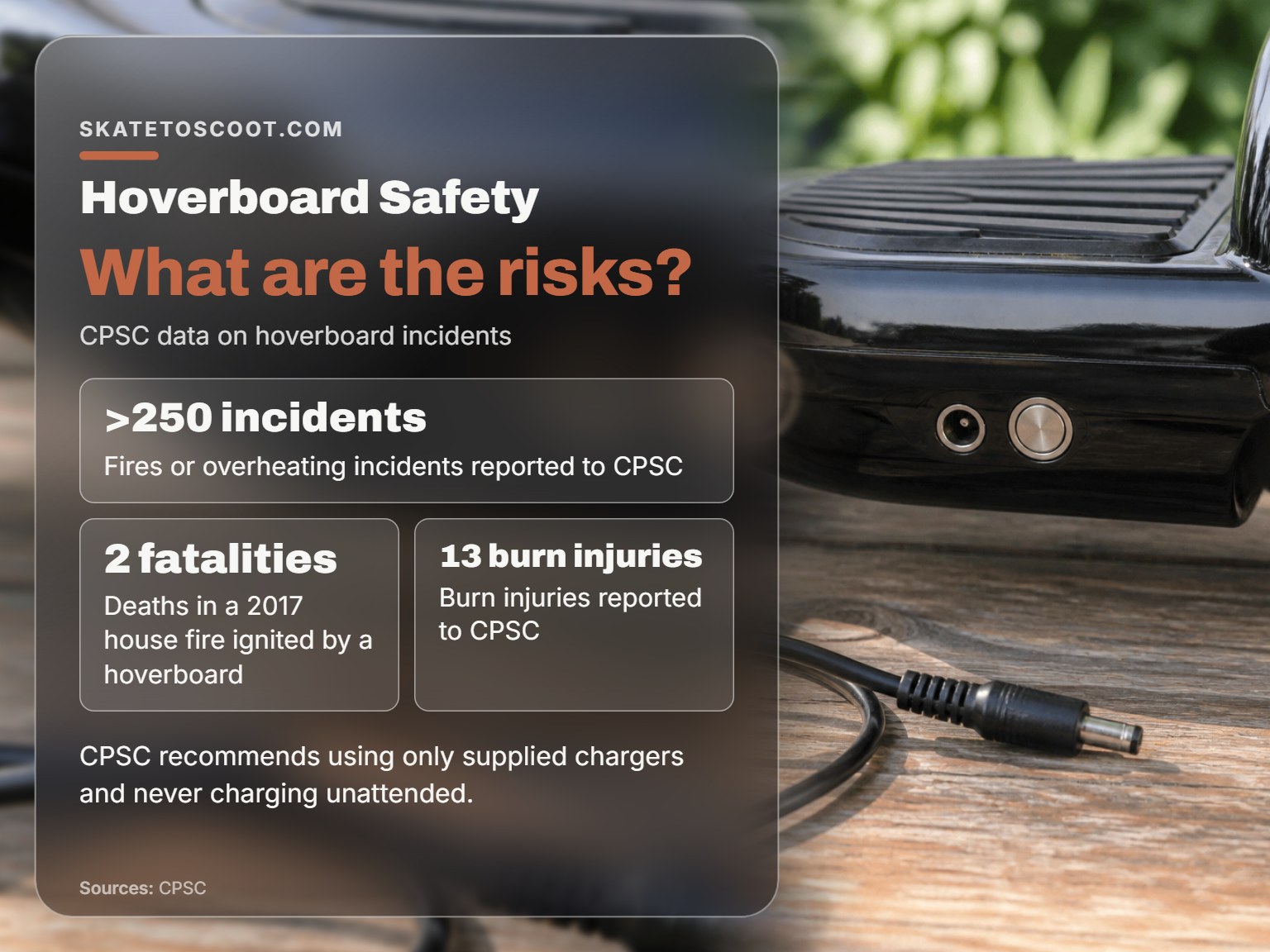
Yes, you can ride a hoverboard outside, but the terrain, temperature, and your board’s UL 2272 certification decide whether you should. Standard models top out at 6.2 mph, handle smooth pavement, and fail on wet grass or in cold storage below 32°F. The U.S. Consumer Product Safety Commission (CPSC) has tracked more than 250 fire and overheating incidents, including two fatal house fires, making charger vigilance and certification checks essential for outdoor use.
That number, 250 incidents, forms the baseline for why every outdoor ride starts with a mandatory safety check. A hoverboard isn’t just a toy; it’s a personal e-mobility device with a lithium-ion battery pack that reacts to heat, cold, and physical stress. Riding it outside changes all three variables, which is why you must ask, can you ride a hoverboard outside, with care.
What follows: a breakdown of the official specs that matter, the terrain limits you’ll hit first, the legal grey zone you’re riding into, and the maintenance routine that adds months to your board’s life. By the end, you’ll know exactly where your board can go, how fast it’ll get there, and what to do when you compare a can you ride a hoverboard outside scenario.
Key Takeaways
- Check for a UL 2272 certification mark on the packaging and a holographic label on the board’s bottom, boards sold before January 29, 2016, aren’t compliant, and component-level “UL-compliant” claims are worthless.
- Charge only with the supplied charger while you’re present, never unattended or overnight; CPSC data links over 250 fire incidents to these boards.
- Standard wheels are for smooth surfaces only; expect a top speed of ~6.2 mph, which is slower than bicycle traffic and often places you legally on the sidewalk, not in the bike lane.
- Keep the board dry, water damage voids warranties and electronics fail fast; the Swagtron T6 specifies a working range of 5°F to 122°F, but cold storage below 32°F can permanently harm the battery.
- After any outdoor ride, wipe down wheels and check for debris in the wheel wells; grit and sand accelerate motor wear and can jam the self-balancing mechanism.
The UL 2272 Compliance Check (And What It Doesn’t Cover)
You find a great deal online. The seller swears the battery is UL-certified. The reality nobody tells you is that this means almost nothing.
The CPSC is blunt: “Many sellers/retailers claim to have UL-compliant battery packs, chargers or other components, but this does not mean they are UL 2272 compliant. UL 2272 covers the entire hoverboard unit, not just individual parts.” A certified component in an uncertified system is like a certified brake pad on a car with no brake lines, it doesn’t make the car safe.
The standard itself, ANSI/CAN/UL 2272, takes a system-wide approach to the electrical safety of devices using rechargeable lithium-ion batteries. It’s the difference between testing a single wire and testing the entire electrical grid under stress. For you, the verification is simple but specific.
Look for a certification mark for self-balancing scooters or personal e-Mobility on the front of the packaging and the holographic certification label with the Enhanced Mark on the bottom of the product.
If your board was bought before January 29, 2016, it is not UL 2272 compliant. The CPSC states this as a hard line. Kiosks, secondhand sellers, and deep-discount online retailers are the usual sources for non-compliant units. The price is tempting. The risk isn’t theoretical.
Between December 1, 2015, and February 17, 2016, the UL Standard notes reports of 52 separate fires directly related to hoverboards, resulting in over $2 million in property damage. That was before the standard was fully enforced. Compliance doesn’t guarantee safety, the CPSC explicitly says even UL 2272 compliance “cannot guarantee that a hoverboard will not overheat or catch fire”, but non-compliance is a known, quantified risk.
So your first outdoor ride depends on a 30-second inspection. No label, no ride. It’s that straightforward.
Wheel Size and Terrain: The 6.5″ vs. 8.5″ vs. 10″ Trade-off
Your board’s wheels are your suspension. Smaller wheels mean a lower center of gravity and quicker response. They also mean every crack in the sidewalk is a potential ejection seat.
Standard hoverboards, like the Glide model, come with 6.5-inch wheels. The manual is clear: “The hoverboard performs best when on a smooth surface e.g. Car parks, smooth roads, footpaths.” That’s the approved list. Grass, gravel, dirt, and uneven pavement aren’t on it.
The physics is simple. A small wheel hits a half-inch crack or a pebble and has to climb over it, transferring a shock through the frame to your ankles and the motors. Do it enough times, and you’re testing the solder joints on the control board. A larger 8.5″ or 10″ wheel rolls over the same obstacle, distributing the force. This is why so-called all-terrain models, often called all-terrain hoverboards, exist; they’re just standard boards with bigger, often air-filled, tires.
| Wheel Size | Best For | Will Struggle With | Real-World Limitation |
|---|---|---|---|
| 6.5″ | Indoor floors, perfect pavement, smooth footpaths | Gravel, grass, cracks > 0.5″, wet surfaces | Becomes unstable on anything rougher than a tennis court. |
| 8.5″ | Pavement, packed dirt paths, slightly uneven sidewalks | Loose gravel, thick grass, sand | Handles mild outdoor variety but still a rigid, short-travel “suspension.” |
| 10″ (All-Terrain) | Packed trails, dry grass, smooth gravel | Mud, deep sand, steep inclines | Adds clearance and roll-over ability, but top speed and battery life drop. |
Common mistake: Assuming a bigger wheel automatically means “off-road.” An all-terrain hoverboard might handle a dry, flat lawn, but its plastic chassis and sealed bearings aren’t built for mountain bike trails. The motor power, often just 200W, is the real limit.
Speaking of power, that’s the next constraint. The Glide hoverboard uses a 200W motor and has a maximum load rating of 176 lb. On perfect pavement, it can reach a top speed of 6.2 mph. On grass, the motor works harder to maintain speed, which drains the battery faster and can trigger an overload alarm. The Swagtron manual warns: if the battery overheats, “a warning alarm will emit from the speaker and the System Indicator will begin to flash. Gradually slow down, get off, and power down the unit to allow it to cool down.”
So your terrain choice directly trades comfort for battery range and the thermal load on your board’s electronics. Push it on a rough surface, and you’ll hear the board complain before you see it fail.
The 5mph Problem: Where Do You Actually Belong?

You’re cruising a bike lane at 6 mph. A cyclist approaches at 15 mph. The speed differential is 9 mph. That’s the same as a car doing 25 mph passing a cyclist doing 16 mph. It feels fast, and it’s where conflicts happen.
Reddit threads from bike commuters spot this immediately. One observer noted a hoverboard “moved way slower than bicycle traffic” and estimated its speed at around 5 mph. Some argue that “5mph is barely faster than average walking speed. IMO that clearly belongs on the sidewalk with pedestrians,” while others believe hoverboards are suitable for bike lanes.
But is that legal? It depends, wildly.
Most local laws weren’t written with electric rideables in mind. They classify vehicles by speed, weight, and propulsion. A hoverboard falls into a grey zone between a pedestrian and a vehicle. In many jurisdictions, if your top speed is under 10 mph, you’re considered a “personal mobility device” and belong on the sidewalk. Others explicitly ban motorized devices from sidewalks, pushing you into the bike lane or onto the road, a dangerous place for a 6.2 mph vehicle.
This practical distinction separates a fine from a safe ride. Before you go out, you need to check your local municipal codes for the can you ride a hoverboard outside answer. Look for terms like “electric personal assistive mobility device” (EPAMD), “motorized scooter,” or “personal transportation device.” Your local laws, such as hoverboard laws in the UK, might be completely different from your city’s in the U.S.
Where this goes sideways: Riding in a bike lane without considering your speed. You force cyclists to suddenly overtake a slow-moving object in a narrow space, which is a recipe for close passes and collisions. If you cannot maintain a speed close to bicycle traffic, some argue the sidewalk (ridden courteously) is safer, while others believe bike lanes are appropriate; you must check local laws.
Your board’s design doesn’t help. Unlike a bike or scooter, you have no hand signals, no lights (usually), and a silent electric drive. You are less visible and less predictable to everyone around you. This is why the Glide manual’s rule, “Always be aware of local road laws, and follow them”, is the most important sentence in the book. Your right to the road is not automatic. You have to earn it by knowing where you’re supposed to be.
Temperature and Weather: The Invisible Limits
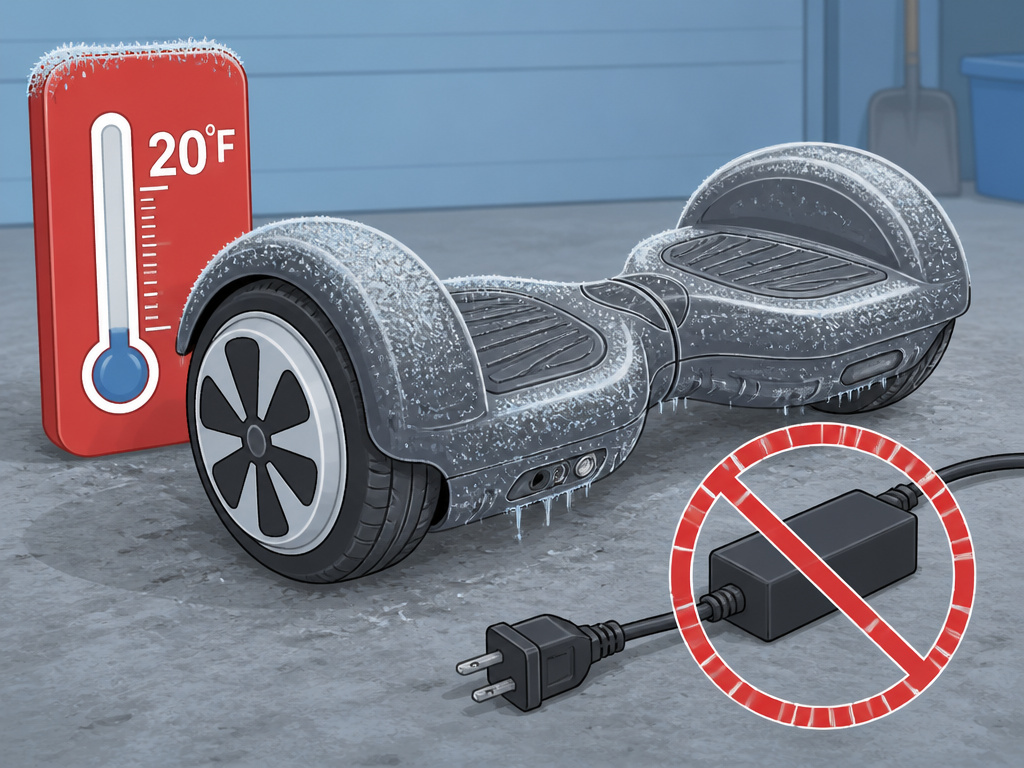
You store your hoverboard in an unheated garage over winter. Temperatures drop to 20°F. Come spring, the battery won’t hold a charge. What happened?
Batteries have strict thermal limits. The Swagtron T6 manual specifies a working temperature range of 5°F to 122°F (-15°C to 50°C). That’s when you can ride. Its charging range is tighter: 32°F to 104°F (0°C to 40°C). You can’t charge a frozen battery. The Glide manual implies a storage limit of 32°F to 104°F (0°C to 40°C), while Swagtron specifies an operating range down to 5°F.
See the conflict? Swagtron says you can operate down to 5°F. Glide implies storing below 32°F risks damage. Who’s right? Both, probably. Lithium-ion cells degrade when stored at low states of charge in freezing temperatures. They can also be damaged if charged while cold. The takeaway is that manufacturer limits mark the points where chemical damage becomes likely.
| Condition | Swagtron T6 Spec | Glide Hoverboard Implied Limit | Practical Rule |
|---|---|---|---|
| Operating Temperature | 5°F to 122°F (-15°C to 50°C) | Not specified | Avoid extremes. Performance drops at temperature extremes. |
| Charging Temperature | 32°F to 104°F (0°C to 40°C) | Not specified | Always charge indoors at room temperature. Never charge a cold board. |
| Storage Temperature | Not specified | 32°F to 104°F (0°C to 40°C) | Store indoors, in a climate-controlled space. |
Rain is a hard no. Every manual screams it. “Do not ride under wet conditions,” says Glide. “The hoverboard is not waterproof. The electronics may be damaged due to water and water damage is not covered by our warranty.” Riding in the rain isn’t just risky for traction; it’s a direct short-circuit threat to the open electronics under the footpads. If you’re caught in a drizzle, get inside fast and dry the board thoroughly before even thinking about charging it. For a deeper dive on this specific hazard, the CPSC hoverboard FAQ page reinforces that moisture and lithium-ion batteries are a dangerous mix.
So your outdoor riding season has invisible boundaries drawn by the thermometer and the weather forecast. Ignore them, and you’re not just risking a bad ride, you’re buying a new board.
Battery and Range: What “3.1 Miles” Really Means Outdoors
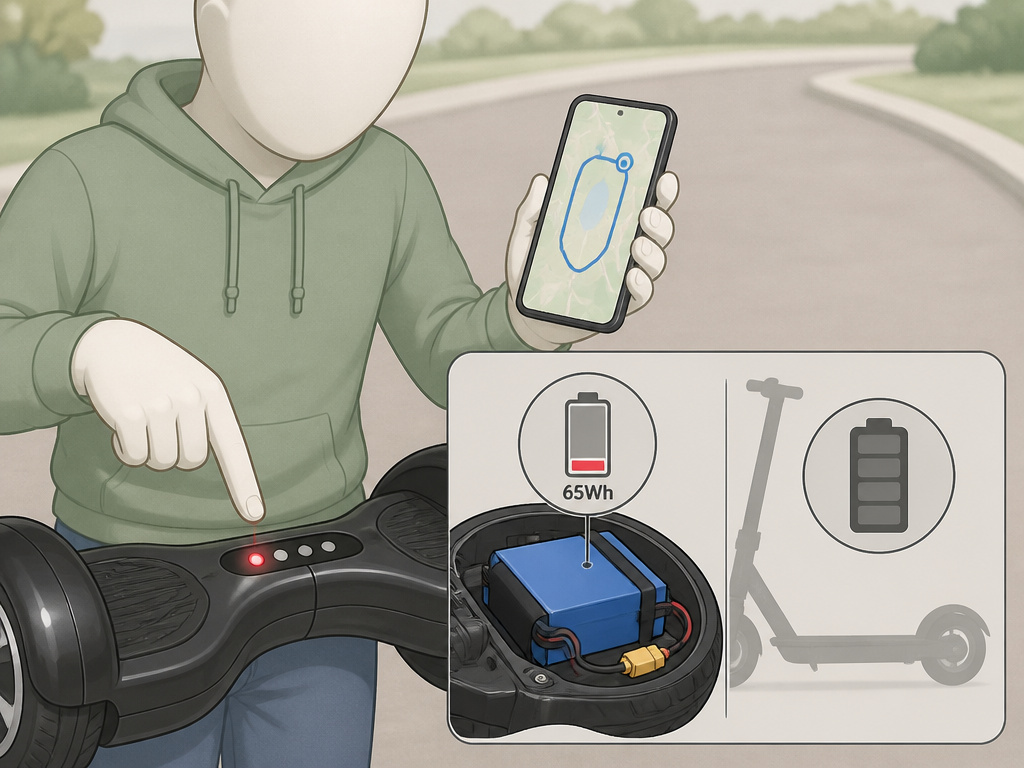
The Glide hoverboard spec sheet says “Distance per Charge: 3.1 Miles.” That’s in ideal conditions, on a smooth surface, at a steady speed. Outdoors, you’ll never see that number.
Here’s why. Outdoor surfaces have rolling resistance. Grass and gravel significantly increase it. Every start and stop drains the battery. Wind resistance, even at 6 mph, is a factor. And if it’s cold, the battery chemistry itself is less efficient, delivering fewer amp-hours of usable energy.
A Reddit user put it bluntly: hoverboards have “tiny batteries that limit their power, range, and top speed.” They’re right. The Glide’s battery is a 25.2V 2.6AH pack. That’s about 65 watt-hours. For comparison, many electric scooters have significantly larger battery capacities. You’re working with a relatively small energy capacity.
So your real-world range will be less than the stated 3.1 miles, especially on surfaces like grass or gravel. This matters because the board doesn’t gradually slow down, it has a hard stop. The Swagtron manual is explicit: “Immediately stop riding the SWAGTRON if the Battery Indicator shows a single LED light. When the SWAGTRON is at low power, the unit may be unable to properly self-balance.”
Run the battery too low outdoors, and you’re walking home carrying your hoverboard. Plan your route as a loop that brings you back home well before the battery indicator hits the final LED. And always start with a full charge, another essential rule from the manual.
Safety and Maintenance: The Post-Ride Ritual
You’ve finished your ride. The board is dirty. What now?
Most owners just lean it against the wall. That’s how you end up with grinding noises and dead motors in six months. Outdoor riding throws grit into the wheel wells and against the motor housings. Over time, this abrasive paste wears down moving parts and can jam the self-balancing sensors.
Your post-ride ritual should take five minutes:
- Wipe down the entire board with a dry cloth.
- Inspect the wheels for wrapped-up string, grass, or hair. Remove it.
- Check the gap between the wheel and the housing for pebbles or debris.
- Look at the charging port, is it clean and dry?
- Store the board indoors, away from direct sunlight or temperature extremes.
This is preventative maintenance that addresses the specific wear points outdoor use introduces. A clean board is also a safer board; debris can unbalance a wheel or block a sensor, leading to sudden, unpredictable behavior.
And never, ever skip the safety gear. The manual’s first line is “ALWAYS wear a helmet when riding your hoverboard.” Outside, you add knee and elbow pads to that list. A fall on pavement is different from a fall on carpet. The consequences are measured in road rash and fractures, not just bruises.
Where the Law Gets Fuzzy: Public Spaces vs. Private Property
Can you ride in a public park? On a school campus? Through a parking lot?
The answer is a frustrating “maybe.” Public spaces often have posted rules prohibiting motorized vehicles. Parks may ban them to preserve tranquility and pedestrian safety. School grounds usually forbid them during school hours. Parking lots are private property; the owner can set the rules.
Private property is your best bet for open, legal practice. Your own driveway, a quiet cul-de-sac, or a friend’s paved lot are ideal. You’re off public roads, away from traffic and pedestrians, and you’re likely within your legal rights.
The moment you move to public spaces, you enter a patchwork of regulations. Some cities explicitly allow electric personal mobility devices in parks. Others ban them. The only way to know is to check local ordinances or call the parks department. It’s tedious, but it beats a confiscated board and a fine.
This legal fog is why so many official hoverboard safety tips emphasize knowing your local laws. The device is global; the rules are hyper-local.
Can you ride a hoverboard on the sidewalk or street?
The law treats where you can ride differently based on whether you’re on private property or in public. On your own driveway or a similar private area, you largely set the rules, but you should still follow the manufacturer’s safety guidelines. Public spaces like sidewalks, bike lanes, and roads introduce legal grey areas. You must always be aware of local road laws and follow them. General advice is to avoid roadways and cars entirely. Due to their limited speed, some argue hoverboards belong on the sidewalk with pedestrians, while others see them as suitable for bike lanes. The safest approach is to stick to smooth, low-traffic areas like empty parking lots or quiet pathways, always yielding to pedestrians.
Frequently Asked Questions
Are you supposed to ride hoverboards outside?
Manufacturers design them for outdoor use on smooth surfaces like pavement and footpaths. However, “outside” covers a vast range of terrains. Riding on grass, gravel, or wet ground is not recommended and can void your warranty. Always check your specific model’s manual for its approved surfaces.
Will a hoverboard work on grass?
Standard hoverboards with 6.5-inch solid wheels will not work well on grass. The small wheels sink in and the motor lacks the torque. So-called off-road hoverboards with larger, air-filled tires (8.5″ or 10″) can handle short, dry, flat grass, but they are not all-terrain vehicles. Performance is slow, battery life plummets, and it’s hard on the motors.
Can you use a hoverboard on the street?
Legally, this depends entirely on local laws. Practically, it is dangerous. With a top speed of around 6 mph, you cannot keep up with traffic. If your local code classifies it as a vehicle and bans it from sidewalks, you may have no legal place to ride on public roads. Always research your municipal codes first.
Are hoverboards illegal now?
Hoverboards are not universally illegal. However, many jurisdictions have restrictions on where they can be ridden (e.g., banned from sidewalks, bike lanes, or public parks). Some countries, like the UK, have specific laws limiting their use to private property. The key is that legality is location-specific, not product-specific.
Before You Go
Riding a hoverboard outside is a game of matching three things: your board’s certified specs, the terrain under its wheels, and the local law on the books. Miss one, and the ride turns into a risk.
The official numbers are your guardrails. More than 250 fire incidents. A 6.2 mph top speed. A 176-pound weight limit. These figures are the documented edges of safe operation. Your board is a system of batteries, motors, and sensors that hates water, cold, and abuse. Treat it like the precision device it is, not a rugged toy.
Start in your driveway. Master the basics on perfect pavement. Then, if you need to tackle rougher ground, invest in a board actually built for it, one with the bigger wheels and higher clearance of a true outdoor model. Don’t force a standard model to do a job it was never designed for.
And finally, read the federal hoverboard safety warning. Those 250 incidents started with someone who thought their board was just fine. Yours might be too, but the cost of being wrong is measured in more than just dollars. It’s measured in the things that can’t be replaced. Ride safe.
