Capsule Skateboards Review: The Polymer Pros and Cons
This post contains affiliate links. As an Amazon Associate, we earn from qualifying purchases.
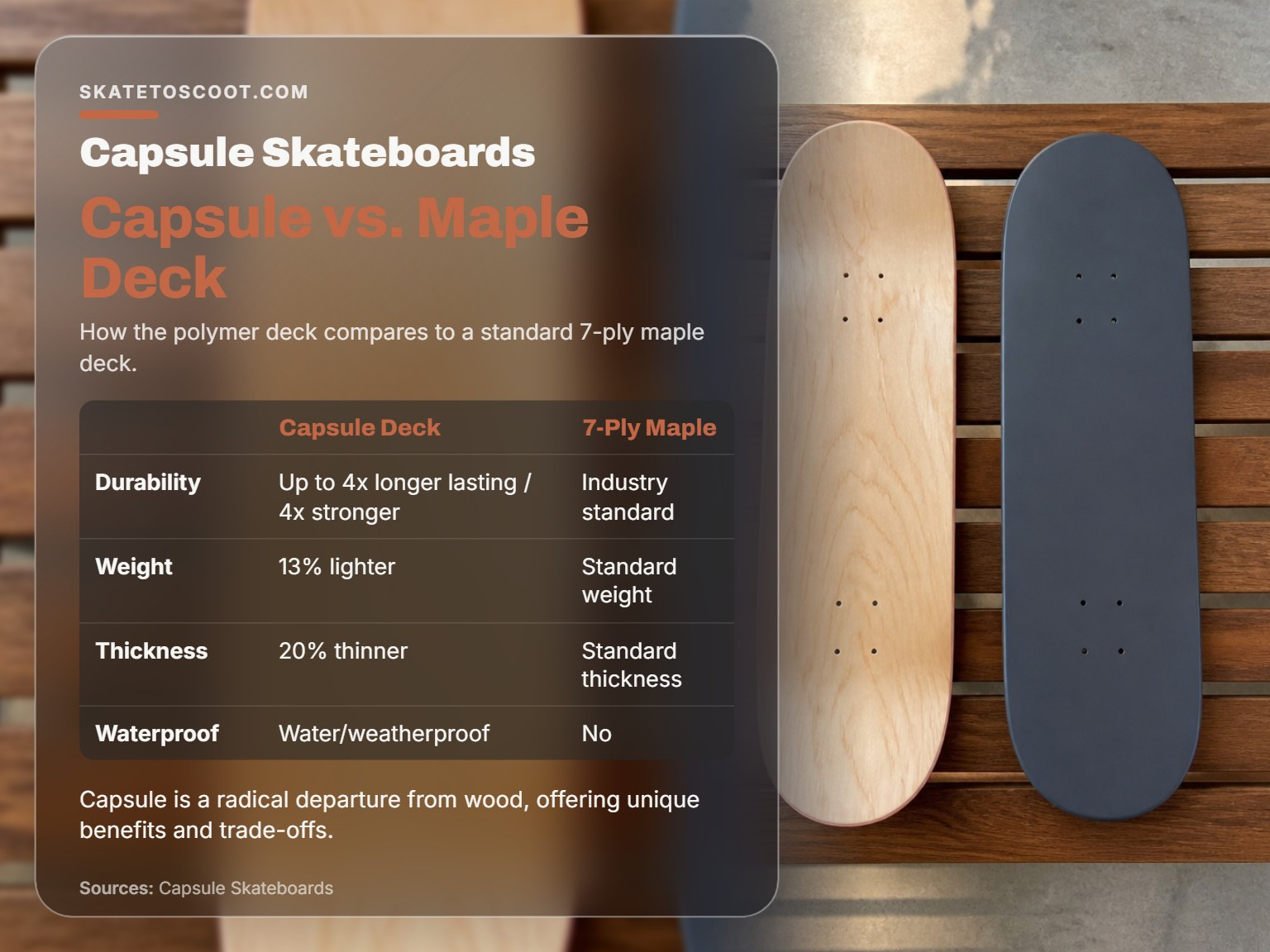
Capsule skateboards replace the classic 7-ply maple deck with a proprietary polymer compound, claiming up to 4x the durability, 13% less weight, and a completely recyclable, waterproof build. The result is a deck that feels profoundly different, extremely flexible, with a pop that changes over time, and excels in wet conditions or for skaters who snap wood decks weekly, but may frustrate those used to the consistent snap of maple.
That difference in feel isn’t just a minor tweak. It rewrites the rulebook on how a deck behaves under your feet, from the first ollie to the hundredth kickflip. Where a maple deck fails with a crack, a polymer deck like Capsule’s fails by getting softer, a key point in any capsule skateboards review.
This capsule skateboards review walks through the specs, the firsthand testing reports, and the brand’s own trade-secret claims. You’ll see where the 4x durability claim holds up, where the extreme flexibility becomes a problem, and who should actually spend their money on a Capsule deck versus a more proven composite like the Powell Flight.
Key Takeaways
- Capsule’s polymer decks are waterproof and weatherproof, making them the only real option for skaters who ride in damp climates or leave boards outside.
- The extreme, increasing flexibility noted by reviewers changes how the deck performs on rails and for certain flip tricks, demanding a longer adjustment period.
- For pure impact durability, lab tests and brand claims align: a tested composite deck failed at an average center pressure of 5,133.33 lbs, and Capsule states its DURA-Tech decks are 4x stronger than maple.
- The non-porous polymer surface may require careful grip tape application.
- If your priority is a consistent, predictable pop from session to session, traditional maple or a hybrid composite like Flight may be a safer bet than Capsule’s evolving flex.
The 4x Durability Claim: What the Numbers Actually Mean
Capsule states its decks last “up to 4x longer” than wooden decks, with its DURA-Tech line labeled as “4x stronger.” That’s a marketing claim, while independent destructive testing on a composite deck recorded a failure at an average center pressure of 5,133.33 lbs. An East Tennessee State University study on a composite deck recorded a failure at an average center pressure of 5,133.33 lbs. That’s a concrete number for how much force a composite structure can take before it goes.
A tested composite skateboard deck failed at an average center pressure of 5,133.33 lbs and an average tongue pressure of 3,600 lbs., East Tennessee State University Thesis
Real-world testing echoes this toughness. One reviewer in a capsule skateboards review skated a Capsule deck aggressively for a week, trying tricks known to snap normal decks. The deck didn’t break. Instead, he observed a seam developing lengthwise down the middle, a wear pattern unique to this flexible material. The performance didn’t falter, but the deck visibly changed.
That’s the first clue that “durability” here doesn’t mean “stays the same.” It means “doesn’t snap.” A wooden deck works until it doesn’t, often with a sudden, definitive crack. A Capsule deck degrades gradually, becoming more flexible with use. For a skater who breaks decks monthly, that’s a win. For a skater who relies on a deck’s stiffness for control, it’s a growing problem.
Where this goes sideways: Assuming “4x stronger” means 4x the lifespan with identical performance. The deck’s feel changes long before it becomes unskateable. If you need a consistent platform, the longevity claim comes with a asterisk.
The Material Mystery: COMPOSI-TECH™ and Trade Secrets
Capsule states its decks are made with zero trees and are free of volatile organic compounds (VOCs) and UV curing monomers. The graphics even use FDA-approved inks. What’s inside is a tighter secret. The brand calls it a “special high-quality polymer compound” and brands it as COMPOSI-TECH™. A third-party tech article speculated it has characteristics similar to “a combination of carbon fiber and wood,” while noting the exact formula is a trade secret.
This matters because material dictates everything: flex pattern, impact response, weight, and how it interacts with your grip tape. We know the results: the decks are 20% thinner and 13% lighter than a standard 7-ply maple deck, according to Capsule’s own specs.
| Capsule Line | Key Claim vs. 7-Ply Maple | Primary Use Case |
|---|---|---|
| COMPOSI-TECH™ (Core) | 20% thinner, 13% lighter | General street/park, standard performance |
| Composi-LITE™ | 24% thinner, 13% lighter | Maximum lightness for tech tricks |
| DURA-Tech™ | 4x stronger, similar weight | Maximum impact resistance, longevity |
The takeaway is you’re not buying a wood deck with a plastic coating. You’re buying a engineered polymer product. Its performance curve, failure modes, and even its environmental footprint (it’s 100% recyclable) are fundamentally different from the maple standard. That’s the innovation, and the risk.
The Feel Underfoot: Flex, Pop, and a Learning Curve
Here’s where the rubber meets the road, or rather, the polymer meets the pavement. A common report from hands-on reviewers is extreme flexibility, though some sources report better pop. One called it the most flexible deck he’d ever skated, noting it became “more and more flexible as I skated it.” For some, that’s a deal-breaker right out of the gate.
The deck’s extreme flexibility made skating rails and some tricks more difficult. It became more and more flexible as it was skated., Ultimate Gear Lists Reviewer
This flex has a direct effect on pop and trick execution. A stiffer maple deck stores energy like a spring and releases it sharply. A flexible polymer deck absorbs more of that energy, then returns it differently. Some Reddit users report hearing Capsule boards offer “better pop,” while others find the flex uncomfortable and unpredictable. It’s likely a matter of style: a slower, more controlled pop might feel powerful, while a skater used to the quick snap of maple might feel the board is mushy.
The adjustment period is real. The same reviewer who praised its near-unbreakable nature needed time to adapt his timing for basic tricks. The deck also features non-standard shapes in its Unconventional Series; one experienced skater mistook the nose for the tail. You can’t rely on muscle memory built on traditional popsicle decks.
Grip Tape and Setup: The Slippery Surface Question
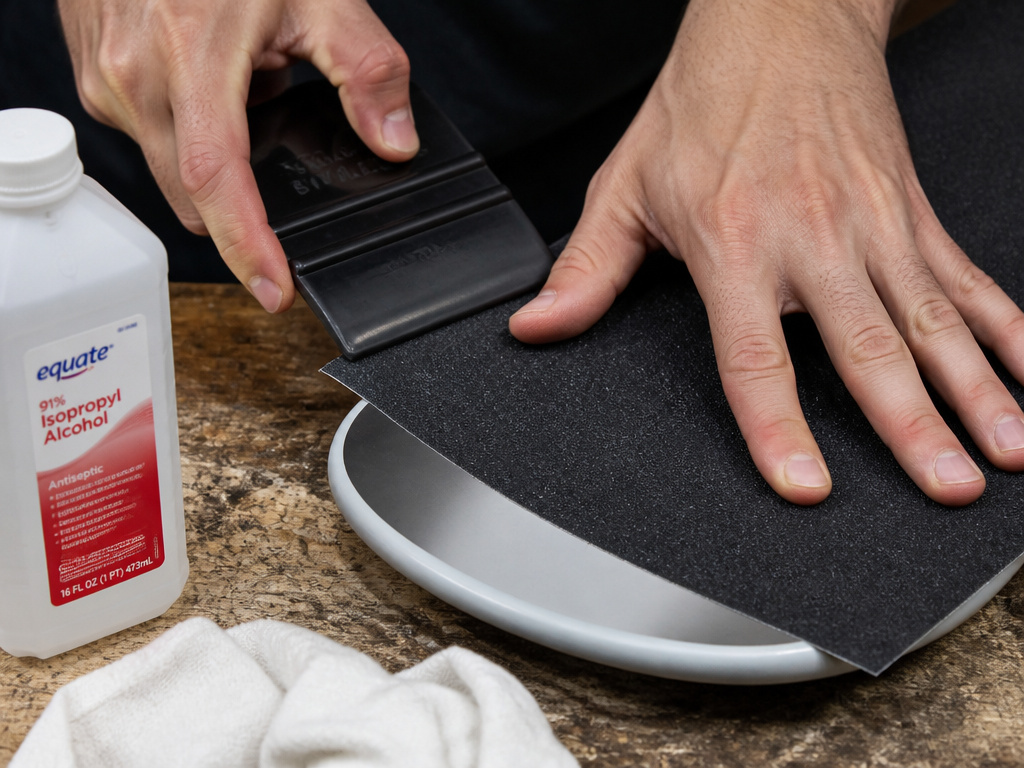
A smooth, non-porous polymer surface presents a unique challenge: grip tape adhesion. Maple is rough and absorbent, giving the adhesive plenty to bite into. Polymer is slick. Capsule doesn’t provide specific application guidelines, and this is a genuine gap in most reviews.
The concern isn’t that grip tape won’t stick at all, but that it might not hold as securely under the sheer and peel forces of skating, especially in hot weather. The best practice is a thorough, clean surface preparation (rubbing alcohol wipe) and firm, even pressure during application. Consider it a 30-second job that deserves 2 minutes of care. Using a high-quality grip tape is recommended.
Your truck and wheel choice also matters more. The deck’s flexibility will amplify the feel of your trucks, so pairing it with the right skateboarding shoes for board feel is key. If you like things loose and carvy, start with your standard setup. The deck’s flexibility may affect the feel of your trucks and stability. It’s not just slapping parts on; it’s tuning for a different material.
Capsule vs. The Competition: Flight, VX, and Wood
When you step away from maple, the field narrows. The two main competitors are the Powell Peralta Flight Deck and the Santa Cruz VX.
| Deck | Core Material | Durability Claim | Key Trait | Reported Drawback |
|---|---|---|---|---|
| Capsule (DURA-Tech) | Proprietary Polymer | 4x stronger than maple | Extreme, increasing flexibility | Non-standard shapes can confuse orientation; flex changes over time |
| Powell Flight Deck | Maple + Carbon Fiber | “Lasts a lot longer” | Lighter, stiffer pop | Gets razor tail easily (per Reddit users) |
| Santa Cruz VX | Maple + Fiberglass | Increased impact resistance | Tighter, more wood-like feel | Heavier than standard maple |
| 7-Ply Maple | Hard Maple Layers | Industry standard | Predictable, consistent pop and fail | Snaps/cracks; not waterproof |
The choice comes down to your personal failure mode. If you get razor tail in two weeks but hate flexible decks, a Flight deck might be your answer, though a Reddit user reports Powell Flight decks get razor tail easily and another skated one daily for six months. If you snap decks at the bolts or skate in the rain, Capsule’s waterproof, impact-absorbing build is unique. If you want something closer to wood but tougher, VX is a proven middle ground, similar to some durable Backfire skateboards. Capsule is the most radical departure, offering the biggest potential benefit with the biggest adjustment.
The Eco Pitch: Recyclable, But Is It Practical?
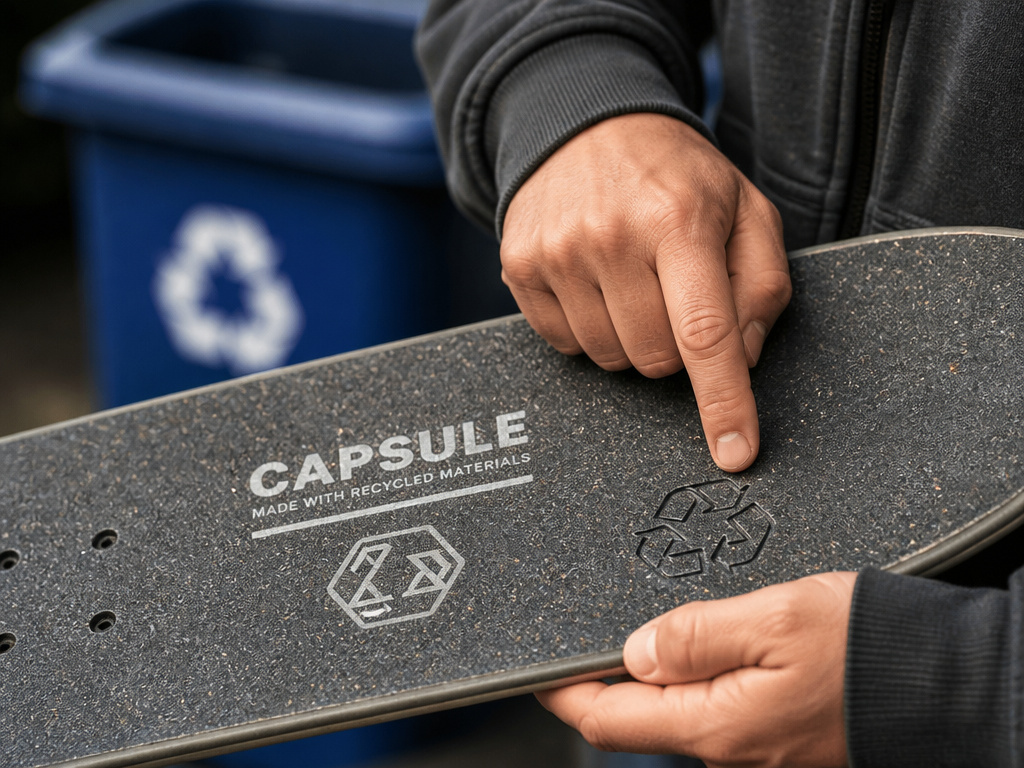
Capsule’s environmental angle is strong on paper: zero trees cut down, 100% recyclable material, and graphics with FDA-approved inks free of VOCs. The brand highlights that its decks are 100% recyclable. It’s a compelling story, especially compared to a broken maple deck heading to a landfill.
The practical question is accessibility. How many local skateshops actually participate in this take-back program? The decks are 100% recyclable, though practical recycling depends on local facilities. The eco-benefit is real, but it’s not a zero-effort perk for the end user. It requires a bit of work to realize.
That said, the durability itself is an environmental benefit. A deck that lasts four times as long replaces four decks. Even if it eventually ends up in the same place, it took far fewer resources to get you there. For the skater who goes through decks quickly, the ecological math works in Capsule’s favor purely through reduced consumption.
Who Should Actually Buy a Capsule Skateboard?
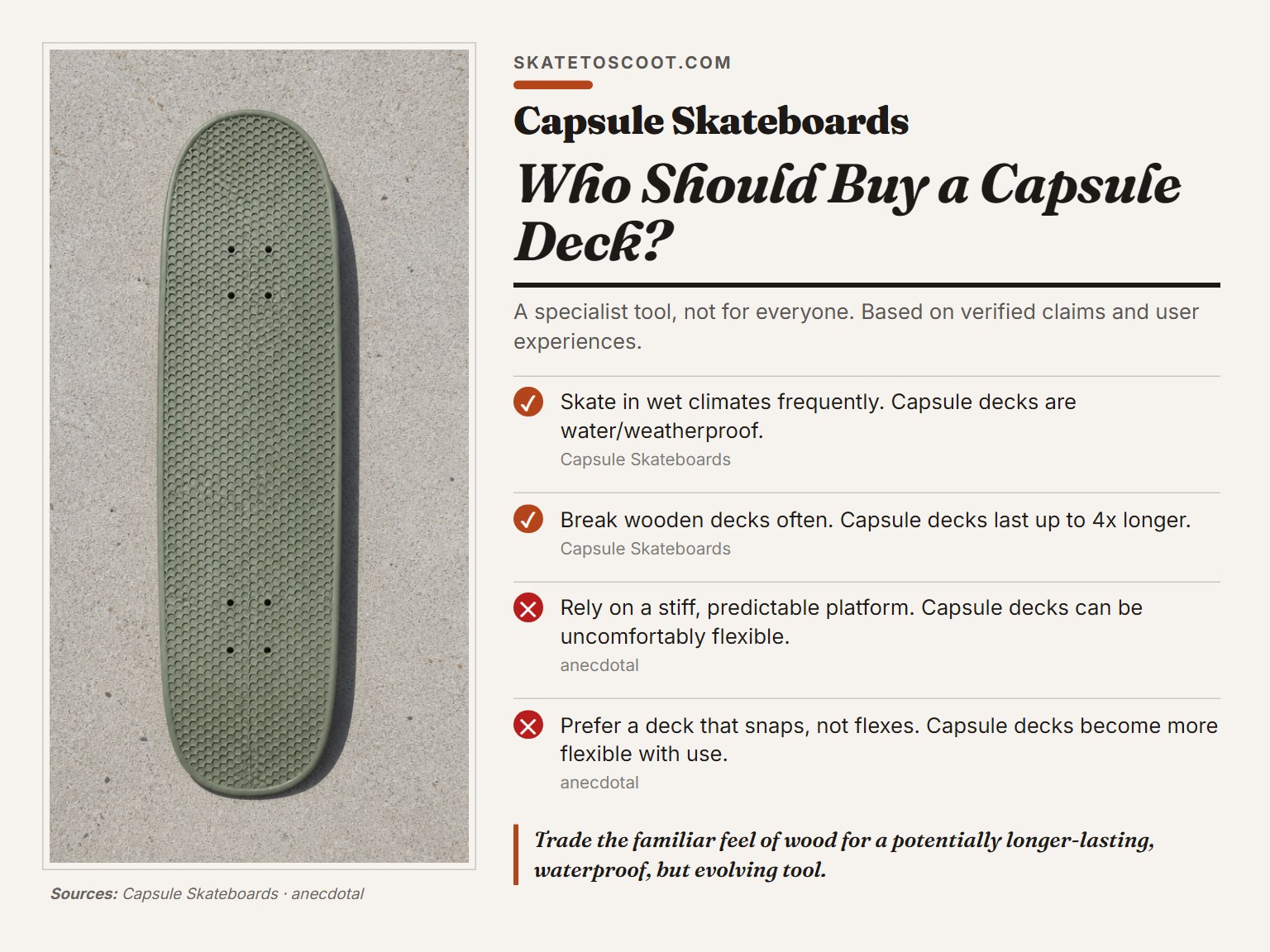
This isn’t a deck for everyone. It’s a specialist tool. Buy a Capsule if:
- You skate in wet climates frequently and are tired of waterlogged, delaminating wood.
- You break maple decks regularly through impact (landing primo, big gaps, heavy street skating).
- You’re curious about new technology and don’t mind a longer adjustment period to relearn your pop timing.
- The environmental pitch aligns with your values, and you’re willing to seek out proper recycling.
Skip the Capsule and stick with maple or a Flight deck if:
- You rely on a stiff, predictable platform for control, especially on rails or vert.
- You dislike the feeling of a deck flexing noticeably under your feet.
- You prefer a deck that performs consistently until the day it snaps, rather than gradually changing.
- You’re on a tight budget and can’t risk an expensive experiment.
The brand’s own advice is to avoid comparing it to maple. That’s impossible, because maple is the benchmark. The real comparison is about what you’re willing to trade. You trade the familiar, consistent performance of wood for a potentially longer-lasting, waterproof, but evolving tool. For the right skater, that’s a fantastic deal. For many, it’s a step too far into the unknown.
Frequently Asked Questions
Are Capsule skateboards really unbreakable?
No deck is truly unbreakable. Capsule decks are extremely impact-resistant and waterproof, making them far less likely to snap or delaminate than maple. However, reviewers note they can develop longitudinal seams and become progressively more flexible with heavy use, which is a different kind of wear.
How does the pop compare to a wooden deck?
It’s different. The polymer’s flexibility absorbs and releases energy differently than stiff maple. Some skaters report a powerful, longer-lasting pop, while others find it feels slower or mushier, especially as the deck breaks in and gets even more flexible.
Can you use normal grip tape on a Capsule deck?
Yes, but take extra care. The polymer surface is non-porous and slick. Clean the surface thoroughly with rubbing alcohol and apply the grip tape with firm, even pressure. It may not bond quite as tenaciously as it does to rough maple.
What’s the difference between Composi-LITE and DURA-Tech?
Composi-LITE decks prioritize being thin and light (24% thinner, 13% lighter than maple). DURA-Tech decks prioritize strength (4x stronger than maple) while keeping a weight similar to 7-ply wood. Choose LITE for tech tricks, DURA-Tech for impact-heavy skating.
Are Capsule decks good for beginners?
Their durability is a plus, but the unusual flex and non-standard shapes of some models add a layer of difficulty. A beginner would have nothing to compare it to, which could be fine, though many start with our picks for the best complete skateboards. But learning fundamental pop and stance might be easier on a predictable, traditional maple deck before experimenting with polymer.
The Bottom Line
Capsule skateboards are a genuine innovation, not just a marketing gimmick. The 4x durability claim is grounded in real impact resistance, and the waterproof, recyclable build is unmatched in the industry. But the innovation demands a trade. You must accept a deck that flexes profoundly and changes feel over time, one that requires a patient adjustment period and might not suit every skating style.
For the skater who destroys decks monthly or skates in soggy conditions, it’s a revelation, a tool that finally matches their abuse (though you should still wear a skate helmet). For the skater who values a consistent, snappy pop and precise board feel, it’s an expensive experiment that may lead back to maple. The answer isn’t in the brand’s specs; it’s in your local climate and how you react when your board starts to feel like it’s made of rubber instead of wood.
