Everything You Need to Know About BLUETOOTH Hoverboards
This post contains affiliate links. As an Amazon Associate, we earn from qualifying purchases.
A Bluetooth hoverboard adds music and app connectivity to a self-balancing scooter, but the real story is safety. The defining feature isn’t wireless sound, it’s whether the entire unit, from its lithium-ion battery to its charging circuit, meets the UL 2272 safety standard. Without that certification, you’re holding a potential fire hazard, regardless of how well the speakers work.
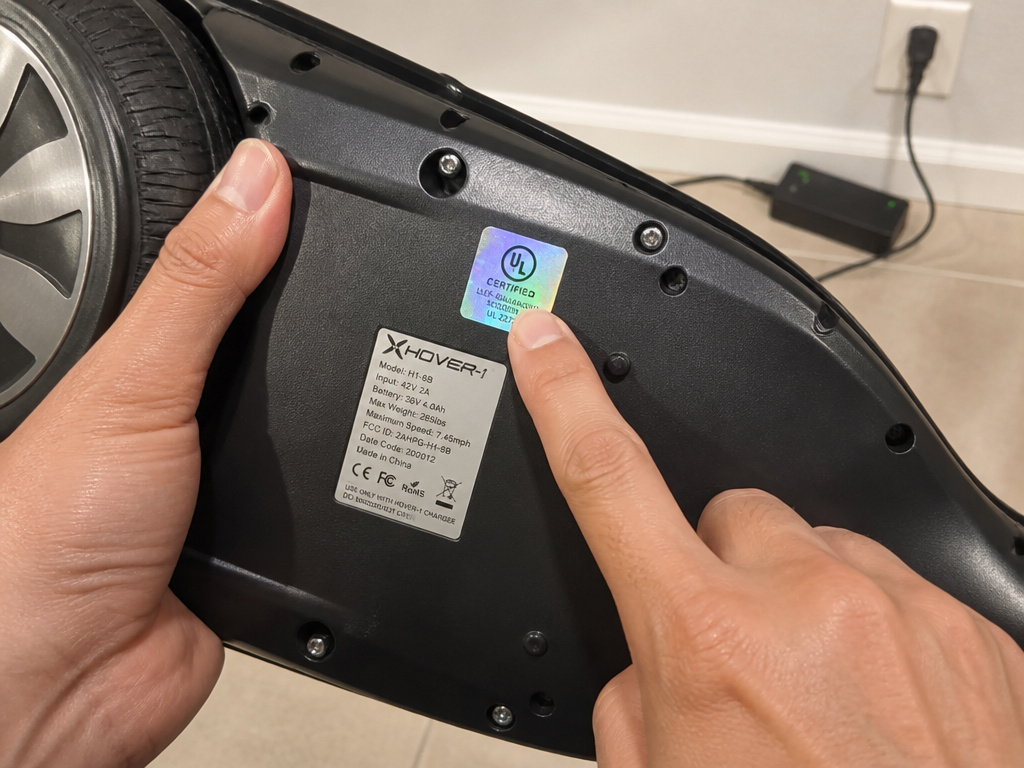
That UL 2272 label is the line between a fun gadget and a documented risk. The U.S. Consumer Product Safety Commission (CPSC) knows of more than 250 hoverboard incidents related to fires or overheating, including fatal house fires. A 2018 Dutch regulator investigation found all 29 hoverboards they examined were non-compliant, with 28 lacking critical overcharge protection. So your first step with any Bluetooth model isn’t pairing your phone; it’s verifying that holographic safety label on the bottom of the board. This is the most critical part of everything you need to know about Bluetooth hoverboards.
What follows is a walkthrough of everything you need to know about Bluetooth hoverboards, from what Bluetooth actually does to how to connect it correctly, which specs signal a safer build, and the essential rules for charging and storage.
Key Takeaways
- Verify the UL 2272 holographic label on the hoverboard itself, a certified battery or charger alone is insufficient, and counterfeit marks exist.
- Use only the supplied charger and never charge unattended, especially overnight. The CPSC reports over $4 million in property damage related to hoverboard incidents.
- Most boards use two separate Bluetooth connections: one for a “music” signal to the speaker and a second, often password-protected one for a companion app that controls lights or monitors speed.
- Bluetooth has a negligible impact on main battery life; the real drain comes from the motors, not the low-power radio maintaining a connection to your phone.
- Speaker volume and voice prompts often cannot be adjusted, a common owner complaint confirmed by manufacturer support threads.
What Does ‘Bluetooth’ Actually Mean on a Hoverboard?
On a hoverboard, Bluetooth typically serves two distinct functions, handled by separate internal modules. The first is a simple A2DP audio stream, think of it as a wireless speaker. The second is a data connection for a companion app. This split design is why your phone might see “Swagtron music” and “Swagtron” as two separate devices.
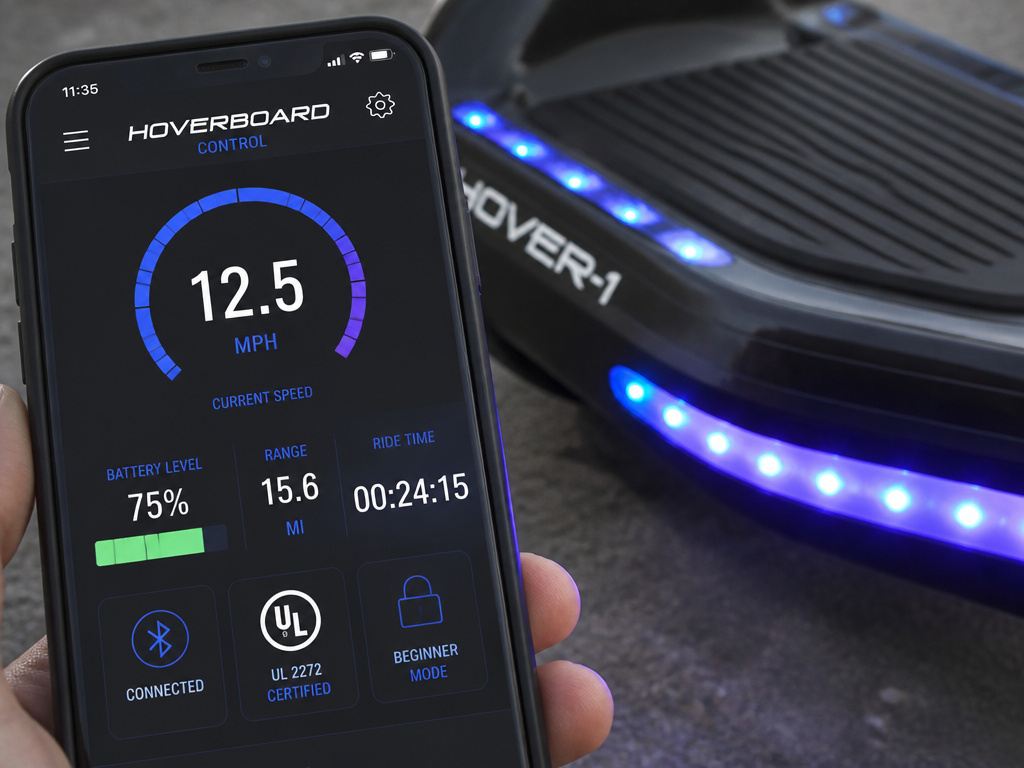
The audio side is straightforward. You can play music from your phone through the hoverboard’s built-in speakers. The quality is what you’d expect from small, downward-facing drivers: decent for background tunes outdoors, not for critical listening. The more important function is the app link. Apps like Jetson’s “Ride Jetson” or Swagtron’s companion app provide features far beyond music: real-time speed and battery monitoring, customizable LED light patterns, and sometimes even mode switching between beginner and advanced settings.
Where this goes sideways: Assuming “Bluetooth” is just for music. The app connection is where you often control safety features like speed limiting for beginners, making it a crucial setup step for new riders.
The takeaway here is specificity, which is a key part of everything you need to know about Bluetooth hoverboards. When a product listing says “Bluetooth,” you need to ask: Is it for audio, for app control, or both? Higher-end models like the Jetson V8 Sport and Swagtron T580 explicitly list both, which indicates a more developed feature set.
How Do You Connect a Bluetooth Hoverboard?
The process varies slightly by brand, but the principle is consistent: power on the board, enable Bluetooth on your phone, and look for two uniquely named signals. The audio stream usually has “music” in the name, while the app connection is often just the brand name.
For the Jetson V8 Sport, you turn on the board and it becomes discoverable. To connect the speaker, you find “V8 Sport” in your phone’s Bluetooth list. To connect the Ride Jetson app, you open the app, tap the Bluetooth symbol, select your board, and enter the default password “000000”. The Swagtron T580 manual details a similar routine: power on, search for “Swagtron music” for audio or “Swagtron” for the app, using the same default password.
Technical Snippet: Bluetooth pairing on hoverboards like the Jetson V8 Sport and Swagtron T580 requires connecting to two separate radio modules: one for A2DP audio streaming (e.g., Bluetooth V4.1) and one for low-energy data transmission to a companion app. The app connection typically uses a fixed default PIN (often “000000” or “0000”) for initial pairing, after which it may remember the device. Audio connections generally do not require a PIN.
The universal hiccup is the default password. It’s almost always “000000” or “0000”. If you skip entering it when the app asks, the connection will fail. It’s a minor step, but it’s the one that stops most first-time users.
Bluetooth Specs and Battery Impact: What the Numbers Tell You
You’ll see Bluetooth versions listed in manuals. V4.1 on the Jetson V8 Sport, V2.1+EDR on the Swagtron T580. In practice, for streaming music to a hoverboard speaker five feet away, the difference is academic. Both will work. The more relevant spec is the requirement noted in the Swagtron manual: to connect to their app, your mobile device needs Bluetooth V4.0 or higher. An older phone might pair for music but not for app functions.
A common practical worry is whether leaving Bluetooth on drains the main riding battery. The short answer is no, not meaningfully. The power draw from a Bluetooth radio is minimal compared to the energy consumed by the motors that propel the board. Your range per charge is decided by rider weight, terrain, and speed, not by your playlist.
The real battery concern isn’t Bluetooth; it’s the health of the lithium-ion pack itself and its charging circuitry. Which brings us to the most critical section.
What Are the Real Risks and Safety Rules?
The reality is, hoverboards have a documented fire hazard history. Treating them like any other Bluetooth gadget is how you end up on the wrong side of a CPSC report. The safety rules aren’t suggestions; they are written from incident data.
The U.S. Consumer Product Safety Commission (CPSC) recommends you use only the charger supplied with the hoverboard and only charge when you are present to watch it, never unattended or overnight. They also advise keeping the board away from flammable items while charging or storing. These aren’t generic warnings. The CPSC is aware of more than 250 hoverboard fire incidents, including one in 2017 that resulted in a fatal house fire in Harrisburg, Pennsylvania.
The cornerstone of safety is the UL 2272 standard. This isn’t a component test; it’s a system-level evaluation of the entire hoverboard’s electrical design. You must look for the holographic UL 2272 certification label on the product itself, not just a mark on the box.
Common mistake: Trusting a “UL-certified battery” claim. The recalled Razor Hovertrax 2.0 GLW battery packs were certified to ANSI/UL 2271 (a battery standard) but were part of a system that still overheated, leading to more than 20 reports of smoke or fire. UL 2272 for the whole unit is what matters.
The Dutch Food and Consumer Product Safety Authority (NVWA) drove this point home in a 2018 investigation. They examined 29 hoverboards and found all 29 non-compliant. The critical failure in 28 of them? Charging did not stop when the battery was full. Their advice is blunt: only charge when you are nearby to intervene and disconnect the hoverboard from the charger once it’s charged.
| Risk Factor | Official Finding | Recommended Action |
|---|---|---|
| Unattended Charging | CPSC links to over $4M property damage, fatalities. | Charge only in a room you are in, on a non-flammable surface. |
| Non-UL 2272 Compliant Boards | NVWA found 29 of 29 sampled boards non-compliant (2018). | Look for the holographic UL 2272 label on the board itself, not just the box. |
| Counterfeit UL Marks | CPSC found New High-Tech X1-5 boards with fake marks failed testing. | Verify the label is holographic and matches official UL examples. |
| Using Non-Supplied Charger | Increases risk of overcharging/overheating. | Use only the charger that came in the box. |
Your first step with any Bluetooth hoverboard, before you even unbox the charger, is to flip it over and look for that label. No label? The conversation should end there.
Popular Bluetooth Hoverboard Models and Features
When you filter for UL 2272 compliance, the field of reputable Bluetooth models narrows. Two that explicitly list the certification and detail their Bluetooth setup are the Jetson V8 Sport and the Swagtron T580. They serve as useful reference points for what to expect.
The Jetson V8 Sport uses Bluetooth V4.1 and has two separate modules: one for the speaker, one for the Ride Jetson app. The app provides speed and trip distance monitoring, and LED light customization. It’s a solid example of app integration. The Swagtron T580 uses Bluetooth V2.1+EDR for audio and requires a V4.0+ connection on your phone for its app, which allows mode switching and battery monitoring.
What about the Razor Hovertrax 2.0? Its main claim to fame is being part of a major recall. Its GLW battery packs, manufactured between September 2016 and August 2017, were recalled in August 2021 after overheating reports. It’s a stark reminder that even brands with recognition can have flawed components. If you’re looking at a used model or see a deal that seems too good, check the official fire hazard recall notice first.
Choosing between models often comes down to these integrated app features. If you want speed control for a beginner rider, an app with a beginner mode is required. If you just want background music, even a basic audio-only Bluetooth connection will do.
Troubleshooting Common Bluetooth and Audio Issues
Owners run into a few predictable problems. The first is connection failure, which usually traces back to not selecting the correct Bluetooth signal or not entering the default app password (“000000”). The second is awful audio quality or impossibly loud system voice prompts.
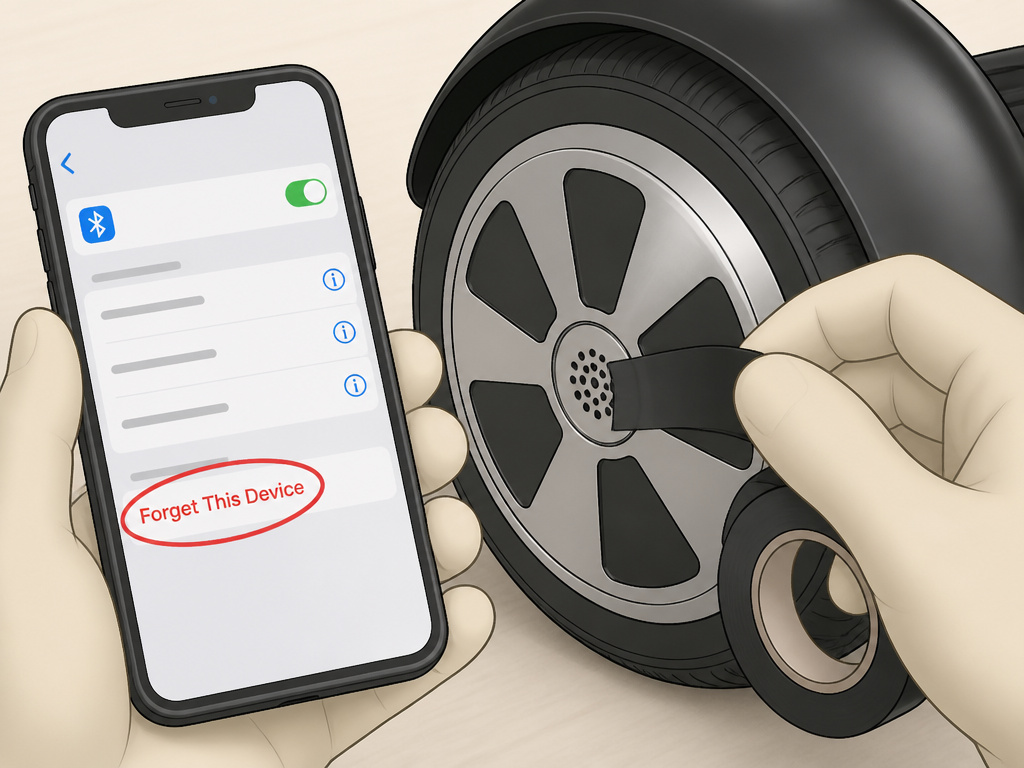
Reddit threads and community forums are full of complaints about the latter. Owners of Jetson models report the “Power On” and “Power Off” voice announcements are startlingly loud with no volume adjustment in the app, you can control music volume, but not the board’s own voice. The consensus fix? Physically muffling the speaker grills with tape. It’s a janky workaround for a design oversight, but it’s the only one that works.
Low music volume or distortion usually points to a weak Bluetooth signal or the speaker’s physical limitations. These are small, weather-resistant drivers. They get muffled if the board is on thick carpet, and they distort at maximum volume because they’re being driven beyond their design. The fix is to lower your phone’s output volume and keep the board on a hard surface.
If your hoverboard won’t pair at all, follow this sequence:
- Power cycle the hoverboard (turn it off and on).
- Delete the hoverboard from your phone’s Bluetooth saved devices list.
- On the hoverboard, initiate pairing mode (often just powering on; consult your manual).
- On your phone, scan and select the correct signal (e.g., “[device name] music” for audio).
- For app connection, open the app first and let it guide the pairing, entering the PIN when prompted.
Most connection issues resolve at step 2. Phones can hold onto old, glitched pairing data.
Who Are Bluetooth Hoverboards Actually Good For?
This is where the rubber meets the road, or more accurately, the polyurethane wheel meets the pavement. Bluetooth features align with specific user profiles.
For teens and older riders, the app connectivity is a legitimate perk. Tracking speed and trip data, competing with friends on app leaderboards, customizing light shows, these features add a digital layer to the riding experience that resonates with that age group. A model like the Swagtron T580 or the Jetson V8 Sport fits here.
For younger children, Bluetooth is largely irrelevant, and potentially a distraction. Safety and simplicity are paramount. You want a board with a physical beginner speed mode (often a switch, not an app), a lower weight limit they won’t outgrow too fast, and of course, UL 2272 certification. The app is just another thing to manage. In this case, focusing on a model chosen with guidance on how to choose a hoverboard for kids is smarter than chasing Bluetooth specs.
And for any rider in a shared living space, the universal owner complaint about loud, unadjustable voice prompts is a serious consideration. That “BLUETOOTH CONNECTED” blare at 7 AM might be a deal-breaker for apartment dwellers or parents with sleeping kids. It’s a sensory detail that never makes the product listing but defines daily use.
How to check if a hoverboard has Bluetooth
Look for a built-in speaker grill on the board’s body. Check the product’s official specifications or manual for any mention of Bluetooth, wireless audio, or a companion app. When powered on, the hoverboard may appear as a discoverable device in your phone’s Bluetooth settings. Some models use two separate Bluetooth connections, one for music and one for the app, so you might see two listings from the same board.
Using Bluetooth vs. Headphones for safety
Using a hoverboard’s built-in Bluetooth speaker is safer than wearing headphones. It allows you to hear ambient traffic, horns, and people around you while you ride. Wired or wireless headphones can block these crucial environmental sounds, increasing the risk of an accident. Keeping your ears free helps you stay aware of your surroundings, which is essential for navigating sidewalks, driveways, and other shared spaces safely.
Frequently Asked Questions
How do I use Bluetooth on a hoverboard?
Turn on the hoverboard. On your phone, go to Bluetooth settings and look for two signals: one named something like “[Brand] music” for audio, and another named just “[Brand]” for the app. Select the “music” signal to play audio. To use the companion app, download it, open it, and follow its pairing instructions, which usually involve selecting the second signal and entering a default password like “000000”.
Why don’t people use hoverboards anymore?
Safety concerns and high-profile fire incidents in the mid-2010s led to widespread bans on airlines, public transit, and many college campuses. While safer, UL 2272-compliant models exist, the initial reputation for hazard stuck. Their utility is also niche, they’re fun for recreational use but not practical for most transportation compared to e-scooters or e-bikes.
How do hoverboards know where you want to go?
Hoverboards use gyroscopic sensors and pressure-sensitive foot pads. When you lean forward, the sensors detect the shift in weight and proportionally power the wheels to move you forward. Leaning back slows you down or reverses direction. There’s no “steering” in a traditional sense; turning is done by applying more pressure with one foot than the other, which varies the speed of the wheels.
What is the best age for a hoverboard?
Most manufacturers recommend ages 8 and up, but maturity and coordination matter more than a birth date. A responsible 10-year-old who follows safety rules is a better candidate than a careless 13-year-old. Key factors are the rider’s ability to understand and respect the board’s power, wear safety gear consistently, and avoid public roads. Always check the specific model’s minimum age and weight requirements.
Can Bluetooth hoverboards catch fire?
The Bluetooth circuitry itself is not a fire risk. The fire hazard comes from the lithium-ion battery pack and its charging system. This is why the UL 2272 certification for the entire electrical system is critical. A hoverboard can have Bluetooth and be safe if it’s UL 2272 compliant, charged with the correct adapter, and never left charging unattended. A non-compliant board is a risk regardless of its features.
The Bottom Line
Here’s the one rule that overrides all Bluetooth features, app specs, and brand names: if the hoverboard doesn’t have a genuine UL 2272 holographic label on its body, walk away. Every other consideration, sound quality, app features, color options, is secondary to that single, essential safety certification.
Once you’ve verified that, understand that Bluetooth on these devices is a convenience layer, not a core performance feature. It won’t make the board faster or safer. Its best use is in companion apps that let you limit speed for a new rider or monitor battery life mid-ride.
Your first ride should be in a wide-open, private space like a driveway or empty parking lot, not just for learning balance, but to listen to the board. A healthy, well-built motor and battery system hums and whirs predictably. Any grinding, popping, or sizzling sound from the wheel hubs or body is your cue to power down and investigate. That’s the kind of hands-on, sensory awareness that no Bluetooth speaker can provide, and it’s the real skill of owning one of these devices.
