HIBOY MAX Electric Scooter Review
This post contains affiliate links. As an Amazon Associate, we earn from qualifying purchases.
The Hiboy Max electric scooter is a budget-friendly, solid-tire commuter scooter with a tested top speed of 19.3 mph and a flat-ground range of 12.2 miles, but it struggles on steep hills and delivers a firm ride. Its 350W motor and 8.5-inch solid tires make it a low-maintenance choice for smooth, short commutes, while its 35.2-pound weight and long folded length challenge its portability claims.
That 12.2-mile range figure isn’t a guess. It’s the result TechGearLab got from a controlled flat-ground test, which is the most honest way to compare scooters. This is a key point in any Hiboy Max electric scooter review. The gap between that number and the “up to 17 miles” you see in ads is the whole story of budget scooters, marketing optimism versus pavement reality.
What follows is a breakdown of where that performance comes from, what the ride actually feels like, and the specific quirks owners report after the first hundred miles. We’ll compare the original Max to its successor, the Max3, and the more powerful S2 MAX, so you can see exactly where your money goes.
Key Takeaways
- The original Hiboy MAX achieved a 12.2-mile range in lab testing, with a top speed of 19.3 mph, but faltered on a steep 10.5% grade hill.
- Its 8.5-inch solid tires require no inflation but developed flat spots in durability tests, leading to a noticeably firm, bumpy ride on rough pavement.
- Error code E4 indicates over-current protection; the scooter will shut down the throttle and brake until it cools, a safety feature that can strand you mid-ride if pushed too hard.
- For storage longer than 30 days, Hiboy’s manual says to fully charge the battery, while other sources like Levy Electric recommend storing lithium-ion batteries at 40-50% charge; follow Hiboy’s instructions to maintain warranty coverage.
- The Hiboy MAX3 updated the original with a 10-inch pneumatic front tire for better comfort, addressing the main ride quality complaint.
Performance: Speed, Range, and Hill Climb
What Are the Hiboy Max’s Real-World Speed and Range?
TechGearLab’s testers pushed the original Hiboy MAX to a top speed of 19.3 mph. That’s plenty for most city commutes. The real story is range. Under their controlled flat-ground test, the scooter traveled 12.2 miles before the battery was depleted to the point of not being able to propel the rider. It managed another quarter-mile or so in fits and starts after that. This is the benchmark. Your real-world mileage will be less if you’re heavier, riding uphill, or using the higher speed mode consistently.
The advertised range for the original Hiboy MAX is not specified in the fact sheet. That’s a specific, conservative lab environment most riders won’t replicate. The gap between 12.2 tested miles and 17 ideal miles is the buffer you should expect to lose.
A 2020 TechGearLab test recorded the Hiboy MAX with a 350W rated motor (500W max) and a 36V 7.5Ah (270Wh) battery achieving a range of 12.2 miles on flat ground, reaching a top speed of 19.3 mph. Charging from fully depleted took 4 hours and 30 minutes.
How Does It Handle Hills?
This is where the 350W motor shows its limits. TechGearLab noted the MAX struggled on a 1/4 mile 10.5% grade hill, faltering near the end. Almost all scooters in its class fail that test, so it’s not a unique flaw. Where it matters more is on more common, gentler slopes. The same review found it performed well on a 3.5% grade test hill, which is representative of many urban inclines.
If your commute has a short, steep hill, the MAX will slow down significantly. If your route is mostly flat with gentle rises, it’ll handle them without complaint. The motor’s rating is a ceiling, not a guarantee.
The 10.5% Grade Reality Check
| Hill Grade | Performance | Note |
|---|---|---|
| 3.5% (Common Urban Incline) | Performed Well | Handles typical gentle slopes without issue. |
| 10.5% (Steep Test Hill) | Struggled / Faltered | Motor power is insufficient for sustained steep climbs. |
| 20% (Manufacturer Claim for S2 MAX) | Not Tested on Original MAX | The more powerful S2 MAX claims this capability. |
Build Quality and Design Features
The original Hiboy MAX weighs 35.2 pounds. The weight is biased toward the front, making it feel slightly off-balanced when carrying. It folds down, but it is relatively lengthy and cannot be rolled when folded. The large diameter of the steering column that becomes the handle when collapsed can be uncomfortable for those with smaller hands to carry for extended periods.
Its frame is built to support a maximum load capacity of 220 lbs. The deck is covered in a grippy rubberized material, and the stem uses a robust locking mechanism. The scooter carries an IPX4 water resistance rating, meaning it’s protected against splashing water from any direction. Don’t ride it through puddles deeper than 0.79 inches, as the manual explicitly warns.
The display is a simple LED panel showing speed, battery level, and riding mode. You get a headlight and a taillight that also acts as a brake light. It’s not a premium-feeling machine, but the components where it counts, the stem lock, the deck, the brake lever, feel solid enough for the price.
Ride Quality, Tires, and Comfort
Here is the thing, comfort is the Hiboy MAX’s biggest trade-off. Those 8.5-inch solid tires mean zero flats, which is a huge plus for low-maintenance commuting. The downside is they transmit every crack, seam, and pebble directly to your feet and knees. TechGearLab’s testers noted the ride was “about average for the class,” but that class is dominated by scooters with air-filled tires that absorb impacts.
The testers observed a specific failure mode: after repeated hard brake tests, the solid rubber tires developed flat spots. This degrades ride quality over time, creating a subtle but persistent vibration. You won’t notice it day one, but by month six on rough city streets, the scooter might feel less smooth.
There is no suspension. The combination of small, solid tires and a rigid frame means you are the suspension. For a 10-minute commute on smooth bike paths, it’s fine. For a 25-minute ride across city bricks and broken asphalt, your legs will know it.
Where this goes sideways: Assuming solid tires are just a minor comfort sacrifice. On chronically rough pavement, the high-frequency vibration can lead to hand and foot fatigue much faster than on a scooter with pneumatics, cutting your practical riding time shorter than the battery range would suggest.
The Hiboy MAX3 updated the original with a 10-inch pneumatic front tire for better comfort. That single change addresses the primary comfort complaint. If you’re looking at a Max today, you’re likely being shown the Max3. The original is the one with the documented firm ride.
Braking System and Safety
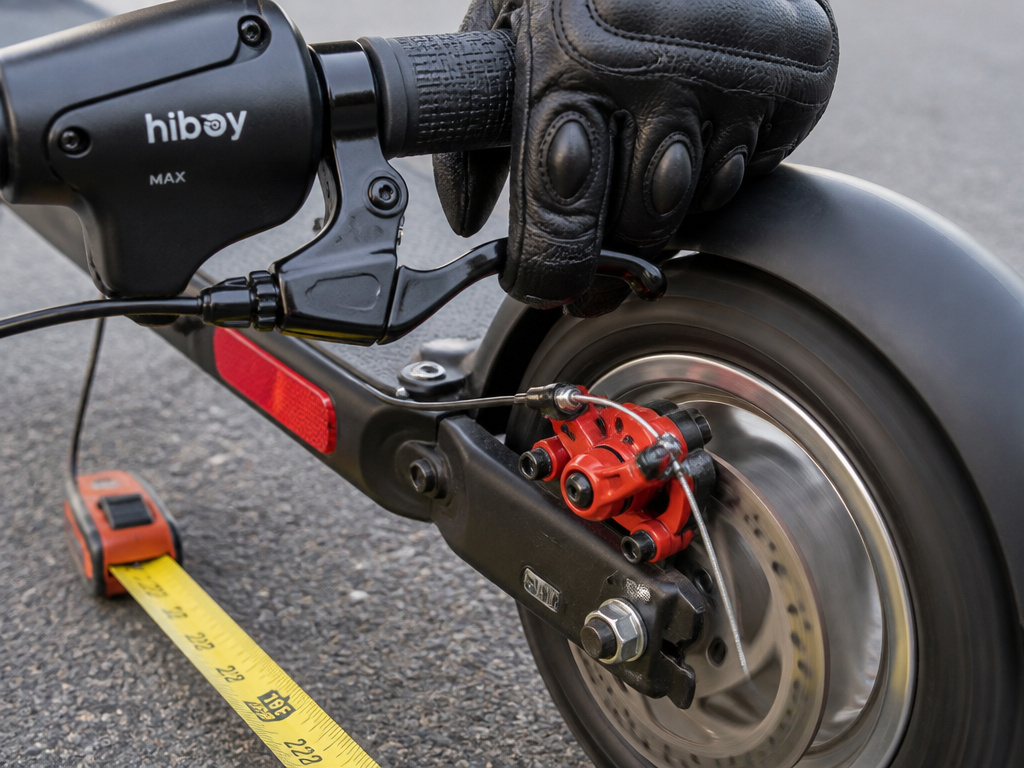
The Hiboy MAX uses a dual braking system: an electric front brake engaged by a paddle and a disk rear brake activated by a hand lever. In testing, it brought the scooter from 12 mph to a complete stop in 19.3 feet. That’s a respectable distance for its class.
Testers raised a concern, though. The mechanical disk brake works, but it doesn’t have the light touch of a higher-end hydraulic system. The mechanical disk brake works, but it doesn’t have the light touch of a higher-end hydraulic system. For emergency stops on flat ground, it’s adequate. For prolonged downhill braking, your hand will get a workout.
The electrical system has built-in protections. Error code E4 indicates over-current protection. When it triggers, both the electronic brake and throttle stop working until the scooter cools down. It’s a safety feature to prevent controller damage, but on a hot day or a long hill, it can leave you without power. The fix is to stop, wait a few minutes, and restart.
Portability, Weight, and Folding
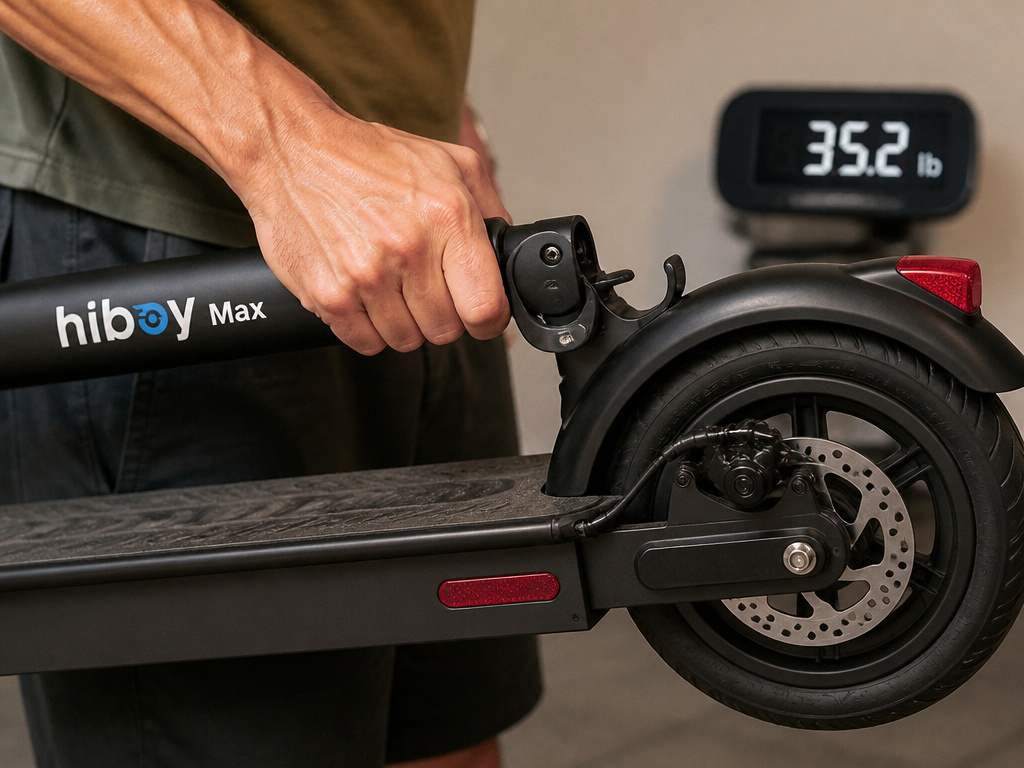
Portability is a mixed bag. At 35.2 pounds, it’s not light. The weight distribution makes it awkward to carry one-handed for more than a few minutes. You’ll be carrying it, not wheeling it.
The folding mechanism itself is simple and feels secure. You release a lever, fold the stem down, and hook it onto a catch on the rear fender. It takes three seconds. Unfolding is just as quick. For storing in a car trunk or tucking beside a desk, it works. For carrying up a flight of stairs to an apartment or onto a crowded bus, its heft and length are genuine drawbacks.
TL;DR: It folds small enough for storage, not easy enough for frequent multi-modal travel.
App Connectivity, Lights, and Smart Features
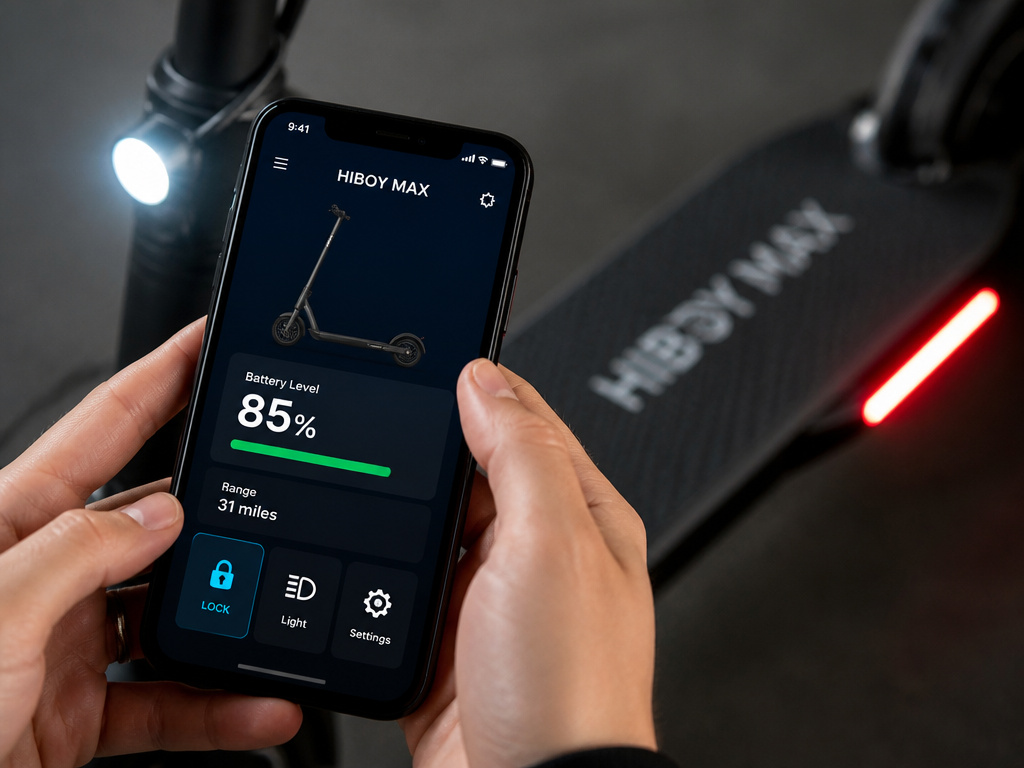
The original MAX connects via the “HIBOY MAX” app with a default password of “000000”. The app allows you to lock the scooter, turn lights on or off, check battery level, view ride stats, and toggle cruise control. It’s a basic companion app. The locking feature is a theft deterrent, not a guarantee, it prevents the motor from engaging, but someone could still pick up and carry the scooter away.
Later models like the S2 MAX use a different app (“Hiboy”) that requires email registration. This fragmentation is a minor annoyance. The core functions across all apps are similar: basic telemetry and remote power control.
The lighting is functional. The headlight is adequate for being seen in twilight, but it’s not bright enough to illuminate a dark path at speed. The taillight is a bright LED that flashes when you engage the brake, a critical safety feature for urban riding.
Hiboy Model Confusion: Max vs. Max3 vs. S2 MAX
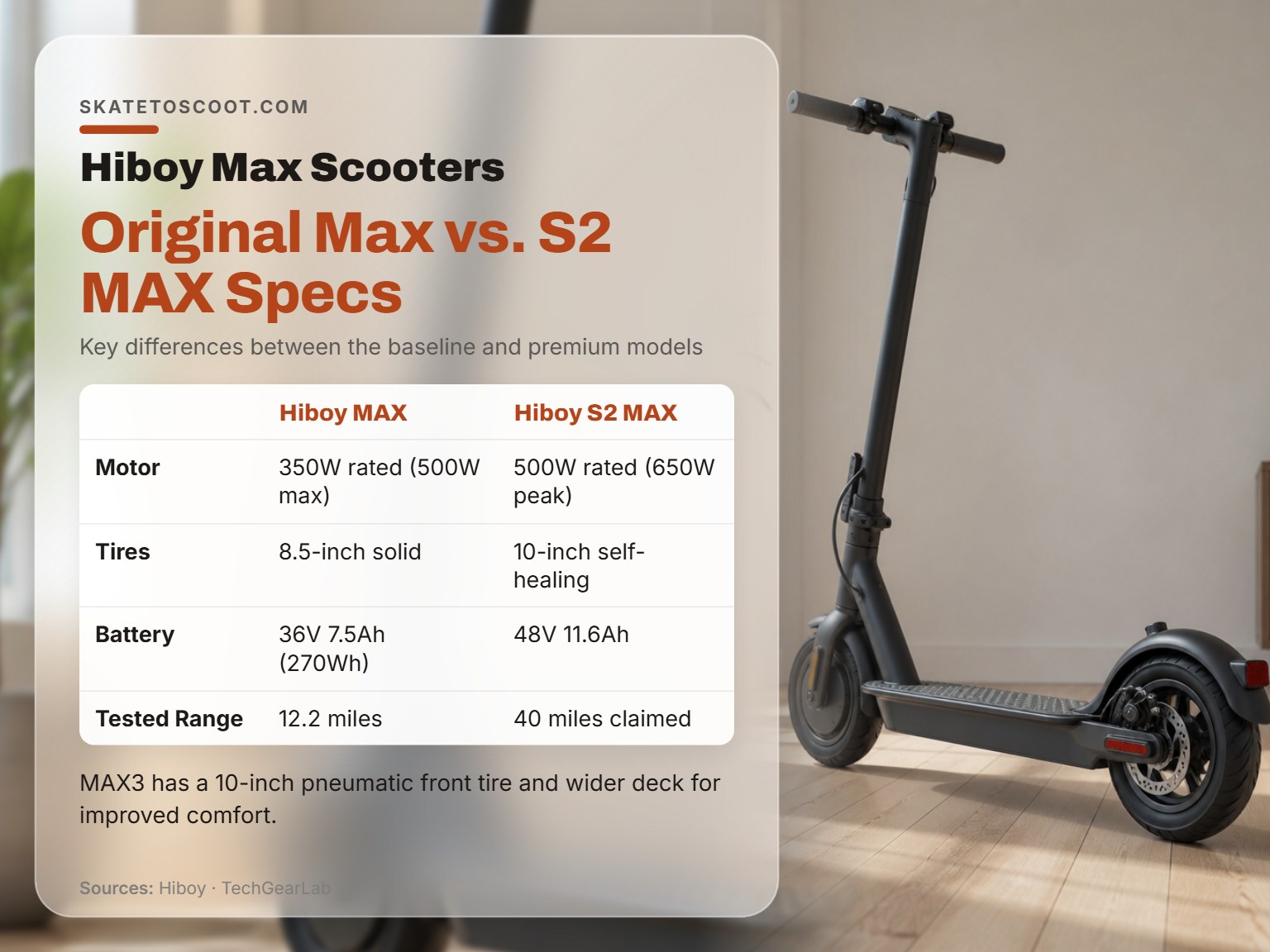
This is where shoppers get lost. Hiboy has iterated its lineup, creating three distinct models with the “Max” name. Here’s how to tell them apart.
The original Hiboy MAX (reviewed here) has 8.5-inch solid tires, a 350W motor, and a 36V 7.5Ah battery. It’s the baseline model with documented performance figures.
The Hiboy MAX3 features a 10-inch pneumatic front tire. This is the model you’ll commonly find now, and it directly addresses the original’s harsh ride.
The Hiboy S2 MAX is a different scooter entirely in the next product tier. It boasts a 500W motor, 10-inch self-healing tires, a 48V 11.6Ah battery, and a claimed 40-mile max range. It also features regenerative braking and a higher 20% max climbing capability. It’s heavier at 40 lbs and costs more.
| Model | Motor | Tires | Battery | Key Differentiator |
|---|---|---|---|---|
| Hiboy MAX (Original) | 350W rated | 8.5″ Solid | 36V 7.5Ah (270Wh) | Baseline, tested 12.2-mile range, firm ride. |
| Hiboy MAX3 | Likely 350W | 10″ Pneumatic Front | Likely 36V 7.5Ah | Improved comfort, addresses main complaint of original. |
| Hiboy S2 MAX | 500W rated | 10″ Self-Healing | 48V 11.6Ah | Longer range (40 mi claimed), better hill climb, regenerative braking. |
When you’re reading a Hiboy Max electric scooter review, always check which model is being discussed. The performance and experience between the original Max and the S2 MAX are night and day.
Real-World Reliability and Common Issues
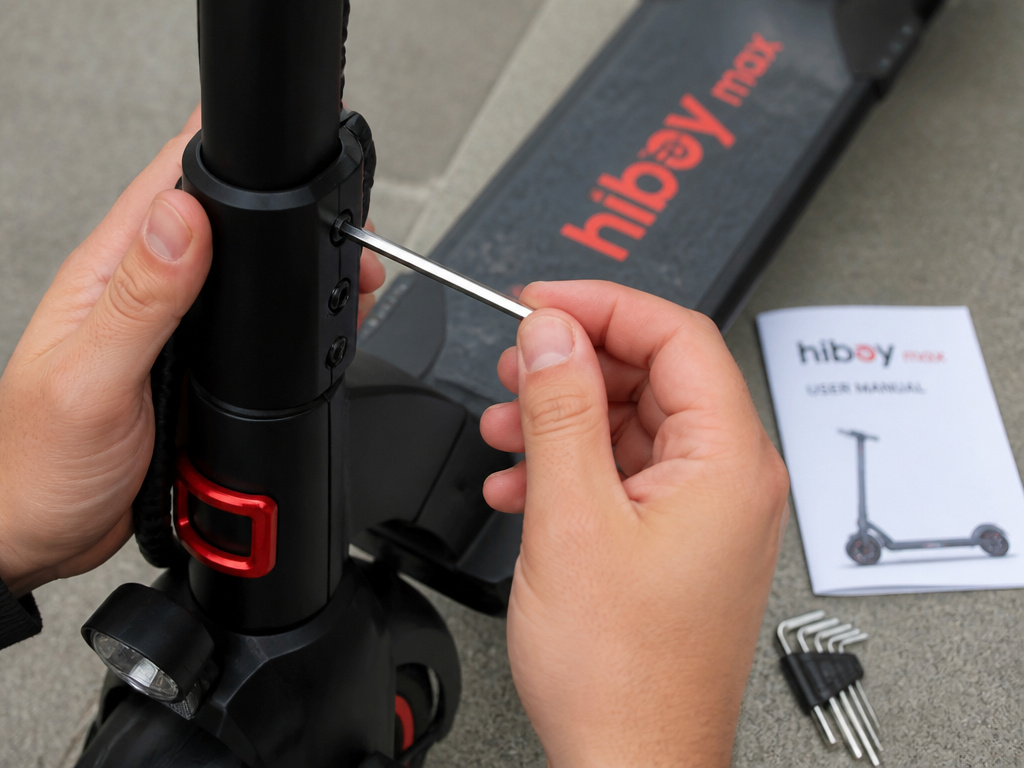
Forum threads and owner reports fill in the gaps left by formal reviews. A common theme is the need for periodic tightening. Stem bolts, handlebar clamps, and folding mechanisms can work loose over time, leading to wobble or a concerning creak. A quick check with an Allen key every few weeks solves this.
Some owners on Reddit have posted photos of broken stems on Hiboy models, though this appears less common on the Max than on some earlier S2 variants. This highlights the importance of not overloading the scooter and avoiding curb jumps or harsh impacts.
The error codes (E4, E5, E8) are a point of frustration. While they’re protection features, their appearance, especially E4 (over-current) during hill climbs, can feel like the scooter is failing. Understanding that it’s a thermal cutoff, not a breakdown, is key. Let it cool, and it’ll reset.
Battery longevity is a silent question. The manual is strict: if storing the scooter idle for more than 30 days, fully charge the battery. Then, recharge it every 60 days during prolonged storage. Damage from prolonged no-charge storage is labeled “irreversible and beyond limited warranty.” Other manufacturers, like Levy Electric, recommend storing lithium batteries at 40-50% charge.
For a deeper look at how the Max stacks up against other options, our guide to Hiboy scooter models breaks down the entire lineup.
Maintenance and Ownership Practicalities
Maintenance is minimal, which is the solid tire’s main selling point. You’ll never patch a tube or worry about pressure. The tasks that remain are crucial.
Brake Adjustment: The mechanical disk brake will need occasional adjustment as the pad wears. A soft lever feel or reduced stopping power means it’s time. It’s a simple turn of an adjustment barrel on the brake caliper.
Tire Inspection: Even solid tires wear. Check for the flat-spotting noted in tests, and look for deep cuts or chunks missing from the rubber. Severe wear affects stability and braking.
Battery Care: This is the most important. Avoid draining the battery to absolute zero. Try to recharge after each use or when it drops below 30%. In cold weather (below 32°F), expect severely reduced range, the manual notes it can be halved or less below -4°F. The battery also dislikes extreme heat during charging; a cool, dry place is best.
Firmware & Connections: Keep the app updated if you use it. Ensure all wire connections, especially near the handlebars and under the deck, are secure and free from corrosion. A drop in performance or error codes can sometimes be traced to a loose connector.
For security, investing in one of the best locks for Hiboy is a smart move, as the built-in electronic lock is only a basic deterrent.
Unboxing & Setup Process
The Hiboy MAX arrives in a single box with the scooter folded. After unboxing, you’ll need to unfold the stem until you hear a secure click, then lock it in place using the provided latch or mechanism. The handlebars may need to be attached by aligning them and tightening a few bolts with the included tools. Before your first ride, ensure the scooter is fully charged. The scooter features a kick-off start, so you’ll need to give it a push to reach a minimum speed before the throttle engages. For app connectivity, download the correct ‘HIBOY MAX’ app and use the default password to pair.
Frequently Asked Questions
Are Hiboy electric scooters any good?
For the price, they are competent. Models like the Hiboy MAX offer verified performance (19.3 mph top speed, 12.2-mile tested range) at a budget cost. The trade-offs are a firm ride from solid tires and limited hill-climbing power. They are good for smooth, short commutes where low maintenance is a priority.
Which is better, Segway or Hiboy?
Segway (specifically the Ninebot Max series) generally offers better build quality, more refined water resistance, and a more proven track record of long-term reliability. Hiboy undercuts Segway on price, offering similar specs for less money. If budget is tight and your route is forgiving, Hiboy is a valid choice. If you want the industry benchmark and can spend more, Segway is the safer long-term bet.
Is the Hiboy Max Pro good?
The Hiboy Max Pro is a more recent, higher-spec model. It boasts a longer advertised range and more power than the original MAX. It represents Hiboy moving upmarket. Without independent test data like TechGearLab’s for the original, it’s harder to verify its real-world performance against its claims. It is likely a step up in capability.
Which is better, Hiboy or Gotrax?
Hiboy and Gotrax compete directly in the budget scooter space. Historically, Gotrax had wider brand recognition but faced reliability complaints. Hiboy has carved a niche with solid tires and straightforward designs. The difference often comes down to specific model comparisons and current pricing, check independent Hiboy Max electric scooter review and Gotrax reviews for the models you’re considering.
The Bottom Line
The original Hiboy MAX is a snapshot of the budget scooter market: capable where it counts (speed, flat range), compromised where costs were cut (ride comfort, portability). Its value was in its verified performance at a low price. The succeeding MAX3 model fixed the biggest issue by adding an air-filled front tire.
If you find a deal on an original MAX and your commute is under 5 miles on smooth ground, it’s a functional tool. Just know the 12.2-mile range is your realistic ceiling, not the 17-mile ideal. For anyone with a longer, rougher, or hillier route, stepping up to the Hiboy S2 scooter or its competitors is a wiser investment in your daily comfort and reliability.
One final, mandatory rule from the manual: if you store it unused for a winter, plug it in. The warranty won’t cover a dead battery killed by neglect. That detail alone tells you more about the ownership experience than any spec sheet.
