How to Charge Lime Scooter: The Official Process
This post contains affiliate links. As an Amazon Associate, we earn from qualifying purchases.
To charge a Lime scooter, you need the correct Lime-branded charger (42V, 2A output), plug it into a standard wall outlet, and connect it to the scooter’s charging port. A full charge takes up to 6 hours, signaled by a green light on the charger and a 99.9% reading on the scooter’s display. However, for Lime Gen4 models and certain flagged scooters, charging is restricted to trained Lime personnel only.
That last line is the catch. It turns a simple plug-and-wait task into a question of which scooter you have and what year it’s from. The official manual tells you to charge after every trip, but the safety bulletin for newer models says never to charge it yourself. This isn’t a contradiction; it’s a timeline of the company’s response to real-world battery issues. This means the official advice on how to charge Lime scooter has changed.
What follows is a breakdown of the two charging paths: one for the older Lime Gen 2.5 scooters you might own, and the other for the rental fleet and newer models where the how to charge lime scooter rules have changed. The specs, timelines, and main error code causing confusion are explained here.
Key Takeaways
- Only use the official Lime charger (42V, 2A output); using unauthorized chargers or parts violates Lime’s safety guidelines.
- According to Lime’s manual, a full charge takes up to 6 hours for a Lime Gen 2.5, signaled by a green charger light and a 99.9% display reading, though some users report shorter times.
- Error Code 02E means low battery, a full charge usually clears it; any other error code means stop riding and contact Lime support.
- For Lime Gen4 models and Segway Ninebot scooters, user charging is prohibited; all charging is managed by trained Lime personnel at secure facilities.
- If you’re considering becoming a “Juicer,” understand that the program is largely superseded by Logistics Providers, and profitability depends heavily on local task density and your operational costs.
The Official Charging Process for Lime Scooters
The process isn’t complicated, but it’s specific. For a Lime Gen 2.5 scooter, the model most commonly sold to individuals, the steps are laid out in the owner’s manual.
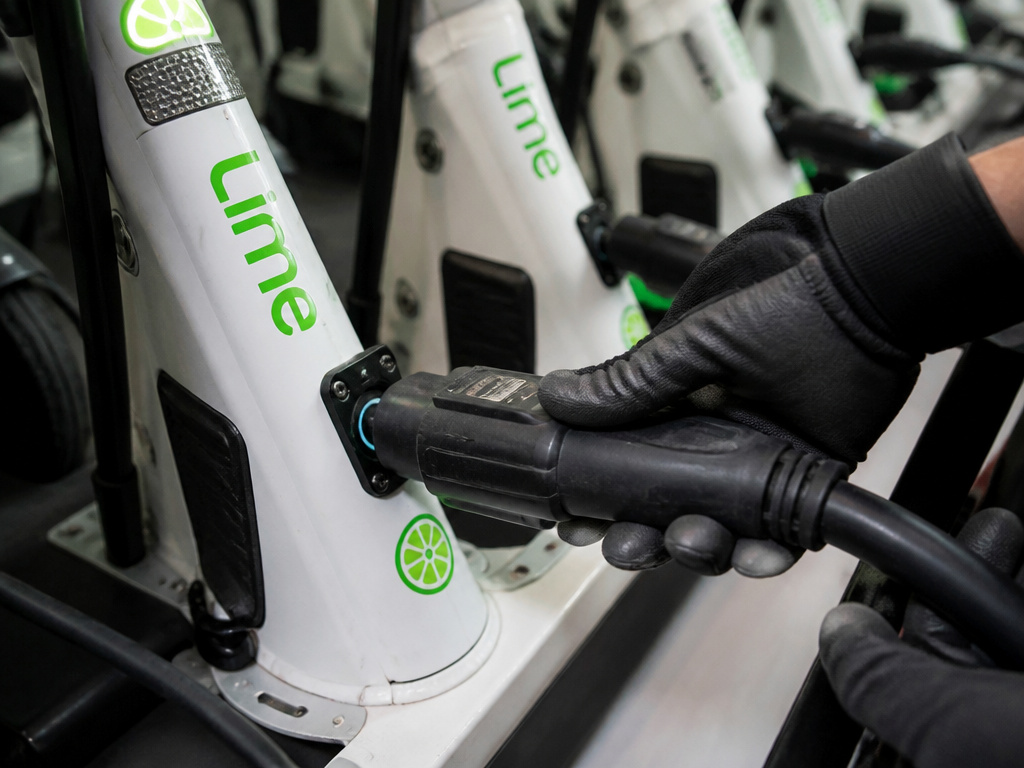
First, locate the charging port, usually under a rubber flap near the deck or stem. You must use the supplied Lime charger. The specs are fixed: input 100-240V, output 42.0V at 2.0A. Plug the charger into a standard wall outlet, then connect it to the scooter. The charger light will typically be red during charging.
Now, you wait. The manual states the battery will take up to 6 hours to fully charge. You’re listening for silence and watching for two green lights: one on the charger itself, and a 99.9% charge indication on the scooter’s display. That’s your confirmation.
Where this goes sideways: Using a non-standard charger or modifying the port. The manual explicitly warns against using “unauthorised chargers or modifying the vehicle,” citing a serious fire hazard. This isn’t scare talk; it’s the predictable outcome of mismatched voltage and current on a lithium-ion battery.
For a Lime Gen 2.5, the manual recommends charging the scooter again after your trip, even if you’ve locked it. Why? Because the lock only secures the wheel; the scooter remains powered on and will eventually deplete the battery. Letting it sit dead for extended periods is worse for battery health than keeping it topped up.
Who Actually Charges Lime Scooters? (User vs. Juicer vs. Logistics)
This is where the simple “plug it in” story splits into three distinct lanes, and most online guides mash them together. Here is the actual situation.
Lane 1: The End User. You bought a Lime Gen 2.5 scooter. You follow the manual above. This is straightforward, private ownership.
Lane 2: The “Juicer” (Historical/Gig Worker). This was Lime’s original crowd-sourced charging program. Individuals (“Juicers”) used the Lime app to find low-battery scooters, collected them, charged them at home with provided chargers, and redeployed them to designated “nests” for payment. A Reddit user reported payouts around $5 per scooter and charge times around 4 hours. Some Juicers estimated costs for electricity and gas, finding net profit was slim and highly dependent on scale and proximity.
Lane 3: The Logistics Provider (Current Model). Post-2022, following battery safety incidents, Lime drastically scaled back the Juicer program. Today, in most markets, charging is handled by Logistics Providers, contracted companies with warehouses, staff, and proprietary charging racks. For high-risk scooters like the flagged Segway Ninebot models, this is the only permitted method.
| Charging Role | Who Does It | Scooter Models | Key Constraint |
|---|---|---|---|
| End User | Private owner | Lime Gen 2.5 (personal purchase) | Must use official 42V/2A charger only |
| Juicer (Legacy) | Independent gig worker (largely phased out) | Gen 2.5 fleet (in active Juicer markets only) | Market-dependent; largely superseded |
| Logistics Provider | Contracted company staff | Gen4 fleet, Segway Ninebot, most modern rentals | Exclusive; no public/individual access |
The confusion in search results comes from mixing these lanes, especially when you compare a how to charge lime scooter guide from 2019 with a 2023 safety page, which is clarified by understanding the Lime scooter system. A guide from 2019 talks about becoming a Juicer; a 2023 Lime safety page says never charge a Gen4 scooter. Both are correct for their specific context and timeline.
Lime Scooter Charging Specs and Safety Standards
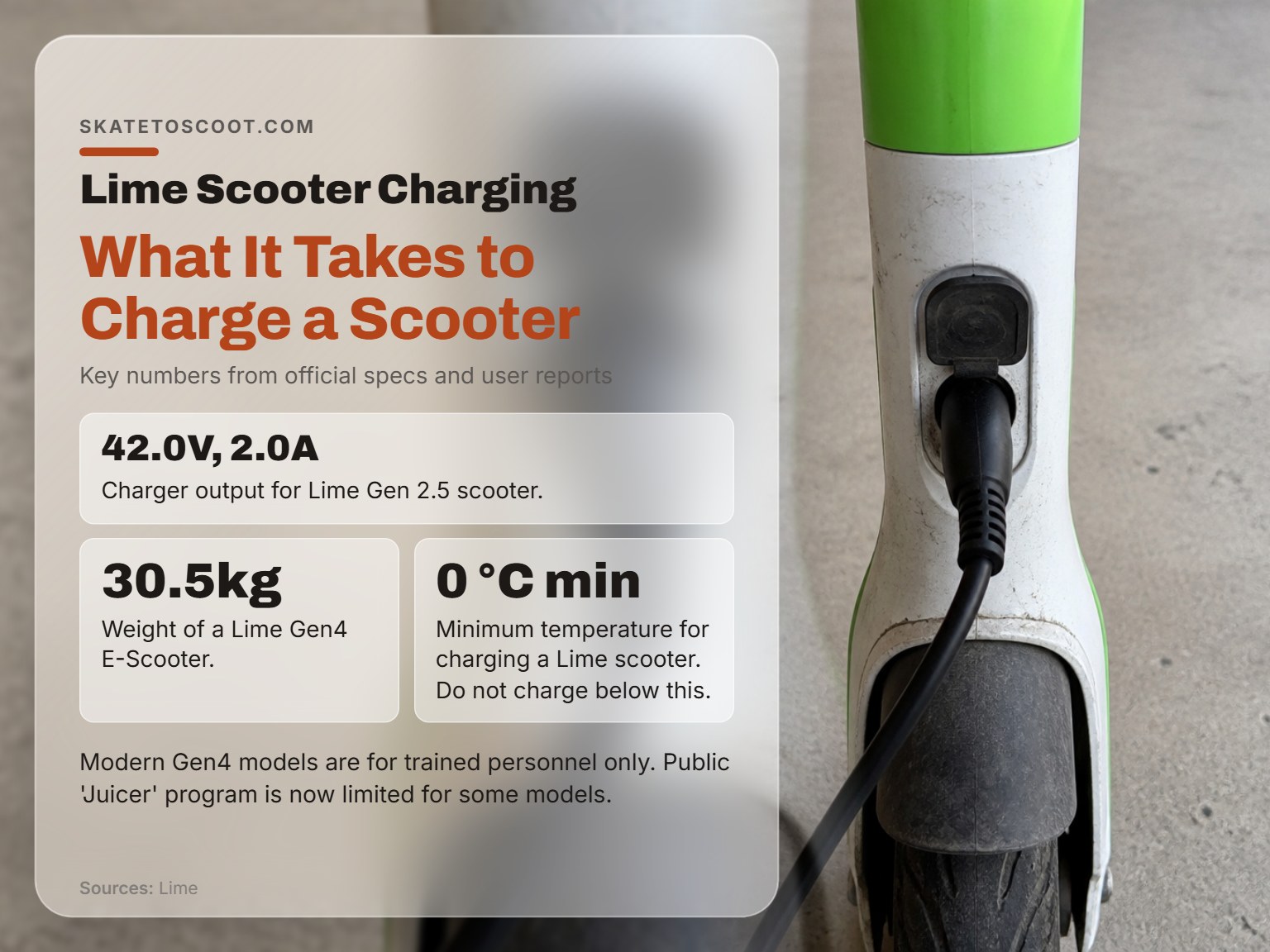
If you’re going to plug something in, you should know what’s flowing through it. The technical specs aren’t just marketing, they’re the boundaries of safe operation.
For the Lime Gen 2.5, the charger is rated for Input: 100-240V~, 2.0A (max) 50/60Hz and Output: 42.0V, 2.0A. The battery is Lithium-ion. These scooters are designed to comply with safety standards UL2849 and UL2272.
The newer Lime Gen4 E-Scooter has different specs: maximum continued power rated at 500W, a weight of 30.5kg, and a top speed of 20 km/h. More importantly, its compliance listing adds AS 15194 (an Australian standard). The critical line from Lime’s NSW Fair Trading page is: “For your safety, all battery charging is managed exclusively by trained Lime personnel.“
The part nobody mentions: That Gen4 directive isn’t a suggestion. It’s a condition of regulatory compliance in certain markets. Attempting to charge a Gen4 scooter yourself isn’t just unsafe; it could void any insurance or warranty and violates the terms of use for a rental vehicle.
Temperature matters. The Gen 2.5 manual says not to charge below 0°C (32°F). Other manufacturer guides, like the one for a DENVER scooter, set the lower bound at 0°C and the upper bound at 45°C. The principle is the same: lithium-ion batteries charge inefficiently and can be damaged outside their happy range.
Troubleshooting the Most Common Charging Problem
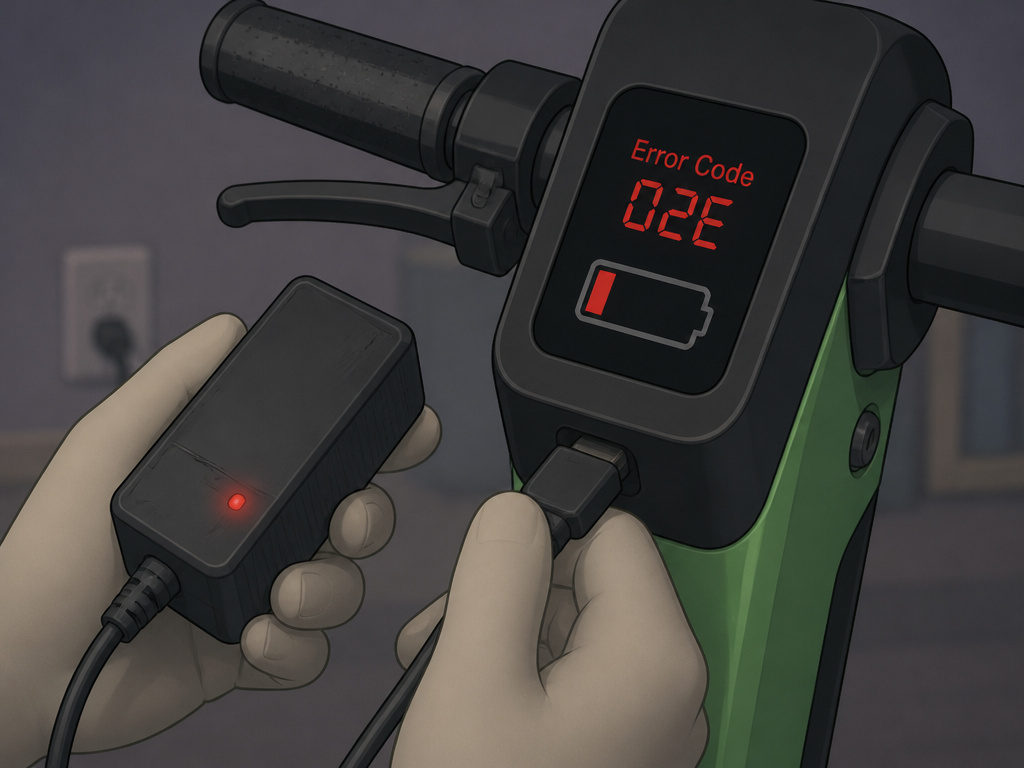
You plug in your Lime scooter, and the display lights up with Error Code 02E. This is the single most frequent issue users face, and the fix is straightforward, but the consequence of ignoring it isn’t.
According to the Lime Gen 2.5 manual, Error Code 02E means one thing: low battery. The instruction is simple: “charge the scooter fully.” In most cases, once the battery reaches a full charge (indicated by the 99.9% display), the code will clear automatically. You don’t need to contact support.
If the 02E code does not disappear after a full charge, contact customer support.
This is the diagnostic tree. Charge first. If the problem persists, then it’s a support ticket. Jumping straight to support for an 02E just gets you told to charge it.
What about other codes? The manual lists over a dozen other error codes (01E, 03E, 04E, etc.). The rule here is absolute: “If the LCD screen shows any of the following error codes other than 02E, do not ride the scooter and please contact the Lime support team.” Any other code indicates a fault that disabling the scooter is designed to prevent.
The Battery Safety Timeline: Why the Rules Changed
In August 2022, Lime learned of a potential issue. Some Segway Ninebot scooter batteries, specifically in early versions, had a manufacturing defect that could cause smoldering or fire.
The company’s response reshaped their entire charging ecosystem. They implemented a software program to detect affected batteries and remotely deactivated the identified scooters (marked with a red code in their system). More permanently, all Segway Ninebot scooters were restricted to Lime-operated charging facilities only and removed from the public “Juicer” program.
This incident is the direct reason for the stark warnings on the Lime Gen4 vehicle information page. It shifted the company’s stance from “crowd-sourced charging is efficient” to “professional, monitored charging is essential for fleet safety.”
For a private owner of a Gen 2.5, this history is a reminder: your charger and battery aren’t generic components. They are a matched set tested to a specific safety standard. Swapping in a different 42V charger is playing with odds that a billion-dollar company decided were unacceptable.
Can You Make Money Charging Lime Scooters Today?
The short answer is: it’s highly market-dependent and no longer the side hustle it was portrayed as in 2018. The Juicer program still exists in a handful of cities, but the trend is firmly toward professional Logistics Providers.
If you’re in an active Juicer market, here’s the real math, drawn from community reports:
- Payout: ~$5 per completed charge task.
- Charge Time: ~4-6 hours per scooter (manual says up to 6).
- Electricity Cost: ~$0.13 per full charge (based on a 42V/2A charger drawing ~0.88 kWh).
- Gas Cost: Highly variable; one user estimated ~$0.38 per scooter for collection/drop-off.
- Scale: To make it worthwhile, you need volume, collecting 20-30 scooters per run, and proximity to minimize drive time.
The barrier now isn’t just math; it’s access. With many modern scooters off-limits to Juicers, the available pool of charge tasks in a given area can be thin. You’re competing against dedicated logistics vans that operate at a much lower cost per unit.
Bottom line: Treat charging Lime scooters for money as a historical case study in the gig economy, not a reliable income plan. The operational and safety realities have shifted the work to professionals.
How to become a Lime charger/juicer (sign-up, requirements)
Becoming a charger for Lime, often called a ‘Juicer’, starts with an application through their official platform (which is separate from the process to unlock a Lime scooter). The process involves a background check and agreeing to their operational terms. The program’s availability varies by city and scooter model, as some newer models are restricted to Lime-operated charging facilities only for safety reasons. Once approved, you’ll use the dedicated app to locate, reserve, and pick up scooters needing a charge.
Pay structure and earnings potential
Earnings as a Lime charger are based on completing charge tasks. Each task has a set bounty paid upon successful completion. Your total earnings depend on how many scooters you can charge and return within the required time windows. You should factor in your personal costs for transportation and electricity. The net profit varies based on your local market, operational efficiency, and the number of tasks you complete in a session.
Tools/equipment needed (app, chargers, vehicle)
You need a smartphone with the official Lime charger app to reserve and manage tasks. You must use the specific chargers supplied by Lime for the scooter models you are approved to charge; using unauthorized equipment is prohibited. A reliable personal vehicle, such as a car or van, is essential for collecting and dropping off multiple scooters. You should also have a secure, temperature-controlled indoor space to charge the scooters safely, following all safety guidelines.
Frequently Asked Questions
How do you recharge a Lime scooter?
For a privately-owned Lime Gen 2.5 scooter, use the supplied Lime charger (42V, 2A output). Plug the charger into a wall outlet, connect it to the scooter’s charging port, and wait up to 6 hours for a full charge, indicated by a green light on the charger and a 99.9% reading on the scooter’s display. For rental Lime scooters (especially Gen4 models), do not attempt to recharge them yourself; they are charged by Lime’s operational staff.
How much is 20 minutes on a Lime?
This question refers to ride cost, not charging; for a full guide, see our article on how to use a Lime scooter. Lime ride fares vary by city and are typically based on time plus an initial fee. These fees are unrelated to the cost of charging the scooter.
Are Lime scooters self-charging?
No, Lime scooters are not self-charging. They must be plugged into an electrical outlet using a compatible charger to recharge their lithium-ion batteries. Lime scooters are not self-charging and must be plugged into an electrical outlet using a compatible charger.
How do I know if a Lime scooter is charged?
For a Lime Gen 2.5 scooter, a full charge is indicated by two things: 1) The indicator light on the charger turns from red to green. 2) The scooter’s display shows a battery percentage of 99.9%. For rental scooters, a fully charged scooter will typically show a full battery icon in the app.
Before You Go
Your path is determined by the label on the scooter’s stem. If it’s a personal Lime Gen 2.5, your job is to follow the manual: use the Lime Gen 2.5 Scooter Charger, watch for the green indicator light on the charger, and know that Error 02E fixes itself with a full charge. That’s the straightforward ownership path.
If you’re looking at a rental Lime scooter, especially a sleek, modern one, your only job is to ride it. The company’s safety evolution, driven by genuine battery incidents, means charging is now a closed-loop professional operation. The crowd-sourced “Juicer” dream of 2018 has largely been eclipsed by logistics contracts.
The one universal rule? Never force a charge. If the plug doesn’t fit, the charger light doesn’t change, or an error code other than 02E appears, stop. The scooter’s system is telling you something is wrong. In the world of high-capacity lithium-ion batteries, that’s a message worth listening to.
