How to Maintain a Longboard: Your 10-Minute Pre-Ride Check
This post contains affiliate links. As an Amazon Associate, we earn from qualifying purchases.
How to maintain a longboard comes down to three things: a ten-minute check before you ride, knowing how to clean each component without damaging it, and understanding when a part needs replacement, not just maintenance. The goal is to stop small issues, a loose axle nut, grit in a bearing, from becoming a crash or a costly repair.
That ten-minute check is where most riders fail first. It’s not about a deep clean every week. It’s about catching the loose kingpin nut before your truck feels sloppy, or spotting the flat-spotted wheel before it throws off your push rhythm. This guide walks through exactly what to look for, how to clean the right way, and when to walk away from a repair and just buy the new part, which is the core of how to maintain a longboard.
What follows: the tool kit you actually need, the manufacturer specs that override forum advice, and the one post-ride ritual that adds years to your board’s life. By the end, you’ll have a clear schedule and the confidence to fix the squeaks and wobbles yourself, mastering how to maintain a longboard.
Key Takeaways
- Perform a ten-minute visual and hand check before every session, tighten hardware, spin wheels, and inspect the deck for cracks. This catches most failures.
- Clean components with the right agent for the material: mild soapy water for urethane bushings and wheels, isopropyl alcohol for bare metal parts (but check your bearing manufacturer’s advice), and only a dry cloth for grip tape. Petroleum-based cleaners destroy bushings.
- Tighten axle nuts until there’s almost no side play, but each wheel still spins freely. Overtightening crushes bearings; undertightening causes speed-wobble.
- Dry your board immediately after any wet ride. Take the wheels off to let bearings and washers air out; leaving a damp board in a bag guarantees rust.
- Manufacturers and the riding community disagree on bearing lubrication. Follow your specific board’s manual, some factory-lubed bearings should never be oiled, while others require a drop of skate-specific lube after cleaning.
The 10-Minute Pre-Ride Check (And What It Catches)
You don’t need a full workshop for this. You need your eyes, your hands, a skate tool, and five points of contact. This is a systems check, not a deep inspection.
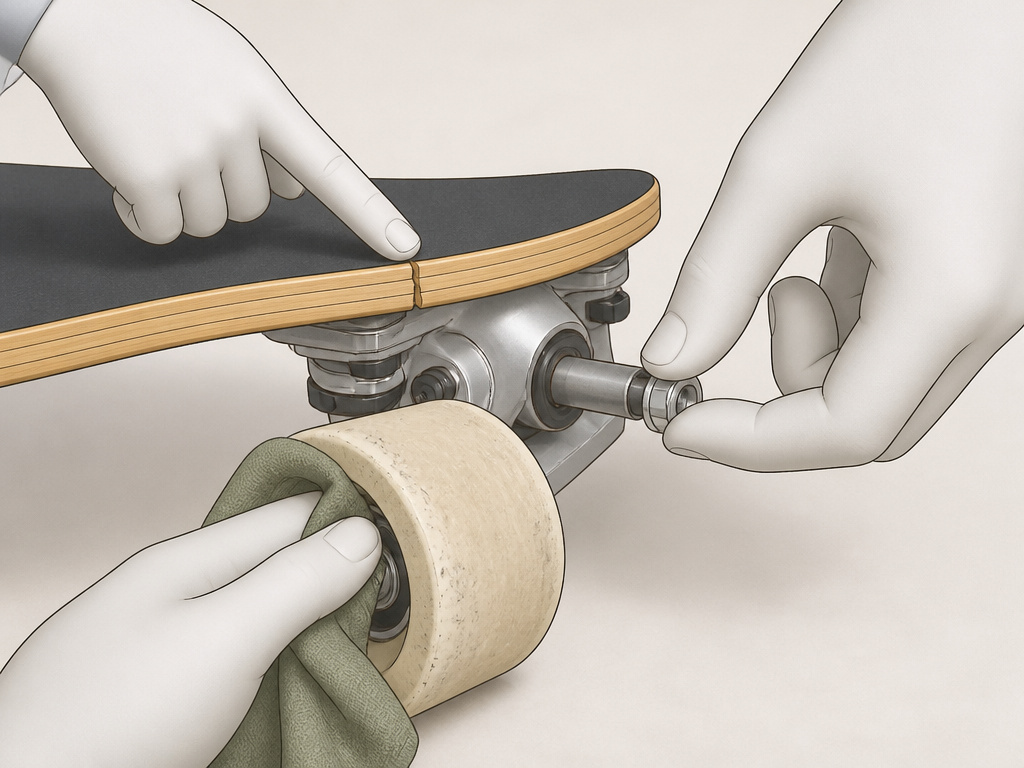
Start with the deck. Run your fingers along the rails, feeling for sharp splinters or soft, spongy spots that signal delamination. Look at the mounting holes, are there radiating cracks? A single hairline crack around a bolt is a warning. A network of them means the deck’s integrity is compromised and it’s time for a replacement, not a repair.
Now, grab each wheel and try to wiggle it side-to-side. There should be a tiny amount of play, less than a millimeter. If you can shake it like a loose tooth, your axle nut is too loose. This is the most common source of speed wobble beginners mistake for bad trucks. Use your skate tool to tighten it just until the play is nearly gone, then give the wheel a hard spin. It should coast freely. If it stops dead, you’ve overtightened it and are crushing the bearing shields.
Common mistake: Tightening the axle nut until the wheel won’t spin. This crushes the bearing races and will destroy a set of bearings within a few rides, turning a smooth roll into a gritty, slow drag.
Check the trucks by standing the board on its tail and leaning it side to side. Listen for creaks from the bushings or pivot cup. Grab the truck hanger and try to twist it, there should be a smooth, rubbery resistance from the bushings. If it feels crunchy or you hear a dry plastic squeak, your bushings are either worn out or your pivot cup needs attention. Finally, check every single bolt connecting the trucks to the deck. They work loose over time, especially if you do a lot of jumps or curbs.
Your Longboard Maintenance Toolkit
You can’t fix what you can’t take apart. A toolkit requires the basic tool for six specific jobs, not expensive specialty gear. Here’s what you actually need, and what happens if you try to substitute.
| Tool | Its Specific Job | What Goes Wrong Without It |
|---|---|---|
| Skate Tool | Tightening/loosening axle nuts, kingpin nuts, and mounting hardware. The right-size socket prevents rounded nuts. | Using an adjustable wrench slips, strips the nut, and makes future adjustments impossible. |
| Clean, Dry Microfiber Cloths | Drying bearings and metal parts after cleaning. Lint-free material prevents new debris from entering bearings. | Paper towels leave fibers inside the bearing shields, which then grind against the races. |
| Soft-Bristle Brush (toothbrush works) | Scrubbing grip tape and wheel urethane without damaging the surface. | A stiff wire brush or Scotch-Brite pad scours away grip tape granules and creates micro-cracks in the wheel surface. |
| Isopropyl Alcohol (90%+) | Degreasing and displacing water from metal bearing components. It evaporates completely, leaving no residue. | Using WD-40 leaves a thin, gummy film that attracts dirt and turns your bearings into a grinding paste. |
| Small Bowl or Container | Soaking bearings or small hardware in cleaning solvent. | Cleaning bearings in an open jar or your hand spills toxic solvent everywhere and is inefficient. |
| Wooden Toothpick or Plastic Pry Tool | Gently removing pebbles and debris lodged in wheel urethane or under bearing shields. | Using a metal pick or screwdriver scratches the bearing seal or cores the urethane, creating a weak spot. |
The kingpin adjustment on your trucks dictates how the board feels. The Decathlon UK guide for drop-through longboards states that tightening the kingpin with a T-tool makes the skateboard more rigid, while loosening it makes it more manoeuvrable. But there’s a limit. Overtightening crushes the bushings, destroying their rebound. Loosening it too much can lead to wheel bite, where the wheel touches the deck during a sharp turn and locks up instantly. It’s a fine balance you find by feel, not by torque specs.
How to Clean Without Causing Damage

Cleaning involves three separate procedures for three different materials: urethane, metal, and wood/composite. Use the wrong cleaner on any of them and you’ll do more harm than good.
For the wheels and bushings, which are urethane, use warm water with a drop of mild dish soap. The Longboard Bible guide is clear: petroleum cleaners swell or weaken urethane. Take the wheels off, pop the bearings out, and scrub the bare urethane with your soft brush. Rinse and let them air dry completely before reassembly. For the bushings, just a wipe with a damp, soapy cloth is enough. Never soak them.
Where this goes sideways: Soaking bushings in any liquid, especially solvents. The liquid seeps into the porous urethane, weakening its structure from the inside. The bushing will feel mushy and lose its rebound, ruining your truck tuning, sometimes within a single ride.
Metal parts, truck hangers, axles, bearing races, get a different treatment. Clean them with a cloth dampened with mild soapy water, then dry immediately. For stubborn grease or after a wet ride, a little isopropyl alcohol on a cloth is fine for bare metal. The key is to never let water sit. After any wet ride, the guidance is urgent: remove surface water immediately and take off the wheels so moisture cannot remain around bearings and washers. This is a disassembly job, not a casual wipe-down.
What about the deck and grip tape? For most decks, a dry brush is sufficient. If your deck has a specific top layer like Deviate’s Lucid light grip, their manual says to use warm soapy water and a soft scrub brush, then pat dry with a towel. Never pour water directly onto the deck, and never use a pressure washer. The force can drive water into the board, leading to damage.
The Bearing Debate: To Lube or Not to Lube
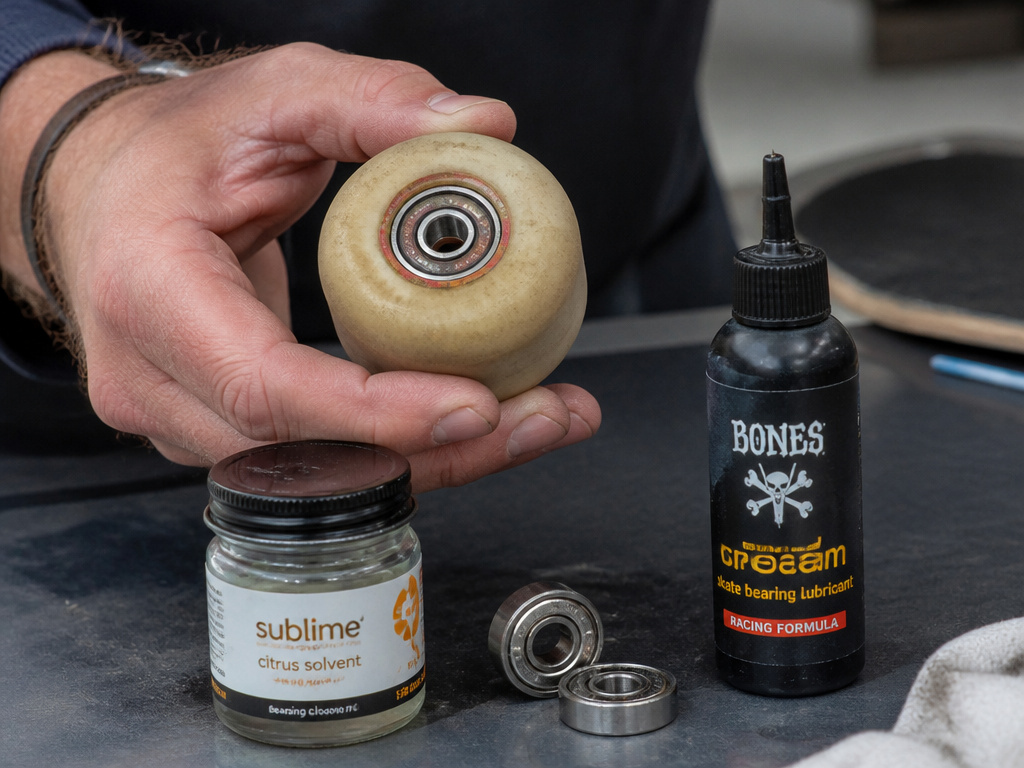
This is the single biggest point of conflict in longboard maintenance. Manufacturers and the riding community give directly opposite advice. Your choice isn’t about right or wrong; it’s about following the instructions for your specific board or choosing the community standard.
The Abisal Sp. Z o.o. Manual for the NILS EXTREME longboard states plainly: “Do not lubricate the bearings – they are factory lubricated.” It advises that if they get wet, you should only “dry wet bearings with a clean, dry cloth.” This is a factory-lubricated bearing system. Adding oil is not recommended by the manufacturer.
In contrast, the Longboard Bible guide and most rider forums treat bearing maintenance as a clean-and-relube cycle. Their instruction is to clean bearings with a solvent, dry fully, and apply one or two drops of skate-bearing lubricant. Sources like The Longboard Store blog recommend soaking bearings in a solvent for a few hours, drying for about half an hour, then adding lubricant.
| Position | Who Holds It | Recommended Action | Best For |
|---|---|---|---|
| Do Not Lubricate | Abisal Sp. Z o.o. (NILS EXTREME manufacturer) | Dry with a clean cloth only. No solvents, no additional oil. | Factory-sealed, pre-lubricated bearings that come on specific completes. |
| Clean & Re-Lubricate | Longboard Bible, The Longboard Store, community consensus | Clean with solvent (e.g., isopropyl alcohol), dry thoroughly, apply 1-2 drops of skate-specific lubricant. | Standard 608 ZZ bearings, riders in wet/dirty conditions, or when bearings feel gritty. |
| Minimalist Wipe-Down | Some forum riders | Wipe bearings with a dry or slightly damp cloth after each ride to prevent major buildup. | Dry-weather cruisers who want to avoid full disassembly. |
How do you decide? Look at your bearings. If they are standard bearings not specified as factory-lubricated, the clean-and-relube path is common. If your board is a specific complete like the NILS EXTREME, follow the manual. The wrong choice has a clear consequence: oiling a factory-lubricated bearing is not recommended by the manufacturer., while never oiling a standard bearing will let it grind itself to an early, gritty death.
When cleaning, avoid WD-40 as a general cleaner. It’s a water displacer and light rust penetrant, not a lubricant. It leaves a residue that attracts abrasive dirt. Use it only as a last resort to free a seized bearing, then clean it properly with alcohol and relube.
Setting Up a Realistic Maintenance Schedule
A schedule based on “every few weeks” is useless. Your maintenance frequency depends on your riding conditions. Here is a decision matrix, not a calendar.
After Every Ride (30 seconds):
- Visually inspect the deck for new major cracks.
- Feel the axle nuts and truck bolts for looseness with your fingers.
- Wipe down the deck and wheels with a dry cloth if they’re dirty.
Weekly or After 5-10 Hours of Riding (10 minutes):
- Perform the full pre-ride check detailed above.
- Tighten all hardware as needed.
- Spin wheels and listen for gritty bearings.
- Check wheel wear for coning or flat spots.
Monthly or After a Wet/Dirty Ride (30-60 minutes):
- Remove wheels and inspect bearings. Dry them if wet.
- Clean wheels with soapy water if caked with dirt.
- Inspect bushings for cracks and wear.
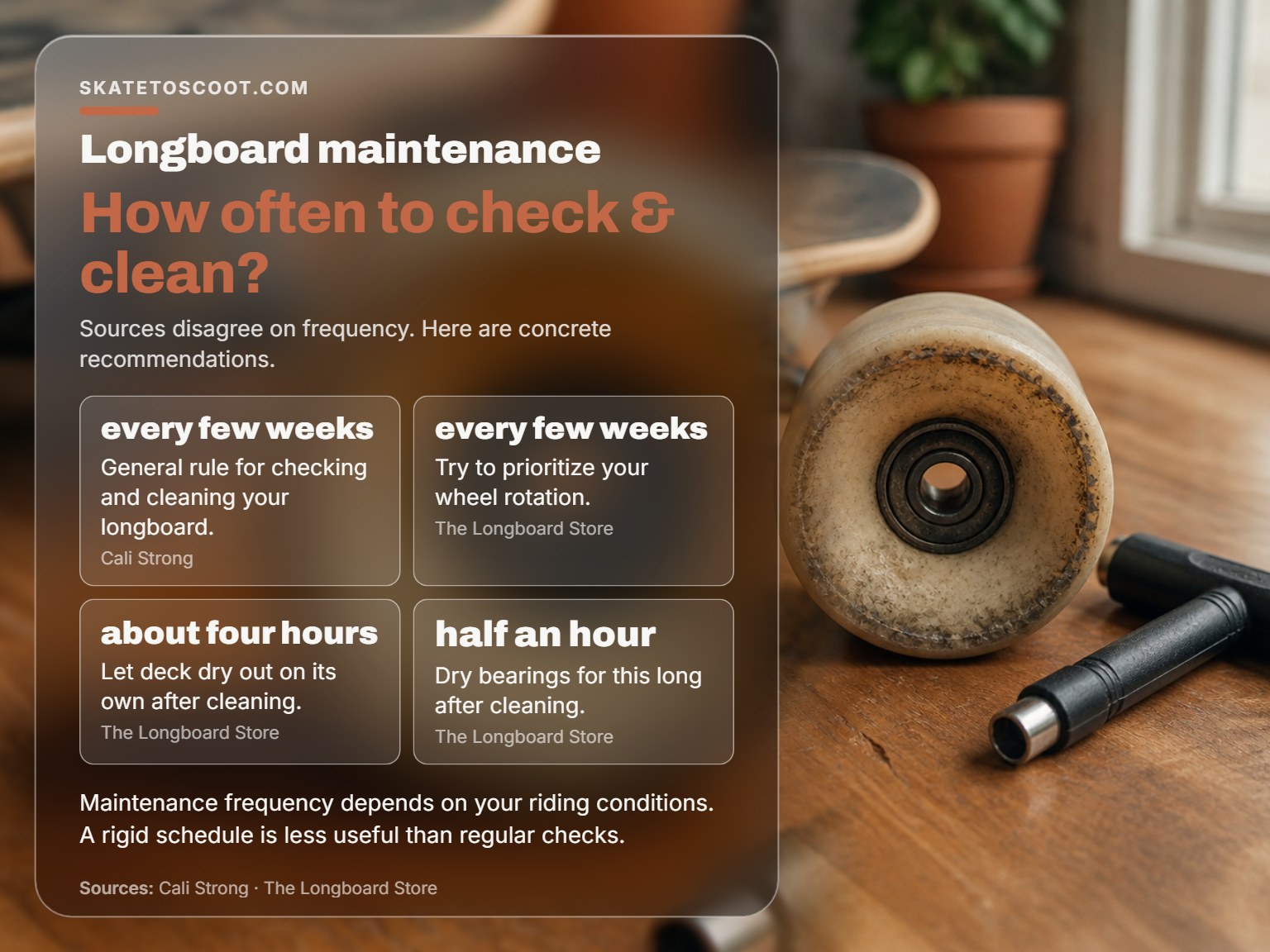
- Rotate your wheels. Swap their positions to even out wear. This evens out wear, especially if you do a lot of pushing or sliding. The Longboard Store blog suggests prioritizing this every few weeks.
Seasonally or When Performance Drops:
- Deep clean bearings using your chosen method (solvent bath or wipe-down).
- Re-lubricate bearings if following that protocol.
- Closely inspect the deck for delamination and the trucks for bent axles or cracked hangers.
- Replace any visibly damaged parts: wheels with deep cracks or exposed cores, split pivot cups, cracked bushings.
The manufacturer Abisal states that self-locking nuts should only be used once. Abisal states these nuts should only be used once, though in practice, many riders reuse them until the locking insert is worn out. The risk is that a worn nut may not hold securely. When in doubt, especially after a bearing or wheel change, use a new nut. It’s cheaper than a crash.
Diagnosing Common Problems (Before You Buy New Parts)
Your board talks to you through noises and feelings. Learning this language saves you money and prevents mid-ride failures.
A rhythmic thump-thump-thump while rolling: This is almost always a flat-spotted wheel. You rode with brakes locked or did a slide that didn’t fully rotate. Inspect the wheel’s surface for a worn, flat section. Rotate the wheel to see if the noise changes. If it’s severe, the wheel needs replacement.
A constant, dry plastic squeak when turning: This is a dry pivot cup. The urethane bushing inside the truck baseplate where the hanger pivots needs lubrication. A tiny amount of dry PTFE or silicone-compatible lubricant on a cotton swab applied to the inside of the cup will silence it. Do not use oil or grease here.
A gritty, grinding feel when spinning a wheel by hand: Dirt or rust in the bearings. If the bearing has removable shields, you can pop them off, clean with isopropyl alcohol, dry, and relube. If they are sealed or the grit persists, the bearing races are likely pitted and the whole set needs replacing. A pack of standard 608 ZZ bearings is a common replacement.
The board feels “dead” or unresponsive to lean: Your bushings are either too soft for your weight, overtightened and deformed, or have hardened with age. First, try loosening the kingpin nut a quarter turn. If that doesn’t help, inspect the bushings. If they are cracked, misshapen, or feel rock-hard, swap them out for a new set matching your weight and riding style. Replacing bushings can dramatically change your board’s feel.
Speed wobble at moderate to high speeds: This is often a combination of loose trucks and uneven wheel wear. Tighten your kingpin nut a half-turn to add stability. Then, check that your axle nuts are snug (with just a hair of side play) and inspect your rear wheels for excessive wear. Rotate or replace worn wheels first before making drastic truck adjustments.
How to fix a cracked longboard deck
Start with the deck. Run your fingers along the rails, feeling for sharp splinters or soft, spongy spots that signal delamination. Look at the mounting holes, are there radiating cracks? A single hairline crack around a bolt is a warning. A network of them means the deck’s integrity is compromised and it’s time for a replacement, not a repair. Avoid sanding structural parts of the deck, as this can weaken it.
How to store a longboard
Store the board indoors in a dry place away from heaters and direct sun. After a wet ride, remove surface water immediately and take off the wheels so moisture cannot remain around bearings and washers. Let the deck dry out on its own for about four hours. Never leave a damp longboard in a closed car or bag, as trapped moisture accelerates damage. This simple routine of keeping it dry and out of extreme temperatures is the single best thing you can do to preserve its shape and components.
Frequently Asked Questions
Is it okay to ride a longboard in the rain?
Manufacturers like Abisal advise against it. The Abisal NILS EXTREME manual explicitly says to avoid riding in the rain or on wet surfaces as it negatively affects grip and the board’s technical condition. Water can damage wood decks, rust bearings and hardware, and degrade grip tape. If you get caught in the rain, dry the board thoroughly as soon as possible, taking the wheels off to dry the bearings.
How often should I replace my longboard wheels?
Replace wheels when they show deep structural cracks, expose the core, or develop severe flat spots that cause vibration. The Abisal manual categorizes wheel sizes (60-65mm for cruising, 70-75mm versatile, 76-85mm for advanced/downhill) and hardness (78A-80A soft for grip, 85A-92A harder for speed), but wear depends on your style, surface, and weight. Rotating them every few weeks spreads the wear and extends their life.
What’s the best way to clean longboard grip tape?
For most standard grip tape, use a stiff-bristled dry brush (a grip tape cleaner or a stiff nail brush) to scrape out dirt and rocks. For specific alternative grip materials like Deviate’s Lucid light grip, follow the manufacturer’s instructions, which typically involve soapy water and a soft brush.
My trucks are squeaking loudly. What should I do?
The squeak is almost certainly from a dry pivot cup. Remove the hanger from the baseplate, clean the inside of the pivot cup and the pivot pin on the hanger with a dry cloth, then apply a minuscule amount of dry lubricant (like a graphite powder or dry PTFE spray) to the cup. Reassemble. Avoid using wet lubricants like oil, which will attract dirt.
Can I use WD-40 on my longboard bearings?
Do not use WD-40 as a lubricant or regular cleaner. It is a water displacer and light degreaser that leaves a thin, sticky residue. This residue attracts dirt and grime, which will form an abrasive paste inside your bearings, destroying them quickly.
The Bottom Line
Longboard maintenance is about respecting the mechanics, not babying your gear. A board is a system of wood, metal, and urethane working under stress. Listen to it.
Set one rule for yourself: after any ride where the board gets wet, take ten minutes when you get home. Take the wheels off. Dry everything. It’s the single most effective habit you can build. Store the board indoors, away from heaters and direct sun. That’s it.
When you hear a new noise or feel a new vibration, don’t ignore it. Use the diagnostic steps above. A squeak is a five-minute fix with a cotton swab. A gritty bearing is a twenty-dollar replacement. Ignoring either leads to a failed truck or a seized wheel, which can lead to a fall.
Finally, know when to stop. A deck with a network of cracks around the trucks is done. A bearing that still grinds after a clean and lube is done. A wheel with the core showing is done. Maintenance keeps a board running. It doesn’t resurrect a dead one. Your time and money are better spent on a new component than on a heroic repair that will fail when you need it most. Keep it simple, keep it consistent, and you’ll spend your time riding, not fixing.
