How to Ship a Longboard and How Much Does the Shipping Cost
This post contains affiliate links. As an Amazon Associate, we earn from qualifying purchases.
To ship a longboard, you need the right box, proper padding, and an accurate shipping label. The cost for ground service within the U.S. Varies by source, with examples ranging from $8 to over $50. The cheapest way depends on the specific route and package dimensions; expedited services like next-day air can be significantly more expensive.
That $20-$50 range is the target, but the actual number on your screen depends on three variables you control: the box size, the declared value, and the service speed. Get one wrong and the quote doubles. This guide walks through the real numbers from actual retailers and logistics companies, so you know what you’re paying for before you click ‘buy label’. It explains how to ship a longboard and how much does the shipping cost.
What follows: a breakdown of packing (complete vs. Disassembled), a side-by-side look at what UPS, USPS, and FedEx actually charge for common routes, and the specific steps to file a damage claim if your board shows up cracked. By the end, you’ll be able to ship a board with the same confidence as a shop.
Key Takeaways
- Ship a complete longboard only if the box is under 34 inches in length; otherwise, disassemble it to avoid massive dimensional weight fees.
- Sources disagree on the base cost for ground shipping: Red Stag Fulfillment quotes specific routes from $20.46 to $39.70, while Fulfyld states an average of $8-$25 for a standard skateboard.
- Always get a free box from a local skate shop before buying one; used boxes are fine if they’re structurally sound.
- For insurance, most carriers cover the first $100 of declared value for free; declare the full replacement cost and pay the small premium for anything above that.
- If shipping to Alaska, Hawaii, or internationally, expect major restrictions and higher costs, and plan for potential customs duty fees on top of the shipping quote.
The Box Size Rule That Decides Your Cost
Look at your longboard. Now imagine the smallest rectangular box it could fit into, lying flat. The price you pay is decided by the volume of that imaginary box, not the board’s weight. Carriers use a calculation called dimensional weight (DIM weight) to bill you for the space your package occupies in their truck or plane.
For a standard 34x10x6 inch box (a common size for a complete skateboard), the dimensional weight calculation will often result in a billable weight higher than the actual weight.
This is the single biggest reason shipping estimates vary wildly. A freestyle longboard can be up to 60 inches long. If you try to ship that in a 60-inch box, the DIM weight will be astronomical. This is why disassembly isn’t just a tip—it’s often the only way to make shipping economically sensible. Your goal is to engineer the smallest possible box.
Common mistake: Using a snowboard bag or a massive wardrobe box for a single longboard. The DIM weight fee will be two to three times the base rate.
To Disassemble or Ship Complete?
This is the first fork in the road. Each path has a clear winner depending on your board’s length and your tolerance for reassembly work.
| Scenario | Best Method | Why It Wins | Box Size Target |
|---|---|---|---|
| Board around 30 inches or less (e.g., old-school deck) | Ship Complete | Faster, less work. Can fit in a common 34x10x6″ box. | 34 x 10 x 6 inches |
| Board 34″-42″ (common longboard) | Disassemble (Deck + Trucks/Wheels) | Cuts box length dramatically, slashing DIM weight. | Deck-only box: ~42 x 10 x 4 in |
| Board over 42″ (freestyle/dancing board) | Disassemble Fully (Deck, Trucks, Wheels) | Only way to avoid “Oversized” or “Freight” classification. | Multiple small boxes |
| Electric Longboard (with battery) | Special Hazardous Goods Protocol | Lithium batteries are restricted. Requires specific labeling and carrier approval. | Varies; often requires original manufacturer box. |
If you decide to disassemble a longboard, you’ll need the right tools: a skate tool or a 3/8″ wrench for the truck bolts, and maybe a bearing press if you’re removing wheels. It takes ten minutes. If you’re shipping a complete board for convenience, just know you’re paying for that convenience in cubic inches.
The 8-Step Packing Process (Disassembled)

The disassembled method is the most cost-effective for boards over 34 inches. I’ve packed dozens of boards for team riders, and the ritual is always the same.
- Remove trucks and wheels. Use your skate tool to loosen the kingpin nut and slide the truck off the deck. Pop the wheels off the axles. Keep all hardware in a sealed plastic bag.
- Wrap the deck. Start with a layer of bubble wrap, paying special attention to the nose and tail. Tape the wrap securely. That crisp pop of fresh bubble wrap is the sound of your deck’s first layer of armor.
- Protect the trucks. Wrap each truck individually in cardboard or more bubble wrap. The metal hanger can punch through a thin box wall during transit.
- Cradle the wheels. Bundle the four wheels together with wrap, or place them in their own small box or cardboard sleeve.
- Prepare the box. If you’re using a single box, create internal dividers with extra cardboard. The goal is to stop the deck, trucks, and wheels from shifting and grinding against each other for hundreds of miles.
- Load and pad. Place the wrapped deck in the box first. Fill all voids around it with packing peanuts, crumpled paper, or more bubble wrap. A board that can’t move inside the box is a board that arrives in one piece.
- Seal the box. Use high-quality packing tape (3 inches wide) to seal all seams, especially the bottom. Reinforce the corners. The tape should form a continuous “H” pattern on the top and bottom.
- Label clearly. Print your shipping label and place it in a clear plastic sleeve before taping it firmly to the largest face of the box. Add a second label inside the box, just in case.
Where this goes sideways: Skipping the internal dividers. Without them, a truck will spend the entire journey hammering against the deck’s fragile plywood, leading to pressure cracks or delamination by the time it arrives.
If you’re reassembling it later, our guide on how to assemble a longboard covers the reverse process.
Finding (Free) Boxes and Packing Materials
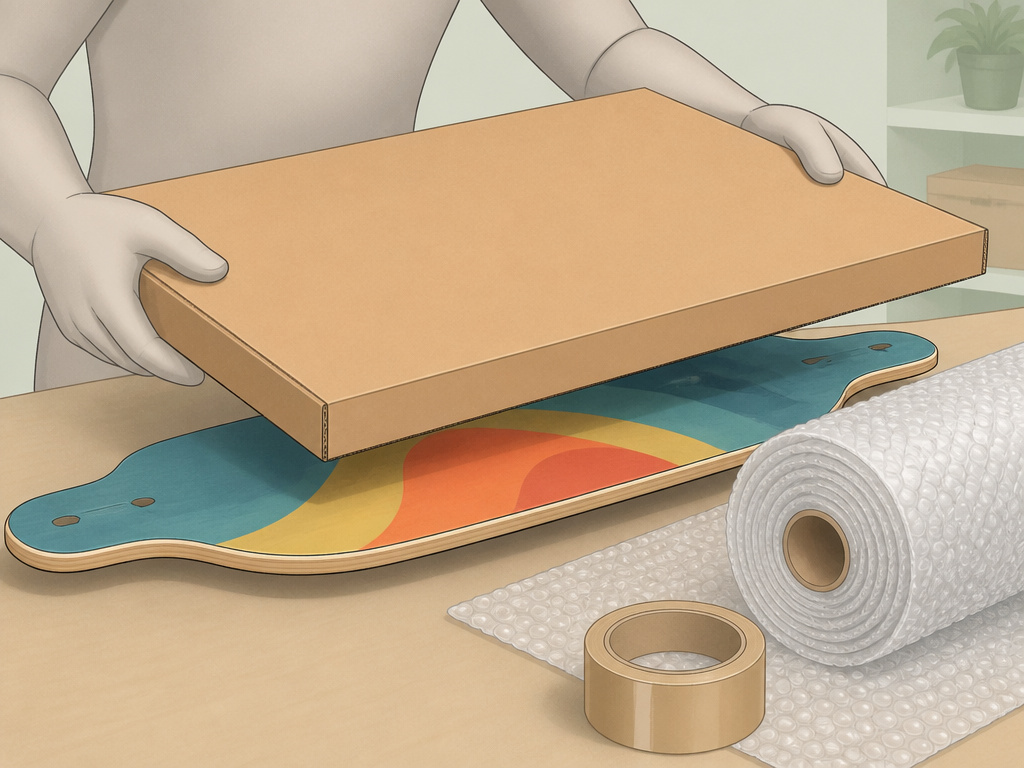
You don’t need to buy a box. Most local skate shops receive weekly shipments of completes and decks. They break down the boxes and recycle them. Walk in, ask politely if they have a spare longboard box, and you’ll likely walk out with one for free. This is the single best cost-saving move you can make.
If a shop box isn’t an option:
- U-Haul / Storage Centers: Sell individual boxes in specific sizes. Look for “mirror boxes” or “picture boxes” which are long and narrow.
- Online Retailers: Sites like Amazon sell specific sizes, like a 34x10x6 inch box, but you’ll pay a premium for a single box.
- Repurpose: A wardrobe box from a moving company can be cut down to size. Just ensure the corrugated cardboard is still rigid.
For padding, bubble wrap is essential. Packing peanuts or crumpled kraft paper work for filling voids. Avoid using towels or clothing as primary padding—they compress under weight and offer little protection against impacts.
Real-World Shipping Cost Examples
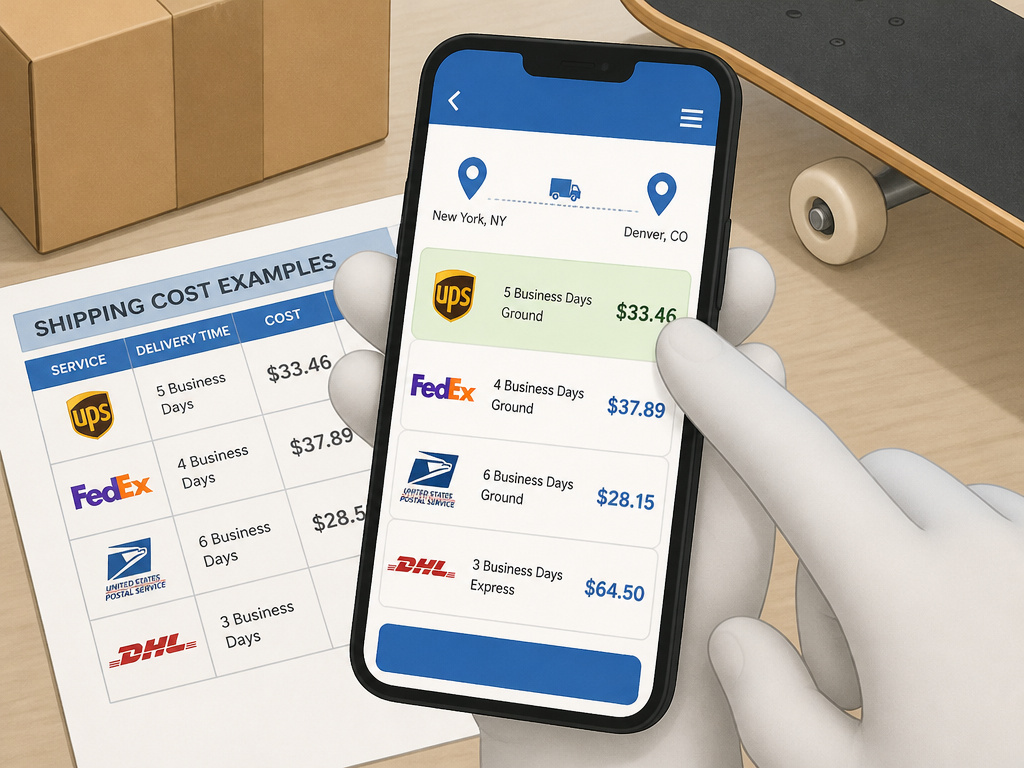
Here’s where generic advice fails. We will use real numbers from the sources. These are for a standard skateboard (around 30-33 inches) in a 34x10x6 inch box, weighing about 5 lbs.
| Route | Carrier & Service | Quoted Cost | Transit Time | Source |
|---|---|---|---|---|
| New York to Charlotte (~622 mi) | UPS Ground | $20.46 | 5-7 days | Red Stag Fulfillment |
| New York to Charlotte (~622 mi) | USPS Ground | $27.70 | 5-7 days | Red Stag Fulfillment |
| New York to Denver (~1,785 mi) | UPS Ground | $33.46 | 5-7 days | Red Stag Fulfillment |
| New York to Denver (~1,785 mi) | USPS Ground | $39.70 | 5-7 days | Red Stag Fulfillment |
| Domestic Average | USPS Ground (Standard Board) | $8 – $15 | 5-7 days | Fulfyld |
| Domestic Average | General Estimate | $20 – $50 | Varies | Industry Consensus |
Notice the disagreement? Fulfyld’s $8-$15 range is for a perfectly packed, ideal scenario. Red Stag’s real quotes are higher because they include full retail rates and perhaps slightly larger boxes. Your quote will likely land in the $20-$50 band. The lesson: always get a direct quote from the carrier’s website with your exact box dimensions before you commit.
Expedited shipping changes the math completely. Longboards USA states faster shipping for longboards can cost an extra $65-$110. Fulfyld notes expedited 2-day service can add $35-$65 more than standard ground. Need it tomorrow? Next-day air services are available at a significant premium, with costs often exceeding $100.
Choosing a Carrier: UPS vs. USPS vs. FedEx
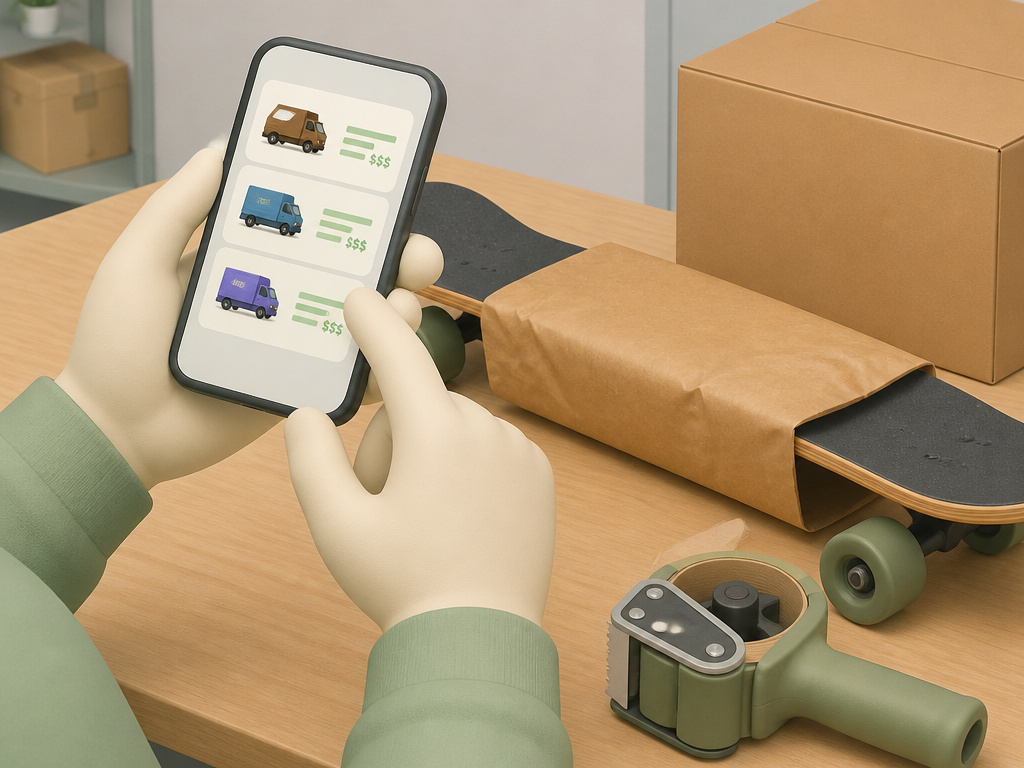
You have three main choices. Your best pick depends on whether you value cost, convenience, or speed when answering the how to ship a longboard and how much does the shipping cost.
- UPS Ground is often the cheapest for this kind of bulky, medium-weight item. Their dimensional weight calculations are standard, but their ground network is efficient. This is the default I use for continental U.S. Shipments.
- USPS (United States Postal Service) can be cheaper for very light packages, but for a 5-7 lb box, they’re often slightly more expensive than UPS for the same speed. Their advantage is delivery to P.O. Boxes, which UPS and FedEx don’t do.
- FedEx Ground is a strong competitor to UPS, with similar rates and service. They, along with The Longboard Store, also offer reliable 2-day and 3-day express options for a significant premium.
Here’s a quick comparison to help you decide:
| Carrier | Best For | Watch Out For |
|---|---|---|
| UPS Ground | Lowest cost for bulky boxes over 5 lbs. | Residential delivery surcharges can apply. |
| USPS Ground | Shipping to P.O. Boxes or remote residential addresses. | Less reliable tracking and higher insurance costs. |
| FedEx Ground | Time-definite 2-Day/3-Day services. | Can be more expensive for one-off, non-account shipments. |
| Specialized Retailers (e.g., Evo, Hawaiian South Shore) | Large/odd items (surfboards, rooftop tents) with flat-rate options. | Strict size categories (Oversized vs. Freight) and geographic exclusions. |
For example, Hawaiian South Shore offers a FedEx door-to-door flat rate of $75 for surfboards up to 6’0″ to the continental U.S. Evo has a $150 flat rate for “Freight” items like rooftop tents and cargo boxes to the continental U.S. These are niche, but they show how retailers simplify complex shipping.
Insurance and Declared Value
This is the part people skip until they need it. If the carrier loses or destroys your board, the declared value is your ceiling for reimbursement.
Most shippers don’t charge for the first $100 of declared value. Anything higher than that will add a small cost to your shipping label.
If you’re shipping a valuable longboard, declare its full replacement cost. The added insurance fee is a small cost added to your shipping label for declared value over $100. It’s the cheapest peace of mind you can buy. Without it, you’re only covered for the carrier’s default liability, which might be $100.
When your board arrives, inspect the box before the driver leaves. If there’s obvious damage (a crushed corner, a puncture), note it on the driver’s digital device or the paper bill of lading. Take photos immediately. This is critical for filing a damage claim.
Shipping to Alaska, Hawaii, and Internationally
Standard advice falls apart here. Ground service doesn’t exist to Hawaii or Alaska from the continental U.S.; everything goes by air, which is expensive.
- Evo ships oversized items (bikes, surfboards) to Alaska/Hawaii for $199.
- Longboards USA does not ship directly to Hawaii, Alaska, or Puerto Rico. They direct customers to third-party forwarders like MyUS.com.
- Hawaiian South Shore uses Alaska Air Cargo for neighbor islands and charges a storage fee of $40 per day for packages held over 5 days.
For international shipping, costs start around $35 to neighboring countries like Canada or Mexico and can exceed $100 to other continents. The Longboard Store explicitly notes that international shipping quotes do not include Custom Duty Fees, and you are liable for all costs if you refuse the package. Always email the retailer for a combined shipping quote if sending multiple items—the system often assumes each needs its own box, which inflates the cost.
The Online Shipping Walkthrough
Imagine you have packed your box. Here’s how to actually buy the label and get it picked up.
- Measure and Weigh. Use a tape measure and a bathroom scale. Note the exact dimensions (Length x Width x Height) and weight in pounds.
- Go to the carrier’s website. UPS, USPS, and FedEx all have “Get a Quote” or “Ship Now” tools front and center.
- Enter addresses. Fill in the “From” (your address) and “To” (destination) fields completely and accurately.
- Enter package details. This is the crucial step. Input the dimensions and weight you measured. Select “Ground” service for the cheapest rate.
- Add insurance. In the “Value” or “Declared Value” field, enter the board’s replacement cost. The system will show the added fee.
- Review and pay. You’ll see a final price. Pay with a credit or debit card.
- Print the label. Print it on standard paper. Cut it out, slide it into a clear plastic sleeve, and tape it securely to the box.
- Schedule pickup or drop off. You can often schedule a free pickup from your home for the next business day. Alternatively, drop the box at a carrier location or authorized drop-off point (like a UPS Store).
TL;DR: The website guides you. Just have your measurements, weight, and a credit card ready.
What If the Board Arrives Damaged?
Don’t panic. Don’t throw the box away. The process is bureaucratic but straightforward.
- Document everything. Take clear, well-lit photos of the damaged box from all angles. Then take photos of the damaged board itself.
- Contact the carrier immediately. File a damage claim online through the carrier’s website. You’ll need your tracking number, the shipment date, and the photos.
- Provide evidence. Submit the photos and a description of the damage. If you noted damage on the delivery receipt, mention that.
- Wait for inspection. The carrier may request to inspect the damaged item and packaging. Hold onto everything until the claim is resolved.
- Follow up. Claims can take weeks. If you hear nothing after 10 business days, call the carrier’s claims department for an update.
Retailers have their own rules. The Longboard Store requires damage reports within 24 hours of receipt for a Return Authorization. Retailers like Lush Longboards have specific warranty processes for defective items. Knowing this process ahead of time saves you a headache.
How to use third-party shipping services
Third-party shipping services are online platforms that let you buy discounted labels from major carriers. You enter your package details, including the box dimensions and weight, and the service gives you a list of rates from different carriers. For a longboard, you’ll need to know the size of your box. These services can be especially useful for finding better prices than walking into a post office or shipping store. They also handle the purchase of insurance, though many shippers include a base amount of coverage automatically. You simply print the label, attach it to your box, and drop the package off at the designated carrier location.
Frequently Asked Questions
What is the cheapest way to ship a longboard?
The cheapest way is standard ground shipping with UPS, using the smallest possible box. For boards over 34 inches, this means disassembling it and shipping the deck separately from the trucks and wheels. Always get a free box from a skate shop if you can.
How much does UPS charge to ship 20 lbs?
For a typical longboard route (e.g., NY to Denver), UPS Ground for a skateboard shipment is quoted at $33.46, but costs for heavier or larger packages will be higher. The exact price depends more on the box size than the weight.
Can I ship a longboard internationally?
Yes, but it’s complex and expensive. Costs start around $35 to Canada/Mexico and go up from there. You are responsible for all customs duty and tax fees in the destination country. Many retailers, like Longboards USA, use third-party forwarders for international shipments to simplify the process.
Should I insure my longboard shipment?
Absolutely. Most carriers cover the first $100 of value for free. For a board worth $200 or more, the additional insurance cost is minimal (often $2-$5) and is worth it for full replacement coverage if the board is lost or damaged.
How do I find the right box size?
First, try your local skate shop for a free box. If that fails, measure your board (or disassembled deck) and look for “mirror” or “picture” boxes at U-Haul, or search for specific dimensions (e.g., 42x10x4) on online retailers. The goal is to have about 2 inches of padding on all sides.
Before You Go
Shipping a longboard isn’t mysterious. It’s a mechanical process of measuring a box, declaring a value, and choosing a service. The price confusion comes from not understanding dimensional weight—once you shrink the box, the how to ship a longboard and how much does the shipping cost becomes predictable.
The one rule I’d add that most guides skip: if your board is worth more than $200 and you’re shipping it more than 1,000 miles, just disassemble it. The twenty minutes of work to take the trucks off guarantees a smaller box, which guarantees you’ll pay the $20-$50 rate instead of the $80-$110 rate. That savings pays for the packing tape, the bubble wrap, and your time.
Now you know the numbers. You know where the disagreements are between sources. Use that knowledge to get an accurate quote before you pack, and you’ll never be surprised by the cost to ship a longboard again.
