Jetson Electric Scooter Review: Key Takeaways and FAQs
This post contains affiliate links. As an Amazon Associate, we earn from qualifying purchases.
Jetson electric scooters offer a budget-friendly entry point into personal electric mobility, with models like the Quest delivering a 15 mph top speed and a 15-18 mile range from a 250W motor. However, purchasing one requires navigating active safety recalls for the Nova, Star, and Rogue models, and managing expectations around real-world performance versus advertised claims.
That 15-18 mile range figure is the ceiling, not the floor. The scooter’s battery, your weight, hills, and even the temperature will pull it down. On paper, the specs look solid for the price. On pavement, the experience is defined by where those numbers meet reality, and by a few critical safety notices you can’t afford to miss. This is a key takeaway from any thorough Jetson electric scooter review.
What follows is a breakdown of what Jetson scooters actually deliver, anchored in their official specs and punctuated by the hard lessons from owner reports and government recalls. This review explains the performance you can expect, the safety issues you must check, and the maintenance that keeps a budget scooter running.
Key Takeaways
- The Jetson Quest is the brand’s flagship adult model, with a 250W motor, a 15 mph top speed, and a real-world range heavily dependent on rider weight and terrain.
- Two active recalls affect Jetson products: the Nova and Star 3-wheel kick scooters for wheel detachment, and the 42V Rogue hoverboard for a fire hazard linked to two fatalities.
- Jetson’s warranty is 180 days for electric scooter frames and electrical components, but only 90 days for most other parts, shorter than many competitors.
- Official charging guidance is strict: use only the model-specific charger, plug into the wall first, and never leave it charging overnight to protect the battery.
- Real-world range often falls short of claims; owner reports cite having to walk home after 6 miles on some models, highlighting the importance of managing expectations.
The Jetson Quest Spec Sheet and Real-World Performance
We begin with the scooter most people are looking at: the Jetson Quest. On paper, it’s a compelling package. You get a 250W motor, a 36V 7.5Ah battery, a top speed of 15 mph, and a claimed range of 15-18 miles. It weighs 28.4 pounds and supports riders up to 220 pounds. The tires are 8.5-inch airless units, and there’s no suspension.
Those are the numbers from the manufacturer. Here’s what they feel like on the ground.
The Quest’s 250W motor provides adequate acceleration for flat urban commuting, reaching its 15 mph cap without strain. Its 270Wh battery offers a theoretical range, but real-world results depend entirely on rider weight, incline, and throttle use.
A 250W motor is entry-level. It won’t rocket you up steep hills, especially if you’re near that 220-pound limit. The 15 mph top speed is fine for bike lanes and sidewalks where legal, but it won’t keep pace with city traffic. That speed aligns with what Consumer Reports testing found for most budget scooters, they travel at about 15 mph on flat pavement.
The Quest’s 15-18 mile range is a variable spec. Owner reports indicate real-world range can fall significantly short of claimed figures. That’s the risk with any budget scooter: the battery capacity is the minimum needed to hit the marketing number under ideal conditions. Add a heavier rider, a few hills, or a cold day, and that range can halve. The Quest’s battery is also non-removable, so you can’t carry a spare to extend your trip.
The lack of suspension and the airless tires define the ride quality. You’ll feel every crack in the pavement. It’s a trade-off for never getting a flat tire, but it makes for a jarring experience on anything but smooth asphalt. For a full breakdown of how other models compare, check our Jetson electric scooter review.
| Specification | Jetson Quest Claim | Real-World Consideration |
|---|---|---|
| Motor | 250W | Adequate for flat ground; struggles on hills. |
| Top Speed | 15 mph | Matches typical budget scooter performance. |
| Claimed Range | 15-18 miles | Highly variable; expect less with heavier riders or hills. |
| Tires | 8.5″ Airless | No flats, but a harsh ride with no suspension. |
| Load Capacity | 220 lb | Riding at max weight significantly reduces range and acceleration. |
| Battery | 36V 7.5Ah (270Wh), Non-Removable | Cannot swap for a fresh battery mid-ride. |
Safety First: Understanding the Recalls
This isn’t scare talk. It’s a mandatory check. Jetson has two significant recalls issued by the U.S. Consumer Product Safety Commission (CPSC), and ignoring them is how people get hurt.
The first is for the Jetson Nova and Star 3-wheel kick scooters. The CPSC recalled them because the rear wheels can detach. As of June 2023, there were 12 reports of wheels loosening or falling off, resulting in one minor injury. If you have one of these, models like JNOVA-BLU with specific serial number ranges, you need a repair kit. Jetson’s support site provides instructions and a kit with 2 bolts, 2 screws, and an Allen key.
The second recall is far more serious and concerns the 42V Jetson Rogue hoverboard. The CPSC determined a fire originating from one of these units caused a fatal house fire on April 1, 2022, resulting in two deaths. The official remedy is “Destroy and discard.” These 42V Rogues were made in 2018-2019, have a UL label, a serial number, no barcode on the bottom, and a 3-pin charge port to the left of the power button.
Common mistake: Assuming a recalled product is just “used.” For the 42V Rogue, the CPSC’s directive is disposal, not continued use. The lithium-ion battery requires specific municipal hazardous waste handling.
These recalls underscore a critical point: with budget electric mobility, you’re often buying a product from a company with limited long-term support. Checking the CPSC recall database before you buy any Jetson product isn’t extra diligence; it’s the first step. For a look at a model with a different risk profile, see our Jetson electric scooter review of the Omega.
Battery Care and Charging: The Rules Aren’t Optional
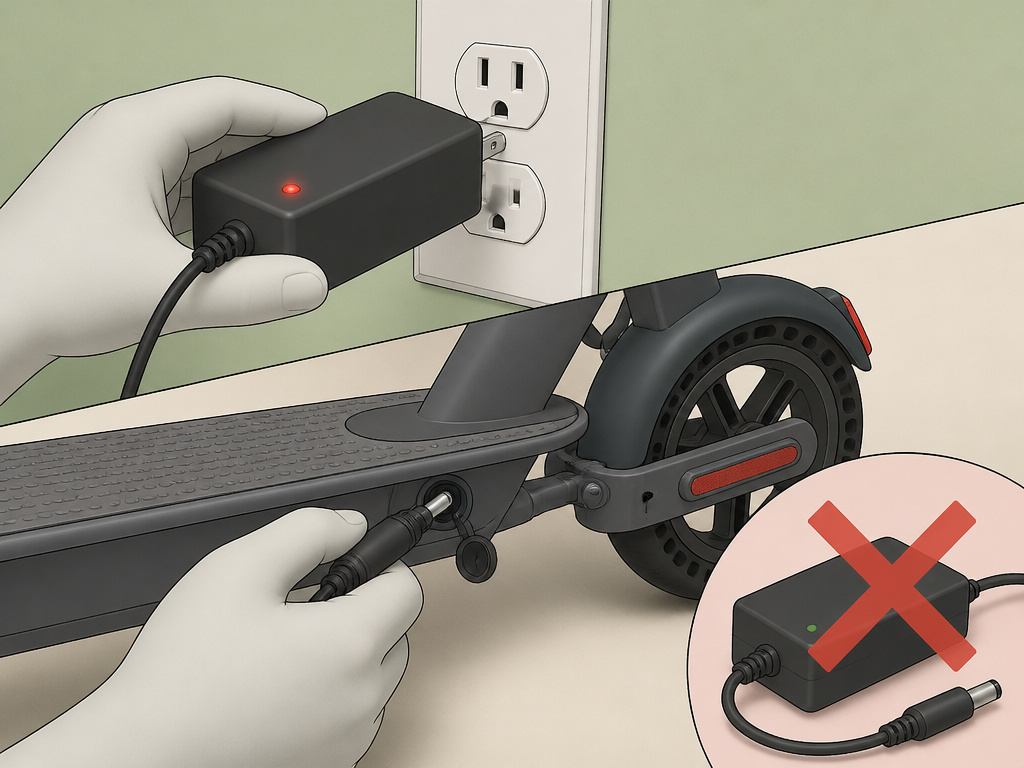
Jetson’s official support articles are very specific about charging. This isn’t generic advice; following it is the difference between a battery that lasts a season and one that degrades in months.
The rules are short and non-negotiable:
- Use only the charger that came with the scooter or a model-specific replacement. A mismatched charger can ruin the battery.
- Plug the charger into the wall outlet BEFORE connecting it to the scooter.
- Do not leave it charging overnight or for extended periods.
- Charge to full whenever possible to maintain long-term capacity.
- Before storage, charge it fully, then give it a full charge once a month while stored.
- Always close the charging port cap when riding to keep debris out.
The charger light is red while charging and green when complete. Charging times vary by model. The Quest takes up to 6 hours. The Copperhead needs up to 7 hours. The Echo X requires up to 8 hours. If you see an error code on the display, the official advice is to contact the Jetson Care Team immediately, don’t try to fix it yourself.
For the Knight model, the battery is removable, which is a nice feature. You can charge it inside the scooter or take it out. Most other models, like the Quest, have a fixed battery.
Warranty, Support, and Long-Term Reliability
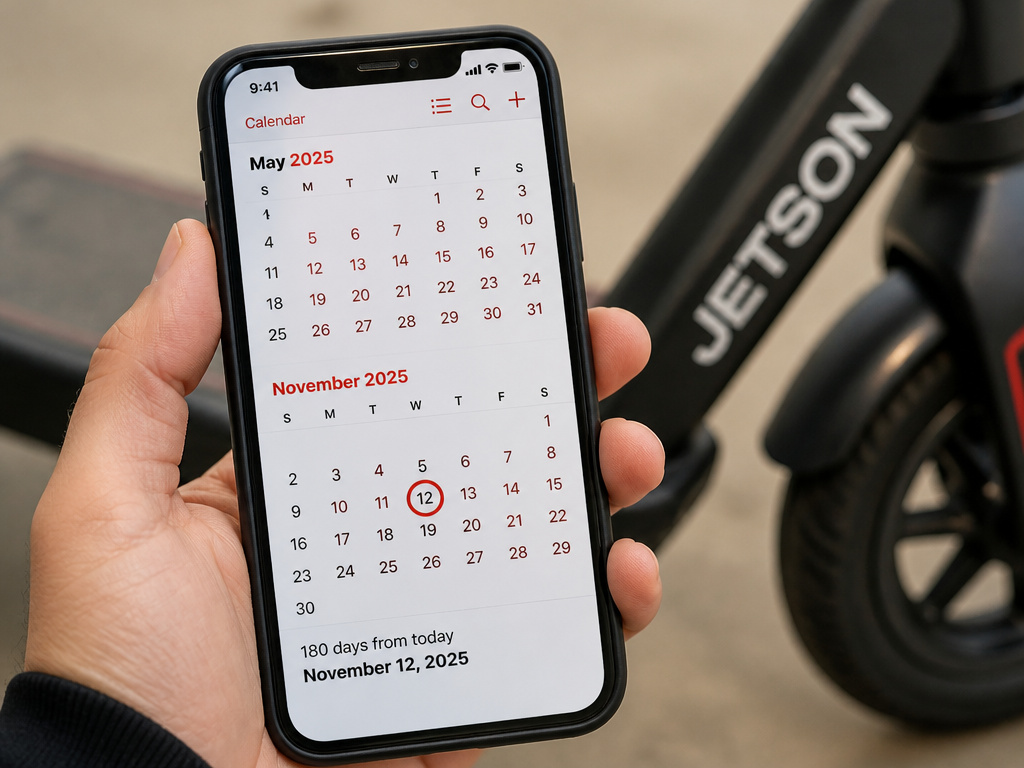
Jetson’s warranty policy is where the budget nature of the product becomes clear. For their electric scooters (both kids’ and adults’ models), the warranty periods are:
- 180 days for the Frame, Fork/Suspension, and Electrical Components.
- 90 days for all other parts, including wear parts and accessories.
Kick Scooters and Hoverboards have a 90-day warranty. All authentic Jetson Accessories, Spare Parts and Replacement Batteries have a 90-day warranty. To make a claim, you need valid proof of purchase from an authorized seller and the product’s serial number.
A 180-day warranty on the frame and electronics is short. Many competitors offer one-year warranties. This shorter coverage reflects the price point but also sets expectations: major repairs after six months will likely be out-of-pocket. When comparing durability, it’s useful to look at other brands covered in our guide to the best electric scooters.
Community reports on forums paint a picture of mixed long-term reliability. Others describe constant, minor repairs. The common theme is that these are simple machines with basic components. They are easy to fix precisely because they lack complex systems, but you may be fixing them often.
How Jetson Stacks Up Against Other Budget Brands
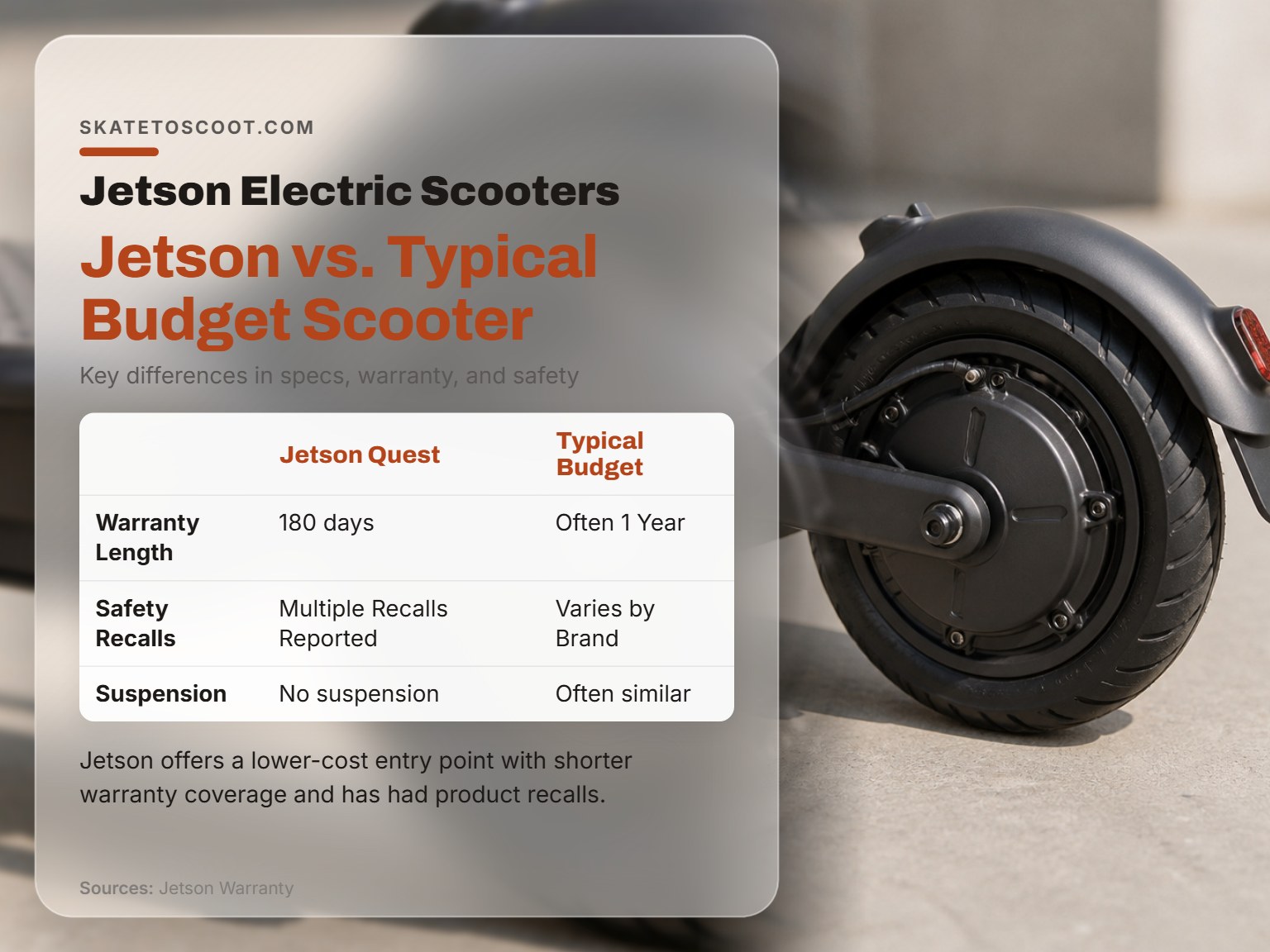
Is Jetson a value brand? It’s a value brand. You trade some performance, warranty length, and sometimes safety oversight for a lower upfront cost. Compared to a brand like Razor, which has decades in the kids’ mobility space, Jetson’s product line feels more volatile, as evidenced by the recalls. Against a brand like Hiboy, which often offers similar specs, the difference might come down to minor design features or local retailer availability.
| Aspect | Jetson (e.g., Quest) | Typical Budget Competitor |
|---|---|---|
| Price Point | Low | Often Similar |
| Motor Power | 250W (Entry) | 250W-350W |
| Warranty Length | 180 days (Frame/Electrics) | Often 1 Year |
| Safety Recalls | Multiple Active Recalls | Varies by Brand |
| Support & Parts | Online support, limited by warranty | Similar online support networks |
| Ride Quality | Harsh (Airless Tires, No Suspension) | Often similar; some add basic suspension |
The decision often comes down to this: if you need the absolute cheapest entry point and are willing to vigilantly check recalls, maintain the battery perfectly, and accept shorter warranty coverage, a Jetson can work. If you can stretch the budget slightly, brands with longer track records and warranties might save you hassle later. For a direct comparison to another popular budget option, read our review of Razor electric scooters.
Build quality & durability concerns
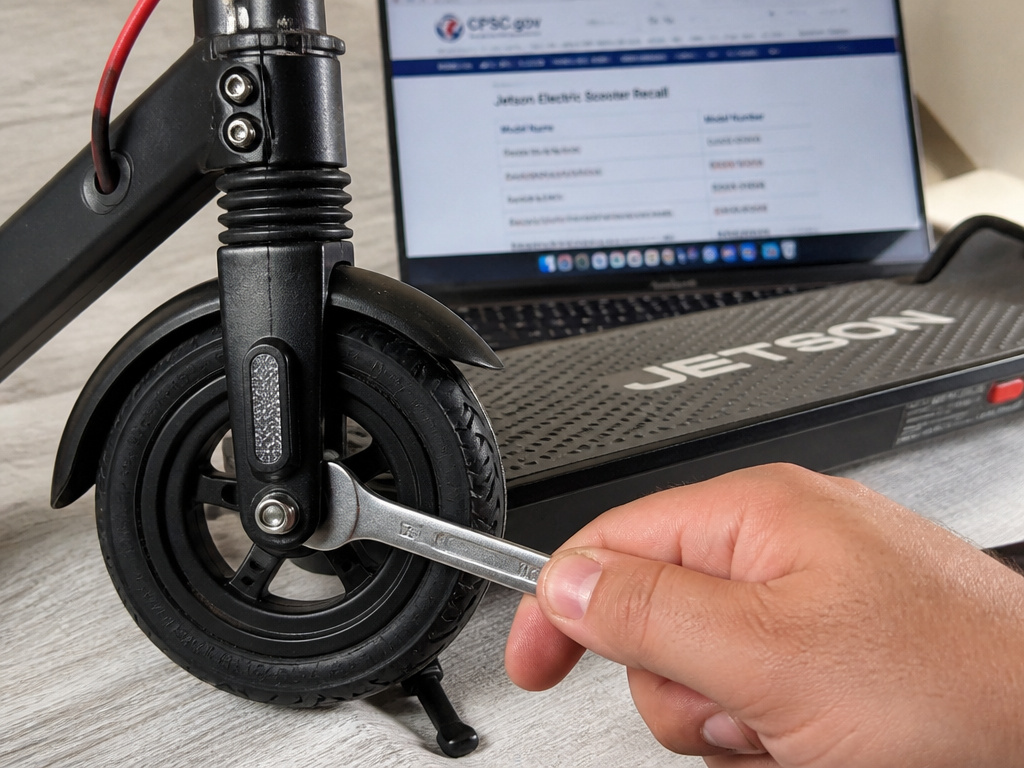
Some Jetson models have been subject to significant recalls. The Nova and Star kick scooters were recalled due to wheels loosening and detaching, with reports of minor injuries. The 42V Rogue hoverboard was recalled after a fatal fire, with the CPSC instructing owners to destroy and discard the unit. These incidents highlight the importance of checking for recalls and inspecting your scooter regularly. The warranty periods for these products are relatively short, so proactive maintenance is key. Always use the model-specific charger and follow proper charging protocols to mitigate risks.
Ease of use & portability (folding, weight)
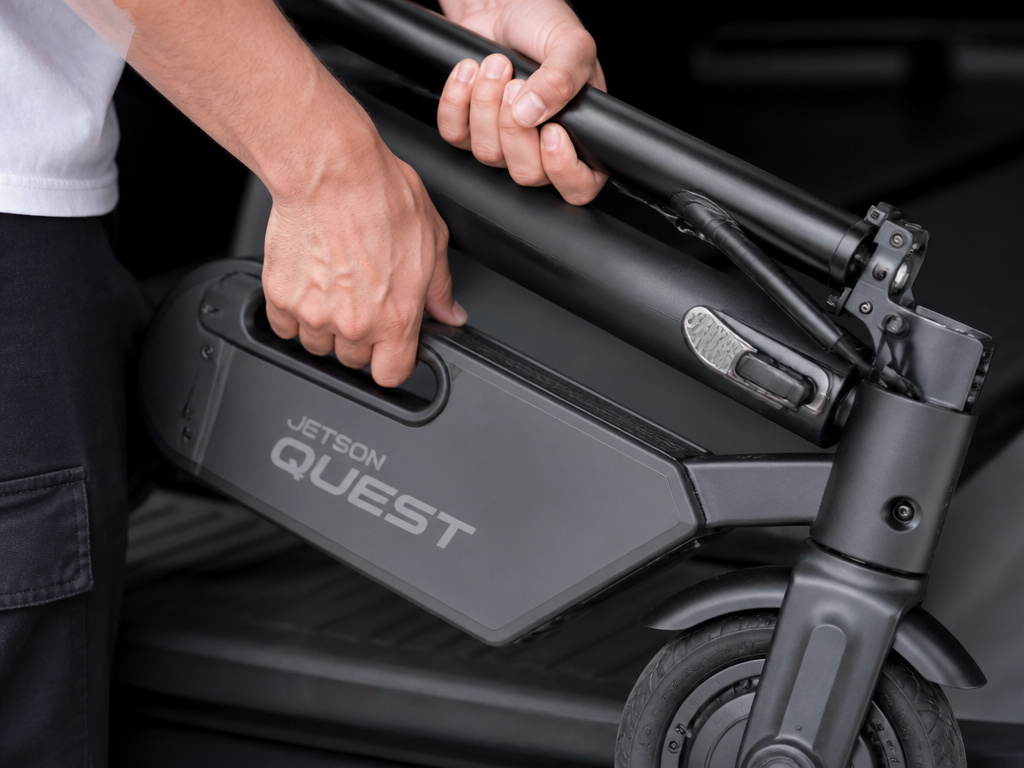
The Jetson Quest weighs 28.4 pounds, which is a manageable weight for carrying short distances or up a flight of stairs. Its folding mechanism is a standard feature on many models, designed for easier storage and transport. When considering portability, check the folded dimensions to ensure it fits in your intended storage space, like a car trunk or a closet. For regular commuters or those needing to combine scooting with public transit, a model that folds compactly and isn’t overly heavy is essential. Practice folding and unfolding it a few times to ensure the process is smooth and secure.
Safety features (brakes, lights)
In general, you should verify the type of braking system on any scooter you consider. Mechanical brakes require regular inspection for wear, while electronic brakes should be tested for responsiveness. Check for integrated front and rear lights, as well as reflectors, which are crucial for visibility in low-light conditions. Always wear a helmet and consider additional safety gear. Before each ride, perform a quick check of the scooter’s key components, including the brakes and any lighting, to ensure they are functioning properly.
Frequently Asked Questions
Are Jetson electric scooters good?
They are good for a very specific purpose: low-cost, short-range commuting on flat terrain by lighter riders. They are not good for high performance, long-range travel, hilly areas, or for riders who want a smooth, comfortable ride. Their value is tied directly to managing expectations and adhering strictly to safety and charging guidelines.
Is Jetson a good brand?
Jetson is a budget brand. It offers low prices by using simpler components and offering shorter warranties. The active CPSC recalls for some models indicate historical quality control issues. For a casual, low-stakes rider who does their homework, they can be a reasonable choice. For anyone prioritizing safety or long-term reliability, other brands with longer histories and cleaner safety records may be better. Our Hiboy electric scooter review covers one such alternative.
How fast do Jetson E-scooters go?
Most adult models, like the Quest, have a top speed of 15 mph. This is governed by the motor and controller. Some smaller or kids’ models may be slower. This speed is typical for entry-level electric scooters and is suitable for bike lanes and sidewalks where permitted by local law.
How long does a Jetson scooter battery last?
On a single charge, range varies significantly by model, rider weight, and terrain. Over its lifetime, the battery’s health depends entirely on charging habits. Following the strict charging rules (no overnight charging, using the correct charger) can help it last through the warranty period and potentially a few seasons beyond. Degradation after a year or two of regular use is common.
What should I do if I have a recalled Jetson product?
For the Nova or Star scooters, visit the Jetson support site for instructions to obtain a free repair kit. For the 42V Rogue hoverboard, the CPSC instructs owners to destroy and discard it. Do not use it or attempt to repair it. Contact your municipal waste authority for instructions on safely disposing of a lithium-ion battery from a recalled product.
The Bottom Line
A Jetson electric scooter is a tool with a clear manual: its specs define its limits, and its recalls define its risks. The 15 mph top speed and 15-mile range are real, but they live at the edge of the scooter’s capability. Push them with weight or hills, and the experience falls apart.
The 180-day core warranty is your timer. If a major flaw exists, it should show up in those six months. The charging rules are not suggestions, they are the maintenance schedule. Break them, and the battery will break first.
For a short, flat commute by a lighter rider who charges diligently, a Jetson Quest is a viable, cheap solution. For anyone else, especially those considering a used model or a different product line, the required homework (checking recalls, verifying model numbers) outweighs the savings. Your money might be better spent on a scooter from a brand with a longer warranty and a cleaner safety slate, even if the initial price is slightly higher. With budget electric mobility, you don’t just buy the scooter. You buy the responsibility to manage everything it can’t do on its own.
