Jetson Scooter Review: The Recalls You Must Know
This post contains affiliate links. As an Amazon Associate, we earn from qualifying purchases.
A Jetson scooter review must start with safety and end with a clear-eyed look at value. The brand offers a wide range of affordable electric scooters and kick scooters, from kids’ models like the Nova to adult commuters like the Quest, but it has been involved in significant safety recalls for wheel detachment and fire hazards. Performance is modest, with top speeds around 15 mph and ranges up to 18 miles, making them best for short, casual rides rather than serious commuting.
That line between an affordable entry point and a genuine safety risk is the whole story. Most reviews talk about price and features. They skip the part where a government agency documents a fire that started with one of these scooters, or where a child gets hurt because a wheel fell off. That’s the data that changes a buying decision from “is it a good deal?” to “is it worth the risk?”
What follows: a breakdown of the two major recalls, the real performance numbers from official specs, a look at where these scooters typically fail, and a direct comparison of which models might fit a casual rider versus which ones you should avoid entirely.
Key Takeaways
- Stop using recalled models immediately. The CPSC and Jetson urge owners of the recalled 42-volt Rogue hoverboard to stop using and stop charging it due to a fatal fire hazard. Nova and Star 3-wheel kick scooters have a separate recall for wheel detachment.
- Warranty coverage is shorter than you think. Electric scooters from Jetson carry a 180-day warranty on the frame and electrical components, with only a 90-day warranty on wear parts and accessories, plan for potential repair costs soon after purchase.
- Real-world range is often below the claim. Even well-reviewed models like the Jetson Quest list a range of 15-18 miles; in practice, factors like rider weight and hills will reduce that, so plan for shorter trips.
- Performance is strictly entry-level. Top speeds cap at 15-15.5 mph across most adult models, with modest 250W motors. These are for casual neighborhood use, not for keeping up with traffic or tackling steep hills.
- Check for active recalls before you buy. Always verify the specific model and serial number against the official CPSC recall database before purchasing any second-hand Jetson scooter or hoverboard.
Jetson’s Safety Record: The Recalls You Must Know
You can’t talk about any product without talking about what happens when it fails. For Jetson, that conversation is dominated by two official recalls, one for a fall hazard, one for a fire hazard. These aren’t rumors. They’re documented by the U.S. Consumer Product Safety Commission with specific incident counts and, in one case, fatalities.
The first involves the Jetson Nova and Star 3-Wheel Kick Scooters. According to the CPSC recall notice for Jetson scooters, the firm received 12 reports of the rear wheel loosening or falling off. One report included an injury involving scratches and bruises to a child’s face. These scooters, which measure about 23 inches tall, were sold from September 2022 through February 2023 for about $40. If you have one, you should stop using it and request a free repair kit from Jetson, which includes new bolts and washers.
The second recall is far more serious. It concerns the 42-volt Jetson Rogue self-balancing scooter, or hoverboard. The CPSC and Jetson announced the recall of about 53,000 42-volt Rogue self-balancing scooters/hoverboards. The lithium-ion battery packs can overheat, posing a fire hazard. This isn’t theoretical. A fire on April 1, 2022, in Hellertown, Pennsylvania, was determined to have originated with a 42-volt Jetson Rogue. It resulted in two fatalities: a 10-year-old girl and her 15-year-old sister. There have been multiple other reports of the recalled scooters burning, sparking, or melting.
The CPSC recall for Rogue hoverboard fire hazard states that consumers should immediately stop using and stop charging the recalled scooters and contact Jetson for a full refund. The recall applies only to 42-volt Rogue models with a 3-pin charge port on the left of the power button and no barcode.
Where this goes sideways: Assuming a recalled product is safe if it hasn’t failed yet. The wheel bolts on the Nova/Star scooters can loosen over time with use, and the Rogue’s battery fault can manifest suddenly. The CPSC’s instructions to stop use are immediate for a reason.
These recalls are a mandatory part of any honest Jetson scooter review. They don’t mean every Jetson product is dangerous, but they do mean you must check if a model you’re considering is affected, especially when buying used.
What Are the Most Common Problems with Jetson Scooters?
Beyond the specific recalls, owners report a pattern of issues that point to the compromises of a budget brand. These aren’t deal-breakers for everyone, but they’re the realities you sign up for.
Battery and Charging Gremlins top the list. The battery indicators are often rudimentary. One owner of a Jetson Bolt Pro noted it “only has lights that tell me within 25% life, so sometimes I left and took off and my bike died.” This lack of granularity makes it easy to misjudge range. Batteries that sit unused for long periods can fail entirely, refusing to take a charge, a common fate for impulse-buy scooters that end up in the garage.
Modest Performance That Feels Weaker Than Advertised is another consistent thread. A top speed of 15 mph sounds fine on paper. On the road, especially with a heavier rider or on a slight incline, it can feel sluggish. The 250W motor in models like the Quest and Ryder is sufficient for flat ground but will struggle on hills steeper than their rated climbing angles (15º for the Quest, up to 20º for the Eris).
Parts Support and Long-Term Durability questions linger. While Jetson offers a repair kit for the recalled Nova/Star scooters, some owners report difficulty sourcing other replacement parts like wheels directly from the company, being directed to third-party suppliers instead. The relatively short warranty, 180 days on core components for electric scooters, means you’re on your own fairly quickly if something wears out or breaks.
| Common Problem | Typical Symptom | Likely Cause & Owner Impact |
|---|---|---|
| Vague Battery Meter | Scooter dies unexpectedly mid-ride. | Basic LED indicators show large increments (e.g., 25% blocks). Rider can’t accurately gauge remaining range. |
| Weak Hill Climbing | Speed drops dramatically on mild slopes; motor strains audibly. | 250W motor is underpowered for rider weight or incline. Limits route planning and practical use. |
| Post-Recall Parts Anxiety | Needing a non-recall replacement part (tire, brake pad) and finding limited OEM stock. | Company may not inventory all wear items, pushing owners to generic third-party parts that may not fit perfectly. |
The takeaway from any Jetson scooter review isn’t that every Jetson electric scooter will have these issues. It’s that these are the known failure points in the design and support chain. If you need reliable, precise range and strong parts support, you’re looking at a different price category.
Jetson Scooter Models: From Kid’s Kick Scooters to Adult Commuters
Jetson’s lineup is broad, which is one of its strengths. You can find something for a young child, a teenager, and an adult looking for a last-mile solution. The key is matching the model’s actual capabilities to the rider’s needs.
For Kids: The 3-Wheel “Lean-to-Steer” Kick Scooters. Models like the Nova, Star, and Saturn are designed for children learning to balance. They use Lean-to-Steer Technology, where the rider leans the handlebars to turn instead of twisting them. This is meant to be more intuitive and stable for new riders. They are simple and inexpensive. The recall on the Nova and Star models is a critical asterisk.
For Adults & Teens: The Electric Scooters. This is where most of the review interest lies. The models have evolved, but specs from primary sources paint a clear picture of an entry-level, short-range commuter category.
- Jetson Quest (2019 Model): Often cited as a “best value” pick in older reviews. Per an Electrek review, it featured a 250W motor, a 36V 7.5Ah battery, a top speed of 15 mph, and a range of 15-18 miles. It weighed 28.4 lbs with a load capacity of 220 lbs. It represents the baseline for what Jetson offered in a portable commuter scooter.
- Jetson Eris: Listed with a max speed of 14 mph, a max range of 12 miles, and a climbing angle up to 20 degrees. It’s a similar, slightly compact profile.
- Jetson Ryder: This is a seated scooter, blurring the line to a mini moped. Specs show a 250W motor, a 36V 6.0Ah battery, a top speed of up to 15.5 mph, and a range of up to 12 miles. It weighs 48 lbs and supports a 265 lb rider. Its key feature is the seat and 12-inch wheels, but it is not water resistant and requires up to 5 hours to charge.
The part nobody mentions: That “up to” before range and speed figures is doing heavy lifting. “Up to 12 miles” means you’ll likely get 8-10 under real conditions. “Up to 15.5 mph” means you’ll hit that on a full battery, on flat ground, with a light rider, it’s a ceiling, not a constant.
When you compare a Jetson scooter review of these electric models to competitors in the same price range, they’re often similar. The differentiator is rarely performance. It’s the specific feature set (like the Ryder’s seat) or the brand’s retail availability at stores like Costco that drives the choice.
Warranty, Support, and the Real Cost of Ownership
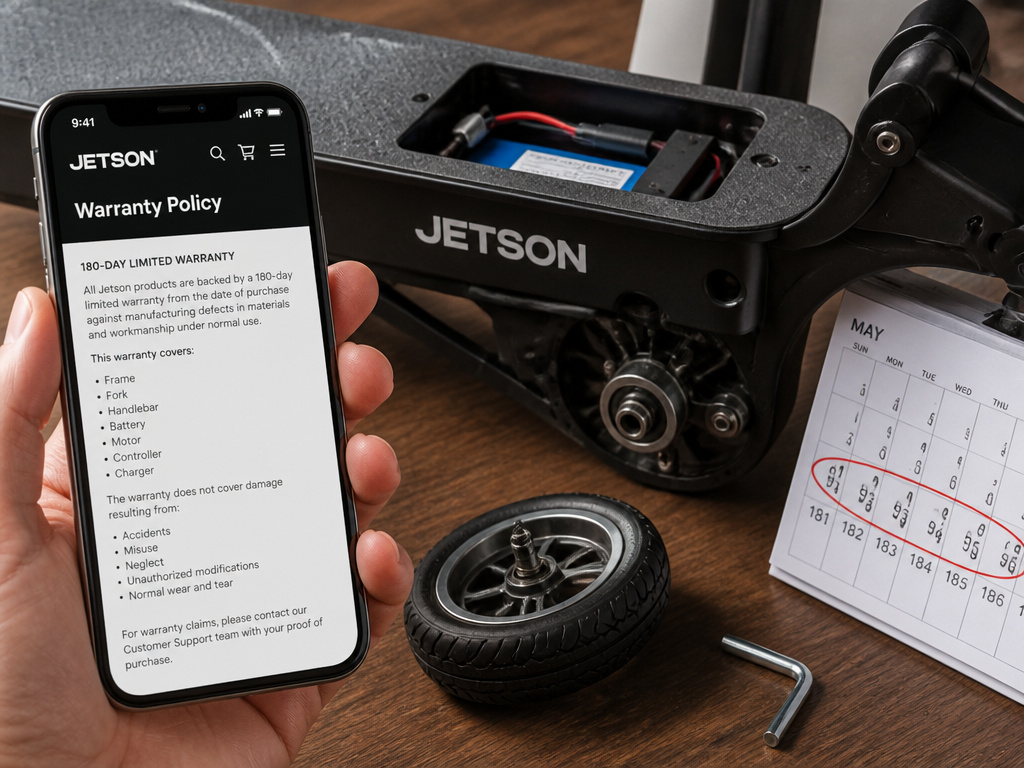
The purchase price is the first cost. The cost of ownership is what happens after you roll it out of the box. For Jetson, the warranty terms clearly define the period where you’re not paying for failures.
According to the official Jetson Warranty Policy, coverage is segmented:
- Electric Scooters (Kids & Adults), Kids’ Electric Ride-Ons, and all-in-one Go-Karts: The frame, fork/suspension, and electrical components are covered for 180 days. Wear parts and accessories are covered for only 90 days.
- Kick Scooters, Hoverboards, Go Karts with detachable hoverboards, and Non-Electric Ride-Ons: These entire products have a 90-day warranty.
- All authentic Jetson Accessories, Spare Parts and Replacement Batteries: Also 90 days.
A 180-day warranty on the core electrical components of an electric scooter is short. Many competitors offer one-year coverage. This shifts more risk to you, the owner, after the first half-year of use.
Support experiences, as gleaned from owner reports, are mixed. The company has an official support portal and phone line, and they mobilized to provide repair kits for the Nova/Star recall. However, some users have reported challenges getting specific replacement parts like wheels, being told to seek third-party options instead. This is a potential headache for a product marketed to families who may not be comfortable sourcing mechanical parts.
The real cost of ownership for a budget scooter often includes:
- An upgraded safety gear budget. The included lights are frequently described as inadequate for night riding. Plan to buy a headlight and taillight.
- A potential battery replacement fund. Lithium-ion batteries degrade. With a 90-day warranty on replacement batteries, a failure after a year or two is an out-of-pocket expense.
- Your time for troubleshooting. When something goes wrong, you may spend more time on hold or searching for compatible parts than you would with a brand that has more extensive dealer support.
Frequently Asked Questions
Is Jetson a good scooter brand?
Jetson is a budget brand that offers affordable entry points into electric scooters and kids’ ride-ons. Whether it’s “good” depends entirely on your expectations. For a casual, short-range rider on flat terrain who values low upfront cost and wide retail availability, it can be a choice. However, its history of serious safety recalls, shorter-than-average warranties, and modest performance mean it carries more risk and compromise than higher-tier brands. You are trading cost for peace of mind and longevity.
How far can a Jetson scooter go?
The advertised range varies by model. The older Jetson Quest claimed 15-18 miles. Current models like the Eris and Ryder advertise a maximum range of 12 miles. It is critical to understand that these are “up to” figures under ideal conditions (light rider, flat terrain, moderate speed). In real-world use with normal stops, starts, and slight hills, you should expect 25-40% less range. For most adult models, plan for a practical range of 7-10 miles between charges.
What is the top speed of a Jetson electric scooter?
Most adult and teen models from Jetson have a top speed between 14 and 15.5 mph. For example, the Quest was rated at 15 mph, the Eris at 14 mph, and the Ryder at up to 15.5 mph. These speeds are governed by the motor controller for safety and compliance. They are sufficient for bike lanes and quiet neighborhood streets but are too slow for mixing with traffic on most city roads.
Are Jetson scooters safe?
This requires a nuanced answer. Jetson has had specific models recalled for safety defects, which is a significant mark against the brand’s overall safety record. However, not all models are recalled. Safety also depends heavily on the rider: wearing a helmet and other protective gear, following local laws, and riding defensively are essential. The scooters themselves are lightweight and can feel less stable at speed or on bumps compared to heavier, more expensive models. Due diligence, checking for active recalls on a specific model and understanding its limitations, is paramount.
Where are Jetson scooters sold?
Jetson has one of the strongest retail presences among budget micro-mobility brands. Their products are commonly found at major retailers like Target and Costco, both in-store and online. They are also sold directly through the official ridejetson.com website. This wide availability makes them easy to purchase but also means after-sales support is typically handled through the manufacturer directly, not a local dealer.
The Bottom Line
Here is the blunt assessment from someone who has spent a decade reviewing gear that fails when you lean on it: Jetson scooters are a calculated risk.
The calculation is simple. On one side, you have a very low price, easy availability, and features that look great on a box. On the other side, you have documented safety failures, short warranty coverage, and performance that barely meets the needs of a casual rider.
If your need is absolute and your budget is fixed, say, a last-mile solution for a three-block commute on perfectly flat ground, a model like the Jetson Quest, with its eyes-wide-open understanding of the range and speed limits, might work. For a child, a repaired Nova scooter with a helmet and strict pavement-only rules is a fine starter.
But if your need is for reliable, worry-free transportation, or if you face hills, longer distances, or plan to ride in less-than-ideal conditions, the math changes. The potential for support headaches, the anxiety of a short warranty, and the very real history of safety issues tilt the scale. In that case, the better buy is often to save a bit longer and step up to a brand with a longer track record of reliability and support, even if it costs more upfront.
The most important step you can take, regardless of your decision, is to check the CPSC recall database for the specific model and serial number before you hand over any money. That single action is more valuable than any five-star review.
