Jking Electric Longboard Review: Which Is Right for You?
This post contains affiliate links. As an Amazon Associate, we earn from qualifying purchases.
The JKING Jupiter-02 hits a manufacturer-claimed 26 mph top speed and a 19.5–21.8 mile range from its 36V 7500mAh battery, while the smaller H2 model is rated for 18.6 mph and 6.8–7.6 miles. The Jupiter-01 all-terrain variant uses solid honeycomb tires. JKING boards are hub-motor powered, have an IP55 rating, and position as a value-focused OEM brand, not a premium competitor like Backfire or Meepo.
That 26 mph claim is a ceiling, not a floor. You feel the difference between a spec sheet number and the power that actually gets to the ground on a slight incline. The gap between advertised and real-world performance highlighted in every jking electric longboard review is where most beginner disappointment lives, especially with battery range.
What follows is a breakdown of the three main JKING models, where their specs come from, and what owners actually say breaks or wears in a typical jking electric longboard review. We’ll look at the conflicting weight limits, the unusual battery storage advice, and where these boards fit in a market full of more established brands.
Key Takeaways
- The Jupiter-02 is the flagship, with JKING’s product page claiming a 330 lbs max load, while its FAQ states a general max of 260 lbs and recommends 245 lbs for best performance.
- Water resistance is IP55, meaning light splash only. JKING’s official wet-board procedure is specific: dry it, then use the remote to spin the wheels for two minutes to clear water from the hubs.
- Battery longevity is rated for 500 deep cycles, after which capacity drops to about 70%. JKING’s storage advice (full charge, then discharge 50% every three months) conflicts with standard lithium-ion care.
- Hub motors mean less maintenance than belt drives, but when the motor sleeve wears on a JKING, you replace just that sleeve, not the whole motor unit.
- For true all-terrain use, the Jupiter-01’s solid honeycomb tires are a compromise, smoother than hard polyurethane but less forgiving than air-filled pneumatics on very rough ground.
The JKING Model Lineup: Jupiter-02 vs. H2 vs. Jupiter-01
JKING doesn’t have a sprawling catalog. You’re essentially picking between a full-sized street cruiser, a compact mini, and one all-terrain option. The specs tell most of the story, but the feel of each is distinct.
The Jupiter-02 uses a 450W dual brushless hub motor paired with a 36V 7500mAh UL 2272 certified battery. Its 8-ply maple deck measures 38.2 x 10 inches, and it rides on 90mm wheels. The H2/H2E model uses a similar 450W hub motor but with a smaller 36V 2500mAh battery and an 83mm wheel setup on a 27.5-inch deck.
| Model | Best For | Claimed Top Speed | Claimed Range | Max Load (Claimed) | Key Differentiator |
|---|---|---|---|---|---|
| Jupiter-02 | Commuting, longer street rides | 26 mph | 19.5–21.8 mi | 330 lbs | Larger battery, wider deck, 90mm wheels |
| H2 / H2E | Portability, shorter trips, smaller riders | 18.6 mph | 6.8–7.6 mi | 200 lbs (90 kg) | Compact 27.5″ deck, lighter weight |
| Jupiter-01 (All-Terrain) | Rough pavement, light trails | 25.5 mph (tested) | 12.3 mi (tested) | Not specified | 6-inch honeycombed airless tires |
The H2 is the one that trips people up. A 200 lbs max load is specified. TechGearLab’s testing showed the H2 struggled on hills steeper than a 14-15% grade. That’s the kind of detail a spec sheet glosses over, the motor has power, but not enough torque for steep inclines if you’re near the weight limit.
The Jupiter-01 is the outlier. Its 6-inch honeycomb rubber tires are used. Reviewers note they transmit less vibration than hard polyurethane wheels but aren’t as smooth as true air-filled tires on really broken pavement.
Where this goes sideways: Assuming all “max load” figures are equal. The Jupiter-02 product page says 330 lbs. The JKING FAQ says a general max of 260 lbs, but recommends 245 lbs for best performance. The H2 manual says 200 lbs.
Performance & Real-World Ride
Manufacturer claims are one thing. Instrumented tests and owner logs are another. The numbers that matter aren’t just top speed and range; it’s how the board delivers power when you need it and how the battery behaves after a year of use.
TechGearLab’s testing provides a reality check, consistent with our broader electric skateboard reviews and any thorough jking electric longboard review. Their Jupiter-01 test unit hit 25.5 mph and traveled 12.3 miles on a charge. That’s notably less than JKING’s claims for the similar Jupiter-02, highlighting how riding style, weight, and terrain eat into the official numbers. Their tested H2 range was 8.2 miles at a speed of 15.8 mph, again showing real-world results can diverge.
The Jupiter-02 uses a 450W dual brushless hub motor. The 20-degree max climb angle is a specific, useful metric. For context, a 20-degree slope is steep, most city streets are under 10 degrees. If your commute has a serious hill, check its grade.
Common mistake: Pushing a wet board. JKING’s IP55 rating is for “protected against low pressure water jets from any direction,” not submersion. The official advice after a splash is to dry the board, then use the remote to spin the wheels for two minutes. That specific step is to eject water from the hub motor cavities before it causes a short.
Build, Safety & The OEM Reality
The 8-ply maple deck on the Jupiter-02 is durable. The UL 2272 certification on the battery is an essential safety standard, meaning the battery pack has passed specific fire and electrical hazard tests. Never consider a board without it.
Safety features extend beyond the certification. The board also has an auto on/off feature that powers down after five minutes of inactivity, a small but smart battery-saving detail.
Worth knowing before you start: JKING’s warranty applies only to new boards bought from their website. Purchases from Amazon or other marketplaces are not covered. This is a critical clause that shifts the risk to the buyer if something goes wrong early on.
Battery Life, Care & Conflicting Advice
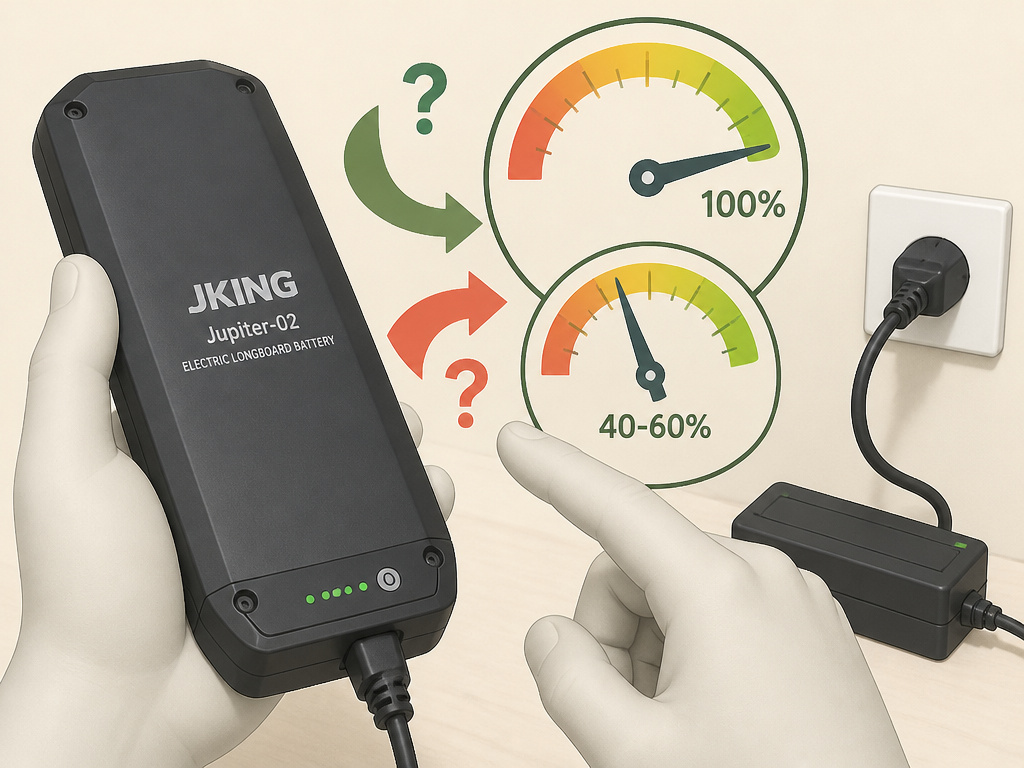
The 36V 7500mAh battery in the Jupiter-02 is the unit’s heart. How you treat it decides how long the board stays useful. JKING provides specific, and sometimes contradictory, guidance.
The factory rates the battery for 500 deep cycles. A “deep cycle” means a full discharge and recharge. After 300-500 full cycles, the battery will still work but at about 70% of its original capacity. That’s the chemistry, not a defect. Your 21-mile range becomes a 15-mile range. Plan for it.
Now, the conflict. For long-term storage, JKING’s FAQ says: “store the board fully charged and then discharge it at least 50% after a maximum of three months and then fully charged.” Most battery experts and other eskate manufacturers recommend storing lithium-ion batteries at a 40-60% state of charge and avoiding full cycles during storage.
Charging the Jupiter-02 takes about four hours for a full drain. JKING explicitly warns against using unsupported or high-current “fast” chargers. The risk isn’t just a broken board; it’s a fire hazard. Use only the supplied charger.
JKING vs. The Competition: Where It Fits
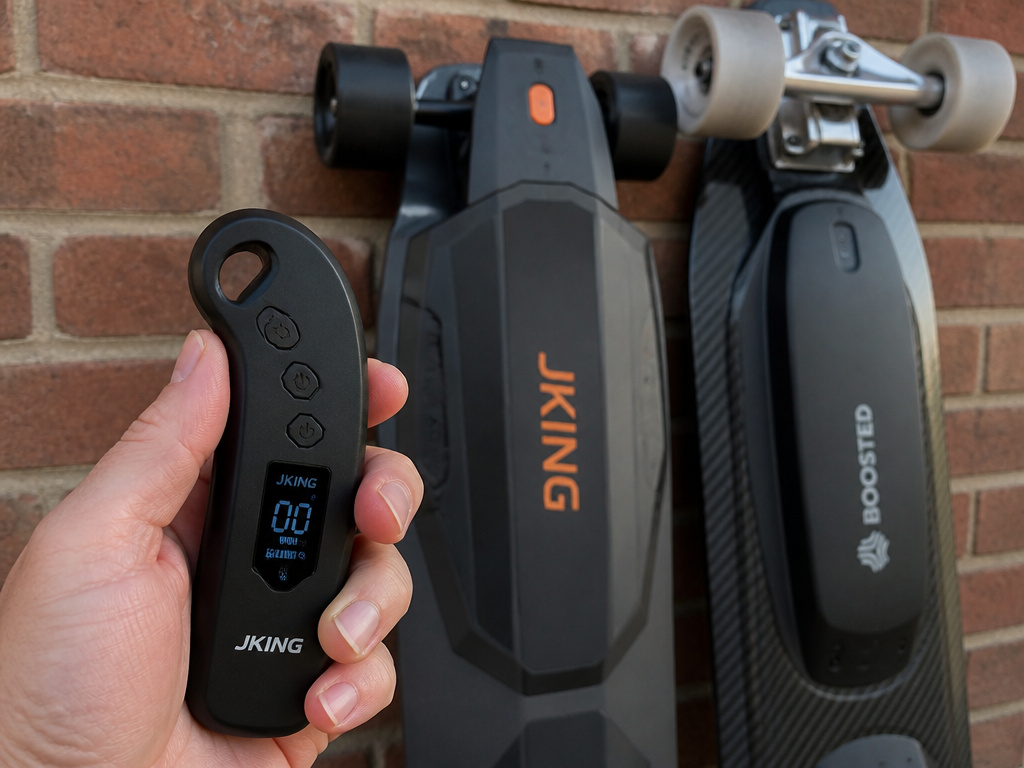
Is a JKING board a good deal? That depends on what you’re comparing it to and what you value. It’s not a premium product, and it doesn’t try to be.
Remote control and riding modes explained
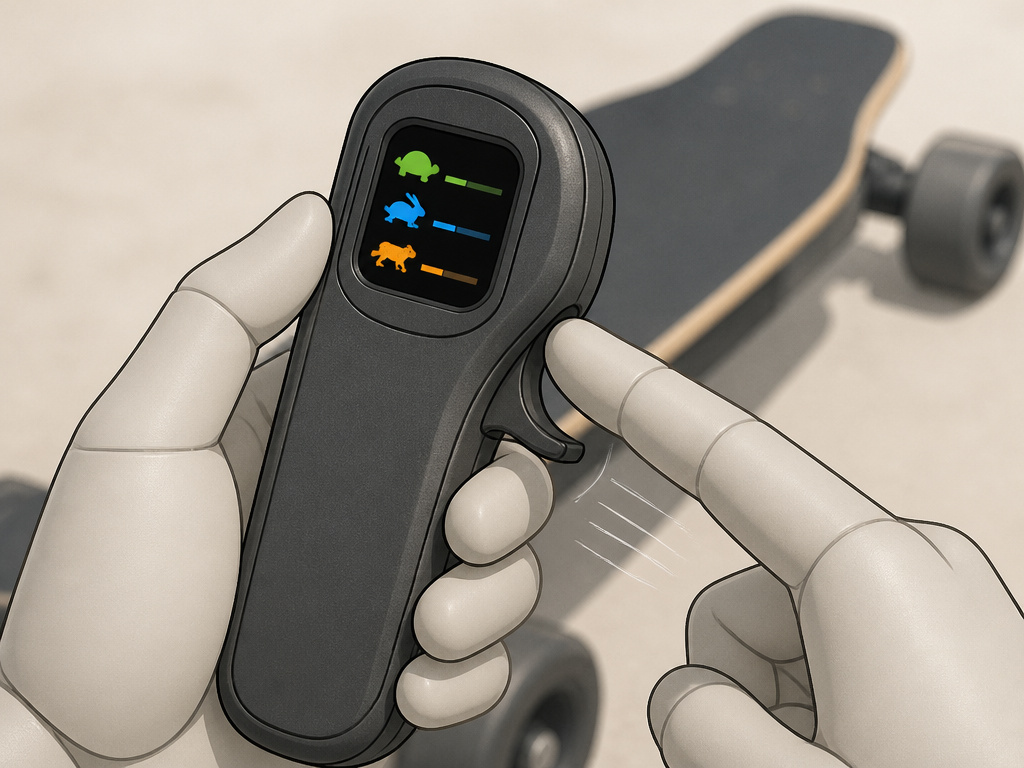
The remote that comes with your board is your main control. It typically offers multiple speed modes, which is crucial for beginners to start slow and work their way up. You’ll use it to accelerate, brake, and sometimes even reverse. Pay close attention to the braking feel as you learn, as stopping distances can vary between models. Remember, the board has an auto-shutoff feature if idle for five minutes, so you may need to power it back on if you pause for a while. Always check the specific manual for your model to understand its exact remote layout and functions.
Frequently Asked Questions
What is the best electric longboard brand?
There’s no single “best” brand. For beginners, Meepo and Backfire offer great value with strong communities; see our picks for the best electric longboards. For performance, brands like Ownboard and Evolve are contenders. JKING sits in the value segment, good for testing the waters without a huge investment. Your choice depends on budget, intended use, and how important customer support is to you.
How long do electric longboards last?
The board itself can last years with proper maintenance. The battery is the wear item. As per JKING’s specs, after 300-500 full charge cycles, you can expect about 70% of the original range. With typical use (a few charges a week), that’s 2-3 years before noticeable degradation. Motors and decks can last much longer.
Is an electric longboard easier to ride than a regular skateboard?
Yes, for straight-line travel and hill climbing. The motor does the work. However, balancing, steering, and braking at speed still require practice. An electric longboard is heavier and faster, which introduces new risks. Always start in a safe, open area on the lowest speed setting, regardless of the brand.
Do electric longboards have brakes?
Yes, all JKING models feature regenerative braking controlled by the remote. You pull a lever or toggle to engage braking, which slows the board and puts some energy back into the battery. It is not an instant, mechanical brake like on a bicycle; stopping distance depends on speed and requires anticipation.
What happens if my JKING board gets wet?
Follow JKING’s specific protocol: dry the board with a rag, then use the remote to spin the wheels for two minutes to eject water from the hubs. For deeper water exposure, they advise removing the battery case to dry visible moisture and not charging or using the board until it’s fully dry inside. The IP55 rating is not for riding in rain.
The Bottom Line
JKING electric longboards are a textbook example of getting what you pay for, fitting into the typical electric longboard cost range. The Jupiter-02 delivers competent performance for its price, with legitimate certifications and a clear set of specs. The H2 is a portable mini for lighter riders, and the Jupiter-01 offers a unique tire compromise for rough pavement.
The caveats are significant. Pay close attention to the 245 lbs recommended weight limit, not the higher maximums. Treat the IP55 rating as splash-proof, not water-resistant. Understand that battery replacement is a future cost and that support is direct-from-manufacturer only.
If your goal is to try electric skating with a sub-$500 board and you’re comfortable with a bit of DIY troubleshooting down the line, a JKING is a viable option for those wondering are electric longboards worth it. If you need a dependable daily driver and view your board as essential transportation, spending more on a brand with a stronger service network is the wiser long-term play. For the casual rider who sticks to dry paths and manages expectations, the Jupiter-02 works.
