Are Electric Longboards Worth It? The 5-Mile Commute Rule
This post contains affiliate links. As an Amazon Associate, we earn from qualifying purchases.
Are electric longboards worth it? For most people, the answer hinges on a single, specific scenario: a short, flat commute of five miles or less. They offer a fun, car-free alternative for that trip, but their value crumbles quickly if your route has hills, you weigh more than average, or you expect advertised range to match reality. The real cost includes the board’s price, plus the gear, the learning curve, and the ongoing dance with local regulations.
That five-mile threshold isn’t arbitrary. It comes from a Duke University electric longboard report that identified this as the realistic limit for using an electric longboard as a primary vehicle. This frames the entire “are electric longboards worth it” question. It’s not about whether they’re cool (they are) or eco-friendly (they can be). It’s about whether your daily life fits inside the very real constraints of battery physics, motor power, and urban infrastructure.
What follows is a breakdown of those constraints: the real range you’ll get versus what’s advertised, how your weight changes everything, the essential safety gear, the confusing legal landscape, and the honest truth about whether you’ll still be using it six months from now.
Key Takeaways
- Your commute decides everything. An electric longboard is only a viable primary vehicle for trips under five miles on flat ground, according to a Duke University analysis.
- Your weight is the single biggest variable nobody talks about. An ICSI study found that reducing a rider’s weight by one-third almost doubled the travel distance on the same battery.
- Real-world range is almost always lower than advertised. The 2018 Boosted Board advertised a 14-mile range, while real-world use was noted as 10-12 miles.
- The upfront cost is just the start. Budget for a full set of protective gear and understand that battery replacement is a significant eventual cost.
- Legality is a patchwork. The Duke University report cites a federal law setting a 35 mph speed limit, but also notes California regulations restrict use to 15 mph.
The 5-Mile Commute: Your First Filter
Forget the marketing videos of riders gliding through endless cityscapes. The practical ceiling for an electric longboard as your sole ride is about five miles. That finding comes straight from a student engineering project at Duke University, which assessed these boards as a realistic primary transport option.
If your one-way trip is longer than that, the math gets shaky fast. You’ll be pushing the battery’s limits every day, which accelerates wear. You’ll also have zero margin for detours, headwinds, or the simple desire to take a longer, more scenic route home. That five-mile radius creates a very specific use case: the dense urban or campus commute where everything you need is packed within a short distance.
Common mistake: Assuming an electric longboard can replace a car for a 10-mile commute. You’ll either be stranded with a dead battery or stressing it to the point of early failure within a few months.
This doesn’t mean longer trips are impossible. It means the board shifts from being your car to being your “last-mile” solution. You’d take a train or bus for the bulk of the journey, then unfold the board for the final mile from the station to your door. This is a much more sustainable use pattern, and it’s where the portability of a smaller board becomes a major asset. The best electric longboards for last-mile use prioritize weight and size over sheer power.
The Real-World Range vs. Advertised Range
Manufacturers love a big, bold range number. Reality delivers something smaller. The classic example is the 2018 Boosted Board, which advertised a 14-mile range. Professional reviewers at The Verge found that in real-world use, with starts, stops, and slight inclines, that figure dropped to 10-12 miles.
This drop from advertised to real-world range is a common pattern. Advertised range is usually achieved under ideal conditions that differ from real-world use. Your commute is not a lab.
The science behind this is clear. A peer-reviewed study by Romania’s ICSI institute measured the energy consumption of a converted electric longboard. An ICSI study prototype measured energy consumption at 9.4 Wh/km for a 75kg rider on flat ground. But the study’s own literature review found that reported consumption values across the industry swing wildly, from 7.5 Wh/km to over 30 Wh/km. That variance is a signal. It captures the huge impact of variables like rider weight, riding style, terrain, and even tire pressure.
| Factor | Impact on Range | Why It Happens |
|---|---|---|
| Rider Weight | High | More mass requires more energy to accelerate and carry uphill. |
| Hill Grade | Very High | The ICSI study found power demand increased 3.2x on a 10% slope. |
| Riding Style | Medium | Aggressive acceleration and braking waste energy as heat. |
| Terrain | Medium | Rough pavement or dirt paths create rolling resistance. |
| Battery Age | Increases Over Time | Lithium-ion cells lose capacity with each charge cycle. |
So, when a brand says “20-mile range,” read it as “up to 20 miles, under perfect conditions, for a 150lb rider.” For you, it might be 14. And if you’re tackling a hill, subtract another chunk. This is why understanding the electric longboard cost is about value, not just the sticker price in the are electric longboards worth it calculation. Paying more often gets you a larger, higher-quality battery that will degrade more slowly and come closer to its claimed performance.
The Rider Weight Multiplier (The Math Everyone Skips)
Here’s the single most underrated spec in the entire buyer’s guide to electric longboards: your body weight. It’s not a linear relationship; it’s exponential when hills are involved.
The ICSI study simulation made this stunningly clear. When they reduced the rider weight by one-third (from 75kg to 50kg), the projected travel distance on the same battery almost doubled. Think about that. A significant difference in rider weight can drastically affect whether a board completes a commute on a single charge.
The physics are straightforward but brutal. Every ounce you add requires more torque from the motor to get moving, which pulls more current from the battery. On a hill, that demand skyrockets. The study also noted that on slopes greater than 10%, issues like wheel slip due to insufficient torque become a problem, sometimes necessitating larger wheels for more grip.
This is why generic recommendations are useless. A board that’s “perfect for commuters” might be perfect for a 130-pound commuter on flat ground and utterly inadequate for a 200-pound commuter with a bridge to cross. Before you look at any specs, step on a scale. That number is your first and most important data point.
Safety Isn’t Just About Falling
When riders ask about safety, they’re usually thinking of pads and helmets. And yes, a full-face helmet, wrist guards, and knee pads are absolutely essential. The stopping distance at typical riding speeds is real, and asphalt doesn’t forgive.
But there’s a second, less visible safety layer: the electrical system. These are high-powered devices with dense lithium-ion battery packs. The U.S. Consumer Product Safety Commission (CPSC) has done destructive testing on similar packs (from hoverboards) to understand failure modes. Their 2019 report found that in close-packed battery configurations, a single cell failing could trigger a chain reaction, called cell-to-cell propagation, that leads to a full pack fire.
Where this goes sideways: Buying a board based solely on top speed and price. Cheap boards often cut corners on battery pack design and the Battery Management System (BMS), which is your only defense against overcharging, over-discharging, and thermal runaway.
The industry standard for evaluating these electrical systems is UL 2849. While written for e-bikes, it’s the benchmark for any light electric vehicle’s electrical safety. A board whose components are tested to this standard has undergone rigorous checks for electrical insulation, battery system integrity, and motor overload protection. You won’t see this advertised on flashy product pages, but it’s a more important question than “How fast does it go?”
This is where a project like the University of Illinois safety suite design provides a glimpse into the engineering mindset. Their senior design project included safety interlocks that would cut motor power if rider weight was suddenly removed (a potential crash detection). That’s the kind of layered thinking, beyond just the battery, that separates a product with safety interlocks from a dangerous toy.
The Learning Curve: More Than Just Balance
So you’ve got your board. Now you have to learn to ride it. This is where many people overestimate their skills and underestimate the process. Riding an electric longboard is a distinct skill from riding a traditional skateboard or longboard.
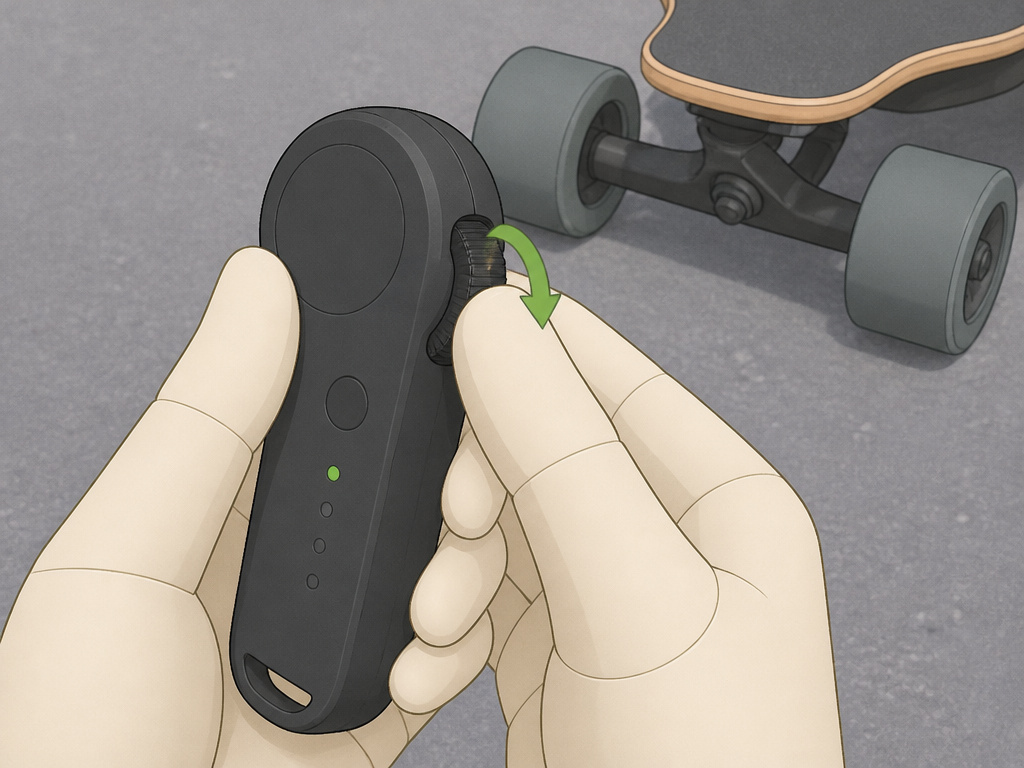
On a traditional board, you control speed by pushing and braking by foot-dragging or sliding. Your brain is directly connected to the pavement. On an electric board, you control speed and braking with a thumbwheel on a wireless remote. There’s a disconnect. Your brain says “stop,” but your thumb must execute a precise, gradual rollback on the wheel. Jerk it, and you’ll fly forward. This muscle memory takes dedicated, empty-parking-lot practice to build.
- Week 1: Practice starting, stopping, and gentle turning in a flat, empty space. Wear all your gear.
- Week 2: Introduce slight inclines. Learn how the board’s behavior changes when the motor is working harder.
- Week 3: Practice emergency stops at gradually increasing speeds (never beyond your comfort zone).
- Month 1+: Start incorporating real-world obstacles like cracks, manhole covers, and gentle slopes.
The remote is your lifeline. A responsive remote feels responsive, not laggy. A bad one can have a dead zone in the center or a delayed response, which is a recipe for panic. This initial learning period is also where you’ll appreciate a board designed for beginners. Brands like Uditerboard explicitly recommend a wider, longer, flexible deck for stability and dual hub motors (which are quieter and require less maintenance than belt drives) for new riders.
Legal Gray Areas and the 15 vs. 35 MPH Confusion
Before you cruise down a bike lane, you need to know if you’re even allowed to be there. The legality of electric longboards is a confusing patchwork.
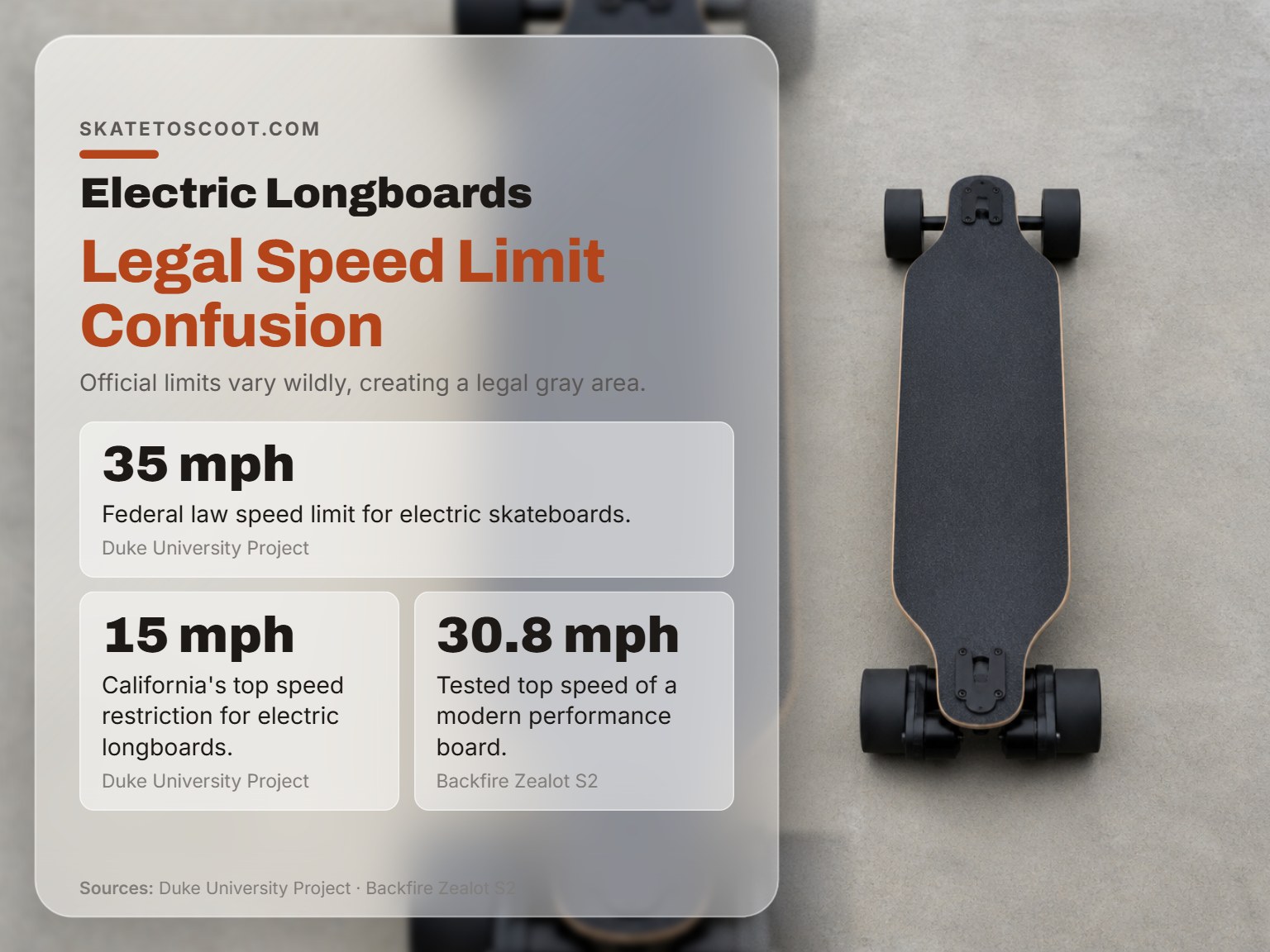
The Duke University report highlights the core confusion. It cites a federal law that sets a speed limit of 35 mph for “electric skateboards.” But in the very next breath, it notes that California regulations, often a de facto standard, restrict their use to a top speed of 15 mph. Also, many states and cities haven’t formally classified them at all, leaving them in a legal gray zone where they may be banned from roadways and restricted to sidewalks (where they can be a hazard to pedestrians).
This creates a bizarre scenario. You might buy a board like the Backfire Zealot S2, which a 2025 TechGearLab test clocked at 30.8 mph, but legally you may only be permitted to ride it at half that speed. Riding at its full capability could not only be illegal but could also invalidate any insurance or liability coverage if you’re involved in an accident.
Your homework before buying:
- Check your state vehicle code for any classification of “electric skateboards” or “personal mobility devices.”
- Check your city and county ordinances. These often have stricter rules.
- Look at where you plan to ride. Are bike lanes permitted? Are roads permitted? Many jurisdictions treat them like bicycles, but not all.
Navigating this is part of the real cost of ownership. The thrill of speed comes with the responsibility of knowing where you can legally use it.
Will You Actually Use It? The Novelty vs. Utility Test
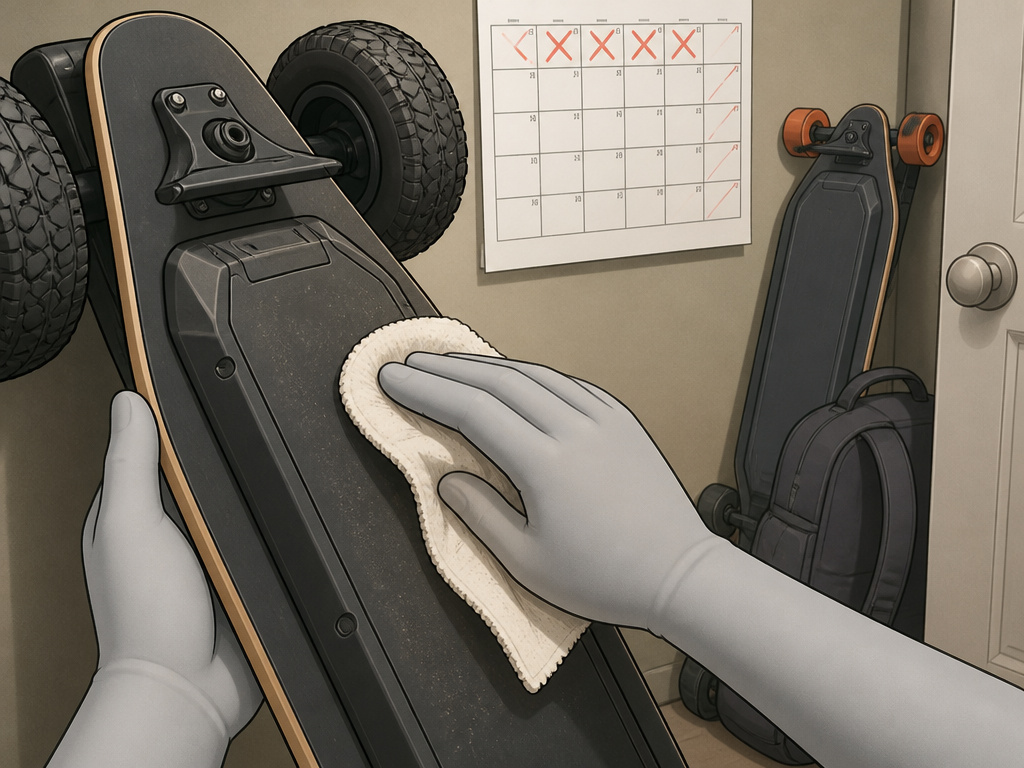
This is the most personal question. An electric longboard is a significant investment. Will it become a trusted tool in your weekly routine, or will it gather dust in the closet after the novelty wears off?
The forum discussions are telling. Experienced riders often talk about their boards in two distinct categories: the “fun” board for weekend rides and the “commuter” board that’s reliable and practical. The boards that survive as commuters tend to have a few key traits:
- Reliable Weather Resistance: A few drops of rain shouldn’t brick the electronics.
- Manageable Weight: If a board is very heavy, carrying it onto a bus or up stairs becomes difficult.
- Predictable Range: You need to trust it won’t die two miles from home.
The “fun” boards, like the all-terrain Meepo Hurricane Bamboo praised for high-speed stability, are fantastic for recreation but might be overkill (and overly heavy) for a daily commute.
The part nobody mentions: The post-purchase usage drop-off. Many buyers use their board intensely for the first month, then usage drops as real-life constraints (weather, schedule, route familiarity) set in. Be honest with yourself about your habits.
A project like the UIC electric skateboard conversion kit speaks to another path: the DIY approach. For some, the value isn’t just in riding, but in building, tinkering, and customizing. This can extend the board’s utility and emotional attachment far beyond a pre-built purchase. It turns the board from a product into a project, which for the right person, is where the real worth is found.
The Verdict: Who Should Buy One?
Cutting through the specs and the hype, an electric longboard is worth it for a specific person in a specific situation.
Buy one if:
- Your one-way commute is five miles or less and primarily on flat, paved paths or bike lanes.
- You have a secure, flat place to store and charge it at both ends of your trip.
- You’re willing to invest in full safety gear and practice diligently.
- You’ve verified it’s legal to ride on your planned routes.
- Your budget covers the board and the inevitable future battery replacement cost.
Think twice if:
- Your route has significant hills. The performance penalty and battery drain are severe.
- You weigh over 200 lbs. Your options for adequate power and range shrink and get more expensive.
- You need to combine it with public transit frequently. A 35+ lb board is a burden on a crowded bus.
- You live in an area with frequent rain or snow. Most boards are not built for wet conditions.
- You’re looking for a toy. The financial and safety stakes are too high for casual use.
For the person who fits the first profile, an electric longboard provides a faster, more engaging, and car-free way to navigate the first or last few miles of the day. For everyone else, the comparison to a traditional skateboard, a bike, or a scooter often reveals a more practical and cost-effective alternative. The thrill is real, but it’s framed by very real limits.
What are the best electric longboard brands and models?
Focus on your needs rather than a single ‘best’ board. For beginners, choose a wider, longer, and flexible deck for stability, and choose dual hub motors for a balance of speed and control. A range of 10-15 miles is generally adequate for new riders. Be cautious of boards under $300, as they often have limited range, speed, and power, especially for larger riders, and may not last. For performance, recent lab tests highlight specific models for top speed and high-speed stability. Always check your local laws, as speed limits can vary significantly by region.
Frequently Asked Questions
How hard is it to ride an electric longboard?
It’s a new skill with a distinct learning curve. If you already skateboard, you have a balance advantage, but you must learn the remote-controlled throttle and braking system. Plan for several hours of practice in a safe, open area before attempting a commute. The first few rides will feel awkward as you build the thumb muscle memory for smooth acceleration and deceleration.
How long does an electric longboard last?
The board itself can last for years with proper maintenance (bearing cleaning, tire rotation). The main wear item is the lithium-ion battery. Lithium-ion batteries lose capacity over many charge cycles, and replacement is a significant eventual cost. With daily use, the battery will eventually need replacement, which is a significant cost.
Can you get a DUI on a non-motorized skateboard?
Laws vary drastically by jurisdiction. Generally, a DUI applies to operating a “vehicle.” Many states define a vehicle broadly enough to include bicycles and skateboards. While enforcement is rare, it is legally possible to be charged with a DUI on a traditional skateboard if you are impaired on a public roadway. The legal risks are significantly higher and more clear-cut on an electric longboard, as it is unequivocally a motorized vehicle.
How fast can you go on an electric longboard?
Performance boards like the Backfire Zealot S2 can hit 30+ mph. However, your legal speed limit is almost certainly lower. California, for example, restricts operation to 15 mph. Also, riding at top speed requires expert skill, perfect pavement, and full protective gear. For most commuters, a comfortable cruising speed is well below a board’s top speed.
