How to Replace a Hoverboard Battery: Step-by-Step Safety
This post contains affiliate links. As an Amazon Associate, we earn from qualifying purchases.
Replacing a hoverboard battery requires matching three things: the correct voltage for your model, the right tools (usually a Phillips #1 screwdriver), and strict adherence to manufacturer safety warnings to prevent fire or shock. The core process involves removing the shell, disconnecting the old battery, and installing the new one, but the voltage, 36V for models like the Razor Hovertrax 2.0 or 25.2V for others, is the essential spec that decides compatibility.
That voltage spec isn’t just a number on a box. It’s the line between a successful repair and a board that won’t turn on, or worse, a damaged power system. Getting it wrong means the motors don’t get the 36Vdc signal, the battery management system gets confused, and you’re left with a very expensive paperweight. A critical step in how to replace a hoverboard battery is matching this voltage exactly.
What follows: the universal six-step swap that applies to most models, the brand-specific quirks you’ll actually encounter, how to test your work, and the one safety recall you must check before you even pick up a screwdriver.
Key Takeaways
- Match the voltage exactly. Installing a 36V battery in a 25.2V hoverboard (or vice-versa) will cause immediate failure or damage.
- Check for the GLW battery recall first. If your Razor Hovertrax 2.0 has a battery serial number starting with ‘GLW’, stop using it and contact Razor for a free replacement under the official CPSC recall, don’t attempt a standard swap.
- Disconnect ALL power sources. Always power off the hoverboard and unplug the charger before starting. The Segway One S1 manual explicitly warns to remove both batteries and press the power button to discharge residual current before touching internal components.
- Have the right screwdriver. Most shells are held by Phillips #1 screws; the iFixit guide for the Hover-1 All Star calls for removing twenty of them.
- Recycle the old battery properly. Take your spent lithium-ion pack to an R2 or e-Stewards certified recycler; tossing it in the trash is a fire and environmental hazard.
The One Thing You Must Do Before Any Repair
Before you unscrew a single bolt, you have a mandatory homework assignment. Is your hoverboard part of a known fire hazard recall? For owners of the Razor Hovertrax 2.0, this is critical.
The U.S. Consumer Product Safety Commission (CPSC) issued a recall in 2021 for specific GLW battery packs sold with those models. The recall notice states there were more than 20 reports of these packs overheating, with some producing smoke or fire. The fix isn’t a DIY battery purchase. If your battery’s serial number on the white sticker begins with ‘GLW’, you must stop using the hoverboard and contact Razor for a prepaid shipping carton to return the defective pack for a free, safe replacement. Attempting a standard battery replacement on a recalled unit bypasses the official remedy and leaves a known hazard in play.
Common mistake: Assuming a new retail battery fixes a recalled model. If your board is under the official CPSC hoverboard battery recall, the only correct path is the manufacturer’s return program.
Tools and Safety: What You Actually Need
You don’t need a full mechanic’s kit. For most swaps, a single Phillips #1 screwdriver is the only mandatory tool. A plastic spudger or pry tool can help separate shell halves without cracking them, but isn’t essential. A multimeter can be used for testing the old battery’s health and verifying the new battery’s voltage before installation.
The safety list is longer and essential. This isn’t scare talk; it’s the manufacturer’s documented protocol to prevent electric shock and fire.
- Work on a clean, dry, non-conductive surface. A wooden table or a clean garage floor is ideal.
- Power off and unplug everything. The Segway One S1 service manual is explicit: “Always power off the One S1 before performing any maintenance… Always unplug the power cord before performing any maintenance.”
- Wear safety glasses. When you’re prying plastic or handling a battery that could potentially leak, eye protection is a cheap insurance policy.
- Handle the battery with care. Do not puncture, bend, or apply excessive force to the battery case. If you see any damage, swelling, or smell an unusual odor, stop immediately. The Segway manual warns to avoid contact with any substance leaking from a battery.
How to Identify Your Hoverboard Battery Specs
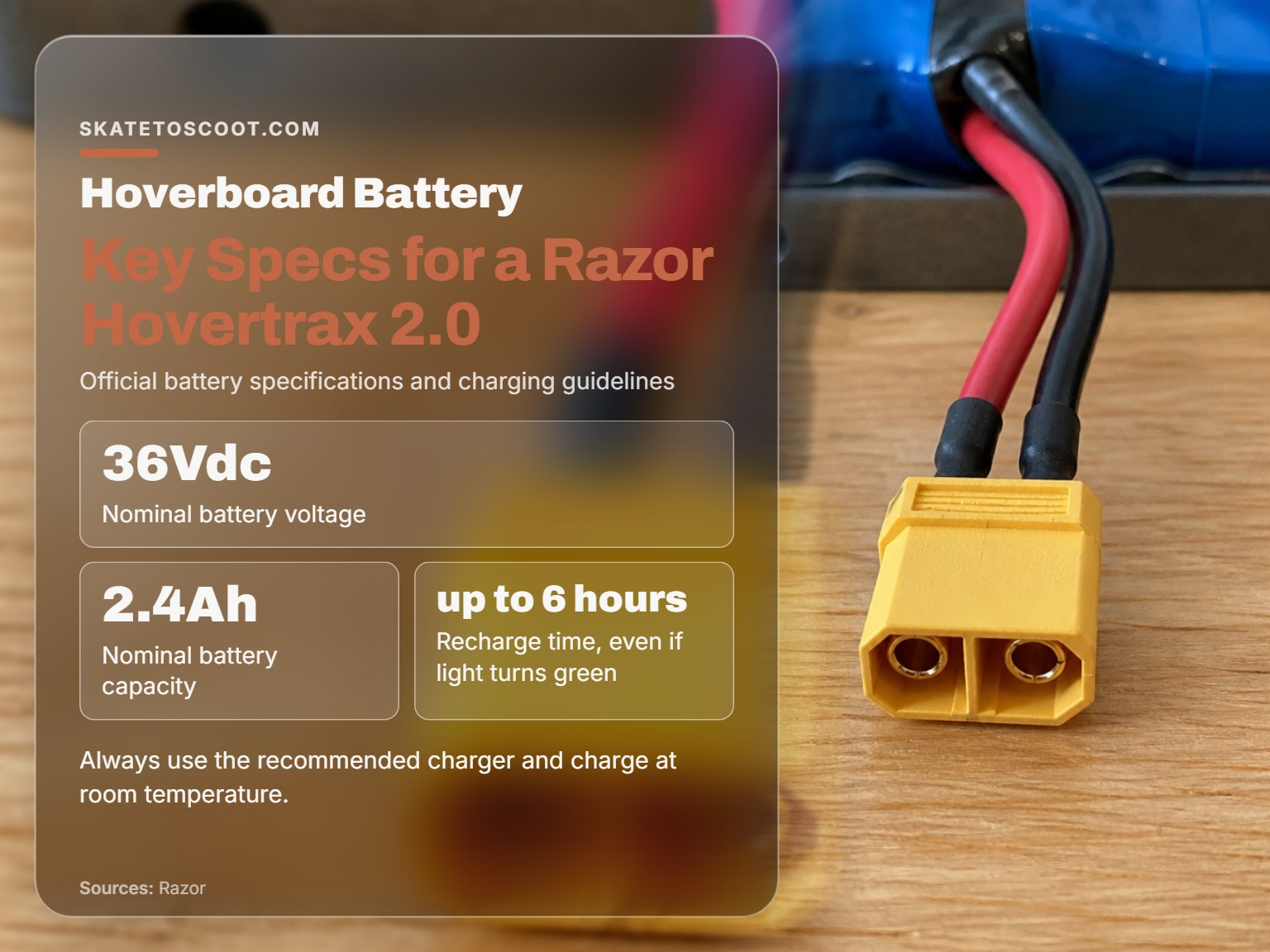
You can’t buy the right battery if you don’t know what you’re taking out. The two key specs are voltage (V) and capacity (Ah), and sometimes the connector type.
| Hoverboard Model | Nominal Voltage | Nominal Capacity | Key Identifier / Source |
|---|---|---|---|
| Razor Hovertrax 2.0 | 36V | 2.4Ah | Printed in official Razor replacement manual. |
| Hoverboards.com X8, X10, HTX Off-Road | 36V | Varies | Retailer Hoverboards.com product page. |
| Hoverboards.com X6 | 25.2V | Varies | Retailer Hoverboards.com product page. |
| Segway One S1 | 50–62 VDC (Healthy Range) | Varies | Segway One S1 Service Manual. |
| Hover-1 All Star | Varies (Check original battery) | Varies | iFixit repair guide shows physical swap. |
The voltage is usually printed on a label on the battery itself. If you can’t see it without opening the hoverboard, check your original manual or the retailer’s website. Brands like Hoverboards.com explicitly map voltages to models: their X6 uses a 25.2V battery, while their X8, X10, and HTX Off-Road models use a 36V battery.
Capacity (measured in Amp-hours or Ah) matters for runtime, but voltage is the compatibility gatekeeper. A higher capacity battery of the same voltage will typically work and give you longer rides, but always verify with the manufacturer.
The 6-Step Universal Replacement Process
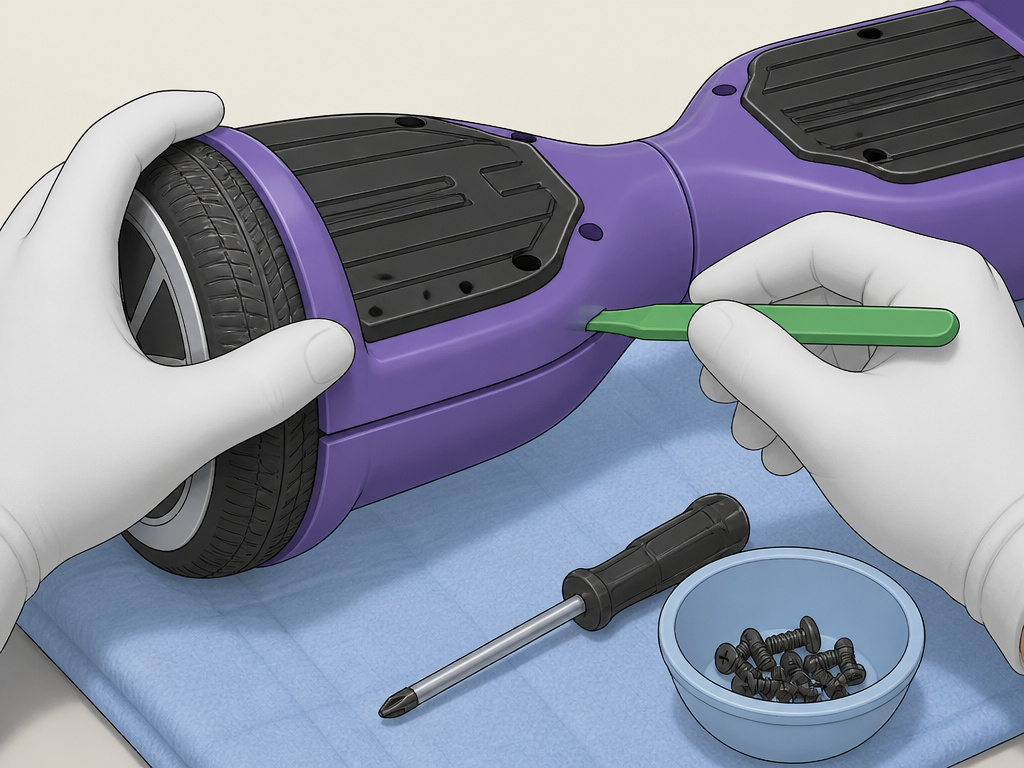
This sequence is the backbone of the job, drawn from OEM manuals and repair guides. It assumes you’ve already sourced the correct replacement battery.
-
Power down and prepare your workspace. Turn the hoverboard off. Unplug the charger from both the wall and the board. Place the board upside down on a stable, protected surface. Gather your tools.
-
Remove the shell screws. Using your Phillips #1 screwdriver, remove all screws securing the bottom shell. Place them in a bowl or magnetic parts tray. The count varies: the iFixit guide for the Hover-1 All Star specifies twenty screws. Some models may have screws hidden under rubber pads or stickers.
-
Separate the shell halves. Carefully pry the bottom shell away from the top. Go slow, working your way around the perimeter. A plastic spudger helps avoid gouging the plastic.
-
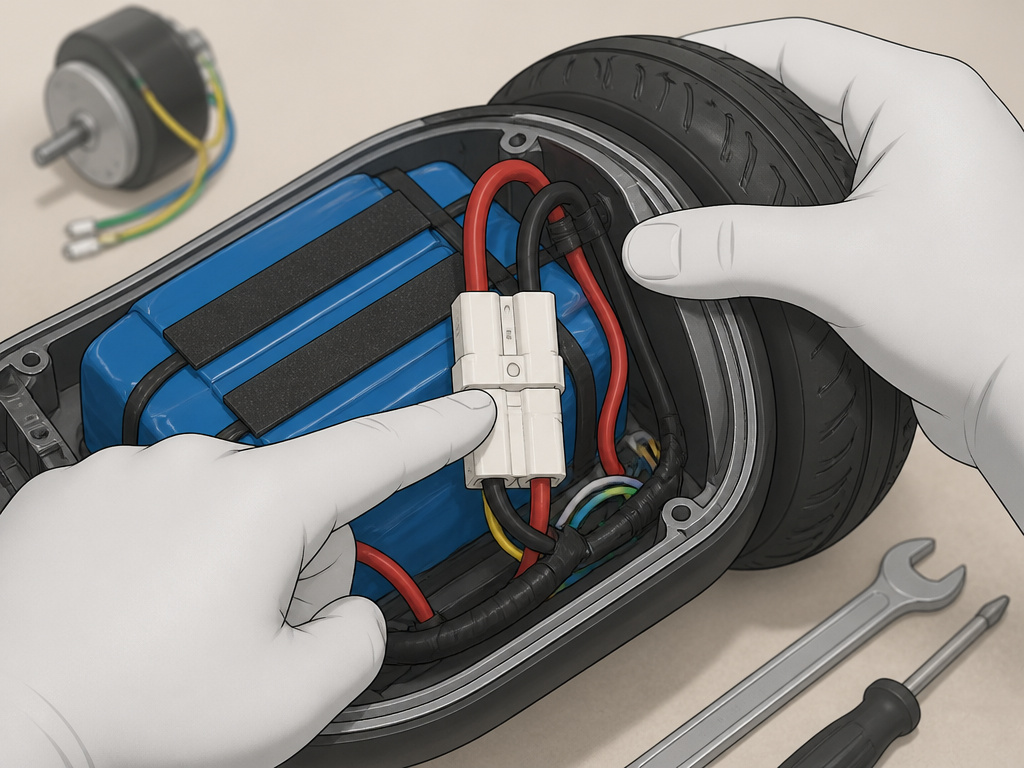
Locate and disconnect the old battery. The battery pack is usually a rectangular block secured with a bracket or double-sided tape. You’ll see one or two main connectors (often white plastic) going from the battery to the main circuit board. The iFixit guide shows disconnecting a connector. Firmly grip the connector body (not the wires) and pull it straight apart.
-
Remove the old battery. There’s often a plastic bracket held by a few small screws. Remove these, as shown in the Hover-1 guide. The battery may also be stuck down with strong double-sided tape. Use a plastic tool to gently wedge and peel it up, avoiding bending the battery cell.
-
Install and reconnect the new battery. Place the new battery in the same position and orientation as the old one. Reconnect the main electrical connector until it clicks securely. If your model had a bracket, reinstall it. Do not reassemble the shell yet.
Where this goes sideways: Forcing a connector that doesn’t fit. If the new battery’s plug doesn’t match the board’s socket, you have the wrong battery. Never cut and splice wires unless you are professionally qualified, you bypass the safety features of the connector and create a fire risk.
Navigating Connectors and Brand-Specific Quirks
The “disconnect the battery” step in how to replace a hoverboard battery is where abstract guides meet reality. You’ll likely encounter a connector from the battery to the main circuit board.
Brands have their own personalities here. A Razor Hovertrax 2.0 replacement is a direct swap of a sealed pack. Its service manual states a healthy battery voltage range is 50–62 VDC.
The Hover-1 All Star, as documented by iFixit, presents a middle ground: a user-serviceable battery held by a bracket and tape, contradicting the common “no user-serviceable parts” warning. This is a perfect example of why you must consult model-specific resources, not just generic advice.
Troubleshooting a Non-Working Hoverboard After Replacement
You’ve buttoned everything up after learning how to replace a hoverboard battery, pressed the power button, and… Nothing. Don’t panic. This is common, and it’s almost always a simple connection issue.
First, double-check the obvious. Is the hoverboard charged? Even a new battery can ship partially depleted. Plug in the official charger and wait. Does the charger light turn red? If it stays green, the battery might be full, or there’s a connection problem.
Now, reopen the shell (power off and unplug first). This is your checklist:
- Is the main battery connector fully seated? Push it in until it clicks. This is the #1 cause of post-swap failure.
- Are any other connectors loose? Did you bump a wire to a motor or gyroscope?
- Did you accidentally damage a wire? Inspect for pinched or cut insulation.
If all connections are solid and the battery is known-good, the issue might lie elsewhere. A complete troubleshooting guide for general hoverboard problems is the logical next step.
Sourcing a Safe Replacement Battery
Buying the cheapest battery you find online is the fastest way to end up with a paperweight, or a hazard. The market has been plagued with counterfeit packs bearing fake safety marks.
These are safety standards for hoverboard electrical systems. As of April 8, 2016, UL had not certified any hoverboards for safety. The UL warning about counterfeit packs specifically advised against disassembling a hoverboard to identify the battery, as it could expose you to shock.
Avoid no-name batteries with vague specs or prices that seem too good to be true. Your battery is the heart of the device; a unit that meets the 36Vdc, 2.4Ah spec is a worthwhile investment.
Charging and Caring for Your New Battery
According to the Razor Hovertrax 2.0 manual, the initial charge time is 6 hours. Even after the charger light turns green, they recommend continuing the charge for the full six hours for the first cycle. The maximum recommended charging time is 24 hours,
For daily care:
- Charge at room temperature. The Razor manual explicitly warns not to charge at or below 32°F (0°C).
- Use only the recommended charger. Using a mismatched charger can overheat the battery.
- Unplug the charger from the wall when not in use. This is a simple fire-safety step.
- Store properly. If storing the hoverboard for months, the Razor manual says to fully charge it first. However, general lithium-ion best practice suggests storing at a 40-60% state of charge for long-term health.
For detailed guidance on how to charge your hoverboard correctly to maximize its overall longevity, we have dedicated guides.
Proper Disposal of the Old Battery
You have a spent lithium-ion battery pack in your hands. Throwing it in the trash is dangerous, it can short-circuit in the garbage truck and cause a fire, and is often illegal.
The iFixit guide for the Hover-1 All Star ends with a clear directive: “Take your e-waste to an R2 or e-Stewards certified recycler.” These certifications ensure the recycler handles hazardous materials responsibly. This isn’t an optional step; it’s part of being a responsible owner. Our guide on how to safely dispose of lithium-ion batteries walks you through the process.
Frequently Asked Questions
Can you replace the battery in any hoverboard?
Technically, yes, as most are designed to allow battery access. However, manufacturers like Segway warn that internal component replacement should be done by authorized technicians to avoid voiding the warranty. For models like the Hover-1 All Star, community repair guides prove it’s a user-serviceable task.
How much does it cost to replace a hoverboard battery?
Costs vary by model and brand. OEM batteries from the original manufacturer are typically the most expensive but guarantee compatibility. Third-party replacements from reputable sellers are less costly but require careful vetting for safety and correct specs.
How do I know if my hoverboard battery is bad?
Signs include drastically reduced run time, the board not holding a charge, failing to power on, or the charger light staying green instead of turning red when plugged in. A multimeter test is definitive: compare the battery’s voltage to its rated nominal voltage (e.g., 36V). A severely under-voltage pack is dead.
What is the typical lifespan of a hoverboard battery?
With proper care and charging habits, a lithium-ion hoverboard battery will degrade over time. Factors like frequency of use, charging cycles, and exposure to extreme temperatures significantly impact its battery lifespan.
The Bottom Line
Replacing a hoverboard battery is a straightforward mechanical job dominated by one rule: voltage compatibility is everything. Get that right, follow the safety steps to the letter, especially disconnecting all power, and the swap itself is a matter of twenty screws and one connector.
Treat the battery with the respect a high-energy density power source deserves, and you’ll restore your hoverboard’s range and reliability for another few seasons of riding. If your board still won’t charge after a verified-good battery swap, the problem likely lies elsewhere, and a systematic diagnosis of charging issues is your next move.
