Can You Turn a Skateboard Into a Longboard: Step-by-Step
This post contains affiliate links. As an Amazon Associate, we earn from qualifying purchases.
You can turn a skateboard into a longboard by swapping its wheels, trucks, and hardware, but you cannot change the deck’s fundamental size and shape. The conversion yields a cruiser-like ride, but it is fundamentally a modified skateboard, not a true longboard.
That deck constraint is the whole game. A skateboard deck is short and stiff, designed for pops and flips. A longboard deck, like the Loaded Vanguard Flex 3 used in a Cal Poly project, is long and often flexible, built for carving and stability over distance. You can mimic the feel of a longboard by putting bigger, softer wheels on your skateboard, but you’re working with a different foundation. A common question is: can you turn a skateboard into a longboard?
What follows is a breakdown of what you can actually change when you ask can you turn a skateboard into a longboard, covering wheels, trucks, tuning, and what you can’t. This section lists the specific parts you need, the practical limits (like the 70mm wheel ceiling), and whether this project is a clever hack or a compromised dead end.
Key Takeaways
- The most impactful change is swapping to larger, softer longboard wheels, but you are limited to roughly 70mm on a standard skateboard deck to avoid wheelbite.
- You must use 1/2″ riser pads and longer hardware (1 1/2″ bolts) when installing bigger wheels; skipping this step guarantees the wheels will lock against the deck.
- Truck tightness is a critical tuning variable; tightening the kingpin increases stability for cruising, while loosening it preserves maneuverability but risks wheelbite.
- You cannot convert a skateboard deck into a true longboard deck; the length, flex, and shape are fixed, which limits carving stability and comfort over long pushes.
- A converted board is best for smoother cruising on flat ground; for downhill speed or serious distance, a purpose-built longboard is a safer, more effective investment.
The Wheel Swap: Your First and Easiest Step
This is where everyone starts. You pull off the hard, small wheels and imagine the smooth, quiet roll of something bigger. It works, but there’s a ceiling.
When exploring can you turn a skateboard into a longboard, the community-tested limit, according to Skateboard Session, is 70mm. Go bigger, and the wheel will contact the deck during a turn, a phenomenon called wheelbite, which stops the board dead. I’ve watched students try to force 75mm wheels onto a standard deck; the first carve sends them over the front when the wheel seizes. The CalPoly project used 83mm wheels on a dedicated longboard deck, not on a converted skateboard. On your skateboard, 70mm is the hard stop.
Mounting longboard wheels on a skateboard requires 1/2″ riser pads and 1 1/2″ bolts to prevent wheelbite, according to Skateboard Session. Exceeding a 70mm wheel diameter almost guarantees the wheel will contact the deck.
You need two specific parts to make this swap safe: riser pads and longer bolts. The 1/2″ riser pad creates the necessary gap. The old skateboard bolts won’t be long enough to reach through the riser, the deck, and the truck baseplate. This is where sources disagree slightly on the exact bolt length. Skateboard Session says you need 1 1/2″ bolts, while a DIY builder used 1.25″ Independent hardware.
The feel changes immediately. Softer, larger wheels like the 70mm Orangatang 4Presidents roll over cracks and pebbles that would stall your old skate wheels. The trade-off is a loss of “pop” for ollies and a heavier, slower feel when trying tricks. Your board becomes a cruiser, not a trick machine.
Trucks and Tuning: Stability vs. Maneuverability
Your existing skateboard trucks might work, but they’ll need adjustment. Longboard trucks are often wider to match wider decks, but for a conversion, you’re likely keeping your stock trucks. The adjustment happens at the kingpin.
Tightening the kingpin with a T-tool makes the truck more rigid. This is the Decathlon support guide’s advice for a more stable, predictable ride, which is what you want when cruising. Loosening it makes the board more maneuverable, but it also lowers the deck, bringing it closer to the wheels. This is where you can get into trouble.
Where this goes sideways: Overtightening the kingpin. The Decathlon guide warns this can damage the rubber bushings inside the truck. You’ll feel it as a gritty, non-returning turn long before the bushing fails.
The goal is a middle ground, tight enough to prevent excessive leaning and wheelbite, but not so tight that the bushings deform. If you’re a heavier rider, you might need harder durometer bushings to achieve this balance without cranking the kingpin down. The board should lean into a turn and spring back to center when you straighten out. If it stays leaned over or feels dead, you’ve gone too far.
This tuning step is essential. Putting big wheels on loose, skate-park-ready trucks is a recipe for a sudden stop. Tighten them down for the first test ride, then back off a quarter-turn at a time until you find the sweet spot between stability and a little carve.
The Deck Dilemma: The Hard Limit

Here’s the part nobody mentions in most quick guides: you cannot turn a skateboard deck into a longboard deck. The dimensions and construction are locked.
A true longboard deck, like the Loaded Vanguard Flex 3, runs from 190 cm to 241 cm (75″ to 95″) in length and 28 cm to 30.5 cm (11″ to 12″) in width, according to Patent US 10,315,100 B2. Your skateboard deck is likely significantly shorter and narrower than a longboard deck. That difference isn’t just about standing room; it’s about mechanical advantage, flex, and wheelbase. A longboard’s length provides stability at speed and a longer, smoother carving arc. Your skateboard deck will always feel twitchy and cramped in comparison.
The materials matter, too. The patent lists materials like fiber-reinforced polymer, carbon fiber, and aluminum for support structures in conversion kits, materials chosen for flex and rebound. A 7-ply maple skateboard deck is a stiff, unyielding plank. You can’t carve the same way, and you’ll feel every bump in your knees after ten minutes.
So, you’re building a cruiser, not a downhill speed demon. That’s fine, as long as you know that’s the ceiling. The deck is the one component you cannot truly convert.
Component Compatibility: A Quick-Reference Guide
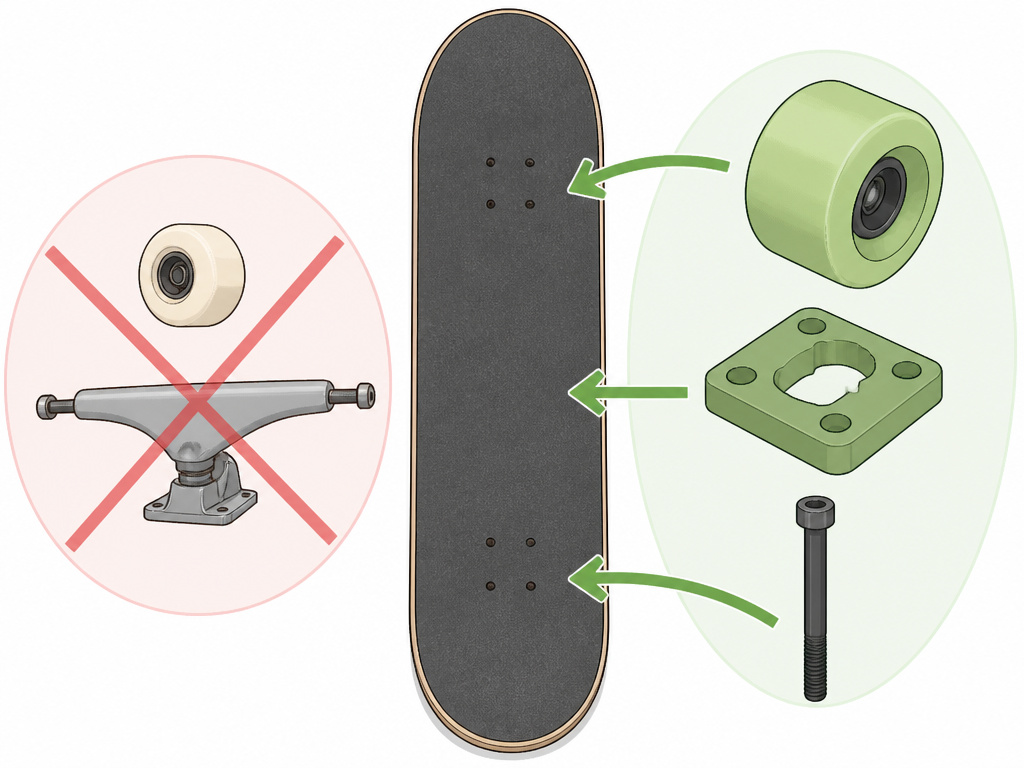
Not every part is a straight swap. This table breaks down what changes, what can stay, and what you absolutely need to buy new.
| Component | Can You Use the Skateboard Part? | What You Likely Need | Why the Change Matters |
|---|---|---|---|
| Deck | Yes (it’s the foundation) | N/A | Defines the board’s length, flex, and ride feel. Cannot be changed. |
| Wheels | No | Softer, larger wheels (≤70mm), 1/2″ riser pads | Larger wheels roll over debris; softer wheels absorb vibration. Risers prevent wheelbite. |
| Trucks | Yes (but may need tuning) | Possibly harder bushings | Wider longboard trucks match wide decks, but skate trucks can be tightened for stability. |
| Bearings | Yes | N/A | Quality bearings like Bones REDS reduce friction for a smoother, longer roll. |
| Hardware | No | Longer bolts (1 1/2″) | Standard bolts are too short to accommodate riser pads. |
| Grip Tape | Yes | N/A | Provides foot traction. You can re-grip if the old tape is worn. |
Step-by-Step Conversion Walkthrough
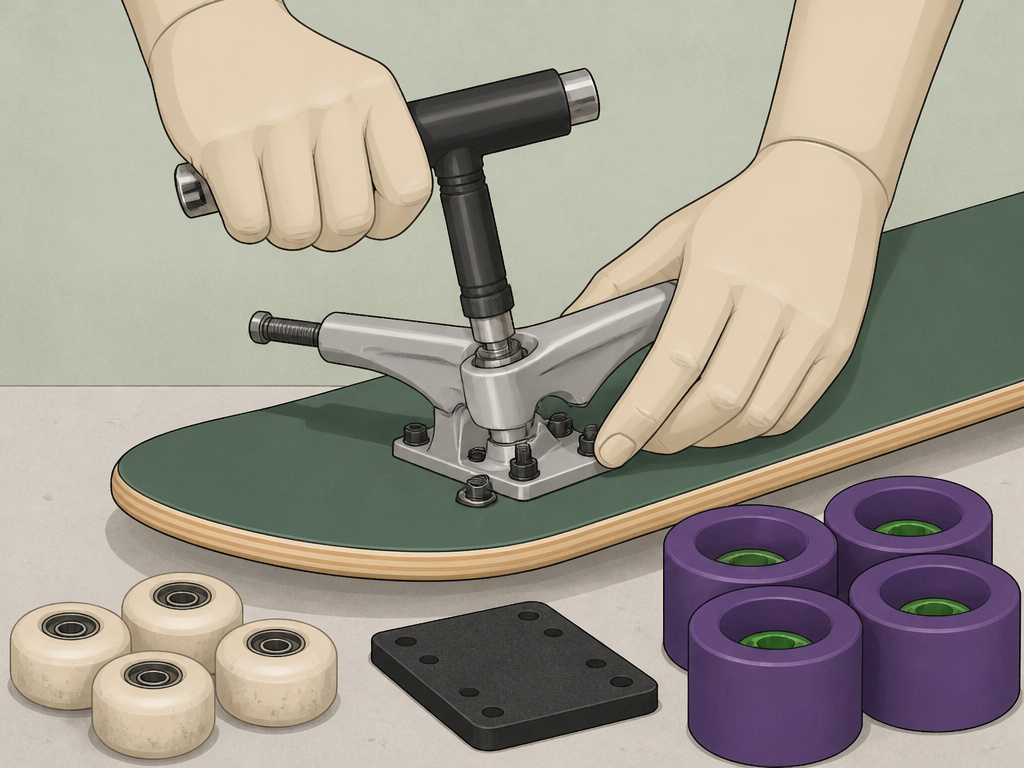
Here is the actual process. You’ll need a T-tool, your new parts (wheels, riser pads, longer bolts), and about 20 minutes.
- Remove the old wheels and trucks. Use your T-tool to loosen the axle nuts and pop off the wheels. Then, loosen the four bolts holding each truck to the deck and remove them. This is good practice for any future maintenance, like when you need to disassemble a longboard for transport or repair.
- Install the riser pads and new trucks. Place the 1/2″ riser pad over the truck mounting holes on the deck. Set your truck (the same one or a new one) on top, aligning the holes. Thread the new, longer 1 1/2″ bolts through from the top of the deck down into the truck baseplate. Finger-tighten them for now. Repeat for the second truck.
- Mount the new wheels. Slide your new longboard wheels onto the truck axles. Add a speed washer between the wheel and the truck hanger if your setup includes them. Thread on the axle nut and tighten it until there’s a slight bit of side-to-side play in the wheel, just enough so it spins freely without wobbling.
- Tune the truck tightness. This is the critical step. With the board right-side-up, use the T-tool on the kingpin nut. Tighten it until the truck doesn’t wobble easily with hand pressure, but still rebounds when you lean it. Refer to the Decathlon guide: overtightening damages bushings, undertightening causes wheelbite. Make small adjustments.
- Test ride and adjust. Take the board for a slow, cautious roll in a safe, open area. Make gentle turns to test for wheelbite. Listen for a rubbing sound. Feel how the board carves. Adjust the kingpin a quarter-turn in either direction based on feel.
The entire process is reversible. If you hate it, you can put the old parts back on. But this is how you assemble a longboard from a box of parts, and the same principles apply to modifying your skateboard.
Converted Board vs. Purpose-Built Longboard
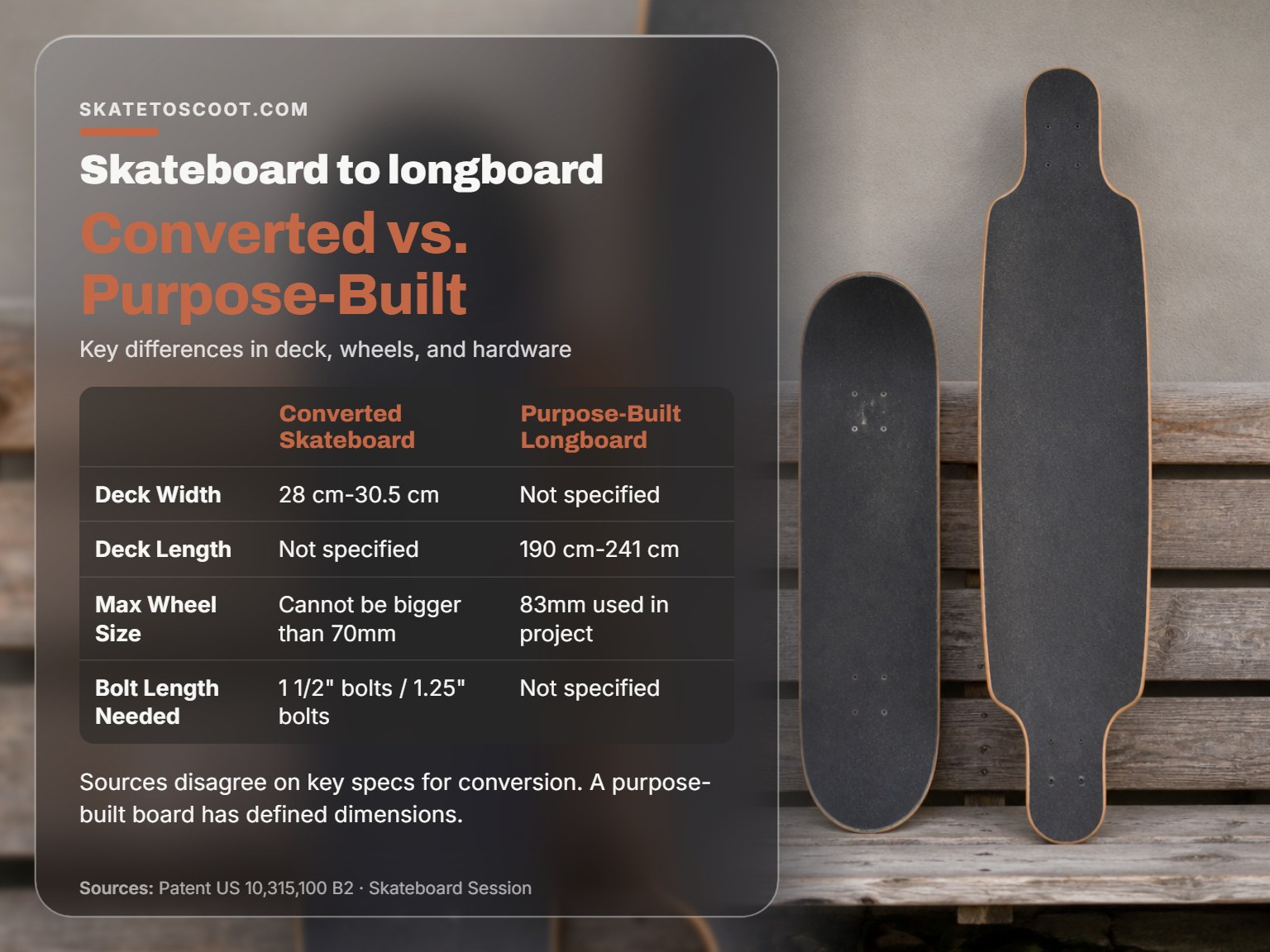
Is this hack worth it, or should you just buy a longboard? We can compare the outcomes directly.
| Aspect | Converted Skateboard | Purpose-Built Longboard |
|---|---|---|
| Deck Length & Flex | Short (≈31″), stiff, no flex. | Long (75″-95″), often flexible for carving and shock absorption. |
| Ride Comfort | Harsh over rough ground, vibrations travel to feet. | Smoother, more dampened ride, better for distance. |
| Stability at Speed | Twitchy, prone to speed wobbles due to short wheelbase. | Inherently stable, designed for downhill and cruising. |
| Carving Ability | Limited by deck shape and truck geometry. | Deep, fluid carves are a core design feature. |
| Cost | Lower upfront (parts only). | Higher, but you get a complete, optimized system. |
| Best Use Case | Casual cruising on smooth paths, short trips. | Distance pushing, downhill, dancing, serious carving. |
The difference isn’t minor. It’s the difference between a multi-tool and a dedicated wrench. A converted board can handle a smooth bike path, but ask it to handle a hill or a long commute, and the limitations become safety issues. The skateboard vs longboard divide exists for a reason.
Safety and Durability Considerations
Modifying equipment always introduces new variables. A converted setup has more points of potential failure.
First, the hardware. Longer bolts have more thread exposed under the truck. Check them periodically for loosening, especially after the first few rides. A lost bolt means a loose truck, which is a direct path to a crash. Second, the increased mechanical force from bigger wheels puts more stress on your truck axles and the deck itself. Don’t expect a deck designed for ollies to handle the torsional forces of hard carving indefinitely.
Finally, the ride feel will be different, and your muscle memory will be off. Your stopping distance increases with the bigger wheels’ momentum. Practice braking and bailing at low speed before you take it into traffic. Learning on a modified board is doable, but it adds a layer of unpredictability compared to learning on a standard, well-matched setup.
How to build a longboard deck from scratch
Building a deck from scratch gives you full control over the shape and ride. According to a patent on conversion kits, a proper longboard deck can be 190 cm-241 cm (75″-95″) long and uses materials like fiber-reinforced polymer, wood, carbon fiber, or aluminum. The deck itself can be made from materials like fiber-reinforced polymer, wood, carbon fiber, or aluminum. These materials provide the necessary blend of firmness and flexibility. If you’re crafting your own, you’ll need to design a shape that accommodates the longer wheelbase and larger wheels typical of a longboard, ensuring enough clearance to prevent wheelbite. The process involves shaping the material, adding any desired flex or concave, and drilling precise truck-mounting holes.
Frequently Asked Questions
Is a converted skateboard harder to ride than a real longboard?
For cruising in a straight line, it can be easier because the deck is smaller and more familiar. For actual longboarding disciplines like carving or downhill, it is significantly harder and less stable due to the short, stiff deck. The difference between boards is most apparent when you push the limits.
Can skateboards be used for cruising?
Yes, absolutely. This conversion is aimed at making a skateboard better for cruising. Even a stock skateboard can be used for short cruises, but the small, hard wheels make it unpleasant over rough pavement. Swapping to larger, softer longboard wheels is the classic upgrade for this purpose.
What tools do I need to convert my skateboard?
The only specialized tool you need is a skate T-tool, which combines a socket for axle nuts and wrenches for truck bolts. Everything else, screwdrivers, hammers, is unnecessary. The T-tool is used for every step, from removing old parts to tuning the new setup, and is essential for any longboard assembly or disassembly.
Will converting my skateboard ruin it?
No, the process is completely reversible as long as you don’t strip any bolts or damage the deck. Keep your original parts, and you can switch back to a standard skateboard setup in under ten minutes. It’s a great way to experiment without commitment.
Is it cheaper to convert a skateboard or buy a longboard?
It depends. If you already have a skateboard, converting it with new wheels, risers, and bolts is cheaper than buying a complete longboard. However, if you need to buy a skateboard and all the conversion parts, you might approach the cost of an entry-level complete longboard, which will be a better riding experience. For a detailed build, some enthusiasts reference a university engineering senior project for component ideas.
Before You Go
A converted skateboard is a fun, functional cruiser for smooth, flat ground. It’s a project that teaches you how your board works and gives you a customize a longboard feel on a budget.
But know its limits. It is not a true longboard. The deck can’t change, and that defines everything from stability to comfort. If your goal is casual cruising and you enjoy tinkering, grab a T-tool and some 70mm wheels. If you want to carve hills or push for miles, the money and time are better spent on a purpose-built deck. The truck differences and deck geometry matter more than the wheels alone.
