How Much Is a Longboard? Price Range and Examples
This post contains affiliate links. As an Amazon Associate, we earn from qualifying purchases.
A traditional, non-powered longboard costs between $60 and $250 for a complete, ready-to-ride setup. The price you pay depends directly on the deck’s construction (ply count, wood type), the truck mounting style, wheel size and hardness (durometer), and bearing rating. Electric longboards, a separate and higher-risk category, start around $1,050.
That price range directly answers how much a longboard costs, reflecting the physical difference between a 7-ply maple deck that flexes on a campus cruiser and an 8-ply Canadian maple deck built for downhill stability. The $60 board exists, but its components are built to a different tolerance than the $250 one.
What follows is a breakdown of where your money actually goes when you ask how much is a longboard, using the exact specs and prices from current manufacturer listings. This article explains the budget traps, the premium justifications, and the one category where price isn’t the main concern, safety is.
Key Takeaways
- You can find a functional beginner longboard for under $100, like the Flybar 40.5″ Drop-Through at $59.99 or several Yocaher models under $90.
- The jump to the $150–$250 range buys more durable materials (like 8-ply Canadian maple), specialized designs for riding styles like downhill or freeride, and often larger or harder wheels.
- Electric skateboards like Onewheel occupy a separate, high-risk category with prices from $1,050 to $2,200 and are subject to a major CPSC recall due to crash hazards linked to deaths.
- The used market is erratic; condition and brand matter more than a fixed discount, and a generic used board often sells for only a small fraction off its original new price.
- Your total cost of ownership must include protective gear (helmet, pads) and eventual replacement parts like wheels and bearings, which can add $100+ to your first-year investment.
The $60 to $250+ Price Range (With Real Examples)
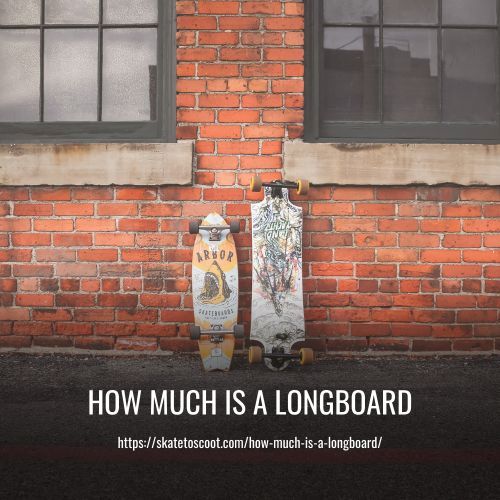
The numbers tell the story better than any category label. Here are the exact prices and specs for nine complete longboards from three brands, sourced directly from their product pages.
| Board Model | Price | Length | Deck Construction | Wheels | Bearings | Best For |
|---|---|---|---|---|---|---|
| Flybar 40.5″ Drop-Through | $59.99 | 40.5″ | 8-ply Canadian Maple | 70mm 82A | ABEC 9 | Casual cruising, beginners |
| Yocaher Kicktail Blank | $69.99 | 40″ | 7-ply Maple | 70x52mm 78A | ABEC 7 | Cruising, basic kicktail tricks |
| Yocaher Drop Down Blank | $79.99 | 41.25″ | 9-ply Maple | 70x52mm 78A | ABEC 7 | Downhill, stability |
| Yocaher Freestyle Geometrix | $89.99 | 40″ | 7-ply Maple & Bamboo Top | 70x51mm 78A | ABEC 9 | Freestyle, dancing |
| Flybar 36″ Pintail Cruiser | $99.99 | 36″ | 7-ply Maple | 70mm 78A | ABEC 7 | Carving, campus commuting |
| Yocaher Drop-Through VW Series | $99.99 | 41″ | 9-ply Maple | 70x52mm 78A | ABEC 7 | All-around, casual riding |
| Flybar 36″ Drop-Through | $99.99 | 36″ | 7-ply Canadian Maple | 70mm 78A | ABEC 9 | Downhill, cruising |
| CALI Strong Original Trojan | $249.99 | 42.75″ | 8-ply Canadian Maple | 73mm 87A | ABEC 7 | Long-distance, freeride, downhill |
A complete longboard’s price directly reflects its component tier. A $60 board uses a functional 8-ply maple deck and ABEC 9 bearings, while a $250 board like the CALI Strong Trojan uses an 8-ply Canadian maple deck, larger 73mm wheels, and a drop-through truck mount for a lower center of gravity suited to speed and distance.
Look at the ply count column. The $60 Flybar and the $250 CALI Strong both list 8-ply Canadian maple. So where does the extra $190 go? It’s in the dimensions (the CALI Strong is longer and has a longer wheelbase), the wheel durometer (82A vs. 87A), and the truck geometry. The cheaper board is a generalist. The expensive one is a specialist built for a specific job, long pushes and stable turns at speed.
I’ve coached students who bought the absolute cheapest board they could find. The deck held up, but the stock bushings were shot within a month, making the trucks wobble at any speed over a light jog. That’s the hidden tax of a budget complete: you’ll likely replace the cushions and maybe the bearings long before the deck wears out. A board in the $150+ range often comes with those components already a grade better.
What You’re Actually Paying For: The Component Breakdown
When you choose a longboard, you’re not buying a single item. You’re buying a system of four interdependent parts: the deck, the trucks, the wheels, and the bearings. The cost of each part scales with its intended use.
The Deck: Wood and Shape Cost Money
Deck construction is the biggest differentiator. More plies (7, 8, 9-ply) generally mean less flex and more durability, which matters if you weigh over 180 lbs or plan to do any downhill riding. Canadian maple is the gold standard for strength. Bamboo tops, like on the Yocaher Geometrix, add a slight dampening flex for comfort over long distances. The shape is free, but the engineering behind it isn’t. A drop-through mount (where the truck baseplate sits through the deck) lowers your center of gravity for stability. A pintail shape is classic for carving. A kicktail adds utility for maneuvering. Each shape serves a different riding style, and manufacturers charge more for the designs that require more precise cutting and mounting.
Trucks, Wheels, and Bearings: The Moving Parts
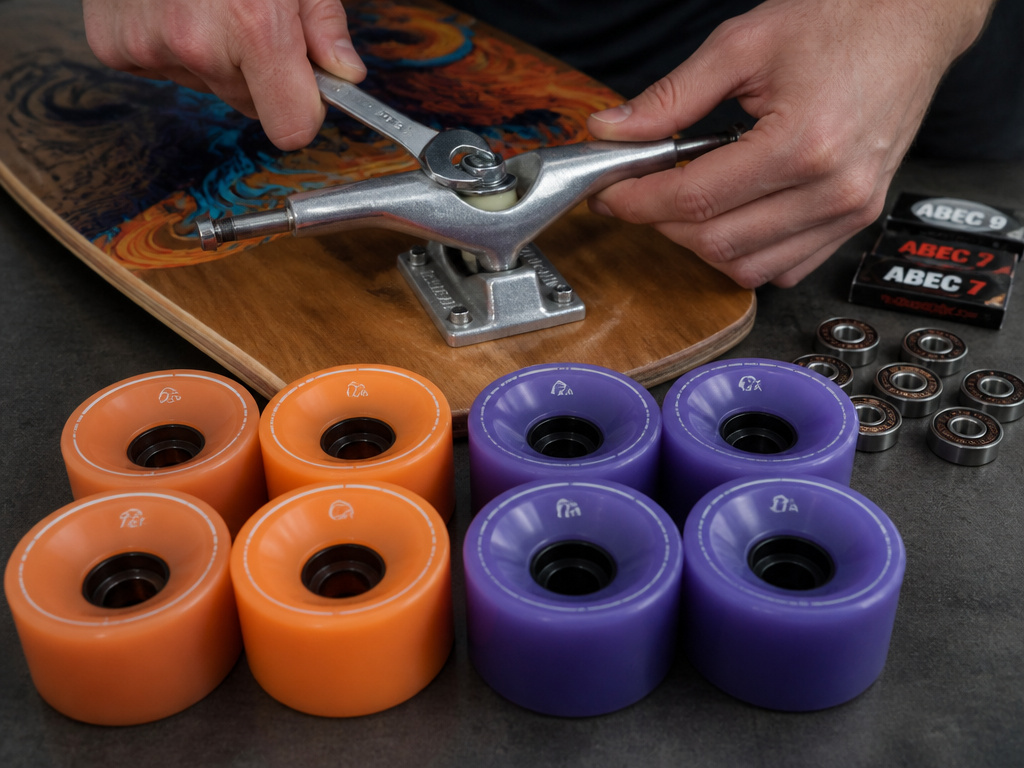
Trucks are the metal T-shaped assemblies that hold the wheels. Wheels are priced by size and durometer (the “A” number). Larger wheels (70mm-73mm) roll over cracks and pebbles more easily. A higher durometer (like 87A) is harder and slides more predictably, favored for downhill. Softer wheels (78A-82A) grip better and absorb vibration, ideal for cruising. The 73mm 87A wheels on the CALI Strong are a downhill spec; the 70mm 78A wheels on the Flybar Pintail are a comfort spec. Bearings are rated on the ABEC scale, which measures tolerances. ABEC 7 and ABEC 9 are common in completes. The difference in smoothness between a cheap ABEC 5 and a quality ABEC 7 is noticeable on the first push. The ABEC 9 rating on some Flybar models is a marketing point, but in practice, clean ABEC 7 bearings roll just as well for most riders. The real cost of bearings is in replacement and maintenance, not the initial rating.
Common mistake: Focusing only on the deck graphic and price. A beautiful $80 board with soft, grippy wheels is miserable for learning to slide, just as a stiff, expensive downhill board is overkill for a three-block commute to class.
This is where the “buy cheap, buy twice” proverb hits home. A beginner who buys a $60 board for cruising might outgrow its flex and wheel setup in six months if they get into freeriding. That’s not a waste, it’s a lesson. But if your goal is clear from the start, matching the components to that goal saves money in the long run.
The Electric Longboard Edge Case
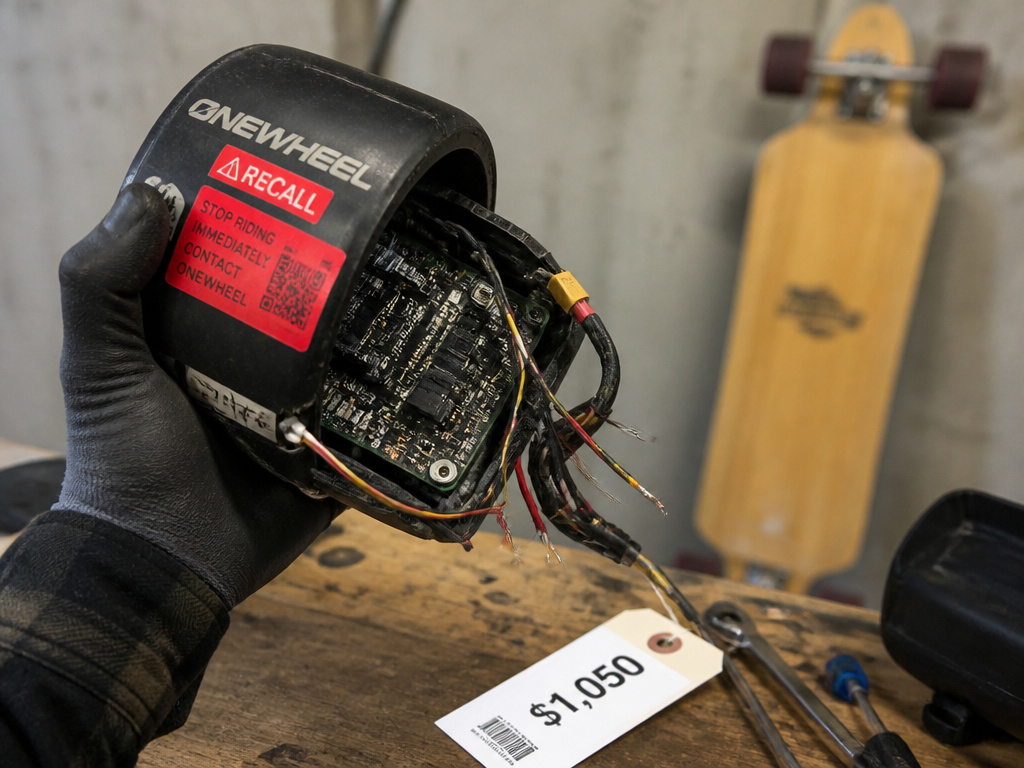
This is not a traditional longboard conversation. Electric skateboards like the Onewheel are a different product category with a different cost structure and, critically, a different risk profile.
According to a Consumer Product Safety Commission (CPSC) investigation, Future Motion’s Onewheel electric skateboards were recalled in October 2023 following four deaths and dozens of serious injuries. The recall covers all models sold from January 2014 through September 2023, with prices ranging from $1,050 to $2,200. The hazard: the board could stop balancing the rider suddenly, leading to ejection and crashes causing traumatic brain injury, paralysis, and broken bones.
Where this goes sideways: Treating an electric skateboard as just a “motorized longboard.” The failure mode, sudden loss of balance at speed, is unique to the self-balancing mechanism. The price reflects complex electronics and batteries, not just deck quality.
This creates a stark price bracket. A premium traditional longboard tops out around $250. A low-end electric longboard starts around $1,050. The jump isn’t for better maple; it’s for a motor, a battery pack, a controller, and firmware, all of which can fail in ways a piece of wood cannot. If you’re looking at an electric board, the cost conversation has to include the manufacturer’s safety record and recall history, not just the specs.
Used Longboards: How Much Should You Really Pay?
The used market is where logic takes a vacation. There’s no standard discount. A 2021 Reddit discussion in r/longboarding suggested sticking to spending at least $150 for a new board with decent craftsmanship, while manufacturers like Flybar and Yocaher sell new completes for as low as $59.99 and $69.99, respectively. This disagreement shapes the used market.
A separate 2025 discussion on r/BeginnerSurfers about used surfboards revealed a telling anecdote: one user stated, “For a used longboard in decent shape, I’d personally be willing to spend $900.” That’s for a surf longboard, not a skate longboard, but it highlights one mindset. Meanwhile, new premium traditional skate longboards from CALI Strong are $249.99, illustrating the disagreement on value.
| Condition | Expected Price vs. New | The Reality Check |
|---|---|---|
| Like New (9/10) | 80-90% of MSRP | Rare. Often sold by someone who bought the wrong style. |
| Good (7/10) | 50-70% of MSRP | Most common. Expect scratched deck, possibly worn bearings. |
| Project (5/10) | 30% or less of MSRP | Needs new wheels, bearings, grip tape. Cost of parts may exceed a new budget board. |
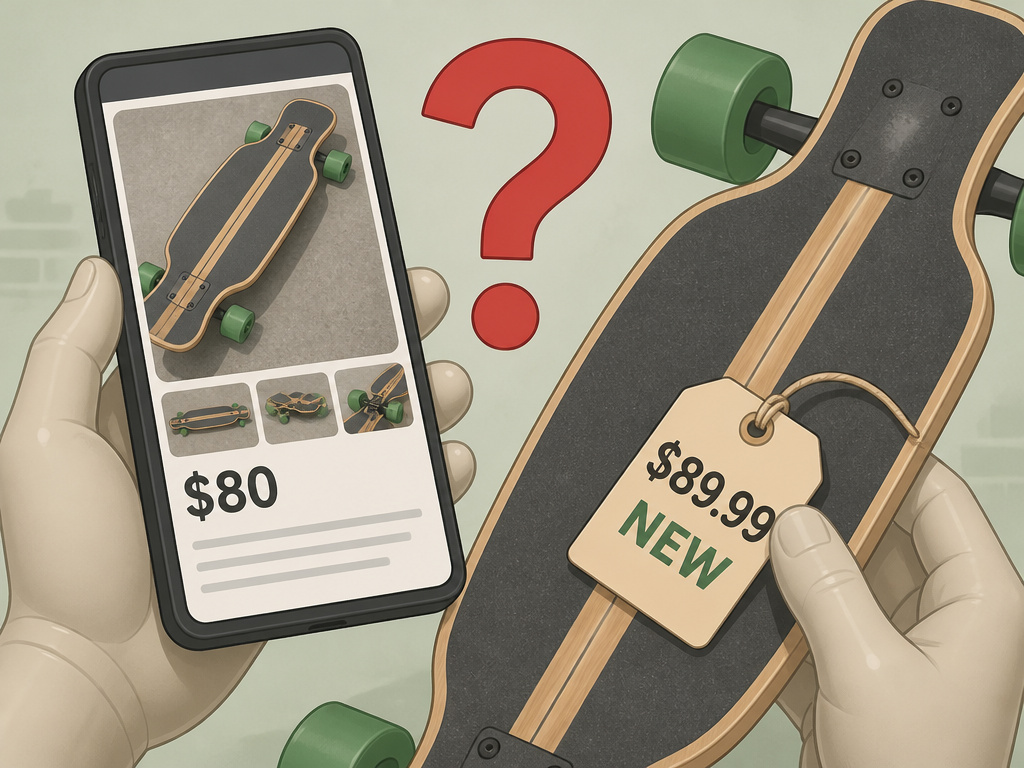
The rule here is simple: know the new price first. If a used Yocaher is listed for $80 and a new one is $89.99, you’re not getting a deal unless it includes upgraded components. The main value of the used market is finding a specific, discontinued deck shape or a high-end brand (like Landyachtz or Loaded) at a discount. For a generic beginner board, the savings are often too small to justify the unknown wear on parts you can’t inspect thoroughly online.
I tell students to budget for new wheels and bearings when buying used. You can’t see grit inside a bearing race, and hardened urethane loses its bounce over time. A $50 used board that needs $40 in parts is a $90 board with a mystery deck.
Is a Longboard Easier Than a Skateboard? (And Does It Cost More?)
This is a common beginner question that ties directly to value. A longboard is generally more stable and easier to ride in a straight line than a traditional popsicle-stick skateboard due to its longer wheelbase, larger wheels, and often lower deck profile.
That ease comes at a slight cost premium. Comparing average prices, a quality complete skateboard often starts around $80-$100. A comparable quality complete longboard starts in the same $80-$100 range, as seen with the Yocaher and Flybar models. The price difference for a beginner isn’t in the board type; it’s in the component quality within that type. The real cost difference appears in the specialized high-end, where premium longboard decks and long-distance setups can exceed the cost of a pro skateboard setup.
When you look at the skateboards vs longboards debate, the choice centers on which tool matches the job. Paying $100 for a skateboard to cruise campus is a mismatch. Paying $250 for a specialized downhill longboard to learn your first push is overkill. The right tool for the job is always the best value.
The Hidden Costs: What “Complete” Doesn’t Include
The price on a complete longboard is the entry fee. The cost of ownership starts the moment you step on it.
Protective Gear is Non-Negotiable
A helmet and a set of wrist guards, knee pads, and elbow pads are essential and add to the total cost. For a beginner, this gear is more important than the ABEC rating of your bearings. Wrist guards, in particular, are the single best investment for preventing the most common serious injury, a broken wrist from an instinctive out-stretched hand catch during a fall. This adds a minimum of $100 to your starting budget.
Maintenance and Replacement Parts
Wheels and bearings are consumables. Soft cruising wheels (78A-82A) will wear down and eventually need replacement. Bearings will get dirty and slow down. A basic set of tools for adjusting trucks and replacing hardware is also a necessary investment. If you ride regularly, budget for new wheels and bearings within your first year or two. Learning about the cost and process to ship a longboard for repair or to a buyer is another potential future consideration.
The part nobody mentions: The first upgrade most riders need isn’t on the board. It’s the skate tool to tighten the kingpin nut on the trucks after the bushings break in. That first wobble at speed isn’t a defect; it’s a setup step. A basic skate tool fixes it.
This is why asking “is a longboard worth it” is the right question. The value lies in the miles you roll, the skills you learn, and the community you find, not in the sticker price. A $60 board that gets ridden daily for two years is a phenomenal value. A $250 board that collects dust in a garage is a waste at any price.
What do different longboard brands cost?
Brands like Landyachtz, Sector 9, and Arbor are well-known in the longboarding world, but this analysis focuses on specific models from Flybar, CALI Strong, and Yocaher. However, looking at other brands shows a clear price range. You can find complete boards from brands like Flybar and Yocaher starting around $60 to $70. These are often general-purpose boards. Moving up, brands like CALI Strong offer premium models around $250, which feature specialized components for enhanced performance. The difference in cost typically reflects the deck construction, wheel specifications, and bearing rating, along with a deck engineered for a specific riding style rather than just general use.
What are the different types of longboards?
Longboards are designed for specific styles. Cruisers are for relaxed riding, often featuring kicktails for maneuverability and softer wheels for a smooth ride. Downhill boards are built for stability at high speeds, with features like a dropped deck for a lower center of gravity and stiffer wheels for grip. Freeride boards are versatile, made for sliding and technical turns, usually with a symmetrical shape and medium-concave for control. Dancer boards are extra long and flexible to accommodate footwork and cross-stepping. Your choice should be based on how and where you plan to ride most often.
Frequently Asked Questions
How much does a decent longboard cost?
Decent beginner longboard that will be safe, durable, and fun for casual riding costs between $80 and $150. In this range, you’ll find models like the Yocaher Freestyle Geometrix ($89.99) or the Flybar 36″ Pintail Cruiser ($99.99), which use 7-9 ply maple decks, decent trucks, and appropriate wheels for cruising and basic carving.
Is a longboard easier than a skateboard?
For a pure beginner, a longboard is easier to start riding because of its inherent stability. The longer wheelbase (distance between trucks) prevents speed wobbles at low speeds, and the larger, softer wheels roll over sidewalk cracks and pebbles that would stop a small skateboard wheel. This makes learning to push, balance, and turn less frustrating initially.
How much does a used longboard cost?
There is no standard discount. A used longboard in good condition typically sells for 50% to 70% of its original new price. However, since many new budget completes are priced under $100, a used one might only be $20-$40 cheaper. The value in buying used is often finding a higher-tier brand (e.g., Landyachtz, Loaded) at a significant discount, not saving money on an entry-level model.
What is a good budget longboard?
Good budget longboard provides a stable, complete setup from a known brand for under $100. The Flybar 40.5″ Drop-Through at $59.99 is a legitimate example, with an 8-ply maple deck and ABEC 9 bearings. The Yocaher Kicktail Blank at $69.99 is another. At this price, expect functional components suited for light cruising, but plan for potential bushing or bearing upgrades as you progress.
The Bottom Line
Start with your actual use case. If you want to cruise around campus or your neighborhood, a $60-$100 complete from Flybar or Yocaher is a perfectly reasonable starting point. Budget another $100+ for a helmet and pads, this isn’t optional.
If you already know you want to push for distance, learn to slide, or tackle hills, stepping up to the $150-$250 range gets you a board designed for that job from the ground up, with components that will keep up with your progression. The CALI Strong Trojan at $249.99 is a benchmark in that category.
And if electric propulsion is the goal, pause. The price starts above $1,000, but the October 2023 CPSC recall of Onewheel boards is a stark reminder that the cost of a failure in that category isn’t just financial. Do your homework on the manufacturer’s safety record before you ever consider the price tag.
The real answer to “how much is a longboard” is another question: what do you want it to do? Match the tool to the job, and the price becomes a feature, not a mystery.
