K2 Hanford Snowboard Boots Review: Who Are They Best For?
This post contains affiliate links. As an Amazon Associate, we earn from qualifying purchases.
The K2 Hanford is a 7/10 flex, dual-zone BOA snowboard boot built for intermediate and advanced riders who want comfort and precise fit adjustment. It’s softer in feel than its K2 Maysis sibling despite sharing the same flex rating, and it fits snug with a slightly wider toe box, a good match for all-mountain versatility, though its heel hold can be average.
The flex number tells you something, but it doesn’t tell you everything. A boot rated 7/10 by one brand can ride like a 6 or an 8 in another, and the Hanford is the perfect example of that discrepancy. You need to know what that feels like underfoot, what happens after 20 days of riding, and where the design might rub you the wrong way. For a detailed breakdown, see the K2 Hanford snowboard boots review.
This review breaks down the Hanford’s specs, the real-world flex, and the dual-zone BOA system. We’ll compare it directly to the K2 Maysis, cover sizing advice to avoid a sloppy fit, and outline who this boot works for, and who should look elsewhere.
Key Takeaways
- The Hanford’s 7/10 flex rating feels softer than the K2 Maysis, which is also rated 7/10, the number is a starting point, not the whole story.
- Its dual-zone BOA system tightens the top and bottom of the boot independently, a step up from the single-zone system on the Maysis.
- Consider going down a half size from your street shoe; the Intuition liner packs out noticeably within the first 10-15 days of riding.
- The boot is built for intermediate and advanced all-mountain riders who value comfort and quick adjustments over maximum stiffness and locked-in heel hold.
- An optional wide version exists for the 2026 model year, addressing a common request for more room in the forefoot.
The Flex Rating: What 7/10 Actually Feels Like
The manufacturer labels the Hanford a 7 out of 10 on the stiffness scale. So does the K2 Maysis. Put them side by side, and the Hanford has a noticeably softer, more forgiving flex.
A field reviewer on evo noted the Hanford has “a softer flex to them than other boots advertised at a similar stiffness (K2 Maysis, Ride Lasso, 32 TM2),” despite the shared 7/10 rating. This highlights the subjective nature of flex numbers.
That difference matters when you’re choosing between models, a key point in any K2 Hanford snowboard boots review. The Hanford’s softer feel makes it more versatile for a mixed day, comfortable on groomers, forgiving in the park, and less punishing on your legs. The Maysis, while sharing the rating, transmits board feedback more directly and feels more precise at high speed. This isn’t about one being better. It’s about matching the boot’s character to your riding style.
If you’re progressing from a beginner boot and want more response without a brick-like feel, the Hanford’s flex is a logical step, a conclusion often found in a K2 Hanford snowboard boots review. If you’re charging hard and want every bit of energy transfer, you might find its limits.
The Dual-Zone BOA System Explained
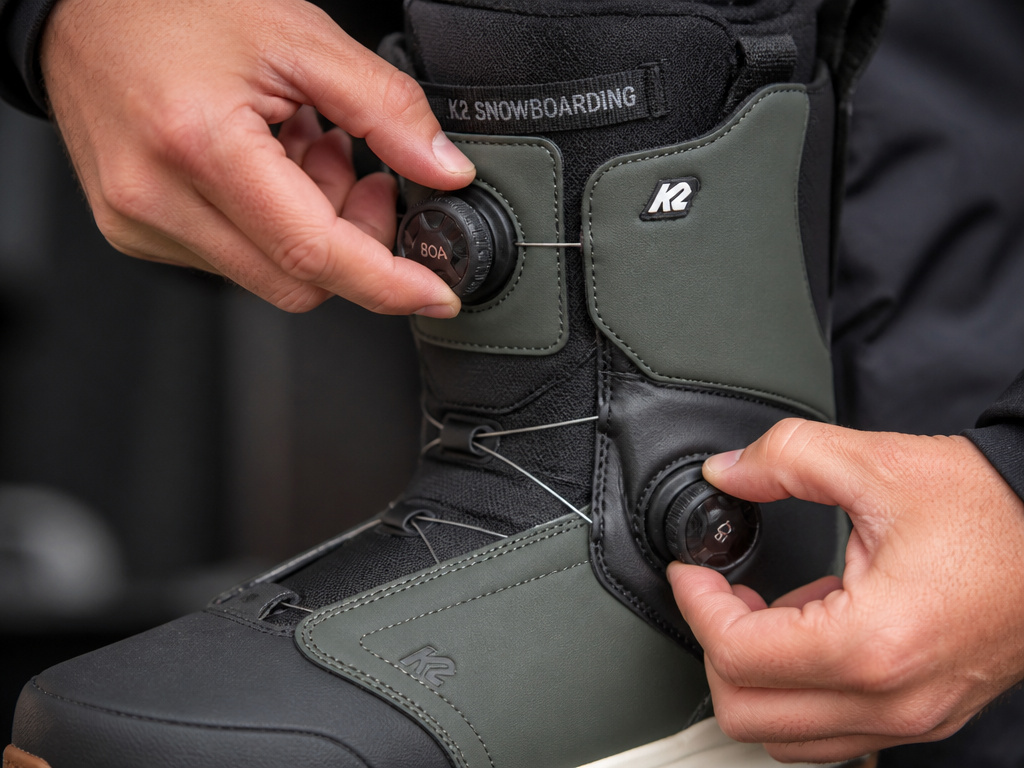
The Hanford uses K2’s H4/M3 Zonal BOA Fit System. That means two separate dials: one on the front controls the top half of the outer laces, and one on the side controls the bottom half.
| BOA Zone | Controls | Best For | Risk If Misadjusted |
|---|---|---|---|
| Front (Top) Dial | Laces over the ankle and lower calf | Securing heel hold and ankle support | Over-tightening cuts off circulation, causing foot fatigue. |
| Side (Bottom) Dial | Laces across the instep and forefoot | Customizing tightness over the bridge of the foot | Too loose reduces board feel; too tight creates a pressure point on the top of the foot. |
| Internal Cinch | Liner tightness around ankle and calf | Fine-tuning the liner’s hold independent of the shell | Skipping this step lets your heel swim, reducing response time. |
The internal liner has its own simple cinch system. You pull it snug around your ankle before you even touch the BOA dials. This two-layer approach, liner first, shell second, is what gives you a truly customized fit. You can crank the lower zone for a firm stance while keeping the upper zone relaxed for comfort on the lift. That flexibility is the system’s main advantage over traditional laces or a single BOA dial.
The H4 dial itself is designed to eject on severe impact, a safety feature to prevent damage. Separately, the evo review warns the BOA system can break if put under too much pressure. Don’t treat the dials like a vice. A firm click is enough.
Fit and Sizing: The Half-Size Rule
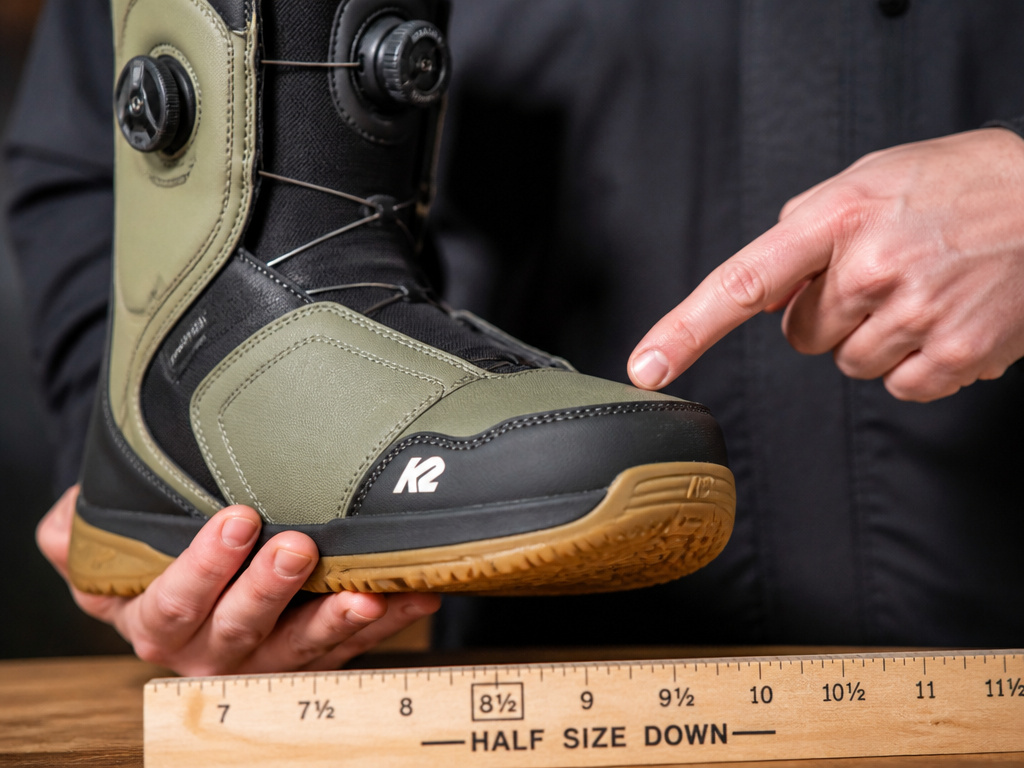
Some sources note K2 boots, including the Hanford, have a slightly wider toe box, while others report a narrower fit; reputation varies. The Hanford continues this trend, offering a slightly wider forefoot than many other brands. For riders with wider feet, this is a relief. For those with narrow feet, it can mean extra volume that needs to be filled.
Several reviewers suggest sizing down a half size, though fitting advice varies. Not a full size, but a half size from your typical street shoe. The reason is pack-out. The heat-moldable Intuition Control Foam 3D Liner compresses and conforms to your foot. What feels perfectly snug on day one can feel comfortably loose by day ten.
Where this goes sideways: Buying your street shoe size. The liner packs out noticeably within the first days of riding. Your heel starts to lift, your toes stop touching the front, and you lose the precise connection to your board that makes the boot responsive.
A reviewer on evo who wore a size 9 said, “Looking back, I might have gone down a half size just to account for the boot packing out.” A YouTube reviewer for the K2 Maysis stated plainly that “K2 boots run a half size big.” The message is consistent. If you’re between sizes, go smaller.
For the 2026 model year, K2 is listing a “Wide” version of the Hanford. This is a direct response to market demand and confirms that the standard width, while roomier than some, still isn’t enough for truly wide feet. If you’ve struggled with pinching in other boots, wait for the wide or look at brands like DC and Nitro, which are often cited as better for wide-footed riders.
Comfort and Common Pressure Points
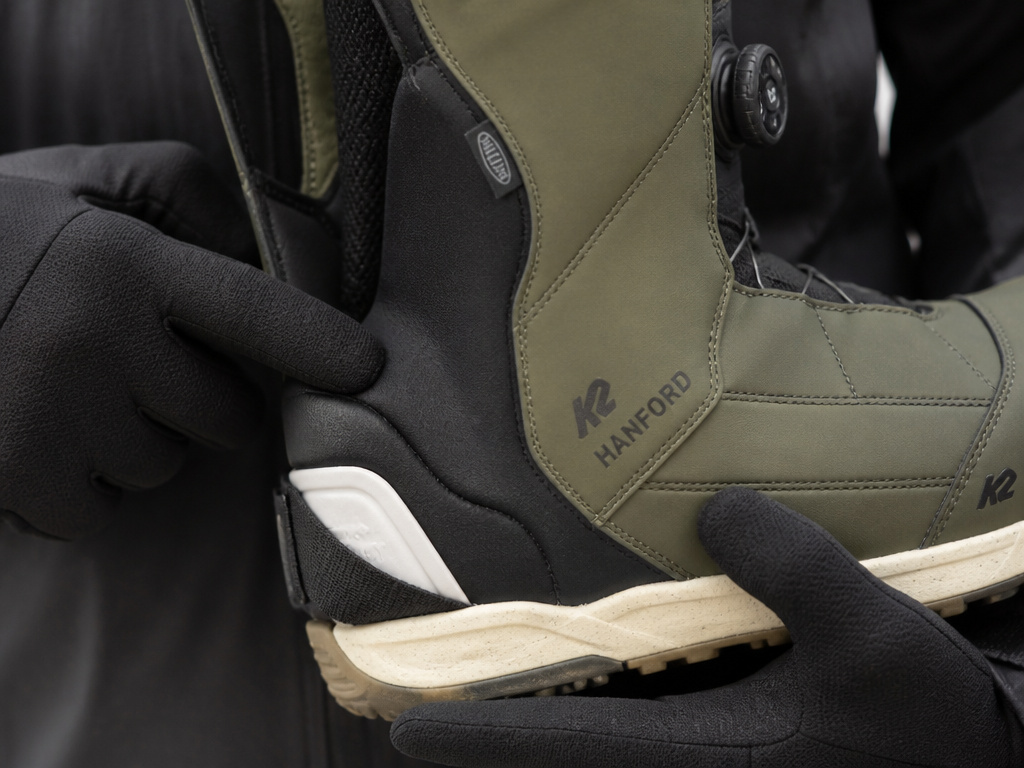
Out of the box, the Hanford gets high marks for comfort. The Intuition liner is a premium feature, and it shows. There’s no brutal break-in period. Your first day on the mountain should be free of major hot spots.
However, comfort has layers. The overall wrap might be great, but localized pressure can still happen. A forum user reported a specific issue with a different K2 boot, the Maysis, where “this sewn spot on the edge of the inner part of the liner… Digs into the leg bone above my ankle.” While not a Hanford-specific report, it highlights that individual anatomy and small liner details can create problems no amount of heat-molding fully solves.
The most common critique of the Hanford’s comfort relates to heel hold. A Reddit user summed it up: “they’re a comfy boot, heel hold isn’t the best, but it’s not the worst either.” The roomier toe box and overall volume can leave those with narrow heels wanting a tighter lock. This is where the internal liner cinch and sizing down a half size are critical. If you have a narrow heel, you might need to add aftermarket heel pads like J-bars or consider a brand known for a narrower fit, like Salomon.
Who Are the K2 Hanford Boots Best For?
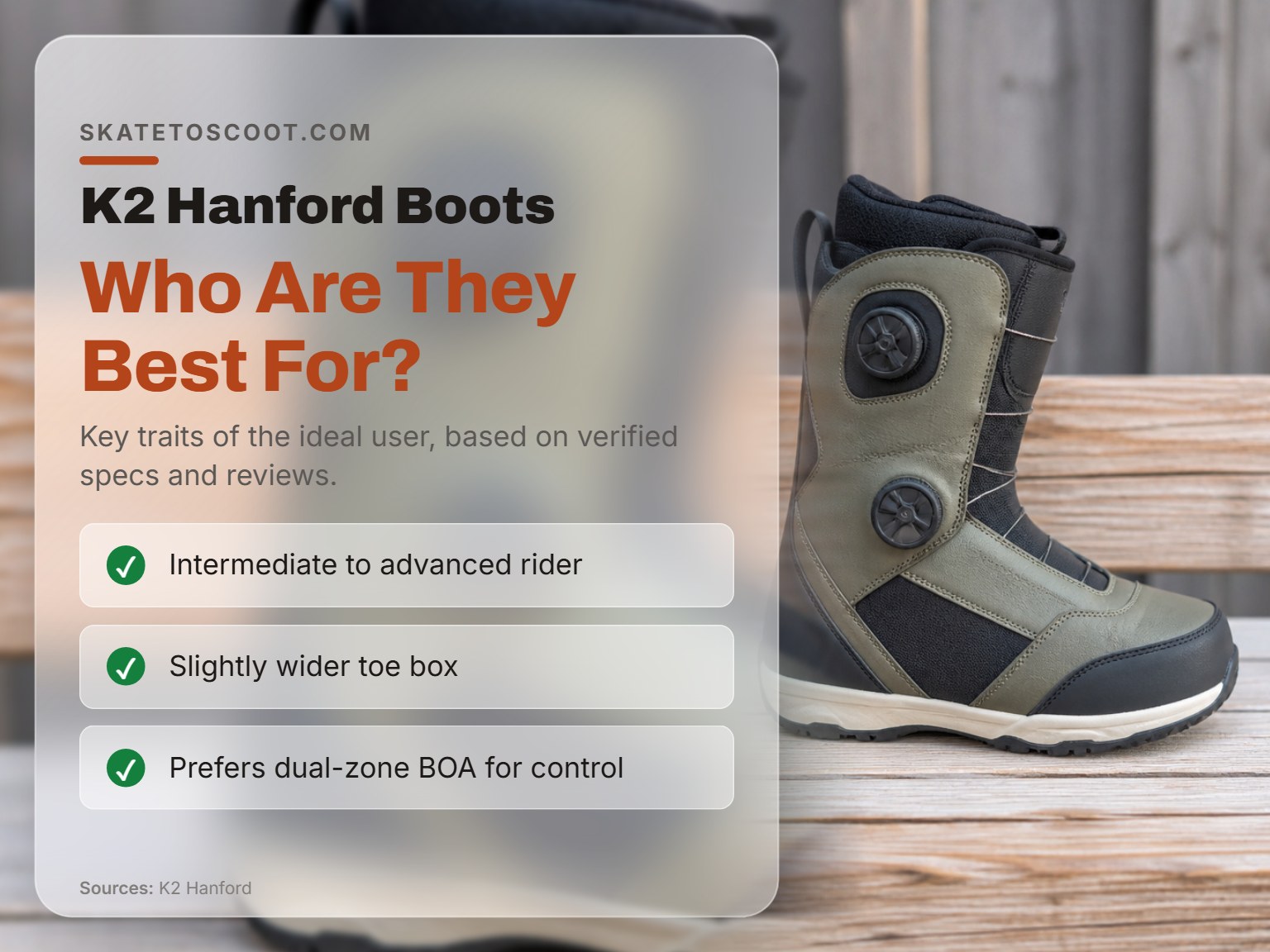
This isn’t a boot for everyone. Its design choices create a clear ideal user.
Choose the Hanford if:
- You’re an intermediate to advanced rider who spends days all over the mountain.
- You value comfort and quick adjustments over an ultra-stiff, race-like feel.
- You have a medium to slightly wide forefoot and a relatively standard heel.
- You like the convenience of BOA but want more control than a single dial offers.
Look elsewhere if:
- You’re a beginner (softer beginner-specific boots will be more forgiving).
- You’re an expert freerider or racer demanding absolute maximum stiffness (look at the K2 Maysis).
- You have a very narrow foot from heel to toe (consider Salomon or Nitro’s narrower models).
- You hate the feel of BOA systems and prefer the micro-adjustability of traditional laces.
The Hanford excels as a one-boot quiver for the rider who doesn’t want to specialize. It’s playful enough for park laps, supportive enough for carving groomers, and comfortable enough for all-day resort riding. It won’t be the stiffest or most responsive boot in the lodge, but it might be the one that leaves your feet feeling the best after a full day of riding.
Direct Comparison: K2 Hanford vs. K2 Maysis
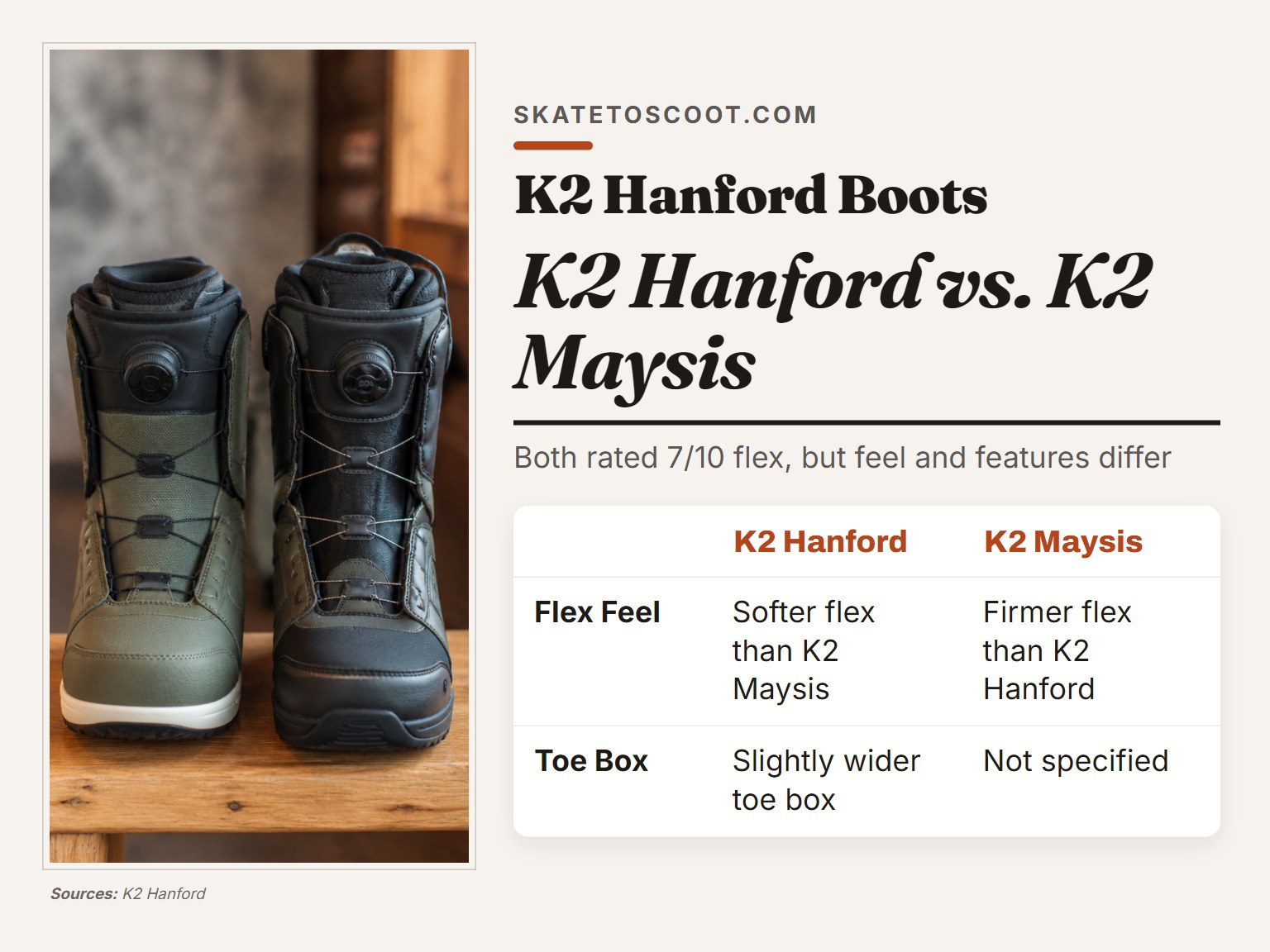
Since these two boots are often cross-shopped, a direct comparison is useful. Both are rated 7/10 flex, but they achieve it differently.
| Feature | K2 Hanford | K2 Maysis |
|---|---|---|
| BOA System | Dual-Zone (H4/M3) | Single-Zone BOA + internal liner cinch |
| Flex Feel | Softer, more forgiving | Firmer, more direct & responsive |
| Fit Profile | Slightly wider toe box, average heel hold | More uniform, snugger heel hold |
| Best For | All-mountain comfort & versatility | All-mountain performance & precision |
| Liner | Intuition Control Foam 3D Liner | Intuition Pro Foam 3D Liner |
The choice often comes down to your priority. The Hanford’s dual-zone BOA offers superior fit customization on the fly. The Maysis’s single BOA is simpler but provides less isolated control. If you constantly adjust your tightness between runs, the Hanford wins. If you set it and forget it, the Maysis is fine.
More importantly, trust your feel over the number. If you like a boot that bends with you, the Hanford is your pick. If you want a tool that resists and pushes back, the Maysis is the better boot for that job among K2 models. For those exploring other stiff, all-mountain options, our guide to the best all-mountain boots provides a broader view.
Durability, Outsoles, and the Long Term
The Hanford’s outsole uses K2’s “This Grips!™” dual-rubber compound with Harshmellow™ foam pods. The goal is vibration damping and grip on hardpack and lodge floors. It’s a solid, modern outsole that should hold up for several seasons of resort riding. It’s not the ultra-hard-wearing Vibram rubber found on some higher-end boots.
The BOA system’s durability is a common question. The components are high-quality, and the eject-on-impact design is a smart fail-safe. The real risk isn’t the dial breaking randomly; it’s the cables or guides wearing over many, many days of use. BOA offers a lifetime warranty and will send replacement parts, but it’s something to be aware of if you ride 100+ days a year. For most recreational riders, it’s a non-issue.
The Intuition liner is a durability highlight. It retains its shape and cushioning far longer than standard foam liners. It’s also heat-moldable, which means you can refresh the custom fit if your foot changes or you pass the boots to a friend. This extends the boot’s usable life significantly.
Frequently Asked Questions
Are K2 snowboarding boots good?
Yes, K2 makes well-regarded snowboard boots known for comfort and innovative features like their BOA systems and Intuition liners. Models like the Hanford and K2 Maysis are staples in the all-mountain category. As with any brand, fit is personal, so trying them on is crucial.
Do K2 snowboard boots fit well?
They fit well for many people, particularly those with medium to slightly wide forefeet. K2 boots, including the Hanford, are often noted for a roomier toe box. However, those with very narrow feet or heels might find better luck with brands like Salomon. Always follow the half-size-down advice for K2.
Is K2 snowboard a good brand?
K2 is a reputable, long-standing brand in snowboarding. They produce a full range of equipment, from boards to boots to bindings, and are generally considered a safe, quality choice. Their boots are consistently among the best snowboard boots for intermediate riders.
Which snowboard boots are better, K2 Maysis or Ride Lasso?
This depends on your foot shape and flex preference. The K2 Maysis is often compared to the Ride Lasso as similarly stiff, all-mountain boots. The Maysis tends to have a roomier fit, while the Lasso can run narrower. The Lasso may feel slightly more responsive, but the Maysis has the edge in overall comfort for many riders. You really need to try both.
The Bottom Line
The K2 Hanford is a confident choice for the progressing rider who has outgrown beginner boots but isn’t chasing expert-level stiffness. Its real strength is the marriage of a comfortable, adaptable fit (thanks to the dual-zone BOA) with a versatile, forgiving flex.
Commit to the half-size-down rule. That single decision is the difference between a boot that feels dialed for two seasons and one that feels sloppy after a month. If your heel still lifts after sizing down a half size and cinching the internal harness, these might not be the boots for your foot shape.
For the majority of all-mountain riders looking for a reliable, comfortable, and easy-to-use boot, the Hanford delivers. It won’t shock you with performance, but it also won’t let you down. It’s the definition of a solid, do-everything resort boot. Check availability on the latest model to see if the new wide version solves the one common fit complaint.
