K2 Snowboard Boots Review: Fit, Flex and Which Model Wins
This post contains affiliate links. As an Amazon Associate, we earn from qualifying purchases.
K2 snowboard boots are a strong choice for riders with average-to-wide feet, offering a reputation for comfort and solid heel hold across models like the Maysis, Boundary, and Trance. The right pick depends on matching your foot shape, flex preference (ranging from Medium 6/10 to Stiff 8/10), and budget, with a clear trade-off between premium materials and long-term durability under heavy use.
That reputation for comfort is built on a specific fit philosophy that K2 spells out in their official guide, which explains why so many riders click with the brand on day one. But that initial comfort also sets expectations, for how long the boots should last, how they’ll handle different bindings, and what happens when the warranty clock runs out, a point where K2’s warranty policy and user reports on premium models can diverge. A K2 snowboard boots review should explore these long-term performance questions.
What follows is a look past the spec sheets. We’ll break down K2’s fit advice, compare their popular models head-to-head, and dig into the real-world reports on where these boots shine and where they’ve let riders down. By the end, you’ll know exactly which K2 boot, if any, matches your foot and your season.
Key Takeaways
- K2’s official fit guide says your toes should lightly brush the front when standing straight and pull back when flexing forward, with minimal heel lift, a slightly snug initial fit is expected as liners pack out.
- If you’re between sizes, K2 recommends you size down, and always try boots on with the specific snowboarding socks you plan to wear.
- The brand’s one-year warranty covers defects like delaminating soles and faulty stitching, but user reports on the Aspect show claims being denied for sole detachment occurring just past the one-year mark, highlighting a potential durability gap for premium models.
- For most all-mountain riders, the K2 Boundary offers the best balance of double BOA convenience, a Medium-Stiff flex, and a lower price point, while the K2 Trance is a top pick for advanced female riders seeking a stiff, precise fit.
- Premium models like the K2 Aspect with full-grain leather and Vibram soles are built for big-mountain abuse, but require careful binding compatibility checks and carry a higher cost that may not align with the one-year warranty coverage for heavy users.
How Do K2 Snowboard Boots Fit?
K2’s own fit advice is refreshingly specific. According to their official guide, when you stand straight in the boot, your toes should lightly brush the front. When you flex forward into a riding stance, those toes should pull back slightly. Your heel should stay planted with minimal lift.
That’s the textbook answer. In practice, it means a new pair of K2s should feel snug, not crushingly tight. The “light brush” is a tactile cue, not a shove. You should feel the liner hugging your arch and the sides of your foot without sharp pressure points.
The part nobody mentions: This “snug but comfortable” fit is calibrated for the liner’s pack-out. K2 explicitly notes that liners pack out with use, so boots will feel slightly looser after several days on snow. Buying for immediate, perfect comfort often means buying a size that will be too big by day ten.
I’ve seen this confuse more than a few students. They’d try on a boot, feel their toes just touching the end, and worry it was too small. But that’s the sweet spot K2 is aiming for. A Reddit user captured an ambiguous feel, saying their toes in a size 9 “weren’t cramped but not quite comfortable either,” illustrating the disagreement some users have with K2’s guidance that a new boot should feel snug.
Where this goes sideways: Ignoring K2’s sock advice. Their guide insists you wear synthetic or merino wool snowboarding socks when trying on boots. A thick cotton sock adds a false layer of volume; when it compresses, your foot swims. Always use the real gear for the real fit.
Sizing Rule: When in Doubt, Size Down
K2’s sizing directive is clear: if you’re between sizes, size down. This aligns with the pack-out principle. A half-size too large might feel fine in the shop, but after 20 days of riding, your foot will be sliding around, killing response and causing blisters. It’s better to endure a day or two of slight pressure than a whole season of slop.
K2 Snowboard Boot Flex and Performance
Flex ratings tell you how much force it takes to bend the boot forward. K2 uses a 1-10 scale, often paired with descriptive labels like Medium or Stiff. But numbers from a manufacturer can be a starting point, not the final word. Independent tests sometimes feel different.
| K2 Model | Rated Flex (K2) | Tested Flex Feel | Best For |
|---|---|---|---|
| Boundary | Medium (6/10) | Medium-Stiff (7/10) | All-mountain riders wanting a responsive, balanced boot. |
| Trance | Medium-Stiff (7/10) | Stiff (7.5/10) | Advanced/expert female riders charging hard, prioritizing precision. |
| Maysis | Medium-Stiff (7/10) | Medium-Stiff (7/10) | All-mountain riders seeking a proven, comfortable workhorse. |
| Orton | Stiff (8/10) | Medium-Stiff (7/10) | Strong riders wanting high-end, dampened power for carving. |
| Aspect | Stiff (Big-Mountain) | Very Stiff | Backcountry/splitboard missions requiring hike-to-ride durability. |
Notice the discrepancies? The K2 Orton is rated an 8/10 Stiff, but a reviewer felt it performed more like a 7/10 Medium-Stiff. The K2 Trance, a women’s model, tested stiffer than its 7/10 rating. This serves as a reminder that your strength, weight, and riding style act as a filter on these numbers. A 6/10 flex feels vastly different to a 200lb expert versus a 130lb intermediate.
Why the flex feel matters: A boot that’s too stiff for your style fights you at slow speeds, making quick turns in trees or moguls exhausting. A boot that’s too soft for aggressive carving will feel vague and unsupportive at high speed. The K2 Boundary hits a noted sweet spot, offering what one tester called “a balance between carving and slow speed turning performance.” That’s the hallmark of a versatile, all-mountain boot.
K2 Snowboard Boot Models Compared
You don’t just buy a “K2 boot.” You buy a specific model designed for a type of riding, a key distinction in any K2 snowboard boots review. Here’s where the rubber meets the snow, or in the case of the Aspect, the Vibram meets the bootpack.
The All-Mountain Workhorses: Boundary & Maysis
The K2 Boundary and K2 Maysis are the core of K2’s lineup. Think of them as the reliable daily drivers.
The Boundary (MSRP $349) is the modern successor, built with a dual BOA system for independent upper/lower tightening. It was praised in a review for its excellent heel hold and carving balance. At 960g per boot, it’s lighter than the average men’s boot.
The K2 Maysis (MSRP $379) is the seasoned veteran. It also carries a Medium-Stiff 7/10 flex. Its legacy means a massive amount of user feedback. The consensus from any K2 snowboard boots review? Incredibly comfortable, with a heel hold system people love. The caveat, straight from a Reddit rider: “You NEED insoles if you ride more than 20 or so days a year. The K2 Maysis insoles are paper thin.” This is a common mod for serious riders on any brand.
Which one wins? For most riders wanting modern convenience, the Boundary and its dual BOA is the pick. For those who prefer a proven design and don’t mind swapping insoles, the Maysis remains a top contender. You can explore other top all-mountain boots in our dedicated guide.
The Performance Chargers: Trance & Orton
Step up in stiffness and price, and you find the K2 Trance and K2 Orton. These are for riders who communicate with their board in shouts, not whispers.
The K2 Trance (MSRP $409) is a women’s-specific performance boot. But that comfort wraps a very stiff package, it tested at a 7.5/10 Stiff feel. The takeaway: it’s for advanced riders who want a stiff boot but have struggled with pressure points in other brands.
The K2 Orton (MSRP $489) is the men’s premium offering. It features a dual BOA system and a damper, more supportive construction. Weighing 1120g, it’s a substantial boot. If you’re considering this tier, also look at our review of the K2 Hanford, another advanced model.
The Big-Mountain Specialist: Aspect
The K2 Aspect (MSRP was $499.95) is a different beast. It’s built for backcountry excursions and splitboarding, featuring a full-grain leather upper, a Vibram Mountaineer outsole for hiking, and a heel welt for crampon compatibility.
Specific warning with consequence: User reports on the Aspect reveal a critical binding compatibility issue. One owner had to “grind the rear lip” of the boot for it to function with their cinch bindings. This modification led to the binding eating through the leather and stitches, accelerating failure. Always test fit your specific bindings with a boot this specialized.
The Aspect’s story is a case study in expectations. It’s a premium boot for extreme use. Yet, one user reported failures, including sole separation, after about 200 days of use over three seasons. Another reported interior wear-through, sole detachment, and BOA casing detachment in a season. In one user’s report, when the sole detached just past the one-year mark, K2’s warranty was not honored. For a boot at this price, that’s a stark reality check about the limits of the one-year warranty coverage.
Durability and the Warranty Reality
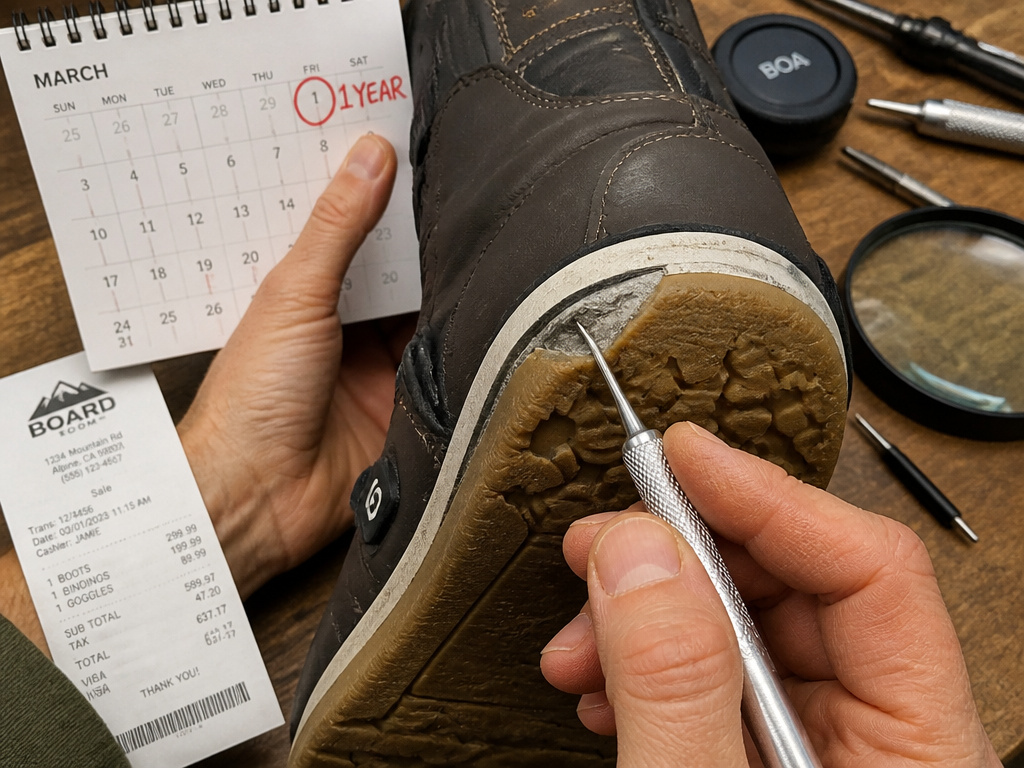
K2 warranties its snowboard boots against defects in materials and workmanship for one year from the original purchase date. The policy specifically covers delaminating soles and damage to stitching, zippers, or Velcro not from normal wear and tear. It explicitly excludes normal wear and tear, like boot laces.
That’s the contract. The reality, as seen with the Aspect reports, is that catastrophic failures can happen just outside that window. A boot failing just past the one-year warranty period after extensive use is arguably a durability issue, not a defect. But for the buyer who spent nearly $500, that distinction feels academic.
| Scenario | Likely Warranty Outcome | Rider Takeaway |
|---|---|---|
| Sole delamination at 11 months | Covered. | File the claim with your original receipt. |
| Torn stitching from impact or abnormal wear | May not be covered if deemed misuse/abuse or normal wear and tear. | Inspect your line for hazards. |
| Damage occurring after 14 months of use | Not covered (outside 1-year period). | Premium boots demand a higher durability expectation. |
| BOA dial breaking | BOA components are backed by their own lifetime warranty; contact BOA directly. | BOA systems have their own lifetime warranty; contact BOA directly as well. |
This disconnect is the single biggest complaint in user forums. Many riders get multiple seasons from models like the Boundary or Maysis, so you should view the one-year warranty as a baseline defect guarantee, not a promise of longevity. How long a boot lasts depends on how many days you ride, how hard you ride, and a bit of luck.
For park rats or those just starting out, more flexible and affordable beginner boots might be a smarter first investment, saving the premium purchase for when your riding style and frequency solidify.
Lacing Systems: BOA, Traditional, and Hybrid
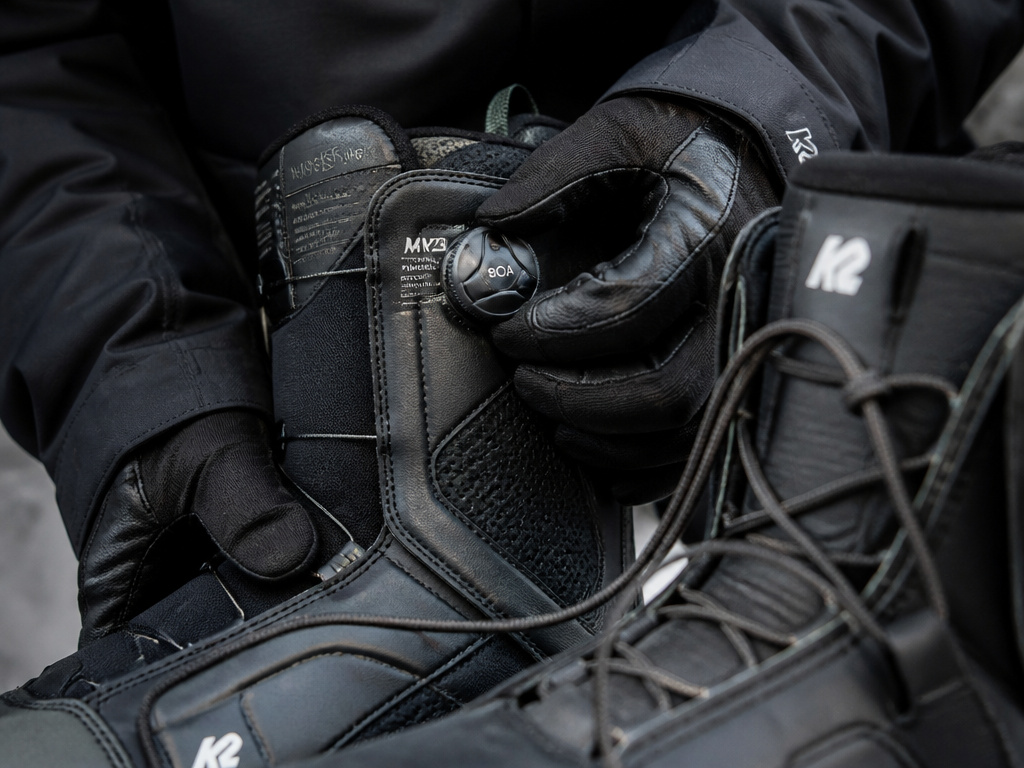
K2 offers the full spectrum. Traditional laces offer the most customizable, zone-by-zone tightness but are a hassle with gloves on. Quick-pull laces are a solid middle ground.
BOA is where K2 invests heavily. The system uses a dial and steel cables to provide even, repeatable tension. Single BOA models, like on some boots for beginners, tighten the whole boot with one dial. Dual BOA systems, like on the Boundary and Orton, separate the upper (shin/calf) zone from the lower (foot) zone, letting you fine-tune fit and circulation.
The latest evolution is systems like the Conda, found on the Aspect, which adds a dedicated BOA for heel retention. The advantage is micro-adjustment on the fly; the potential drawback is more mechanical parts that can fail (though BOA components are famously reliable and backed by their own lifetime warranty).
If you love the convenience of a dial, our guides to the best Boa snowboard boots and the best double Boa snowboard boots can help you compare across brands.
How is the shock absorption in K2 boots?
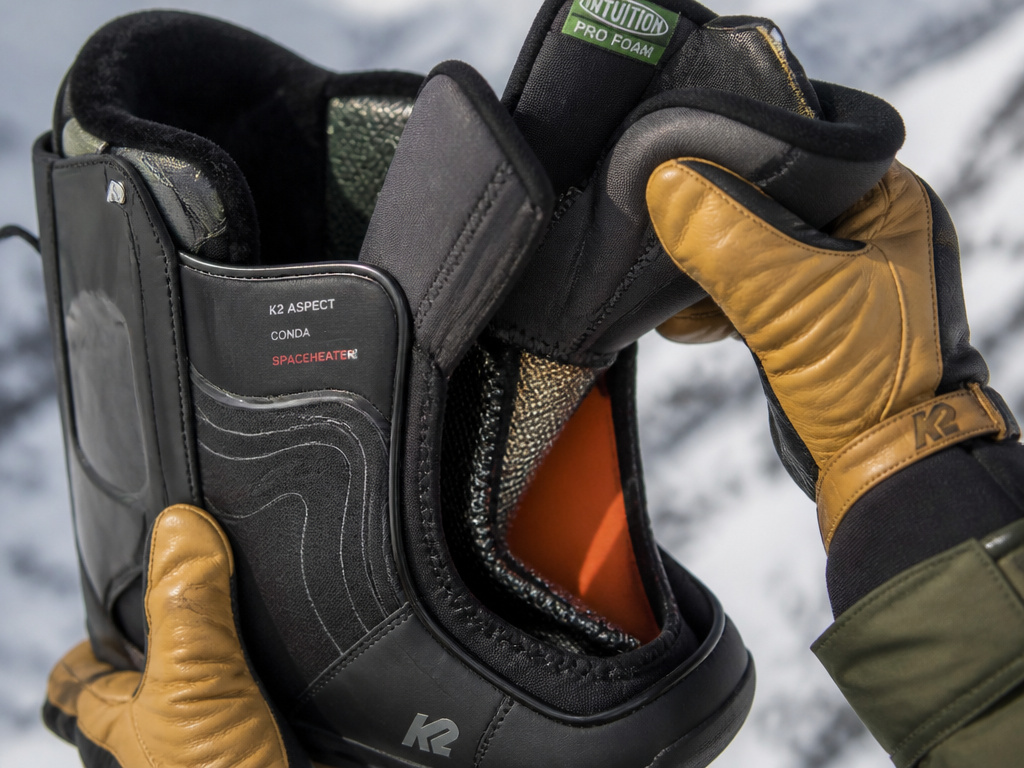
K2’s approach to cushioning varies by model, with some boots receiving specific praise for their liner systems. The high-end Aspect, for example, features an Intuition Pro Foam Liner with SpaceHeater material. Other models rely on their internal construction to manage vibration and shock from variable terrain. User reports on the Aspect, however, suggest that structural integrity can degrade with heavy use, potentially affecting long-term comfort. For a softer or more forgiving ride, look for boots with a lower flex rating, as a stiffer boot will naturally transmit more ground feel.
Frequently Asked Questions
Are K2 snowboard boots good?
Yes, K2 snowboard boots are generally considered good, particularly for riders with average to wide feet who prioritize comfort and heel hold. Models like the Maysis and Boundary have loyal followings for their out-of-the-box comfort and all-mountain performance. As with any brand, the “goodness” depends on matching the specific model’s flex and features to your riding style and foot shape.
Is Burton or K2 better?
Neither is universally better. Burton often has a narrower, more performance-oriented fit, while K2 is famous for accommodating wider feet. Burton’s focus on integrated binding compatibility (EST) is a major plus for riders invested in their ecosystem. K2 often wins on initial comfort and value. The best brand is the one whose boots fit your feet correctly and match your riding needs.
Do K2 snowboard boots fit well?
K2 snowboard boots are renowned for fitting well, especially for riders with wider or higher-volume feet. Their fit guidance, toes lightly brushing the front when standing, is designed to account for liner pack-out, leading to a secure fit that breaks in to comfort. You must try them on with proper snowboarding socks to assess the fit accurately.
Is K2 snowboard a good brand?
K2 is a well-established and reputable brand in snowboarding. They produce a wide range of well-regarded equipment, from boards to boots to bindings. Their boots are a cornerstone of their offering, known for reliable performance and a comfort-focused fit. They sponsor top athletes and invest in boot technology, making them a solid and legitimate choice in the market.
Before You Go
Choosing a K2 boot boils down to a simple filter: match the model’s intention to your own.
For the majority of riders hitting resort groomers and all-mountain terrain, the K2 Boundary is the default answer. Its dual BOA offers modern convenience, its Medium-Stiff flex provides a great balance, and its price sits below many competitors. It’s the boot I’d point most people toward first.
If that boot feels too stiff or you’re just starting out, look at softer K2 models or explore our roundup of the best snowboard boots for beginners. If you’re a powerful rider who hated the Boundary’s ankle bite, the K2 Trance (for women) or K2 Orton (for men) are the logical next steps to try.
And if you’re eyeing the premium, big-mountain Aspect? Go in with clear eyes. It’s a tool for a specific job, backcountry travel. Check its compatibility with your bindings before you buy, understand that its one-year warranty is a hard stop, and weigh its cost against how many brutal days you’ll actually give it. Sometimes, the right tool is the one you won’t cry over when it eventually wears out.
