K2 Maysis Snowboard Boots Review: Which Is Right for You?
This post contains affiliate links. As an Amazon Associate, we earn from qualifying purchases.
Its defining feature is a dual BOA system where one dial tightens the outer shell and a side-mounted dial cinches an internal Conda harness for heel hold.
The Maysis sits at a performance-for-price crossroads. The boots are often praised for immediate comfort and a locked-in heel, but the single-shell BOA design trades off independent upper/lower adjustability, and durability reports on the BOA system are mixed. For a detailed breakdown, see our k2 maysis snowboard boots review.
This review breaks down the specs, the conflicting fit advice, and the real-world failure modes that don’t make it into the marketing copy. We’ll compare it directly to the Ride Lasso, walk through the warranty maze if a BOA breaks, and tell you exactly which foot shape this boot serves, and which it doesn’t.
Key Takeaways
- The K2 Maysis scored 80.4/100 in testing, ranking 21st out of 25 all-mountain boots and below the 85.0 category average.
- The internal Conda harness provides exceptional heel hold but is part of a single-shell BOA system that lacks independent upper/lower tightening.
- For most intermediate riders seeking a balanced, medium-stiff boot under $400, the Maysis is a contender, but wide-footed riders should look at alternatives.
The K2 Maysis Spec Sheet: What You’re Actually Buying
We’ll begin with the parts list from K2’s product page. This isn’t just marketing jargon; each term points to a specific engineering choice that affects how the boot feels and lasts.
The liner is heat-moldable, open-cell Intuition foam. That’s a premium feature. It means the foam will conform to the shape of your foot with heat, which can shorten the break-in period. When you crank the side BOA, it’s pulling on this plastic Conda to suck your heel back into the cup. It’s clever, and it works.
The shell closure is the BOA Fit System H4 Coiler. This is the main dial on the tongue. The shell closure is the BOA Fit System H4 Coiler. This dial controls the outer shell. For shell tech, K2 uses Endo 3.0, a rubberized material in high-flex areas meant to keep the boot from getting soft too quickly. The outsole is This Grips! Dual-rubber compound, and the midsole is a dual-density mix of EVA and proprietary Harshmellow for vibration damping.
Technical Snapshot: The K2 Maysis employs a dual-BOA system: a primary BOA H4 Coiler for the shell and a secondary BOA operating a Conda internal harness. The liner is heat-moldable Intuition foam, and the shell incorporates Endo 3.0 technology for flex retention. The sole uses a This Grips! Dual-rubber compound over a Harshmellow/EVA midsole for damping.
All that tech lands at a recommended retail price of $379. In the context of the all-mountain boot category, where the tested average is $426, that’s a noticeable difference. You’re not paying for the most boot; you’re paying for a specific set of features.
Do K2 Maysis Boots Fit True to Size?
Here is the first major split in the data. You cannot get a straight answer because the foot is a three-dimensional object and reviewers measure differently.
The Good Ride states the boot runs about 1/2 size large on the US Brannock Scale. Their tester wore an 8.5 when he normally takes a 9. Snowboarding Profiles echoes this, saying the boot is “bordering on running 1/2 size too large” and advises sizing down. However, Japan Grabs reports a completely different experience: “the Maysis fit true to size.” Their reviewer wore his regular US size 10 (10.5 street shoe) with a perfect fit.
So who’s right? Both, probably. It depends on your foot volume and which part of the boot you’re measuring. Sources disagree on sizing, with some advising to size down a half-size from your street shoe and others reporting a true-to-size fit, but a thorough k2 maysis snowboard boots review will emphasize that trying them on is essential.
| Review Source | Sizing Advice | Notes |
|---|---|---|
| The Good Ride | Size down 1/2 size | Runs large on the Brannock Scale. |
| Snowboarding Profiles | Size down | “Bordering on running 1/2 size too large.” |
| Japan Grabs | True to size | Regular snowboard boot size fit perfectly. |
What About Width?
The split continues. Snowboarding Profiles categorically states the Maysis has a “Medium” width and is “Not for wider than average feet.” The Good Ride describes a more nuanced fit: “snug around the back of the foot/heel but then widens out a bit as you move towards the middle of the foot,” concluding it fits “most mid-width feet as well as those who have narrow feet.”
Sources disagree on width suitability; Snowboarding Profiles states it is ‘Not for wider than average feet,’ while The Good Ride finds it fits most mid-width feet, so a careful k2 maysis snowboard boots review would conclude that if you have genuinely wide feet, the standard Maysis is a gamble. K2 does make a wider version of the Maysis, which may suit riders with higher-volume feet. The takeaway: width is subjective, but the boot is not universally wide-friendly.
Where this goes sideways: Buying your street shoe size without trying the Maysis on first. The 1/2-size-large reports are consistent enough that an online gamble often ends with a return label.
Comfort, Break-In, and the “Pack-Out” Clock
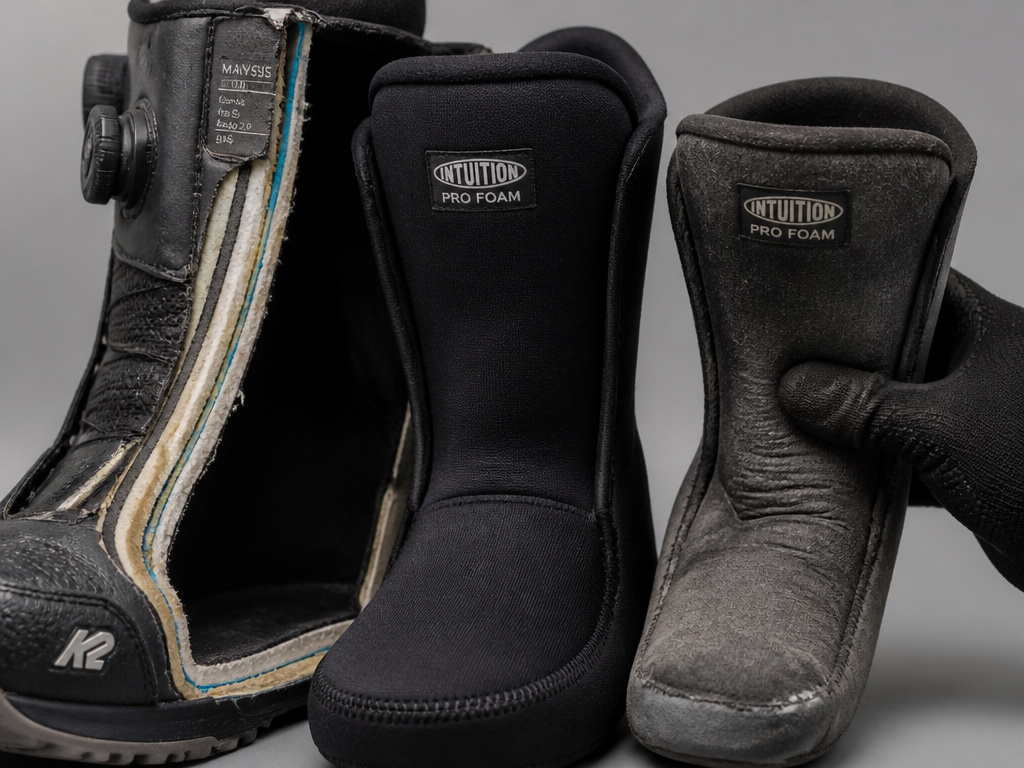
A new Maysis is famously comfortable out of the box. The Intuition liner is soft, and the entry is easy. Japan Grabs noted the break-in took about 3 days of riding to go from a “boxy fit to a molded fit,” with some ankle bone soreness on day one that subsided.
But comfort has a timeline. The flip side of a soft, comfortable liner is that it can compress over time, a process called “packing out.” This is where the Maysis develops a reputation.
It’s a stark reminder that comfort at day one doesn’t guarantee comfort at day 30. The Intuition foam molds to you, but it also loses some of its initial volume. The liner is heat-moldable, which can customize its shape to your foot.
Flex, Response, and On-Snow Feel
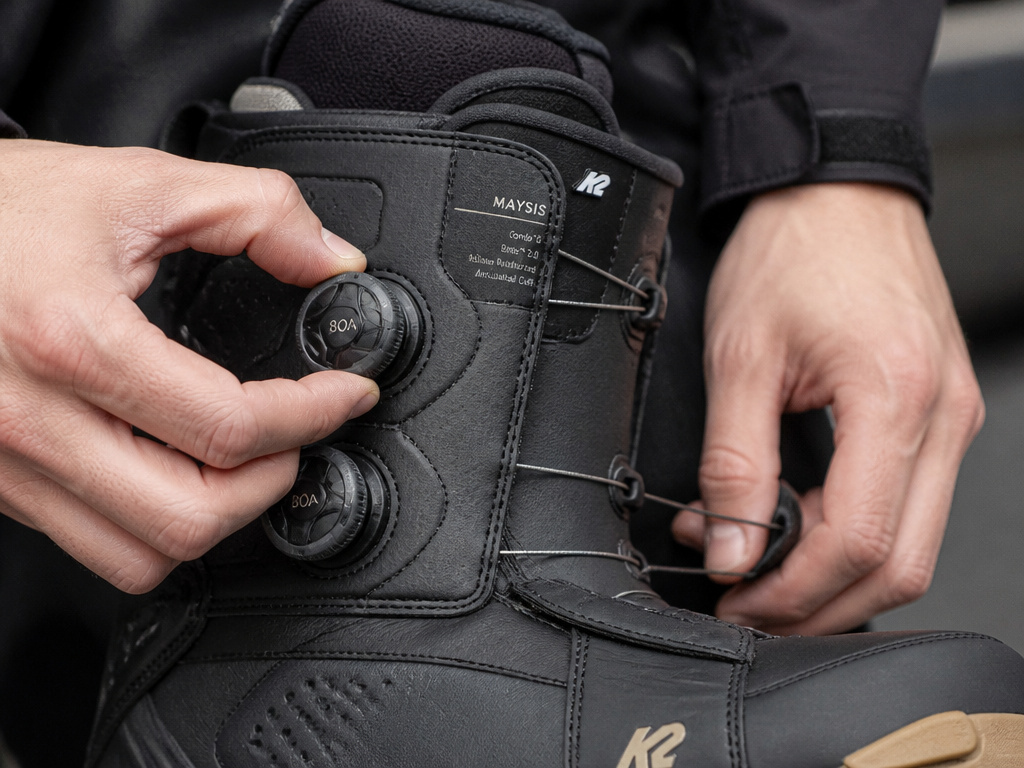
The Maysis carries a flex rating of 7 out of 10, putting it in the medium-stiff category. It’s not a noodle, and it’s not a plank. For all-mountain riding, a bit of everything, nothing too extreme, this is a sweet spot for many intermediate to advanced riders.
The power transfer feels direct, thanks in large part to that internal Conda harness. Your heel isn’t going anywhere. A trade-off of the dual BOA system is that it doesn’t adjust the upper and lower boot independently. The main dial controls the shell closure. If you like a looser cuff for freestyle but a tight ankle for carving, you can’t have that here. It’s one tightness for everything.
The shell incorporates Endo 3.0 technology for flex retention. The midsole is dual-density with EVA and Harshmellow for damping, and the outsole is a This Grips! Dual-rubber compound.
Durability and the BOA Question
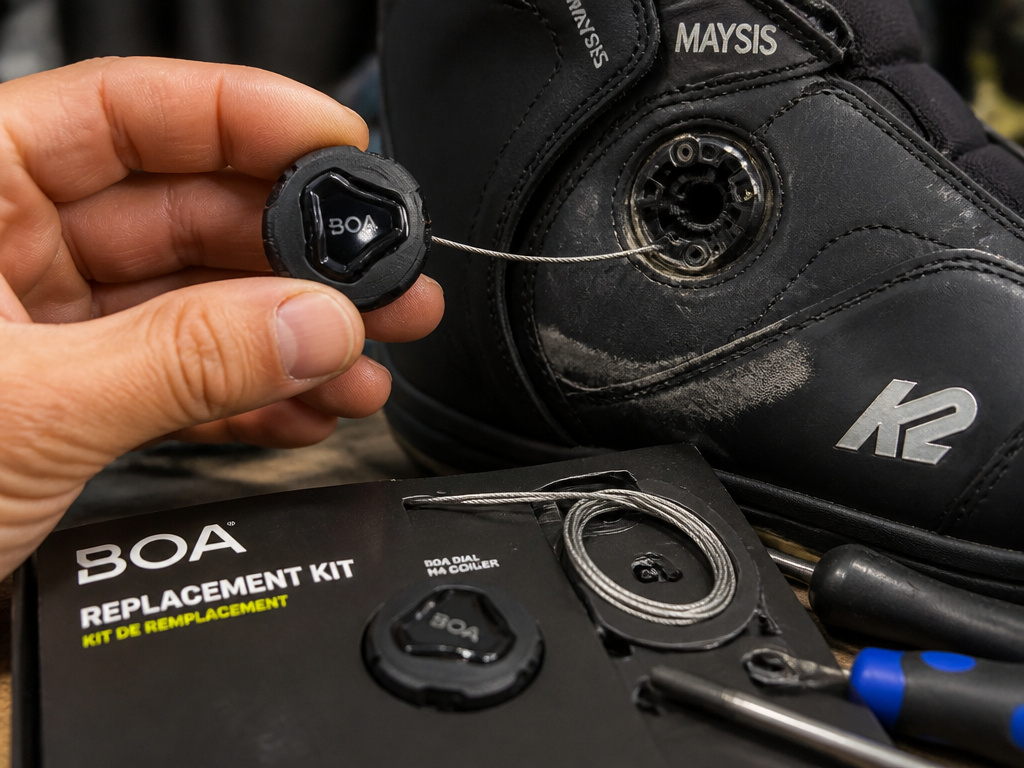
This is the section that separates the marketing story from the owner reports. The boots are well-constructed, but the BOA system is a potential single point of failure.
The manufacturer warranty, as listed by Tactics, is 1 year, covering defects in materials and workmanship.
Forum threads are illuminating.
- A side BOA “ripped itself out” after about one month of use.
- A side BOA (the liner harness) broke after about 1 year of use.
- A user on The Good Ride reported a “boa break after the first couple of days.”
Common mistake: Assuming a broken BOA is a dead-end. Forum users report successfully obtaining replacement parts directly from BOA Fit System (boafit.com).
This is a critical piece of non-commodity insight. The BOA system has its own support channel. A separate repair channel exists directly through BOA Fit System. One forum user detailed the process: “I went through the company boa and they gave me the replacement parts free… You’ll have to go through like a dozen questions about the exact brand/model and I think I also had to take some pictures.”
The boots themselves, aside from the BOA, show good durability. Japan Grabs reported that after 30 days of riding, there were only scuff marks and some wear under the Boa cables.
K2 Maysis vs. Ride Lasso: Which All-Mountain Boot Wins?
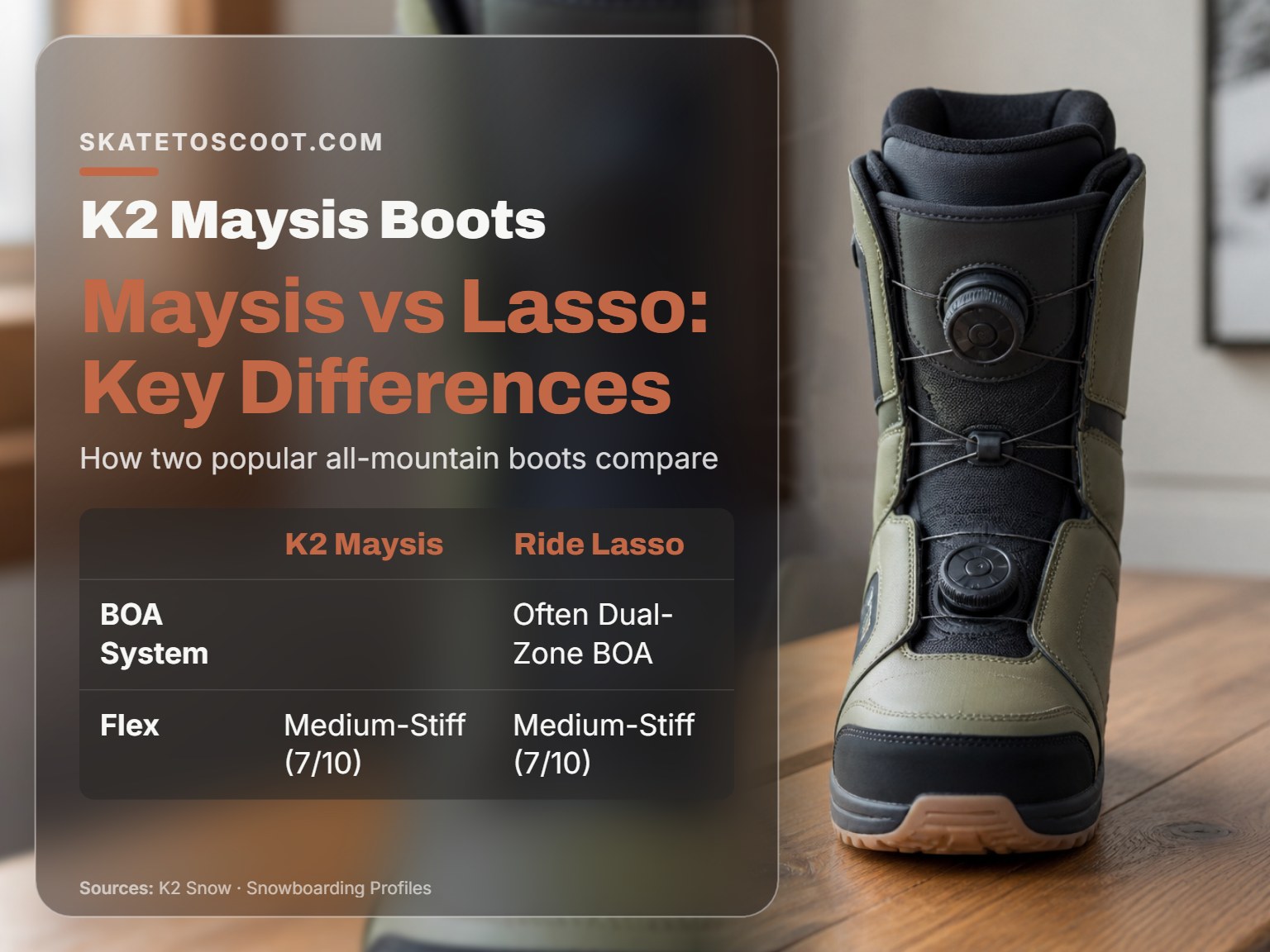
A top “People also ask” question is a direct comparison between these two. The Ride Lasso is a similar price-point, medium-stiff, all-mountain boot, also often with a BOA system.
The core difference is in design philosophy. The K2 Maysis uses its dual BOA to create an exceptional heel hold via the Conda harness, but sacrifices independent upper/lower adjustment. The Ride Lasso (especially the Lasso Pro) typically uses a dual-zone BOA system, one for the upper cuff, one for the lower ankle, giving you more granular control over tightness in different areas.
For riders who prioritize a locked-in heel above all else and don’t mind a unified shell tightness, the Maysis has an edge. For riders who want to tweak the fit for different parts of the day or different runs, the Lasso’s dual-zone system is more versatile. Regarding width, the Ride Lasso Wide exists as a direct competitor to the Maysis Wide, so wide-footed riders should try both.
| Feature | K2 Maysis | Ride Lasso |
|---|---|---|
| BOA System | Dual BOA (Shell + Conda Harness) | Often Dual-Zone BOA (Upper + Lower) |
| Key Strength | Exceptional heel hold via internal harness | Granular adjustability across upper and lower zones |
| Flex | Medium-Stiff (7/10) | Medium-Stiff (7/10) |
| Best For | Riders who hate heel lift, prefer simple two-dial operation. | Riders who like to fine-tune fit for different riding styles. |
Who Are the K2 Maysis For? (And Who Should Look Elsewhere)
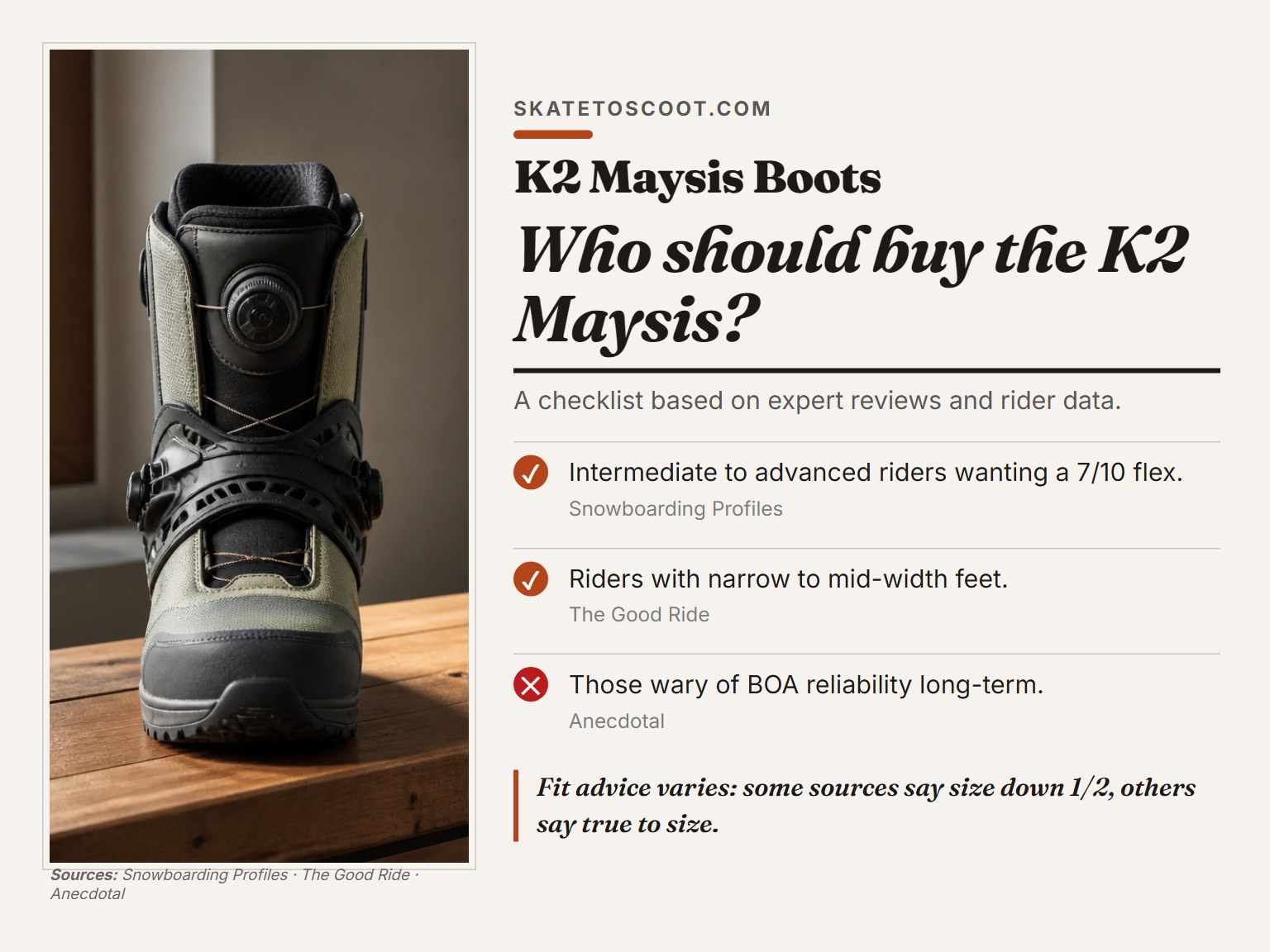
One point is clear. The Maysis is not for everyone, and the data tells us exactly who it serves.
The Maysis is a great fit for:
- Intermediate to advanced all-mountain riders who want a stiffer-than-medium boot without going full race-stiff.
- Riders plagued by heel lift. The Conda harness is arguably the best in class at solving this.
- Value-conscious buyers who want premium features (Intuition liner, quality rubber outsole) at under $400.
- Riders with narrow to mid-width feet who confirm the fit after trying on.
Look elsewhere if:
- You have wide feet (try the Maysis Wide model first).
- You require independent upper/lower adjustability. Check out boots with traditional dual-zone BOA like many Burton or Ride models.
- You are a first-time beginner. The 7/10 flex is too much boot; you want something softer to learn in.
- You prioritize long-term, multi-season durability above all else and are wary of BOA reliability stories.
For a different take within the K2 boot lineup, the K2 Hanford offers a more traditional dual-zone BOA setup, while the K2 Kinsley serves a similar all-mountain purpose in the women’s line.
How do the K2 Maysis boots handle shock and board feel?
The boot uses a dual-density midsole with EVA and a proprietary Harshmellow material for damping. This setup is designed to absorb vibrations from choppy snow and hard landings. For board feel, the boot’s medium-stiff flex provides a direct connection to your edges, giving you a responsive platform for carving and control. The combination aims to mute the chatter underfoot while still letting you sense what the board is doing. It’s a balance between all-day comfort and precise input.
Frequently Asked Questions
Are K2 Maysis Boots Good?
Yes, for the right rider. They are good boots with a specific performance profile: outstanding heel hold, a comfortable break-in, and a medium-stiff flex that handles all-mountain terrain well. Their 80.4/100 test score is respectable, though it places them in the bottom third of the all-mountain category they compete in. The main caveats are the lack of shell adjustability and the mixed reliability reports on the BOA system.
Which Snowboard Boots Are Better, K2 Maysis or Ride Lasso?
Neither is universally better; they are different tools. The K2 Maysis is better if your primary concern is eliminating heel lift. Its Conda harness is superior. The Ride Lasso (or Lasso Pro) is better if you want independent control over the tightness of your upper cuff and lower ankle. For most riders who like to tweak their fit throughout the day, the Lasso’s dual-zone system offers more versatility. It’s a classic trade-off between specialized performance and adjustable comfort.
Are K2 Snowboarding Boots Good?
K2 makes a wide range of boots, and the Maysis is one of their most popular models. Overall, K2 boots are known for innovative features like the Conda harness and Endo technology, and they often offer strong value. Like any brand, some models will fit certain foot shapes better than others. It’s wise to look at specific reviews for models like the K2 Raider for park riding or their broader boot lineup to see where the Maysis fits.
What Is the Flex Rating of the K2 Maysis Snowboard Boots?
The flex rating is 7 out of 10, or medium-stiff. This is confirmed by multiple sources, including Snowboarding Profiles, The Good Ride, and Gear Institute. It provides responsive control for aggressive carving and variable terrain while retaining enough forgiveness for all-day comfort and some freestyle play.
Should I Heat-Mold My K2 Maysis Boots?
Yes, it is highly recommended. The liner is made of heat-moldable Intuition foam, which is designed for this process. Heat-molding customizes the liner to your foot’s contours, which can drastically improve comfort, reduce pressure points, and potentially extend the liner’s life before it packs out. Many shops offer this service for free or a small fee with purchase. Doing it before your first ride can eliminate the initial break-in discomfort.
The Bottom Line
The K2 Maysis presents a clear value proposition: premium materials and a brilliant heel-hold system for under $400. Its test score of 80.4 tells you it’s competent, not class-leading. The real decision comes down to your foot shape and your tolerance for system quirks.
If your heel lifts in other boots, the Maysis’ Conda harness is a legitimate solution. Just buy a half-size down from your street shoe, get them heat-molded, and understand that the BOA components have a separate lifeline at boafit.com if they fail after the one-year warranty. For riders who need more width or more adjustability, the range of all-mountain boots and Boa boots has plenty of other strong options, like the Ride Lasso or a traditional laced boot.
For the intermediate all-mountain rider who values a locked-in heel above all else, the Maysis is a solid, specific choice. For everyone else, the trade-offs require a closer look.
