K2 Kinsley Snowboard Boots Review: How They Fit and Wear
This post contains affiliate links. As an Amazon Associate, we earn from qualifying purchases.
The K2 Kinsley is a women’s all-mountain/freestyle snowboard boot with a medium flex, a dual-zone BOA® Fit System, and a heat-moldable Intuition® liner. It’s designed for intermediate to advanced riders who want a comfortable, responsive boot for varied terrain, but its longevity and fit for narrow heels versus wider forefeet are the key points to verify before buying.
That “medium flex” label gets thrown around a lot. With the Kinsley, it means the boot offers enough stiffness for confident edge hold on groomers and side hits, but it’s forgiving enough for park sessions without feeling like a wooden clog. The real question isn’t about its intended use, it’s whether the boot’s specific construction and fit profile will match your foot and your season’s ambition. For a detailed breakdown, see our K2 Kinsley snowboard boots review.
What follows is a breakdown of the Kinsley’s tech, a hard look at where it might wear, and a direct comparison to its K2 siblings. We’ll cut through the marketing specs with sourced measurements and owner reports so you can decide if this is your next boot or a pass.
Key Takeaways
- The Kinsley’s internal shape is a “tight V” in the heel, making it a better match for feet that are narrower at the heel with a wider forefoot rather than a uniform width.
- A Reddit user recommends riders who snowboard five or more days per season replace the stock footbed with an aftermarket insole like Superfeet Greens, while K2 includes the Harshmellow™ footbed as part of the product.
- Pay close attention to the double-stitch seam and overlap on the toe box; this is a noted stress point, and over-cranking the lower BOA dial can accelerate wear here.
- Sizing is critical: a Reddit user reports sizing up in Kinsleys only to find the boots become too roomy after break-in, while another Reddit user reported sizing down in a different K2 model (Trance) led to a perfect fit after break-in.
- Sources disagree on the exact BOA specification for the Kinsley across model years: K2’s 2026 product page lists an H4 Coiler/M+2 Zonal BOA® Fit System, a 2021 Freeride.com article references an H4/M3 Zonal Boa® Fit System, Tactics.com lists an H4/H3 Focus Boa® Fit System for the 2024 model, and a 2027 video review shows an H5 Coiler upper dial with a non-H5 lower dial.
How Does the K2 Kinsley Fit?
Forget just reading your street shoe size. The Kinsley fits a specific foot shape, and getting this wrong is how boots end up on marketplace listings after two trips.
The boot’s internal shape is described by a reviewer as a “tight V” in the heel, suiting feet that are wider in the forefoot and narrower in the heel. If your foot is essentially the same width from ankle to toes, the Kinsley’s heel will feel constrictive. It’s designed for feet that “V out”, a wider forefoot tapering to a narrow heel. You won’t find on the product page, and it immediately rules the boot in or out for a lot of riders consulting a K2 Kinsley snowboard boots review.
Where this goes sideways: Sizing up in the Kinsley to get more forefoot room. The heel stays narrow, but the rest of the boot volume increases. After break-in, that extra space translates to slop and a loss of precise control, a lesson learned the hard way by owners who reported the boots becoming “too roomy.”
So, what’s the right size? The sourced data gives us concrete numbers. Your street shoe size is a starting point, but if you’re between sizes and have that “V” shaped foot, sizing down is the smarter play.
Common mistake: Assuming all K2 boots fit the same. A Reddit user states K2 boots tend to be a little more narrow than some other companies, and the Kinsley’s pronounced “tight V” heel is a specific design within that. A rider with a uniformly narrow foot might find a better match in a different K2 model, like the Contour or Trance from the K2 boot lineup, which have their own distinct last shapes.
The Kinsley’s Build: Where It Might Wear
K2 packs the Kinsley with recognizable tech: the dual BOA dials, the Intuition® Control Foam 3D liner with its 3-point harness, and the Harshmellow™ damping in the midsole. These features deliver on their promises, convenient micro-adjustment, excellent heel hold, and vibration absorption. The conversation shifts when you look at the materials and stitching holding it all together.
The most cited concern from hands-on reviews is the construction at the toe. The upper uses multiple fabric pieces joined by seams. One reviewer specifically pointed out a double-stitch seam and an overlapping fabric layer on the toe box as the first place you’ll see breakdown. The mechanism is simple physics: every time you flex forward, that seam stretches. If you also tend to crank the lower BOA dial excessively tight to secure your forefoot, you’re adding direct, focused pressure to that exact spot. Over a season of hard riding, that’s a predictable failure point.
This isn’t hypothetical. It aligns with owner anecdotes of the boots “broke down very quickly” requiring duct tape by season’s end due to water intrusion. While not every pair will fail, being aware of this vulnerability means you can mitigate it. Be gentle with the lower dial, snug, not strangled, and keep an eye on the toe area for early signs of thread wear or fabric separation.
Decoding the BOA System & Liner Tech
The lacing system is a major selling point, but the spec sheet is a moving target. Here’s what the sources actually say, and why it matters.
| Model Year / Source | BOA System Listed | Key Detail |
|---|---|---|
| 2021 (Freeride.com) | H4/M3 Zonal Boa® Fit System | Early reference point. |
| 2024 (Tactics.com) | H4/H3 Focus Boa® Fit System | Marketed as “Focus” system. |
| 2026 (K2 Official) | H4 Coiler/M+2 Zonal BOA® Fit System | Current official spec. |
| 2027 (Video Review) | H5 Coiler (Upper), Non-H5 (Lower) | Mixed generation dials. |
The core function is consistent: two independent dials provide a dual-zone closure. This is fantastic for dialing in heel hold without crushing your toes.
A 2027 video review criticizes K2 for equipping only the upper dial with the newer H5 Coiler while the lower uses an older style, stating ‘if you’re going to make one H5, make the other one an H5.’ K2’s official 2026 product page lists an H4 Coiler/M+2 Zonal BOA® Fit System. For a boot in this price tier, that’s a valid observation.
Inside the boot, the Intuition® Control Foam 3D liner is a premium feature. The heat-moldable foam will conform to your foot’s contours for a custom fit, and the integrated J-Bars lock your heel down to prevent lift. This is where the Kinsley feels like a higher-end boot. However, the included Harshmellow™ footbed gets mixed reviews. The damping material works, but the arch support is minimal. For anyone logging multiple days a season, swapping it for a supportive aftermarket insole like Superfeet Greens is one of the best upgrades you can make, a recommendation that comes directly from experienced owners in forum discussions.
K2 Kinsley vs. Contour vs. Trance: Which K2 Boot Is For You?
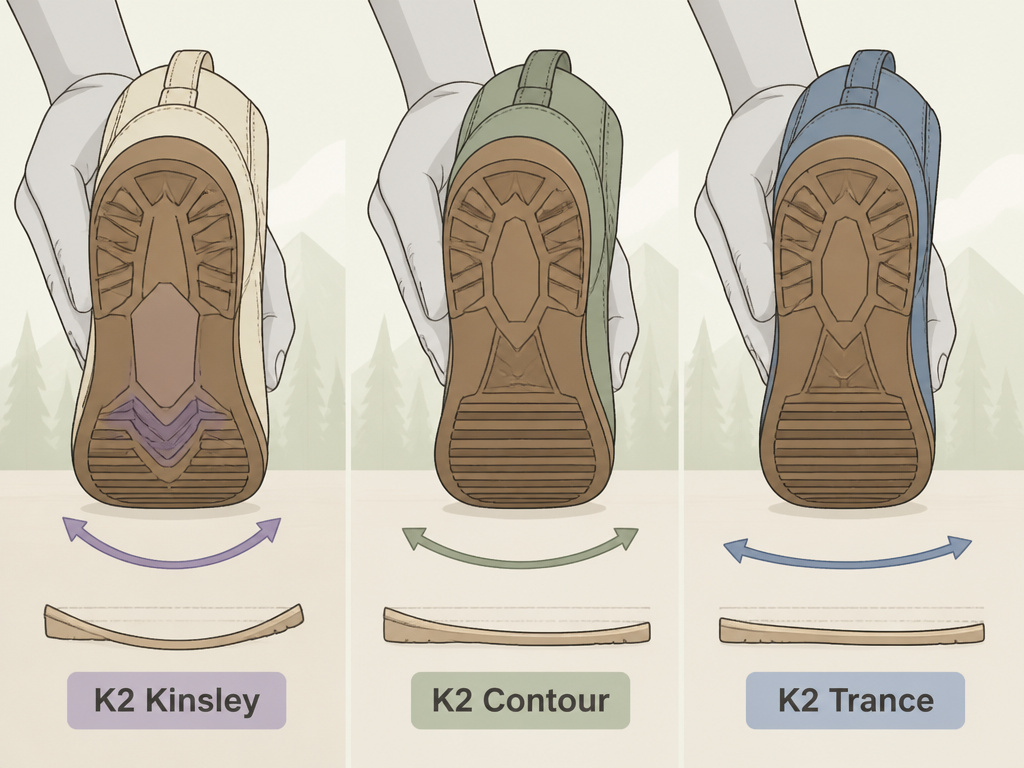
You’re looking at the Kinsley, but the K2 family has other compelling options. We need to examine their differences, since the “medium flex” category isn’t one-size-fits-all.
The K2 Contour is often mentioned alongside the Kinsley. Per owner reports, the Contour traditionally has a stiffer flex, rated around a 6 or even an 8/10 in older models, making it more directional and supportive for aggressive all-mountain riding. It’s for the rider who prioritizes powerful carves over playful flex. The K2 Trance takes another step up, with a flex rating around 7, placing it firmly in the stiff, responsive category for advanced riders who charge hard. The Kinsley, by contrast, occupies the middle ground with its true medium flex, aiming for versatility between the park and the rest of the mountain.
This isn’t just about numbers. The flex pattern and last shape differ. The Contour and Trance may use a more uniform width last compared to the Kinsley’s distinct “tight V” heel. If the Kinsley’s shape doesn’t match your foot, the stiffer K2 Hanford boots or the popular K2 Maysis boots might be a better investigation, as they cater to different fit profiles and performance needs.
| Boot Model | Reported Flex | Best For | Key Fit Note |
|---|---|---|---|
| K2 Kinsley | Medium (True Medium) | All-Mountain/Freestyle Versatility | “Tight V” heel, narrower overall. |
| K2 Contour | Medium-Stiff (~6/10) | Aggressive All-Mountain | Potentially more uniform width. |
| K2 Trance | Stiff (~7/10) | Advanced, Charging Riders | Supportive, high-performance fit. |
The part nobody mentions: Choosing between these isn’t just a flex decision. It’s a foot shape decision first. A boot that’s the “wrong” flex but fits your foot perfectly will always outperform the “right” flex that doesn’t.
Who Should (and Shouldn’t) Buy the K2 Kinsley
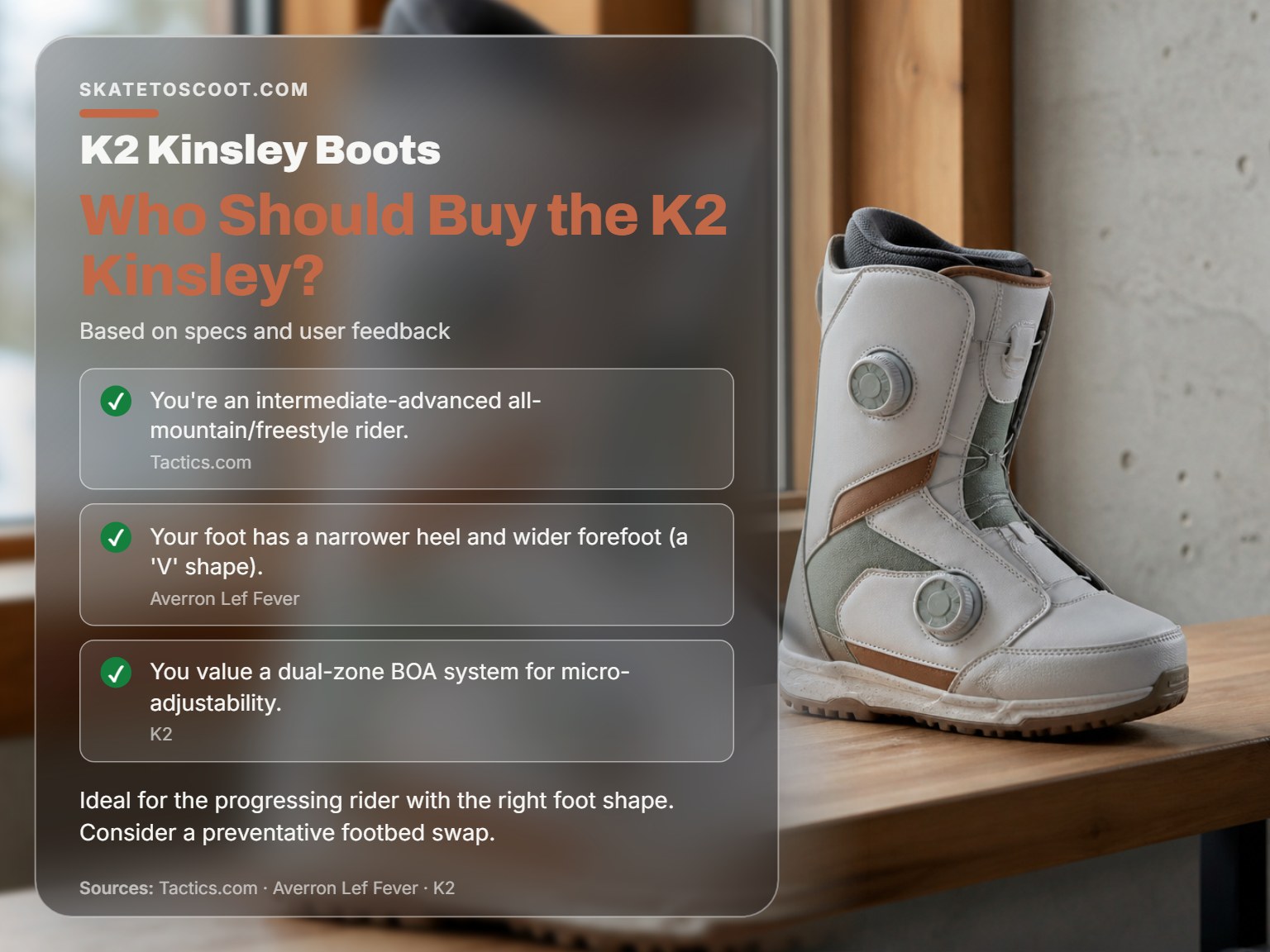
Based on the sourced specs and real-world feedback, the Kinsley has a clear ideal user, and a few riders who should keep looking.
Buy the K2 Kinsley if:
- You’re an intermediate to advanced rider who splits time between groomed runs, side hits, and the park.
- Your foot has a narrower heel and a wider forefoot (the “V” shape).
- You value the convenience and micro-adjustability of a dual-zone BOA system.
- You’re comfortable with the idea of a preventative footbed swap and will monitor the toe seams.
Look at other boots if:
- You have a uniformly narrow or uniformly wide foot. The Kinsley’s specific last might not match. Consider trying a Ride boot model known for a different fit, or explore other Boa snowboard boots with a more neutral volume.
- You’re a true beginner. The medium flex and performance focus might be overkill while you’re mastering the basics. A more forgiving, softer boot for beginners could build confidence faster.
- You demand maximum durability and are hard on gear. The noted construction details might give you pause.
- You ride exclusively in deep powder or exclusively in the park. More specialized boots exist for those ends of the spectrum.
For its target rider, the versatile, progressing all-mountain shredder with the right foot shape, the Kinsley offers a compelling blend of comfort, response, and convenience. Just go in with your eyes open to its quirks.
How durable are K2 Kinsley boots and do they pack out?
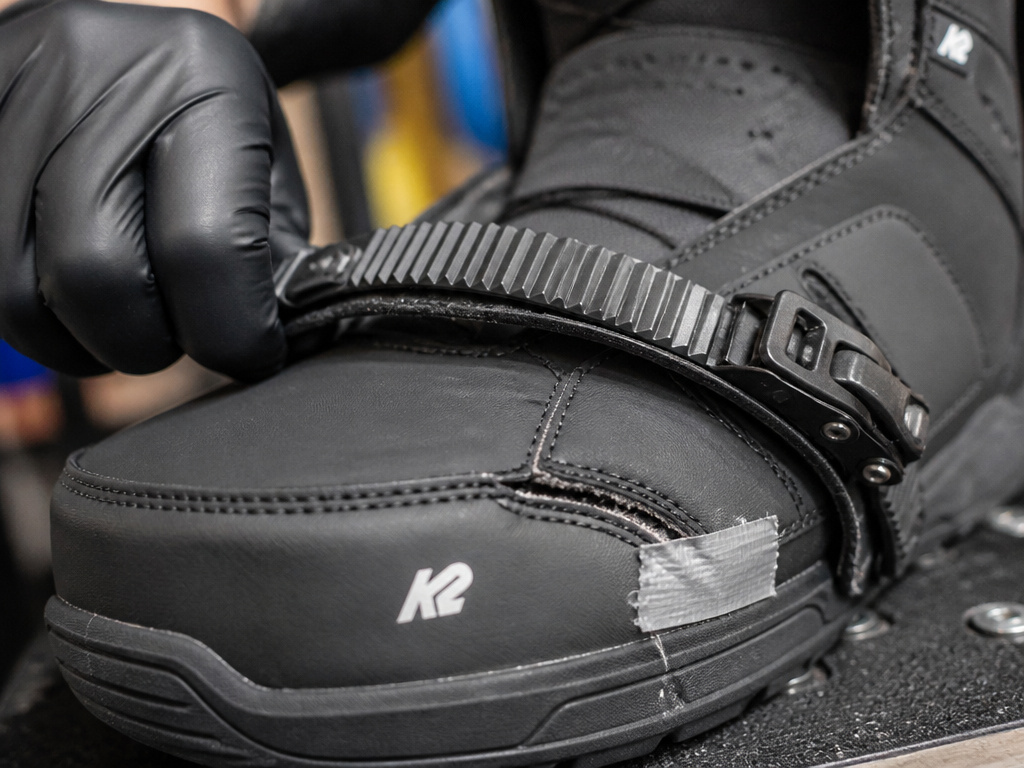
A close review of the Kinsley’s construction points to specific seams, like a double-stitch and overlap on the toe, as potential early failure points. The reviewer notes that over-cranking the toe strap creates direct pressure on this seam, accelerating breakdown. User reports vary, with one stating their boots broke down quickly, requiring duct tape for water intrusion by season’s end. Another notes that sizing up led to the boots becoming too roomy as they wore in. The heat-moldable liner is designed to conform, but its materials will naturally compress and soften with consistent use, which can change the fit over dozens of days.
Frequently Asked Questions
Are K2 snowboarding boots good?
Yes, K2 makes well-regarded snowboard boots, particularly known for their integration of BOA® lacing systems and consistent fit profiles. Like any brand, specific models excel for certain foot shapes and riding styles. The key is to match the boot’s last shape and flex to your individual needs, not to assume all models from a brand will work for you.
Do K2 snowboard boots fit well?
K2 boots have a reputation for a narrower overall fit compared to some other brands. However, “fit well” is personal. The Kinsley, for example, fits very well if you have a narrower heel and a medium-to-wide forefoot. If your foot is uniformly wide or has a high volume, you might find a better match with brands like Ride or ThirtyTwo. Always try them on with the socks you’ll ride in.
What is the BOA system on the K2 Kinsley?
The Kinsley uses a dual-zone BOA® Fit System with a dedicated dial for the upper shell and a second dial for the lower part of the shell. This allows for precise, independent adjustment. The exact model name (H4 Coiler/M+2, H4/H3 Focus) has varied across model years, with the latest models featuring a mix of H5 and older dials.
How stiff are K2 Kinsley boots?
The K2 Kinsley is designed with a medium flex. It’s stiff enough to provide responsive edge control for carving and variable terrain, but soft enough to remain comfortable and forgiving for presses, butters, and park riding. It’s not a soft, jib-specific boot, nor is it an ultra-stiff freeride boot. It’s the definition of an all-mountain flex.
Should I heat mold the K2 Kinsley liner?
Yes, the Intuition® Control Foam 3D liner is heat-moldable and designed to be customized to your foot. Proper heat molding can dramatically improve comfort and heel hold by allowing the foam to conform to your individual contours. Most reputable ski shops offer this service, or you can follow the manufacturer’s guidelines for at-home molding.
Before You Go
The K2 Kinsley isn’t a mystery. It’s a boot with defined strengths, a versatile medium flex, a convenient dual BOA system, and a premium heat-moldable liner, tailored to a specific foot shape. Its potential weaknesses are equally clear: pay attention to the toe seams and plan on a footbed upgrade if you ride more than a few days a year.
For the rider it fits, both in skill and anatomy, it’s a reliable, high-performing partner across the mountain. For everyone else, the detailed specs and owner experiences here should point you toward a better match, whether that’s a stiffer K2 Raider, a more beginner-friendly model, or a different brand entirely. Your boots are the single most important piece of your setup. Choose them with as much precision as you’d choose your line down the mountain.
