Lib Tech Skate Banana Review
This post contains affiliate links. As an Amazon Associate, we earn from qualifying purchases.
The 2017 Lib Tech Skate Banana is a playful, rocker-dominant freestyle snowboard best suited for low-speed ground tricks, buttering, and park jibbing. Its centered stance and loose feel make it forgiving but limit high-speed stability and aggressive carving. The 10th-anniversary model reintroduced the original banana-yellow colorway and, per Lib Tech, was improved for stability on par with twin camber.
That “on par with twin camber” claim is the central focus of every lib tech skate banana 2017 review. It’s the line that separates the marketing sheet from the snow under your boots. A board this loose and playful hitting twin-camber stability is a big promise, and whether it delivers decides if you’re buying a versatile all-mountain tool or a specialized park noodle.
What follows is a breakdown of where the 2017 Skate Banana excels, where it genuinely falls short, and the specific numbers, from its 255mm waist to its 8.3m sidecut, that should guide your choice after reading a lib tech skate banana 2017 review. We’ll also tackle the conflicting advice on whether it’s a true beginner board and how its iconic Magne-Traction edges actually perform when you’re not on perfect corduroy.
Key Takeaways
- The Skate Banana’s BTX profile creates a surfy, catch-free ride ideal for presses and butters, but its centered stance is a disadvantage in deep powder.
- Independent reviewers like those at SnowboardingProfiles.com and The-House.com categorize it as a freestyle/park board, while Lib Tech markets it as an ‘All Mountain’ board.
- Lib Tech’s official flex rating is ‘Medium Flex’, while reviewer Nate at SnowboardingProfiles.com rated its ‘Flex Feel on Snow’ as ‘Medium-Soft (4/10)’.
- While easy to turn and forgiving, its very loose feel can be tricky for true beginners, especially when one-footing off the chairlift.
- For the 156cm size, key specs are a 255mm waist width, 8.3m sidecut radius, and a 117cm contact length, use these, not the generic weight chart, for sizing.
The Skate Banana’s Specs & Construction
Forget the hype for a minute. What you’re actually standing on is a specific stack of materials with a measurable shape. The 2017 Skate Banana, the 10th-anniversary edition, brought back the classic yellow but underneath was a defined recipe often detailed in a lib tech skate banana 2017 review.
The core is FSC-certified Aspen and Paulownia, which Lib Tech calls “Columbian Gold.” It’s wrapped in Tri-Ax and Bi-Ax fiberglass, topped with an Eco Sub PBT top sheet, and rides on a “TNT” base, that’s Teflon-infused sintered material. The edges are the famous Magne-Traction with seven serrations, and the profile is BTX: rocker between your feet, transitioning to flat and then mild camber at the contact points.
The 156cm Skate Banana has a 255mm waist width, an 8.3m sidecut radius, and a 117cm contact length, with a centered stance and zero setback, according to the official Lib Tech spec table. This geometry prioritizes maneuverability over high-speed stability.
Those numbers matter more than a generic weight chart. A 255mm waist provides a specific width for the 156cm board. The 8.3m sidecut radius is a specific measurement for the 156cm board. The board has a true-twin shape and zero setback.
Where this gets real is the flex. Lib Tech labels it “Medium Flex.” Lib Tech labels it “Medium Flex.” But reviewer Nate at SnowboardingProfiles.com, after riding it, rated its “Flex Feel on Snow” as a 4 out of 10, medium-soft. That discrepancy isn’t just semantics.
Rocker Profile & On-Snow Feel: BTX Explained
The BTX profile is the soul of the Skate Banana. It’s why people love it or find it limiting. Imagine setting the board on a flat floor: it rocks like a teeter-totter, with the tips hovering. That’s the rocker between your feet. As you move out toward the nose and tail, it flattens and then kicks up into a subtle camber right at the contact points.
This design does two main things. First, it makes the board incredibly catch-free. Beginners (and veterans having an off day) appreciate this. You can be sloppy with your weight distribution and the board is less likely to dig an edge in and send you flying. Second, it creates a natural pivot point under your feet. Pressing the nose or tail for a butter requires minimal effort, the board wants to flex there.
The feel is best described as surfy or loose. It’s not locked in. It’s playful and forgiving. When you’re cruising greens or blues, slashing little turns, it feels like a dream. That loose feel is also why, as one Reddit user perfectly put it, it rides like “a skateboard with loose trucks.” At low to medium speeds, that’s fun. At high speeds, that sensation turns into a nervous chatter. The board lacks the planted, damp feel of a camber-dominant deck.
Common mistake: Assuming the BTX rocker will provide effortless float in deep powder. The rocker helps, but the true-twin, centered stance works against you. You need to consciously shift your weight back, and even then, a directional board with setback will outperform it. It’s doable, not ideal.
Performance Breakdown: Where It Shines & Where It Folds
You don’t buy a tool for every job. You buy it for specific tasks. The Skate Banana is a specialist, and judging it against the wrong rubric is how you end up disappointed. We will examine its performance by discipline.
Park & Jibbing: This is its home turf. The catch-free nature inspires confidence on rails and boxes. Presses are effortless. For low-speed ground tricks, buttering, spins, and small to medium jumps, it’s a blast. The board wants to play. It won’t punish you for a slightly off-center landing on a side hit.
Carving & Groomers: Sources disagree on performance: Lib Tech claims it “carves ice” and was improved for stability on par with twin camber, while SnowboardingProfiles.com states it is not well suited to aggressive carving or bombing hard. The loose feel and softer flex mean it can feel squirrely when you really try to lay it over on a hardpack carve. It can carve, but it doesn’t excel at carving. For casual turns down a blue run? Absolutely fine. For aggressive, high-edge-angle carves? Look elsewhere.
Speed & Stability: This is the board’s ceiling, and it’s a low one. The 2017 model was touted as improved for stability, but the fundamental physics of a rocker-dominant profile limit damp, high-speed performance. The board is not well suited to bombing hard according to SnowboardingProfiles.com. It’s not a board for bombing.
Powder: Sources disagree on performance: Lib Tech claims it “floats effortlessly in powder,” while SnowboardingProfiles.com notes its centered stance is a disadvantage in deep powder, calling it “not great” compared to directional boards.
| Riding Style | Skate Banana Performance | Key Limitation |
|---|---|---|
| Park/Jibbing | Excellent. Loose, playful, forgiving. | Smaller jumps only; lacks pop for big air. |
| Casual Carving | Good enough for relaxed turns. | Lacks precision and grip for aggressive carves. |
| High-Speed Charging | Poor. Gets unstable and nervous. | Not built for bombing or steep, firm terrain. |
| Deep Powder | Doable, but not ideal. | Centered stance requires constant weight shift. |
Who Is The Skate Banana Really For?
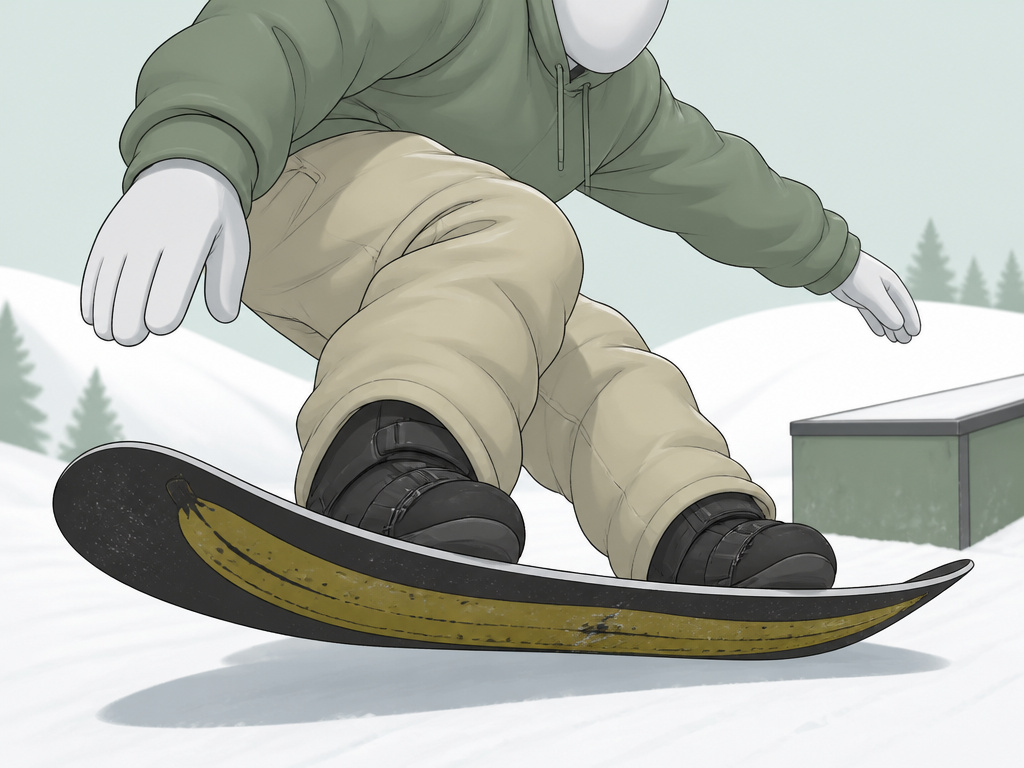
This is the million-dollar question, and the answer gets muddied by marketing. Lib Tech calls it “All Mountain” and “redefined snowboarding.” A more honest categorization, from sites like SnowboardingProfiles.com and The-House.com, is freestyle/park board. That shift in label changes everything.
The Skate Banana is for the rider who spends most of their day in the park, hitting features, playing on side hits, and buttering around. It is best suited for low-speed ground tricks, buttering, spins, grabs, small jumps, side-hits, and jibbing.
Where this goes sideways: Buying it as your one-board quiver expecting aggressive all-mountain performance. You’ll be frustrated by its speed limit and lack of carving power, and you’ll underutilize its park strengths.
Is it a beginner board? Sources disagree: Whitelines.com called it “a perfect beginner purchase,” while SnowboardingProfiles.com notes its loose feel can make it trickier for beginners to control. Its loose feel can make it trickier to control for beginners and challenging when one-footing off the chairlift. It’s doable, but not necessarily the easiest path.
Magne-Traction & Edge Hold: Marketing vs. Reality
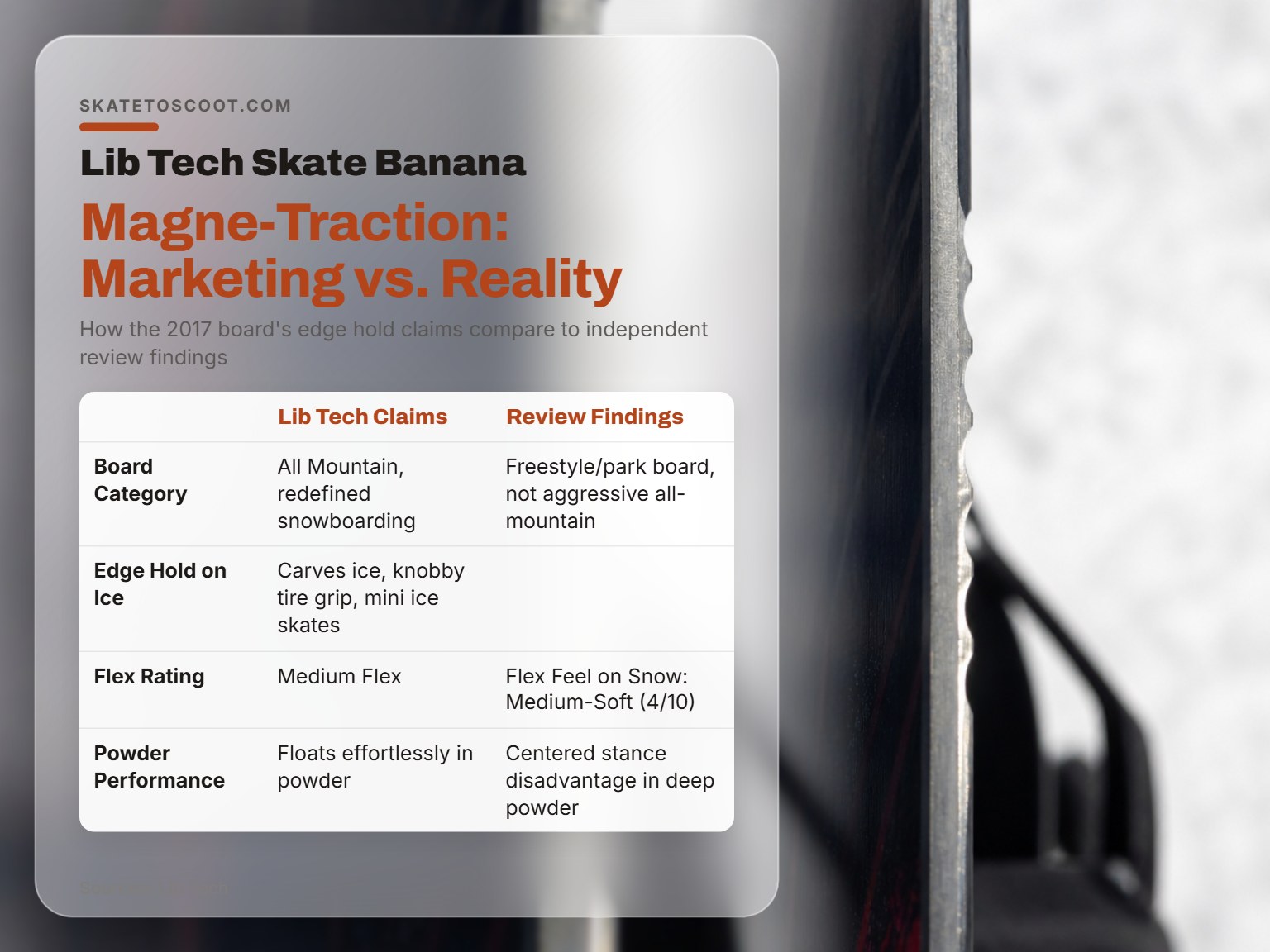
Lib Tech’s Magne-Traction edges are legendary. The serrated design is supposed to act like “little grippy mini precision ice skates” on ice, providing “knobby tire” grip. On the 2017 Skate Banana, you get seven of these serrations.
Lib Tech claims Magne-Traction edges provide ‘knobby tire moto mountain bike edge hold’ and act like ‘little grippy mini precision ice skates’. It provides more bite than a traditional straight edge when you’re leaning the board over at moderate angles.
But there’s a crucial caveat: edge hold is a function of both the edge technology and the board’s flex and torsional stiffness. The Skate Banana’s softer flex means that when you really lean on it for a hard carve, the entire board can torsionally twist and wash out before the Magne-Traction serrations can fully engage. So while Magne-Traction helps, it doesn’t magically make the soft, rockered Skate Banana into an ice-carving machine. The board is not well suited to locking in an edge for aggressive carving according to SnowboardingProfiles.com.
Sizing & Setup: Ignore the Weight Chart
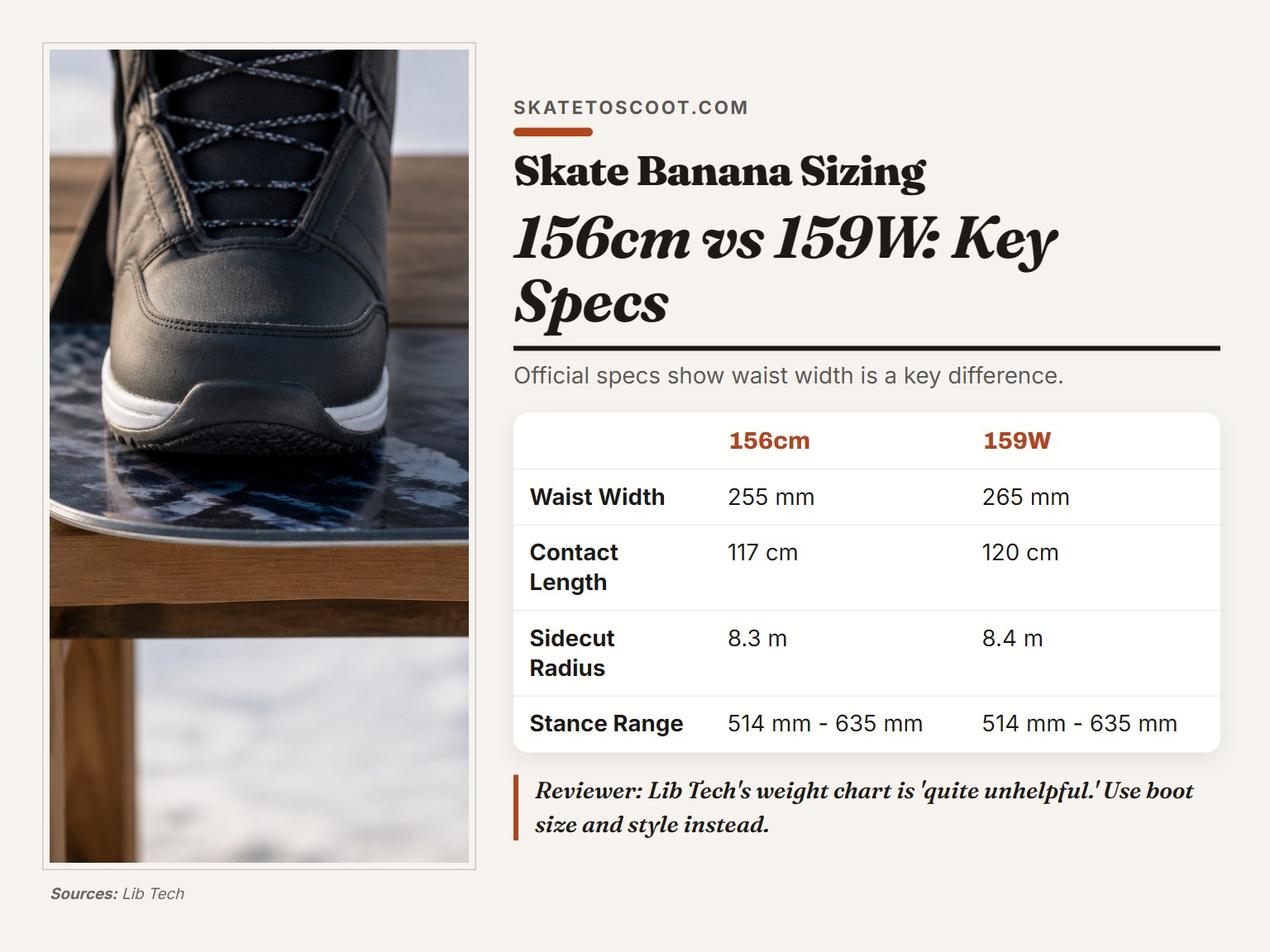
Lib Tech provides a rider weight recommendation for each size. For the 156cm, it’s 80+ lbs (36+ kg); for the 159W, it’s 85+ lbs (39+ kg). Reviewer Nate at SnowboardingProfiles.com bluntly stated these “are quite unhelpful, in my opinion.” They’re overly broad.
A better approach is to use the board’s geometry. Are you a bigger rider or have larger boots (size 11+)? The 159W with its 265mm waist might be necessary to prevent toe drag. Your boot size and preferred riding style are better guides than body weight alone.
Frequently Asked Questions
Is the Lib Tech Skate Banana a good board?
It’s a very good board for a specific purpose: playful, low-speed freestyle and park riding. It’s not a good board if you want to charge at high speeds, carve aggressively, or ride deep powder as a first choice.
Are Lib Tech boards any good?
Yes, Lib Tech boards are generally well-regarded for their durable construction (made in the USA), innovative technologies like Magne-Traction, and distinct ride feel. Like any brand, specific models vary widely in performance.
Is Lib Tech better than Burton?
This isn’t a matter of better or worse, but different.
What are some alternatives to the Skate Banana?
Can the Skate Banana handle jumps?
It can handle small to medium jumps just fine. Its limitations appear on larger jumps where you need a lot of pop and stable landings. The soft flex and rocker profile mean it won’t give you the explosive snap of a camber board, and it can feel less stable landing from bigger air.
The Bottom Line
The 2017 Lib Tech Skate Banana is an icon for a reason. It delivers exactly what it promises to its target rider: a silly, forgiving, endlessly playful experience in the park and on mellow terrain. The 10th-anniversary yellow is a nice throwback.
But buy it with clear eyes. Its “All Mountain” tag is marketing stretch. This is a freestyle board with clear boundaries. It wobbles at speed, struggles with aggressive carves, and demands work in powder. For the rider who lives for butters, jibs, and a surfy feel, it’s a near-perfect match. For anyone else, there are more versatile tools in the shed.
Your first move after reading this shouldn’t be to click “buy.” It should be to honestly answer one question: do you want a specialized park toy, or a daily driver? The Skate Banana is decisively the former. If that’s what you’re after, you’ll love it. If not, you’ll outgrow it in a season.
