Season Nexus Snowboard Review: The Daily Driver Breakdown
This post contains affiliate links. As an Amazon Associate, we earn from qualifying purchases.
The Season Nexus is a directional all-mountain snowboard built with an aspen and cedar wood core, triax fiberglass, and carbon stringers for the 2027 model. It features a 20mm stance setback, a sintered P-Tex 3000 base, and is marketed as a versatile daily driver for intermediate to advanced riders who want a single board for groomers, powder, and side hits.
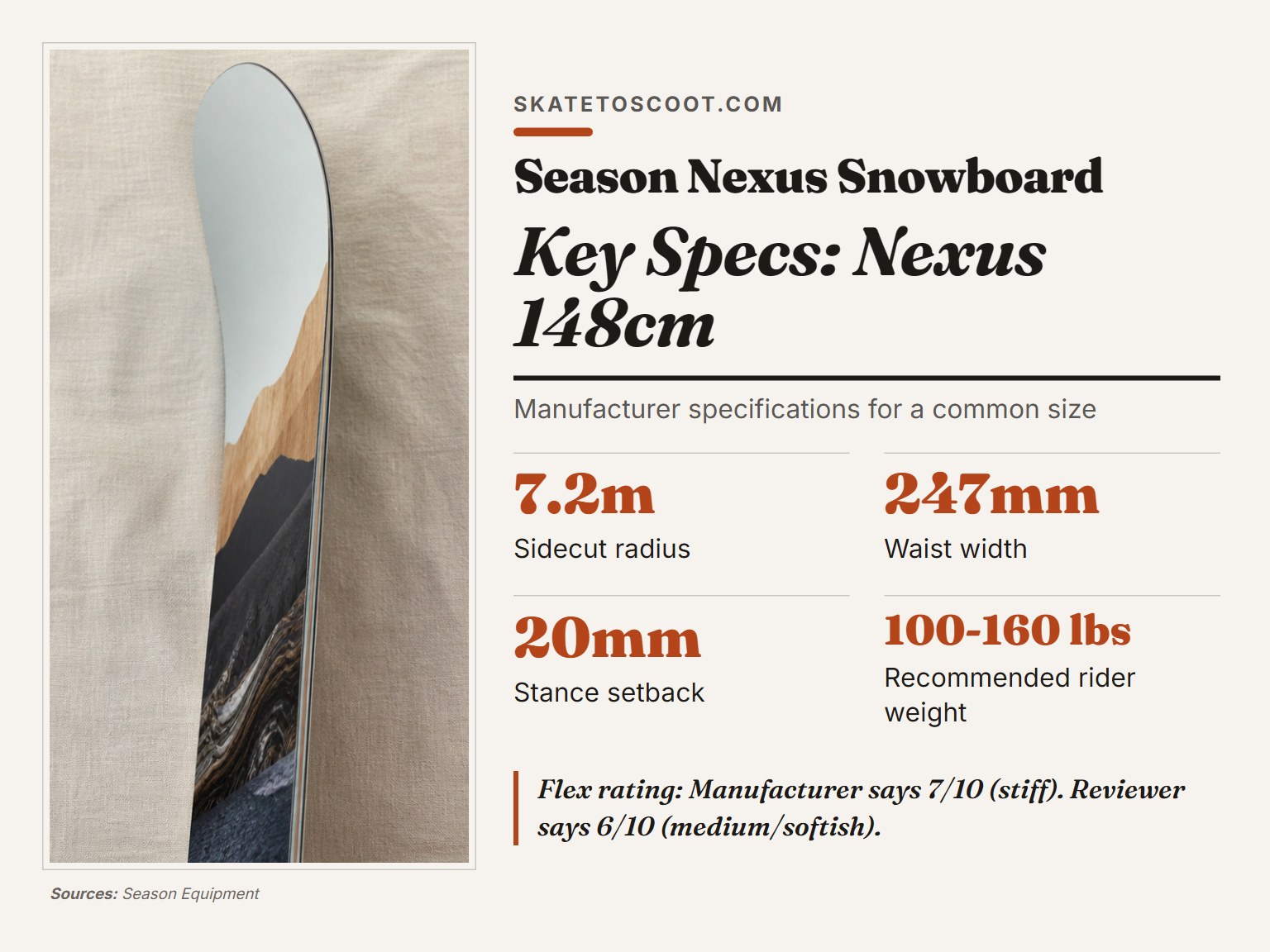
That description covers the spec sheet. What it misses is the board’s split personality. One review calls its landings “super stable” and fun on jumps, but also notes “severe chatter at the nose” at high speed. The manufacturer rates it 7/10 (stiff), while a reviewer felt it rode more like a 6/10 (medium/softish). Your weight and boot size might fit the chart perfectly, yet the board could still feel too big. This split is evident in the Season Nexus snowboard review.
This review breaks down those contradictions. We’ll walk through the Nexus’s construction, how it actually rides across different conditions, who it’s genuinely for, and where the Lifetime Service Pass fits into the value equation.
Key Takeaways
- The manufacturer rates the Nexus a 7/10 (stiff), but a hands-on reviewer felt it rode more like a 6/10 (medium/softish) on snow.
- Sizing is tricky. A reviewer within the recommended weight and boot size for the 148cm found it “felt a bit big,” suggesting the 143cm might be a better match for her profile.
- Performance is highly condition-dependent. Turn initiation is “medium fast” in soft snow but becomes “medium/slow” on hardpack or ice.
- The included Lifetime Service Pass provides unlimited free waxes and a free annual tune, which factors heavily into the board’s long-term cost of ownership.
- For a similar directional all-mountain ride, compare it to other versatile boards like the Jones Stratos or models in our guide to the best all-mountain freeride snowboards.
Construction & Materials: What’s Under the Hood
We will examine this point by point. The 2027 Season Nexus gets a meaningful construction update. The core is a blend of aspen and cedar wood.
Overlaying that core is triax fiberglass with carbon stringers. Triax glass provides torsional stiffness across the board’s width, which helps with edge hold. The carbon stringers, typically laid along the board’s length, aim to add pop and longitudinal stiffness., and the base is a sintered P-Tex 3000. A sintered base is denser, harder, and faster than an extruded base, but it also requires more frequent waxing to maintain that speed, a point where the free Lifetime Service Pass becomes very practical.
The 2027 Season Nexus snowboard features an aspen and cedar wood core, triax fiberglass with carbon stringers, a TPU topsheet, and a sintered P-Tex 3000 base., with the sintered base prioritizing glide speed over easy maintenance.
It’s a solid, modern construction stack you’d expect on a board in this category. The real question isn’t the materials list, but how they translate to on-snow feel, and that’s where opinions start to diverge.
The Manufacturer’s Flex Rating vs. On-Snow Feel
Flex ratings from the manufacturer are only a beginning, not a final judgment. According to the manufacturer’s rating on evo.com, the 2027 Nexus is a 7/10 on their flex scale. Evo standardizes these ratings, classifying 6-8 as “stiff.”
However, a reviewer from The Good Ride who actually rode the board subjectively rated its on-snow flex feel as a 6/10, which they described as “medium to medium/softish.” This isn’t necessarily a contradiction, but a clarification. The “stiff” rating might reflect the board’s torsional rigidity (resistance to twisting), while the rider’s feel accounts for its longitudinal flex (how it bends nose-to-tail when you press or butter).
With a stiffer tail that provided “really nice pop” and a more flexible nose. This uneven flex profile, stiffer tail, softer nose, is a deliberate design choice for a directional board, making it easier to lift the nose in powder and providing a stable platform for ollies from the tail.
| Flex Perspective | Rating | Description / Source |
|---|---|---|
| Manufacturer (evo.com) | 7/10 | Rated as “stiff” on a standardized 1-10 scale. |
| On-Snow Review (The Good Ride) | 6/10 | Subjectively felt “medium to medium/softish” during riding. |
| Key Takeaway | The board’s torsional stiffness may rate higher than its longitudinal, playful flex. |
This discrepancy is useful. It tells you the Nexus likely has good edge grip but won’t feel like a plank. If you’re comparing it to a true freeride charger, it will feel more forgiving. If you’re coming from a soft park board, it will feel substantially more stable.
Sizing & Fit: When the Chart Is Just a Guide
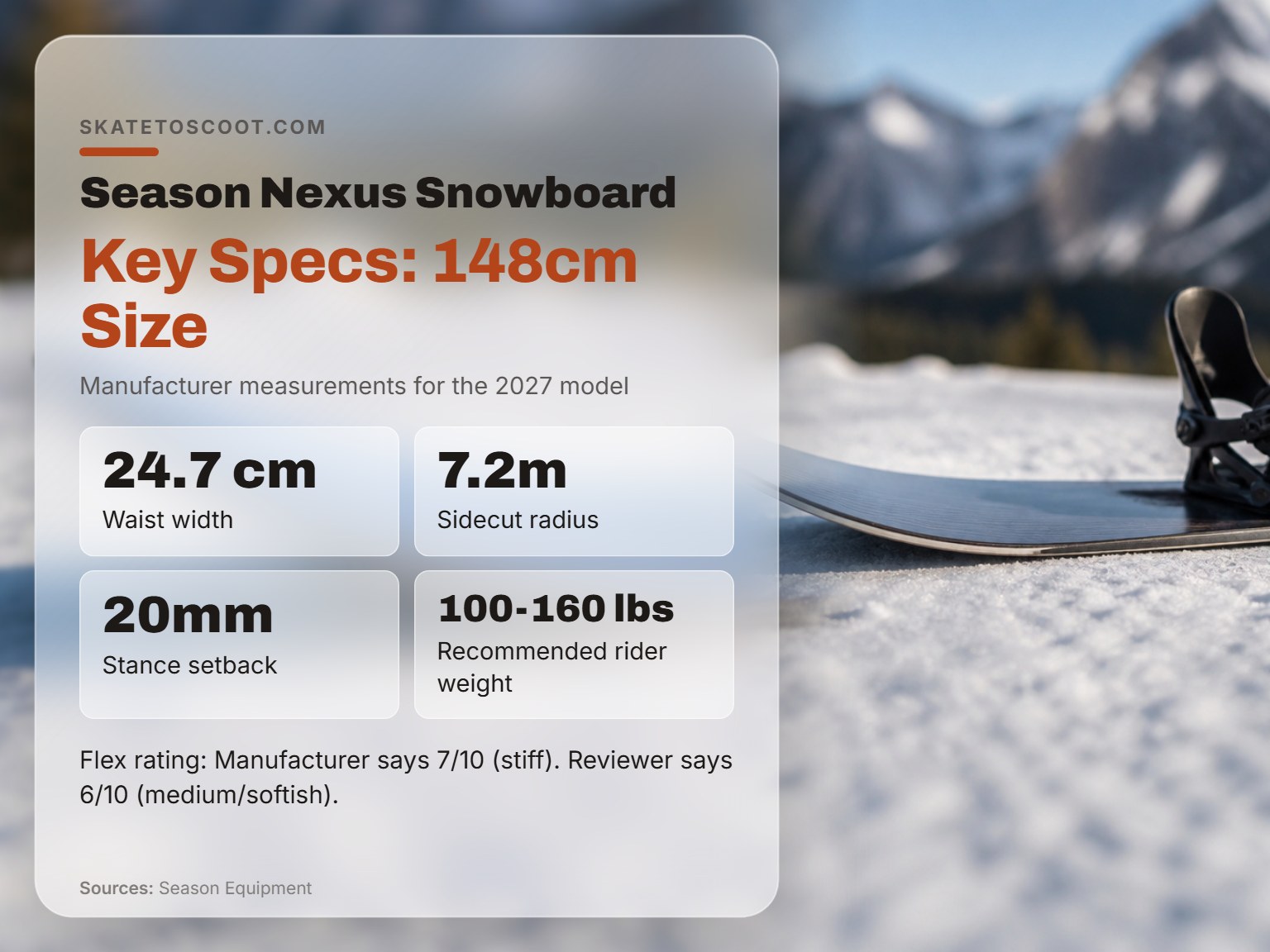
The manufacturer provides a detailed size chart with weight ranges and boot sizes for each Nexus length. For the 148cm model, it recommends a weight of 100-160 lbs and a men’s boot size of 6-8.5 US.
Yet, a real-world experience from a reviewer (5’4″, 109 lbs, size 7.5 boot) who fell within that recommended range found the 148cm “felt a bit big.” She suggested a 143cm would have been more appropriate for her size. This highlights a critical point: sizing charts are population averages, not personal prescriptions. Your riding style, leg strength, and personal preference for a nimble vs. Stable feel matter as much as your weight.
Where this goes sideways: Blindly following the manufacturer’s size chart. A rider well within the 148cm’s recommended range found it too large, compromising quick turn initiation. When in doubt, sizing down can offer more control for less aggressive riders.
For reference, here are the waist widths across the Nexus range, which is crucial if you have larger boots:
| Nexus Size | Waist Width (cm) | Recommended Weight (lbs) | Men’s Boot Size (US) |
|---|---|---|---|
| 143cm | 24.2 | 90-150 | 5-7.5 |
| 148cm | 24.7 | 100-160 | 6-8.5 |
| 152cm | 25.1 | 120-180 | 7-9.5 |
| 155cm | 25.8 | 120-180 | 9.5-11.5 |
| 158cm | 26.0 | 150-190 | 10.5+ |
| 159W | 26.6 | 160+ | 11+ |
| 162W | 27.0 | 160+ | 12+ |
| 164cm | 26.4 | 180+ | 11.5+ |
The 148cm’s 247mm waist width puts it in “mid-wide” territory. The manufacturer recommends it for men’s boot sizes 6-8.5 US, but the reviewer’s experience suggests the length might be the issue for lighter riders, not the width. If you’re between sizes, leaning shorter often increases fun and maneuverability unless you’re solely chasing high-speed stability.
On-Snow Performance: Strengths and the Chatter Caveat
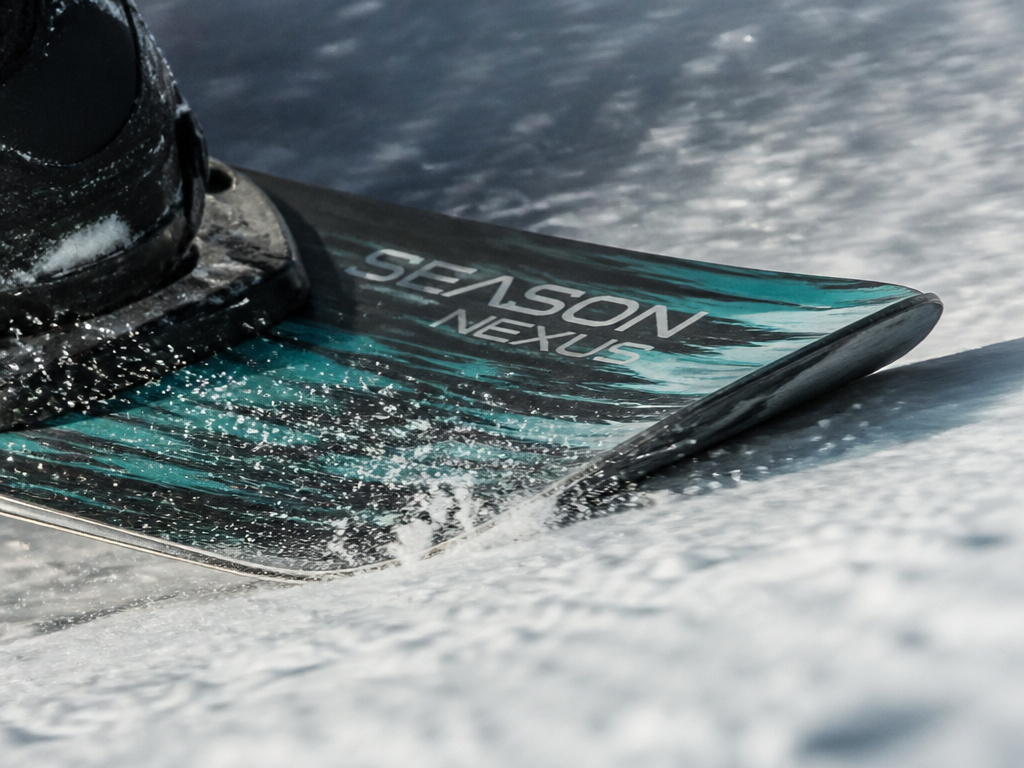
The Nexus is designed as a quiver-killer, and it gets surprisingly close. In soft snow and powder, it earns high marks. The 20mm stance setback, directional shape, and rockered nose provide noticeable float. One review specifically called out that it “performs well in powder despite not having extreme taper or width.”
Carving on groomers is where it feels most at home. The camber underfoot provides solid edge hold, and the board feels stable and confident when arcing turns. Carving on groomers is where it feels most at home. The camber underfoot provides solid edge hold, and the board feels stable and confident when arcing turns.
Now, for the caveat. While one review praised its “super stable” landings on jumps, another offered a crucial counterpoint: “high-speed stability [is] ordinary” with “severe chatter at the nose when riding at high speeds.” This is a significant detail for riders who like to point it straight down the fall line. The board’s relatively softer nose and directional profile can struggle to remain composed in choppy, high-speed scenarios.
Common mistake: Pushing the Nexus beyond its comfort zone on bulletproof ice or through rutted, high-speed chunder. The nose can chatter violently, breaking your edge contact and confidence. It’s a board for confident, fluid turns, not for straight-lining boilerplate.
Turn initiation is another condition-dependent trait. The same review found it “medium fast” in soft groomers but “medium/slow” on hardpack and ice. The wider waist width (especially on the 148cm and up) requires more effort to roll from edge to edge on firm snow.
As for switch riding, the consensus is positive for a directional board. It’s not a twin, but you can comfortably ride switch when needed, which adds to its versatility. This capability places it in a similar do-it-all category as many directional twin snowboards, which are designed to bridge the gap between freestyle and freeride.
The Lifetime Service Pass & Value Proposition
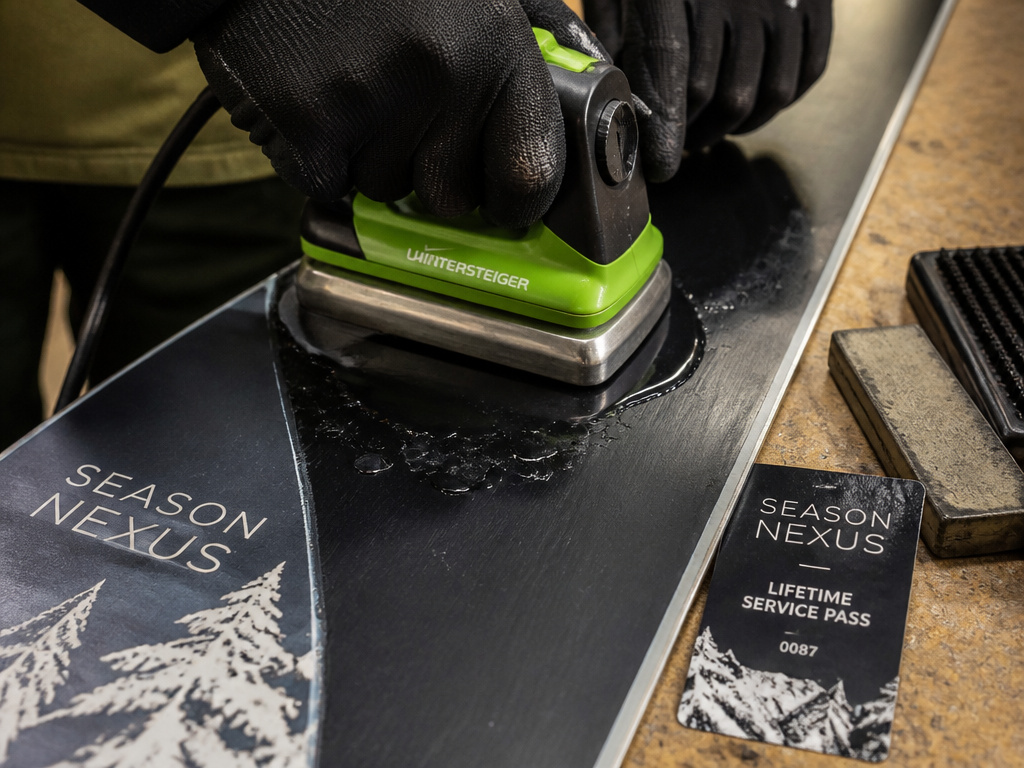
A major part of the Season Nexus equation is the Lifetime Service Pass. This program offers unlimited free waxes and a free annual tune for the life of the equipment. From a pure cost perspective, this is substantial. The Lifetime Service Pass offers unlimited free waxes and a free annual tune, which can represent significant savings over the life of the board.
The value is clear: if you maintain your gear, the pass pays for itself. It also lowers the barrier to owning a sintered base, which performs best when freshly waxed. However, the pass is only as good as your proximity to a Season service center or an authorized partner.
This service model is a defining brand characteristic, similar to how other direct-to-consumer or value-focused brands structure their offerings. It’s a point of differentiation from larger manufacturers and is a key factor when weighing the Nexus against other boards in its class, like those in the Never Summer lineup, which are also known for their durability and warranty.
Who Is the Season Nexus Actually For?
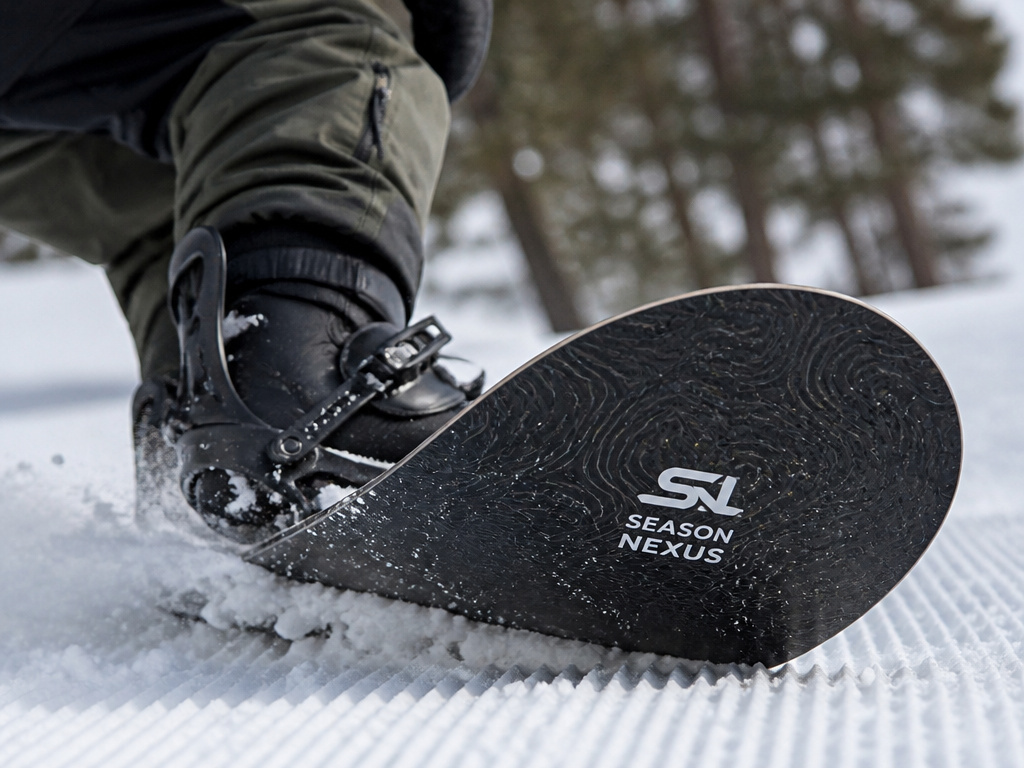
Let’s be real about this. The Season Nexus is an excellent fit for an intermediate to advanced rider who wants one board for 80% of their resort days. It’s for the rider who spends the morning carving groomers, hunts for side hits in the afternoon, and hopes to find some leftover powder in the trees.
Its versatility is its greatest strength and its primary weakness. It does many things well, but doesn’t excel in extreme scenarios. If you want a playful, press-friendly jib board, look elsewhere.
Given the conflicting reports on flex and high-speed performance, it sits in a interesting spot. For a similar versatile, directional-all-mountain experience, it’s worth reading our reviews of boards like the Camp 7 snowboard or the White Space snowboard to see how different constructions tackle the same goal.
What is the shape and profile of the Season Nexus?
The Nexus uses a directional shape with a setback stance. This design, combined with a rockered nose, helps it perform well in powder. On groomers, its turn initiation is medium fast in soft snow but feels medium/slow on hardpack or ice. The board’s tail is reported to be stiffer, providing nice pop, while the nose is more flexible.
How does the Season Nexus compare to similar boards?
Direct comparisons to specific models like the Jones Stratos are based on user experience. Some riders note the Nexus offers a fun, poppy ride with super stable landings on jumps. However, its high-speed stability is often described as ordinary, with some reports of severe nose chatter at speed. Durability experiences vary widely; some users report their board feeling softer over a single season, while others praise quick warranty service. Consider your priority for damp stability versus a more playful, accessible feel when comparing.
What is Season’s brand philosophy and approach?
Season’s approach centers on long-term rider support through its Lifetime Service program, which includes unlimited free waxes and a free annual tune. The brand was founded by a professional rider after leaving a major manufacturer, aiming to build boards with a specific riding experience in mind. Their construction uses materials like an aspen and cedar wood core, triax fiberglass, carbon stringers, and a sintered base. The philosophy extends the board’s usable life through service, not just the initial sale.
Frequently Asked Questions
Is the Season Nexus good for beginners?
It’s not ideal. The medium-stiff flex, directional shape, and camber profile require more active riding and confident edge control. A true beginner would benefit more from a softer, more forgiving, true-twin board. The Nexus is better suited to an intermediate rider looking to progress their all-mountain skills.
How does the Season Nexus handle ice?
Reviews are mixed. It “can hold an edge on hard pack and ice” but is “less than a board that has some sort of sidecut disruption.” Its performance is adequate for typical resort ice, but it’s not a dedicated ice-coaster like some boards with aggressive edge tech.
Can you ride the Season Nexus in the park?
Yes, but it’s not a park specialist. It’s “fun on jumps and side hits” with “super stable landings,” thanks to the stiffer tail. However, its directional shape and setback stance make switch takeoffs and landings, rails, and butters more challenging than on a true twin park board.
What bindings work well with the Season Nexus?
The board’s 2×4 insert pattern offers plenty of stance options. A medium-stiff all-mountain binding like a Union Force or Atlas would match its flex and provide responsive power transfer. A softer binding could make it feel more playful, while a very stiff binding would emphasize its precise carving characteristics.
Is Season a good snowboard brand?
Season is a smaller brand founded by professional rider Austin Smith after his tenure at Nitro. They focus on a curated lineup of versatile boards backed by the Lifetime Service Pass. Reviews from sources like The Good Ride and user reports generally praise their ride quality, though there are isolated anecdotal reports about durability, as with any brand. It’s considered a legitimate, rider-driven brand, not just a generic “store brand.”
The Bottom Line
The Season Nexus delivers on its promise of being a highly versatile, do-almost-everything daily driver. Its updated 2027 construction feels modern and capable, and the included Lifetime Service Pass is a genuine value-add that offsets long-term maintenance costs.
The catch is in the details the marketing glosses over. Pay close attention to the sizing, the chart is a guide, not a guarantee. Understand that its “stiff” rating might feel more “medium-softish” when you’re riding, which could be a pro or a con depending on your style. Most critically, accept its limit: if your favorite thing is straight-lining through choppy snow at top speed, the Nexus’s nose chatter will remind you it’s a turn-oriented board.
For the rider who values a surfy, fun feel across the whole mountain, from groomer carves to powder stashes, and who appreciates a board with a bit of personality, the Nexus is a compelling, well-supported choice. Just know what you’re signing up for.
