SIMATE Hoverboard Review: Key Takeaways and Comparisons
This post contains affiliate links. As an Amazon Associate, we earn from qualifying purchases.
A SIMATE hoverboard is a budget-friendly, entry-level self-balancing scooter with a top speed of 7.5–9.5 MPH, a range of 7–8 miles, and a 90-day warranty, but its real-world performance and customer support experience can vary significantly from the advertised specs.
Throw in a few hills, a rider over 150 pounds, or a battery that’s not fresh from the factory, and you’re looking at 30 to 45 minutes of ride time, not an hour. That gap between the manual and the sidewalk is where most buyer frustration starts.
What follows is a breakdown of the two main SIMATE models, the safety certifications that matter, the common problems owners actually report, and a direct comparison to other brands, as detailed in this simate hoverboard review. By the end, you’ll know exactly who this board is for—and more importantly, who should look elsewhere.
Key Takeaways
- The SIMATE Apato (P6) is a lightweight, 6.5-inch wheel model aimed at younger riders (6-12 years), while the SIMATE Tank (Z13) offers more power and larger 8.5-inch wheels for a broader age range (6-60 years).
- UL 2272 certification is essential for fire safety, but the U.S. CPSC still warns against unattended charging and recommends specific protective gear.
- Real-world range can be significantly shorter than the typical 7 miles, especially for heavier riders or on uneven terrain, based on user reports.
- The 90-day warranty explicitly excludes water damage and physical wear-and-tear, and return processing incurs a 10% fee after 24 hours.
- For most casual family use, the Apato is sufficient; for teens or adults wanting more stability and power, the Tank is the better investment, though competing brands may offer better value.
SIMATE Apato vs. Tank: Which Model Fits You?
SIMATE sells two distinct hoverboards under its brand: the Apato (P6) and the Tank (Z13). They share a manufacturer and some features, but they’re built for different users. Confusing them is the first mistake buyers make when they skip a thorough simate hoverboard review.
The Apato P6 is the entry point. Its 6.5-inch wheels and 13.6-pound frame make it nimble and easy for a kid to carry. The dual 150W motors (300W total) provide enough torque for a 15-degree slope, which covers most driveway inclines. According to the Jinhua SIMATE manual, its sweet spot is riders aged 6 to 12, weighing between 40 and 220 pounds, though SIMATE’s FAQ recommends riders be at least 7 years old and states a payload range of 44-220 pounds. The smaller wheels mean a slightly bumpier ride over cracks and a lower top speed of 7.5 MPH.
The Tank Z13 is the heavier-duty option. It weighs 28.4 pounds, so it’s not something a young child will haul around easily. The 8.5-inch wheels roll over sidewalk seams more smoothly, and the dual 250W motors (500W total) deliver more punch, though the maximum climbing slope is still listed at 15 degrees. The top speed bumps up to 9.5 MPH, and the recommended age range stretches to 60 years, with a higher maximum payload of 264 pounds. It’s the board you’d pick for a teenager or a lighter adult.
The part nobody mentions: The Tank’s larger battery (36V 4.0Ah vs. The Apato’s 36V 2.0Ah) doesn’t double the range—it only extends it by about a mile (8 miles vs. 7). The extra weight and power draw from the more robust motors eat into the efficiency gains.
Here’s a quick breakdown of the key differences:
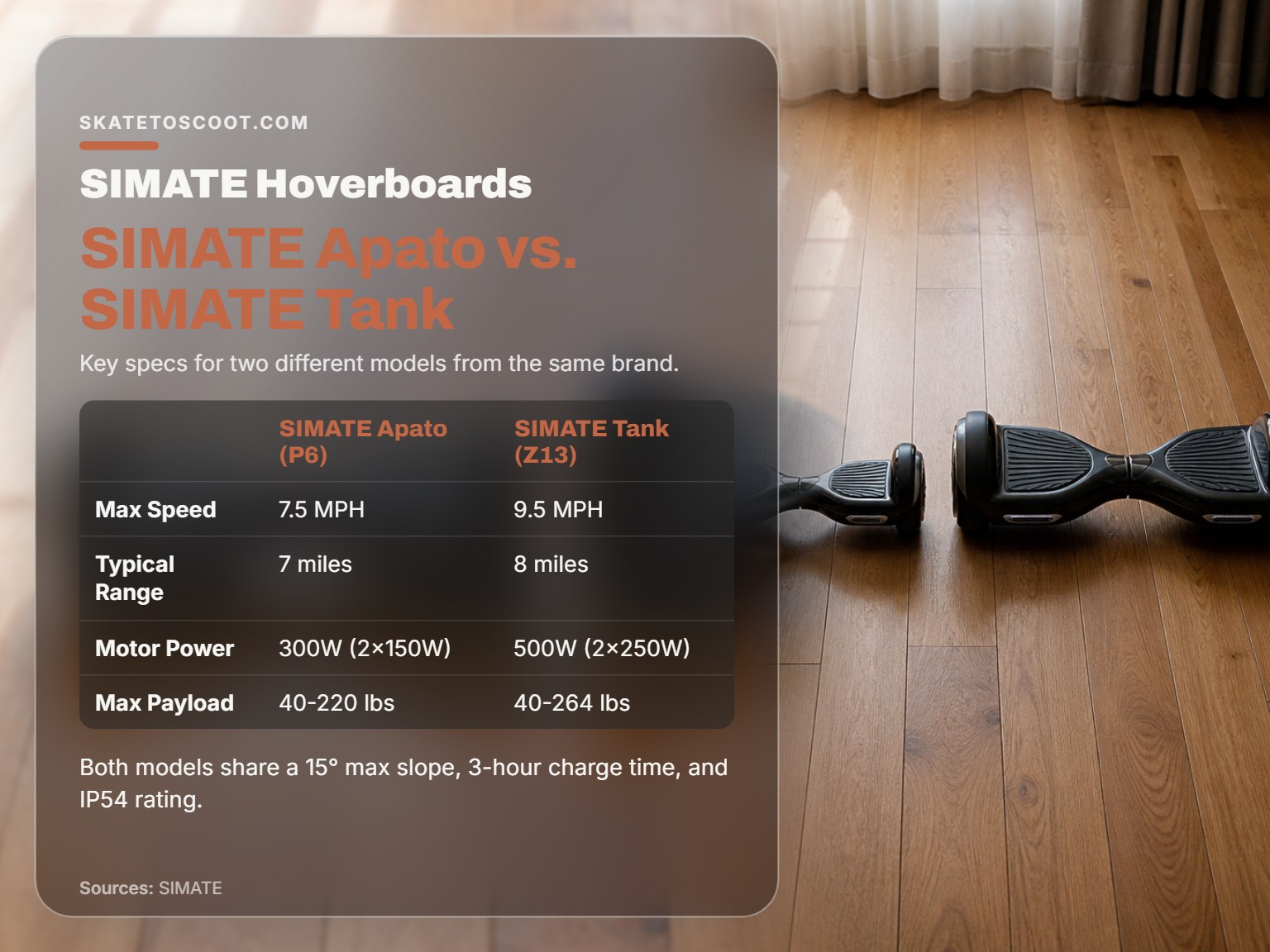
| Specification | SIMATE Apato (P6) | SIMATE Tank (Z13) |
|---|---|---|
| Motor Power | 300W (2x150W) | 500W (2x250W) |
| Max Speed | 7.5 MPH | 9.5 MPH |
| Typical Range | 7 miles | 8 miles |
| Max Payload | 40-220 lbs | 40-264 lbs |
| Wheel Size | 6.5 inch | 8.5 inch |
| Net Weight | 13.6 lbs | 28.4 lbs |
| Best For | Younger kids, casual use | Older kids, teens, lighter adults |
If your decision is between these two SIMATE models, it’s straightforward, as any simate hoverboard review will note: small child, flat surfaces, Apato; older rider, rougher paths, Tank. But this is only half the picture. You should also weigh them against other top hoverboards from brands like Swagtron or Gyroor before pulling the trigger.
Safety, Certifications, and the Fine Print You Must Read
The reality of safety is this: a hoverboard is a lithium-ion battery pack you stand on. The U.S. Consumer Product Safety Commission (CPSC) opened investigations into hoverboard fires back in 2015. While standards have improved, their core warnings remain critical.
SIMATE states its batteries and chargers are UL certified, and the FCC ID 2A5BV-SIMATE001 filing shows compliance for radio frequency use. The boards also carry an IP54 ingress protection rating, meaning they’re resistant to dust and water splashes from any direction. This does not make them waterproof. The SIMATE FAQ is blunt: water damage voids the warranty.
The official CPSC hoverboard safety statement from Chairman Elliot F. Kaye lays out rules that often go beyond the manual:
- Do not charge overnight or unattended.
- Charge in an open, dry area away from anything flammable.
- Let the board cool for an hour after riding before plugging it in.
- Wear a skateboard helmet, knee and elbow pads, and wrist guards.
Before you start:
These federal guidelines exist because the chemistry is inherently risky. The manual adds specific temperature rules: don’t charge if the board is below 0°C (32°F); only charge in an environment above 10°C (50°F). Ignoring this to “top it off” in a cold garage is how you stress the battery. For detailed hoverboard safety advice that blends manufacturer specs with real-world precautions, it’s worth reading beyond a single review.
Real-World Performance: Where the Specs Meet the Sidewalk
The official Jinhua SIMATE manual states a typical range of 7 miles for the Apato, though user experiences can vary significantly. An Amazon review from March 2025 tells a different story: an initial unit died in under 30 minutes; a replacement provided “a solid hour of runtime.” That’s a huge spread, and it highlights the biggest variable: rider weight and terrain.
My take? The 7-mile figure is a best-case-scenario lab test. On actual pavement, with a rider near the 180-pound mark, expect 4 to 5 miles. A child at 70 pounds might hit the advertised range. The Tank’s 8-mile claim follows the same logic.
The learning curve is another area where reality is kinder than expectations. SIMATE says it takes 3–5 minutes to learn balance and 30 minutes to get good. For most kids, that’s about right. That takes a few sessions.
Common performance hicwarts owners report:
- Calibration drift: If the board starts pulling to one side, the fix is in the manual: turn it off, then press and hold the power button for about 10 seconds until it beeps. This resets the gyroscopes.
- Charger variability: The manual states a 3-hour charge time, though some users report longer charge times, which can indicate a weaker charger or a battery issue.
This performance profile places it squarely in the “toy” or “short-commute” category, not serious transportation. For a more capable personal transporter, you might want to read a hoverboard vs scooter comparison to see if a two-wheeled scooter better fits your needs.
Warranty, Returns, and Customer Service Reality
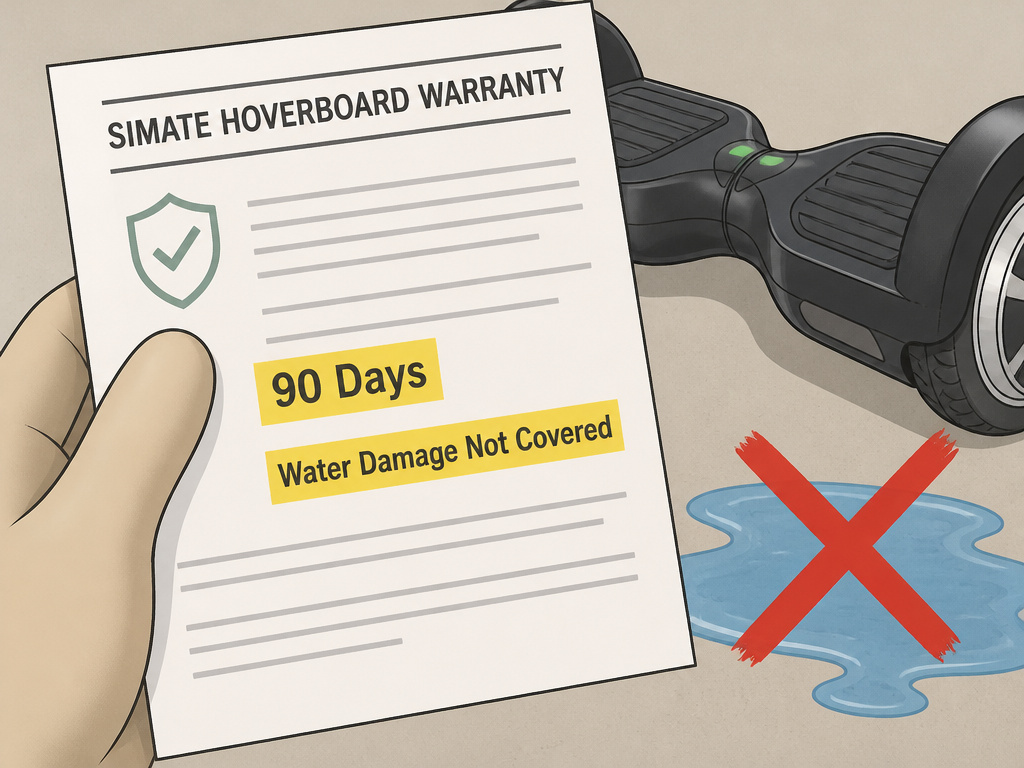
SIMATE offers a 90-day warranty on hoverboards purchased from its website, though their FAQ also mentions a 1-year warranty in the context of water damage exclusions. This is a key point of confusion: their FAQ mentions both a 90-day manufacturer’s warranty and states “water-damaged boards are not covered under a 1-year warranty.” The official returns page confirms the 90-day term for esimate.com purchases.
What does the warranty actually cover? The policy states it covers “manufacturing faults or electrical failures.” You must contact them within 7 business days of receiving a defective product and return it within 15 days, in original packaging. Crucially, you pay the return shipping.
What most people get wrong: The warranty does not cover “water damage” or “crash or accidental damage (such as scratches or broken shells).” If your kid rides through a puddle and the board fries, or if they take a tumble and crack the plastic shell, you’re buying a new board.
The return policy for a change of heart is strict. Cancel an order within 24 hours for a full refund. After that, a 10% processing fee is charged for cancellation. This is more restrictive than many larger retailers. It means you need to be fairly confident in your purchase after the first day.
This approach to support is a hallmark of value-focused direct-to-consumer brands. The savings upfront come with less cushion on the backend. It’s a trade-off. When considering the overall hoverboard cost, factor in that a longer warranty or more generous return policy from another brand might be worth a slightly higher initial price.
How SIMATE Stacks Up Against Other Brands
SIMATE isn’t the only player. Brands like Swagtron, Gyroor, and Hover-1 dominate the Amazon bestseller lists. How does the Apato compare? It’s a game of trade-offs.
SIMATE’s Advantages:
- Price: It’s typically positioned at the lower end of the price spectrum for UL-certified boards.
Where Competitors Often Win:
- Warranty: It’s common to find 1-year limited warranties from competitors, offering longer protection than SIMATE’s 90 days.
If you’re looking for a simple, app-enabled board for a child and the price is right, the SIMATE Apato is a contender. If you prioritize long-term durability, a longer warranty, or need a board that can handle a full-grown adult more confidently, you should expand your hoverboard reviews to include models specifically designed as hoverboards for adults.
Is a SIMATE hoverboard worth the price?
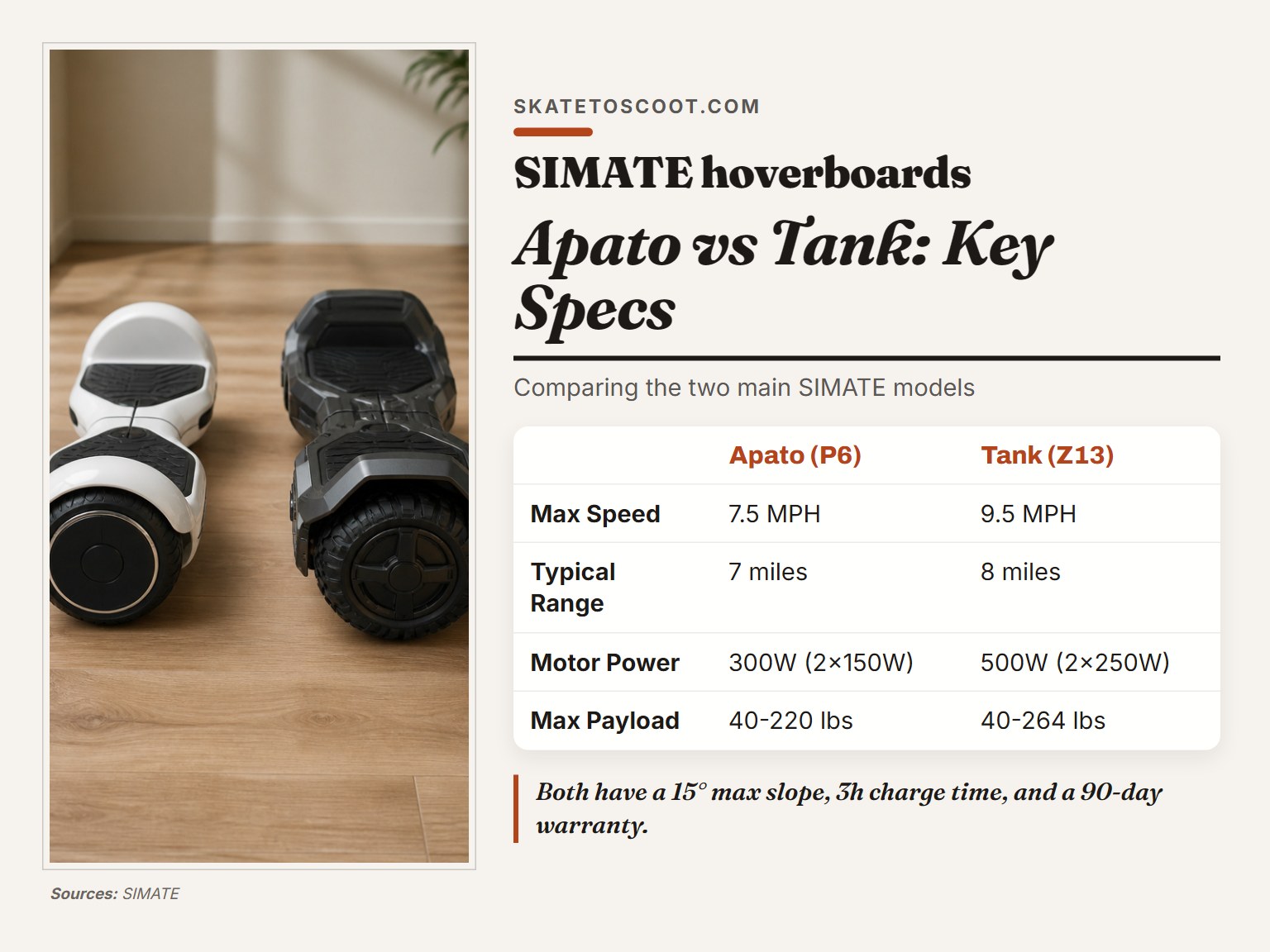
SIMATE hoverboards are positioned as entry-level options, and their value depends heavily on matching the right model to the rider. The Apato (P6) is the lighter, more basic model with a maximum speed of 7.5 MPH and a typical range of 7 miles, suited for younger riders. The Tank (Z13) offers more power and a higher maximum speed of 9.5 MPH for a slightly longer range of 8 miles, catering to a broader weight range. Both come with a 90-day warranty. To assess value, consider the rider’s age, weight, and whether the primary use is casual play or more frequent riding. The performance specs align with the budget-friendly category, so expectations for hill-climbing or long-distance travel should be tempered.
Frequently Asked Questions
Is the SIMATE hoverboard good for beginners?
Yes, especially the Apato model. Its lower weight, slower top speed (7.5 MPH), and beginner speed mode make it manageable. The learning curve is relatively short, and the board’s self-balancing technology does most of the work once you step on correctly.
What is the weight limit for a SIMATE hoverboard?
The limit varies by model. The SIMATE Apato (P6) has a maximum payload of 40-220 pounds according to its manual, though SIMATE’s FAQ states a range of 44-220 pounds. The Tank (Z13) can handle a maximum payload of 40-264 pounds. Always check the specific model’s manual, as these are the maximum limits, not necessarily the recommended weights for optimal performance.
Does the SIMATE hoverboard have Bluetooth?
Yes, both the Apato and Tank models have a Bluetooth module that allows you to pair a smartphone to play music through the built-in speakers. The speaker quality is basic, and the connection can sometimes drop if the board is too far from the phone.
Are SIMATE hoverboards UL 2272 certified?
SIMATE states that its hoverboard batteries and chargers are UL certified. This is a critical safety certification that reduces the risk of fire. You should verify this certification is listed on the specific product listing or packaging before purchase.
How long does the SIMATE hoverboard battery last?
Under ideal conditions, the Apato’s 36V 2.0Ah battery is rated for about 7 miles, and the Tank’s 36V 4.0Ah battery for about 8 miles. Real-world range is heavily influenced by rider weight, terrain, and use of features like lights and speakers, and can be significantly shorter.
Can adults ride SIMATE hoverboards?
Adults within the weight limit can ride them, but the experience differs by model. The Apato is best for lighter adults. The Tank, with its higher weight limit and more powerful motors, is the better choice for most adults, though many dedicated self-balancing scooters from other brands are engineered specifically for adult use and comfort.
The Bottom Line
The SIMATE hoverboard, particularly the Apato model, is a functional entry point into the world of self-balancing scooters. It gets the basics right: UL certification, a usable app, and a manageable learning curve for its target age group. The catch is in the details you don’t see in the marketing: the real-world range can be half the advertised figure, the 90-day warranty has glaring exclusions, and the build quality is commensurate with its budget price.
Who it’s for: A parent looking for a first hoverboard for a child under 12, who will supervise its use, charge it safely, and understands it’s a toy with a limited lifespan.
Who should look elsewhere: Heavier riders, adults seeking reliable transportation, or anyone who values a longer warranty and robust customer support over the lowest upfront cost. In those cases, the savings aren’t worth the trade-offs, and investing in a more established brand is the wiser move.
Your fundamentals are your foundation, even in buying gear. Prioritize certified safety and realistic performance expectations over flashy LED patterns. That approach will keep the rider safe and the experience fun, which is the whole point.
