Viro Rides Vega 2 in1 Scooter Review: Specs and Limits
This post contains affiliate links. As an Amazon Associate, we earn from qualifying purchases.
The Viro Rides Vega 2-in-1 Transforming Electric Scooter is a kid’s toy with a 100W motor, a top speed of 10 mph, and a 6-mile range on a sealed lead-acid battery. It converts between scooter and mini-bike modes, carries up to 120 lbs, and takes 10-12 hours to charge. It’s built for ages 8+ on flat pavement, not for speed or hills.
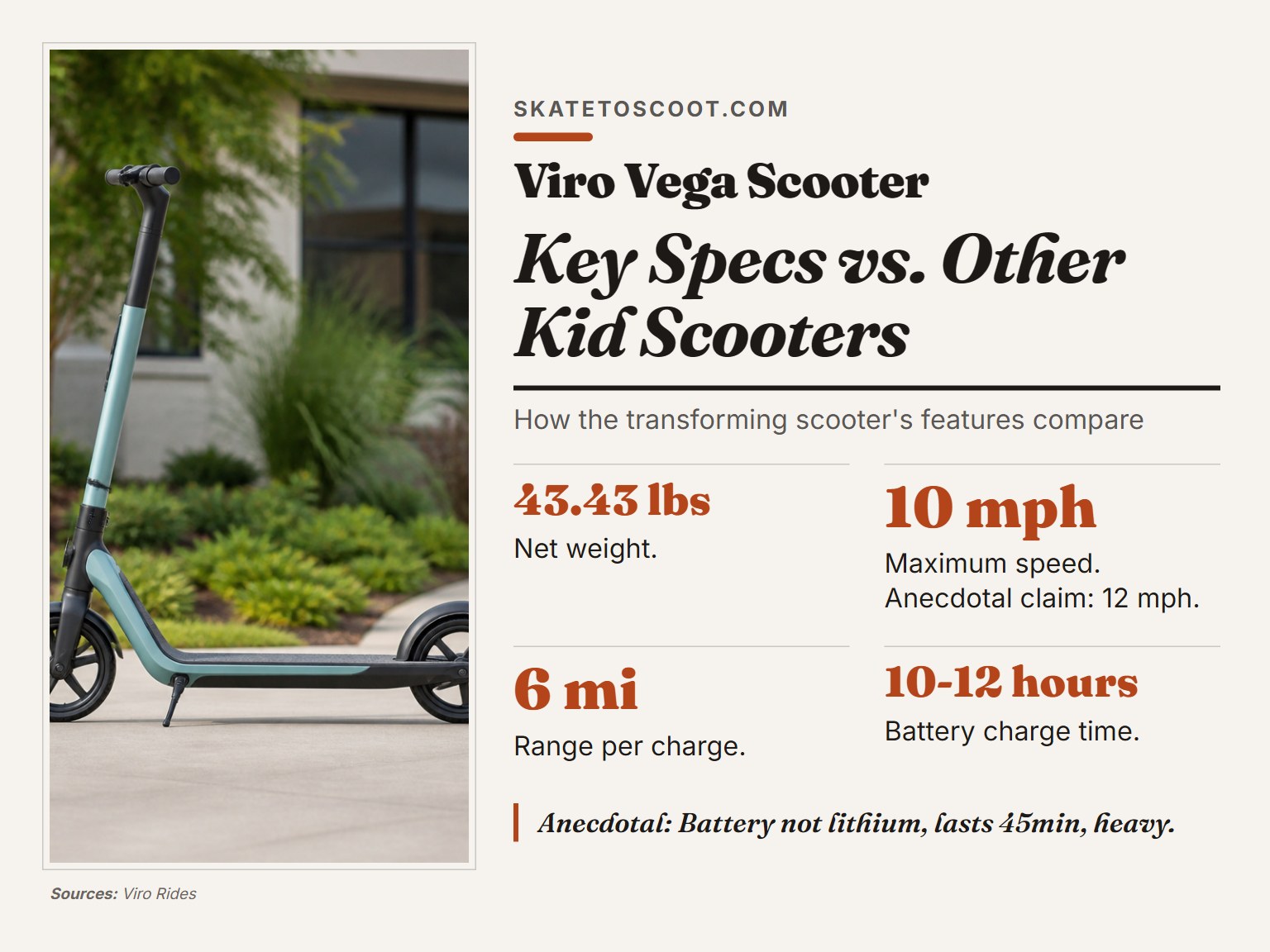
That 10 mph figure is the manufacturer’s number, pulled straight from the Viro Rides manual. The official top speed is 10 mph, though some owners report speeds closer to 12 mph on a fresh charge. The difference of a couple of miles per hour marks the line between a controlled ride in a driveway and a dash that might feel too fast for a younger rider on their first electric vehicle.
What follows: a breakdown of every spec from the manual, the real-world gripes from owners, and the one storage rule that kills the battery if you forget it. This review focuses on whether the scooter’s limits match your expectations and what you’re actually buying for the money, not on its fun factor for kids.
Key Takeaways
- The 10 mph top speed and 6-mile range are for a 120 lb rider on flat ground; add weight or a slight incline and both numbers drop.
- It uses a sealed lead-acid battery, not lithium-ion, which requires a monthly charge during storage and is permanently damaged by freezing.
- The 90-day warranty explicitly excludes normal wear and tear, tires, tubes, and cables, the parts that fail first.
- Switching between scooter and bike modes requires adult help; the mechanism isn’t designed for young kids to operate alone.
- Attempting to modify it for more speed means replacing the motor, battery, and controller, a project that costs more than a faster scooter.
The Viro Vega’s Core Specs (and What They Actually Mean)
You can find a list of numbers on any box. The manual has them all. The trick is knowing which ones are ceilings, which are estimates, and which are hard stops.
The motor is a 24V DC brush type rated at 100 watts. That’s not a lot. For comparison, a typical adult electric scooter might start at 250 watts. The rated output torque is 0.45 N.m. In practice, this means the scooter has enough grunt to get a kid moving on level pavement, but it will noticeably struggle on anything steeper than its rated 4° grade ability. If your driveway has a slope steeper than its 4° grade ability, expect the speed to dip or the scooter to stop.
The Viro Rides Vega 2-in-1 uses a 24V, 5Ah sealed lead-acid battery (two 12V cells) with a 120Wh capacity. The specified charger is model FY0172400600, outputting 24VDC at 600mA. A full charge cycle takes 10-12 hours from empty. The battery’s operational temperature range is 5°F to 104°F (-15°C to 40°C).
That battery chemistry is the single biggest factor in how this scooter behaves. Sealed lead-acid is heavy, slow to charge, and loses capacity faster over time than lithium-ion. The 120Wh capacity translates to the advertised 6-mile range under ideal conditions. In real back-and-forth driveway play, runtime will be less than the advertised 6-mile range. Owners on YouTube confirm this, one noted it “lasts 45min charge.”
Here’s how the key performance specs stack up and what they practically limit:
| Specification | Official Number | What It Means for the Ride |
|---|---|---|
| Top Speed | 10 mph (16 km/h) | The governed maximum. Some riders report ~12 mph on a full battery, but sustained speed is closer to 10. |
| Range | 6 mi (9.6 km) | Best-case scenario. Frequent throttle use, rider weight near the limit, or cold temps reduce this. |
| Max Load | 120 lbs (54 kg) | A hard limit. Exceeding it stresses the motor, battery, and frame, voiding the warranty. |
| Charge Time | 10-12 hours | The battery must charge fully after each use. Partial charges degrade lead-acid cells faster. |
| Grade Ability | 4° | The scooter can handle a very gentle incline. Most driveway aprons are steeper than this. |
The scooter has 7-inch solid tires and a 4.92 ft turning radius. The IPX4 rating provides protection against water splashes from any direction.
The 2-in-1 Transformation: How Easy Is It?
The main selling point is the switch between scooter and mini-bike. The marketing makes it look like a one-button magic trick. Switching modes is a mechanical process that, according to the TTPM toy review, “isn’t the easiest so kids are probably not going to be able to do it themselves.”
The transformation involves pulling a lever to release the seat post, rotating the main frame, and locking a new latch. It requires a firm pull and some coordination. According to a review, switching modes isn’t easy for kids, so they may need adult help. This isn’t a flaw in your unit; it’s a design trade-off for sturdiness. The mechanism has to withstand crashes and kid-handling, so it’s built tight.
Where this goes sideways: Forcing the transformation levers. The plastic latches can crack if you use excessive strength instead of checking for debris in the tracks. A broken latch means the scooter is stuck in one mode.
But that same seated position means less room for error if the rider leans too far, the foot pegs are the only contact point besides the seat.
The assembly out of the box is straightforward. You attach the handlebars, secure the seat, and charge the battery. The official Viro Rides YouTube channel has a playlist of how-to videos that walk through each step clearly. Assembly requires a Phillips head screwdriver.
Battery, Charging, and the Critical Storage Rules
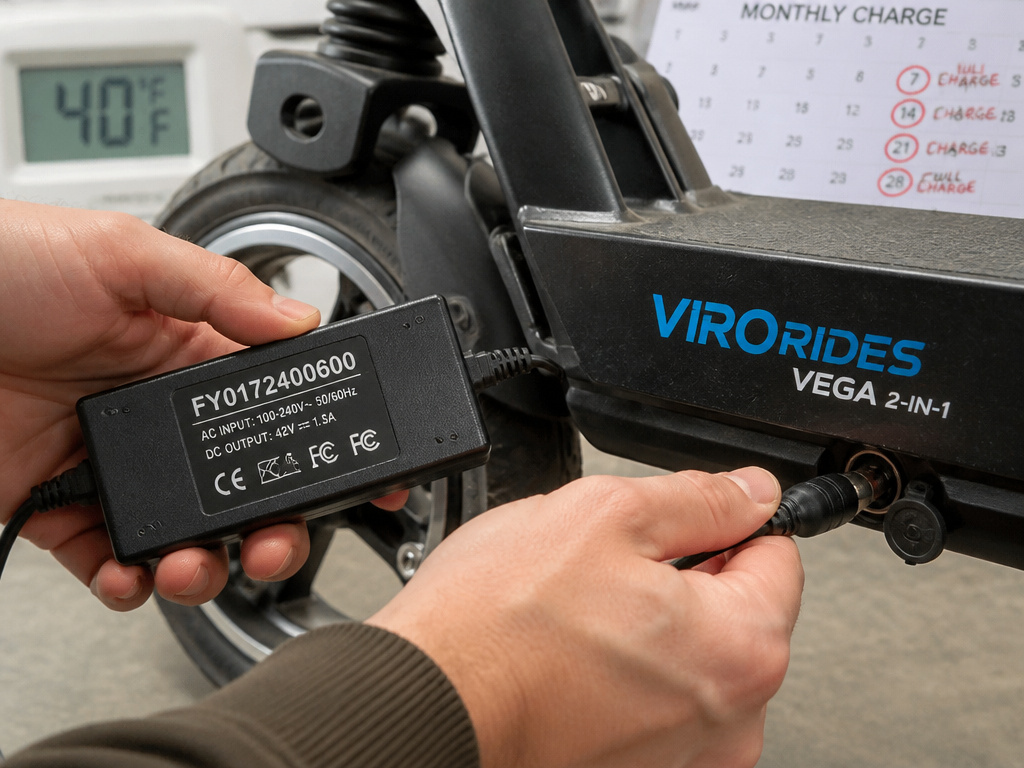
This isn’t just a “plug it in overnight” situation. The sealed lead-acid battery demands a specific routine. Ignore it, and you’ll be buying a replacement, which, given the 90-day warranty doesn’t cover normal wear and tear, is an out-of-pocket cost.
First, the charger. The manual specifies the FY0172400600 model, outputting 24VDC at 600mA. The manual specifies using the FY0172400600 charger. Lead-acid batteries are fussy. The charge time is 10-12 hours.
Second, temperature. The operating range is 32°F to 104°F. The charging temperature must not exceed 104°F (40°C). More critically, the storage rule is absolute: Never store the product in freezing or below freezing temperatures. Freezing will permanently damage the battery. If you live in a climate with winters, the scooter cannot live in an unheated garage or shed.
Third, maintenance. The manual states the battery must be charged at least once a month during storage. This monthly charge during storage helps maintain battery health. If you put it away in October and forget about it until spring, the battery will likely be dead.
| Scenario | Correct Action | Risk of Skipping |
|---|---|---|
| After a ride | Plug in for a full 10-12 hour charge. | |
| Storing for winter (in freezing climate) | Bring indoors, charge monthly. | Freezing expands the electrolyte, cracking the case and ruining the battery. |
| Storing for a month (in a garage) | Charge to full, then charge again every 30 days. | Sulfation builds, reducing range until the battery won’t hold a charge. |
| Battery seems dead after storage | Try a full 12-hour charge with the correct charger. |
The alternative is a battery replacement. It’s a known issue, there’s a YouTube video titled “Viro ride Vega battery replacement” that walks through the process. It’s doable, but it involves disassembly and working with lead-acid terminals.
Performance Realities: Speed, Weight, and Terrain
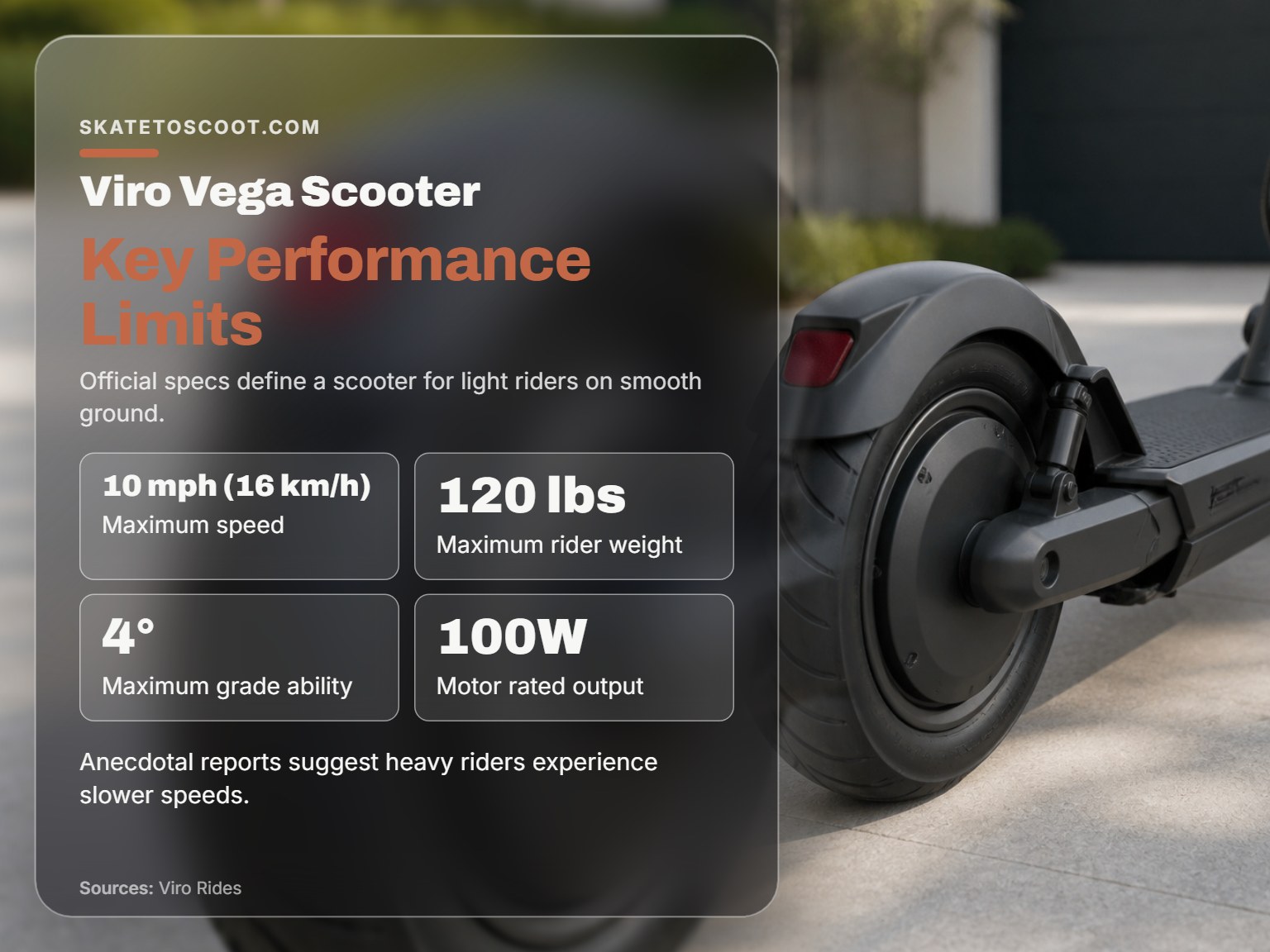
Consider the 120 lb weight limit. It’s there because the 100W motor and plastic-geared transmission can’t handle more. A rider at the limit will experience slower acceleration and a shorter range. One YouTube comment put it bluntly: “If they are heavy kids the scooter goes slow.” This isn’t a slight against the scooter; it’s simple physics. The motor’s rated output torque is 0.45 N.m.
The 10 mph top speed is another point of context. There’s a Reddit thread where an owner asked about modifying their Viro Vega to go faster, calling its 12 mph max “slow.” The community response was unanimous: don’t bother.
“The Viro is a child’s toy with a 24Volt system,” one user wrote, misstating the wattage (the official motor is 100W) but capturing the sentiment. “To make it faster, you would have to replace the controller, motor, and battery.” Another added, “You’re better off putting the money into a more powerful scooter from the beginning.”
That’s the reality. The frame, wiring, and electronics are designed as a closed system. Pushing more voltage through the stock motor would fry it. The modification ceiling is effectively zero.
On terrain, the 4° grade ability and solid tires tell the story. This is for smooth, paved surfaces. Grass, gravel, or bumpy sidewalks will drain the battery quickly and deliver a jarring ride. The scooter’s grade ability is limited to 4°. It’s a park, driveway, and smooth path machine.
Warranty, Safety, and What Breaks First
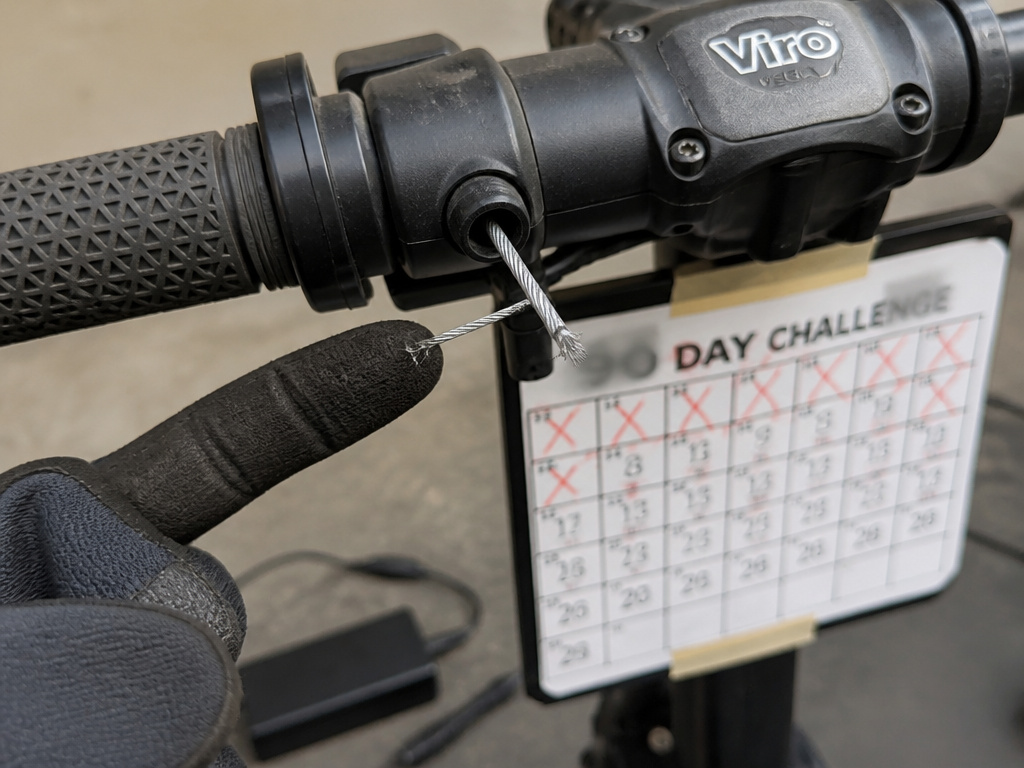
The warranty is 90 days from the date of purchase. Read that again. It’s not a year. It’s three months. The manual is explicit about what isn’t covered: normal wear and tear, tires, tubes, or cables. The warranty excludes normal wear and tear, tires, tubes, and cables. Cables include the throttle and brake wiring.
Common mistake: Assuming the warranty covers everything that stops working. The 90-day period is short, and the exclusions are broad. A frayed throttle cable or a dead battery after four months is your problem.
The scooter complies with FCC Part 15 Class B limits, Industry Canada license-exempt RSS-210, and CAN ICES-3(B)/NMB-3(B). These are electromagnetic interference certifications, not safety standards like UL 2272 for lithium-ion battery systems. This reflects a different class of product with a different battery type, not a mark against it.
What will likely need attention first? Based on owner reports, the charging system and the mechanical latches. The charger is a common point of failure. The latches for the transformation mechanism can get stiff or misaligned.
Safety-wise, a helmet is essential. The scooter has a rear brake lever and a thumb throttle that cuts power when released.
How It Stacks Up: Viro Vega vs. Other Options
The Viro Vega occupies a specific niche: an introductory, transforming electric ride for younger kids. It’s not competing with higher-performance teen or adult scooters. Its real competition is other toy-grade electric scooters and bikes in the same price bracket.
The sealed lead-acid battery is the biggest differentiator. Most modern electric scooters, even for kids, have moved to lithium-ion for its lighter weight and faster charging. The Viro’s battery choice keeps the cost down but adds significant heft, the scooter weighs 43.43 lbs. That’s not something a child can easily carry.
Compared to non-transforming scooters at a similar price, you’re paying for the 2-in-1 feature. If that feature isn’t a must-have, you might find a simpler scooter with a lithium battery and slightly better performance. Conversely, if the transformation is the main draw, there aren’t many direct competitors.
For families with two kids, the Viro Vega isn’t built for sharing in the way a tandem bike is. Its weight limit and slow charge time make it a one-kid-at-a-time toy.
The bottom line on comparisons: The Viro Vega is for the specific use case of a child aged 8-10 who wants both a scooter and a mini-bike, who will ride only on flat pavement, and whose parents are diligent about charging and storage. Our other electric scooter reviews cover those alternatives in depth.
Is the Viro Vega UL 2272 certified?
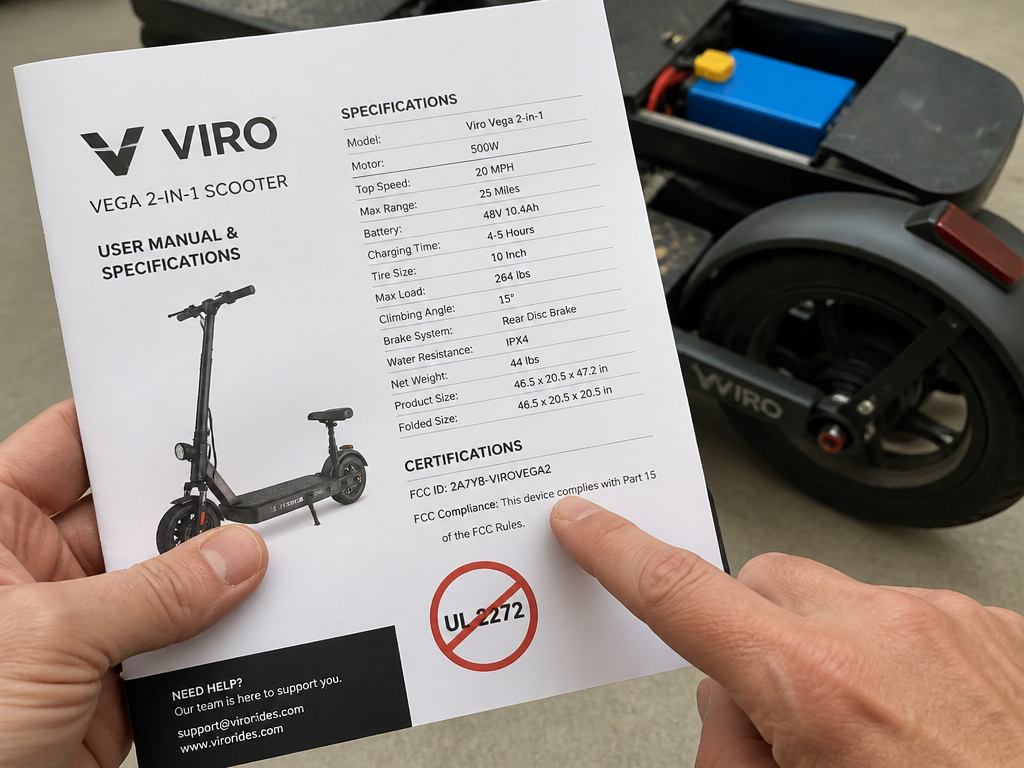
The official manual and specification sheet for the Viro Rides Vega 2-in-1 do not list a UL 2272 certification. This is a critical safety standard specifically for the electrical systems and battery of personal e-mobility devices, designed to mitigate fire risk. The fact sheet only notes compliance with FCC and Industry Canada regulations for electromagnetic interference. For a device with a sealed lead-acid battery, the absence of this specific certification is a point for buyers to consider. It’s a practical reminder to always check the manufacturer’s official documentation for any safety certifications before purchase, as they are a key indicator of a product’s tested safety profile.
Frequently Asked Questions
What is the weight limit for the Viro Vega scooter?
The maximum load is 120 lbs (54 kg), as stated in the Viro Rides user manual. This is a strict limit for the motor, battery, and frame. Riding above this weight voids the warranty and risks damaging the drivetrain.
How long does the battery last on a single charge?
The official range is 6 miles (9.6 km). In practice, with a rider near the weight limit and typical stop-and-start play, expect 40 to 50 minutes of ride time. The sealed lead-acid battery provides consistent power until it’s nearly depleted, then stops abruptly.
Can you make the Viro Vega scooter go faster?
Technically, yes, but practically, no. As discussed in Reddit forums, increasing speed requires replacing the motor, controller, and battery with higher-voltage components, a complex and costly project that defeats the purpose of buying an entry-level toy. The consensus among enthusiasts is to buy a faster scooter instead.
Is the Viro Vega scooter safe for an 8-year-old?
With proper supervision and safety gear, yes. Its 10 mph top speed is manageable, and the seated bike mode offers stability. The rear friction brake is effective, and the thumb throttle cuts power when released. Always pair it with a helmet and consider wrist guards.
What does the 90-day warranty cover?
The manufacturer’s limited warranty covers defects in materials and workmanship for 90 days from purchase. It explicitly does not cover normal wear and tear, tires, tubes, or cables. Damage from improper use, modification, or failure to follow storage/charging instructions also voids the warranty.
Before You Go
The Viro Rides Vega 2-in-1 is a competent toy for a specific moment in a kid’s life. It delivers on its core promise: a transforming electric ride that feels exciting for a first-timer. Its specs, from the 10 mph speed to the 120 lb limit, create a built-in safety envelope.
Your decision comes down to matching its constraints to your environment. Do you have flat, smooth pavement? Are you willing to manage a 10-12 hour charge cycle and monthly battery maintenance? Is your child in that 8-10 age range and under the weight limit? If you answered yes, it’s a solid choice. If any answer is no, you’ll feel every one of those limitations.
For everything else, hills, older kids, longer rides, or less maintenance, the wider world of electric scooters has better options. Check our scooter reviews for models that match a different set of needs. The Vega does its job well, but its job is deliberately small.
