What Are Skateboard Trucks Made of: Materials Explained
This post contains affiliate links. As an Amazon Associate, we earn from qualifying purchases.
Skateboard trucks are made of aluminum alloys for the hanger and baseplate, steel alloys for the axle and kingpin, and polyurethane for the bushings and pivot cup. The specific grades, like A356 T6 aluminum, SCM435 chromoly steel, and Grade 8 steel, determine strength, weight, and cost. Magnesium and premium aluminum alloys are used in lightweight and high-performance models.
That breakdown comes straight from product spec sheets and a 2025 peer-reviewed study. The “aluminum and steel” answer you’ll find everywhere is correct, but it misses the specifics that actually decide how a truck performs and how long it lasts. A key question for any rider is: what are skateboard trucks made of?
What follows: the exact alloys used by major brands, the one material trade-off that burns out electric motors, the two tools you must have for any maintenance, and a clear verdict on when a premium material is worth the upgrade.
Key Takeaways
- The hanger and baseplate of mass-produced trucks are often A356 T6 aluminum, a sand-cast alloy chosen for cost, but other materials like 7075-T6511 milled aluminum (Parsec), 6061 extruded aluminum (a patent), and magnesium (Tensor) are also used.
- Axles and kingpins use high-strength steel alloys; SCM435 chromoly and Grade 8 steel are industry standards for durability.
- Urethane bushings are consumable parts; their hardness (measured in durometer) controls turn responsiveness and must be replaced periodically.
- Magnesium and 7075 aluminum save weight but involve stiffness and cost trade-offs most street skaters don’t need.
- All axle nuts need a 3/8 inch socket, and all kingpin nuts need a 9/16 inch socket, these are mandatory for basic adjustments.
The Core Materials: Hanger, Axle, Kingpin, and Bushings
We’ll examine this step by step. A truck isn’t a monolithic piece of metal; it’s an assembly of parts, each with a specific job and a material chosen to do it, which is the core of what are skateboard trucks made of. Getting the wrong material for any part means that part fails first.
The hanger of a standard truck is made from aluminum sand casting (A356 T6) for cost reasons, while the axle is a high-strength steel like SCM435 chromoly. Bushings and pivot cups are polyurethane, and the kingpin is typically Grade 8 steel. These material choices represent a balance of weight, strength, wear resistance, and manufacturing cost.
The Hanger and Baseplate: A356 T6 Aluminum (Almost Always)
The hanger is the big, grindable triangle you see. The baseplate is the flat piece that bolts to the deck. For many mass-produced trucks, the default material has been A356 T6 aluminum, though other alloys are used for specific performance goals.
This isn’t a random choice. A 2025 study from Friedrich-Alexander-Universität Erlangen-Nürnberg identified A356 T6 aluminum sand casting as the standard for mass-produced trucks precisely because of cost. It’s strong enough, light enough, and cheap to produce in volume. You’ll find it in the benchmark Independent Stage 11 Standard truck, where the product page explicitly lists “A356 T6 Aluminum Hanger & Baseplate.”
What does that mean? A356 is the aluminum alloy; “T6” refers to a specific heat treatment that increases its strength and hardness. It’s a workhorse.
The Axle: Where Steel Takes the Load
The axle is the rod your wheels slide onto. It handles shear forces every time you land and lateral forces when you turn. Aluminum would bend here. Steel doesn’t.
Brands use different high-strength steels, but they all serve the same purpose. The Independent Stage 11 Standard uses SCM435 chromoly steel. Ace AF-1 Trucks use SAE 4140 Alloy Steel. Sabre Forged Precision MK3 trucks use EN24T steel for their axle studs, an aerospace-grade alloy they bond permanently to the hanger.
The choice matters for maintenance. Sabre’s manual warns that its EN24T axles, while extremely strong, are not stainless. They require periodic wiping with an oily rag to prevent surface corrosion, which can make bearings seize. That’s a specific care requirement cheaper, coated axles don’t have.
The Kingpin: Grade 8 Steel or Better
The kingpin is the large bolt that holds the hanger to the baseplate and clamps the bushings. It needs to resist bending and snapping. Grade 8 steel is the common standard, denoted by six radial lines on the bolt head. It’s a minimum.
Some brands go further. Independent stamps “Grade 8” directly on their kingpins. The point is sheer reliability, this part should never be the point of failure. Overtightening it, however, is a common mistake that destroys the next component.
Bushings and Pivot Cups: Urethane’s Domain
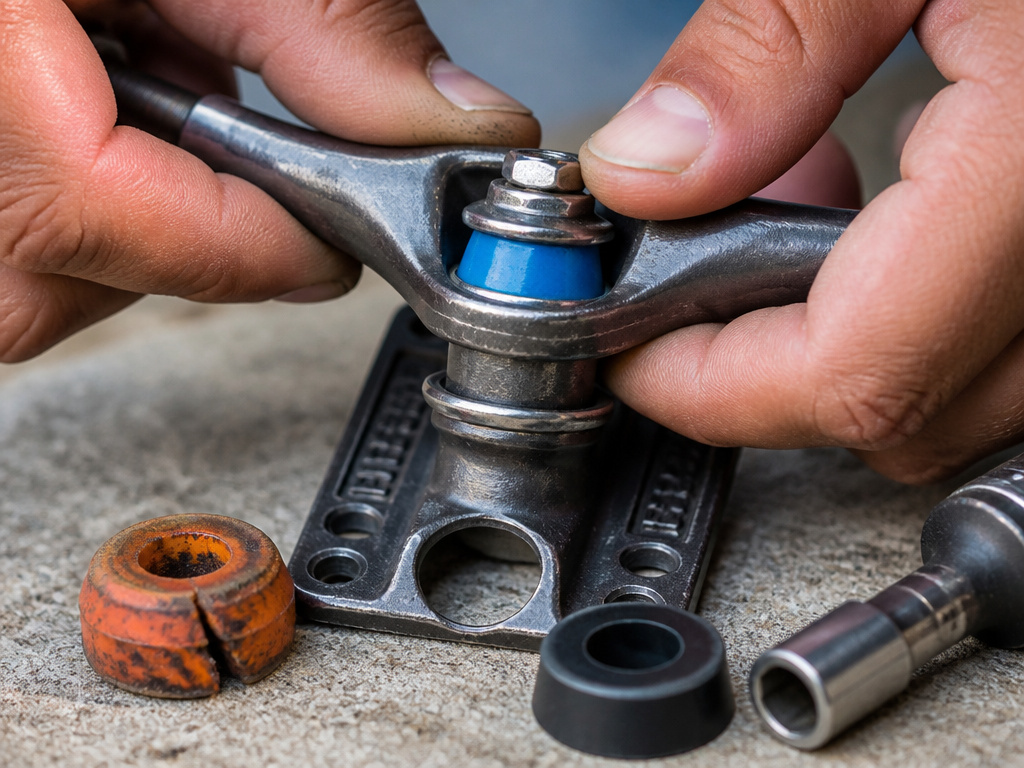
Bushings are the urethane donuts that fit over the kingpin. The pivot cup is the urethane socket the hanger pivots in. They are the suspension system, and they are consumable.
Urethane is chosen for its predictable rebound and resistance to deformation. Different hardnesses (90a, 92a, 96a) offer different turn feels. Ace AF-1 Trucks use hand-poured 96a urethane pivot cups for a specific, consistent feel.
Bushings and pivot cups wear out long before any metal part fails. Sabre’s manual states both are “consumable parts” that should be periodically inspected and replaced. Ignoring a worn, cracked, or over-compressed bushing is how you get speed wobbles and unpredictable turning.
Material Trade-Offs and Performance
So we have aluminum for the frame and steel for the bones. Why would anyone use anything else? The answer lives in a three-way tug-of-war between weight, stiffness, and cost when you compare a what are skateboard trucks made of list.
| Material | Best For | Trade-Off / Risk |
|---|---|---|
| A356 T6 Cast Aluminum | Standard street trucks, cost-effective mass production | Heavier than premium alloys; standard performance. |
| 7075-T6511 Milled Aluminum | High-performance/E-skate trucks (e.g., Parsec Aero Pro) | 2-3x stronger & 30% lighter than cast, but significantly more expensive. |
| Magnesium | Ultra-lightweight trucks (e.g., Tensor) | ~25% lighter, but the 2025 study notes “lower stiffness,” making it less popular for street skating. |
| Titanium | High-end, weight-conscious builds | Exceptional strength-to-weight ratio; price is extremely high for marginal gain. |
The peer-reviewed sports equipment optimization framework puts numbers on this. It analyzed the market and found an average truck mass of 344 grams. Tensor’s lightweight truck has a mass of 288 g, but the study directly links its “lower stiffness” to its lack of popularity among street skaters who need a solid, predictable platform for impacts.
Meanwhile, Parsec claims its 7075-T6511 milled aluminum trucks are “2–3 times stronger and 30% lighter than standard cast aluminum.” This claim sits in direct tension with the academic view that lighter materials often sacrifice stiffness. Who’s right? It depends on the riding. For high-speed electric skateboarding where weight and strength are critical, the premium alloy might justify its cost. For a street skater doing stair sets, the standard A356 T6 casting is proven, predictable, and replaceable.
When a Premium Material Makes Sense
Consider upgrades honestly. Moving from standard cast aluminum to forged or milled aluminum (like on Sabre or high-end Independent trucks) gets you more precise machining, often better grinding surfaces, and slightly better weight distribution. It’s a sensible step up if you’re building a performance setup and care about the details.
Moving to magnesium or titanium is a luxury weight-shavings game. The performance difference for most skaters is negligible. The cost difference is not. It’s like buying a race car to drive to the mailbox.
How Long Will Skateboard Trucks Last?
This is a “People also ask” question for a reason. The lifespan isn’t about a single number of months; it’s about which part wears out first under your specific use.
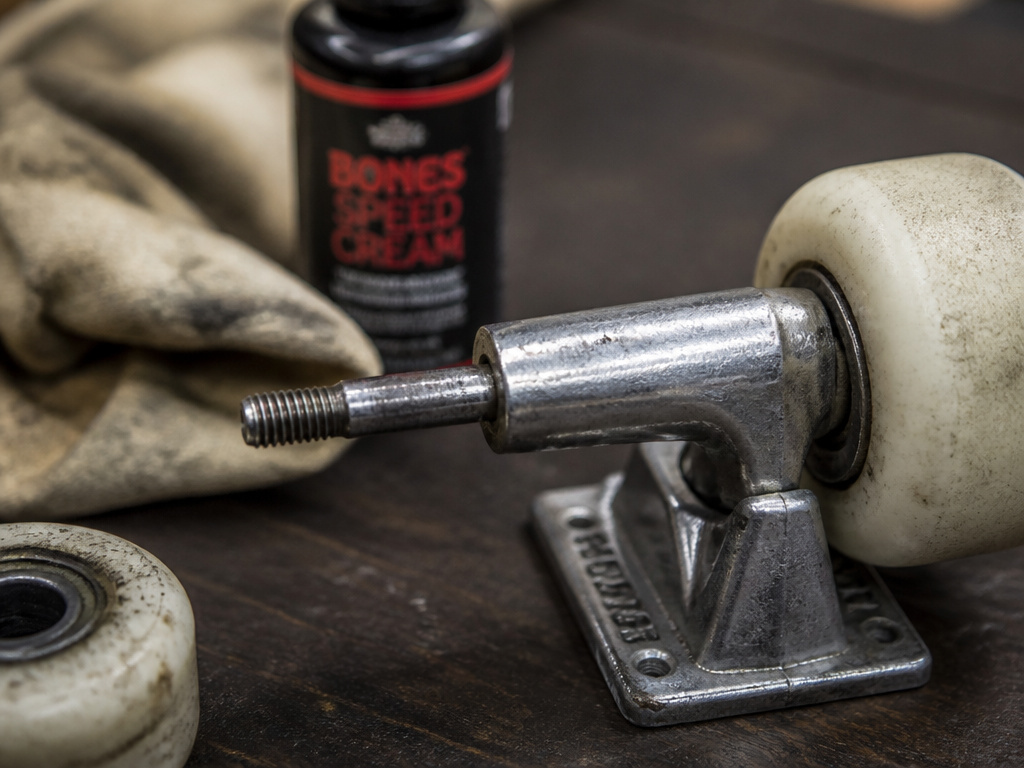
The metals can last for years, even a decade. A well-made aluminum hanger and steel axle don’t fatigue under normal skating loads. Corrosion is the main enemy, especially for raw or black-oxidized steel axles in wet climates.
The urethane parts are on a shorter clock. Bushings degrade from compression, heat, and ozone exposure. Bushings are consumable parts that need periodic replacement; a hard-charging skater may need to replace them more often. Pivot cups wear from friction and grit.
The real killer is neglect. Grit in the pivot cup acts as sandpaper. An overtightened kingpin nut (more than three threads showing, per Sabre’s rule) crushes and pre-matures bushings. Surface corrosion on axles, which a quick wipe with an oily rag prevents, can seize bearings.
Your maintenance habits decide the calendar more than the materials do.
Compatibility: Can You Put Any Truck on Any Skateboard?
Almost, but with three firm rules. The truck must match the deck in width, hole pattern, and wheel clearance.
1. Width Matching: The axle width should roughly match the deck width. A common rule is the truck axle should be close to the deck width. Too narrow feels unstable; too wide leads to wheelbite or kicking your own wheels when pushing.
2. Hole Pattern: The baseplate must match your deck’s mounting holes. The modern standard is a 6-hole pattern (often with two holes unused). Some older decks or specific cruiser shapes use different patterns.
3. Wheel Clearance (Height): This is where material choice subtly matters. Truck height (low, mid, high) determines how big a wheel you can run without bite. Warehouse Skateboards recommends 53-56mm wheel size for mid-level trucks and 56mm+ wheel size for high trucks. If you’re using a lightweight truck to run bigger, softer wheels for cruising, you still need the height to match.
Common mistake: Pairing low trucks with large, soft wheels to get a cushy ride. Without a riser pad, you’ll get wheelbite on the first carve. The solution is either smaller wheels or higher trucks.
The material of the truck itself doesn’t affect compatibility. A titanium truck bolts on the same as an aluminum one. Your choice should flow from your deck size and wheel preference first.
Essential Tools for Maintenance by Material
You can’t adjust or maintain what you can’t take apart. The tools are defined by the hardware, not the brand.
| Truck Part | Tool Required | Notes & Material-Specific Tips |
|---|---|---|
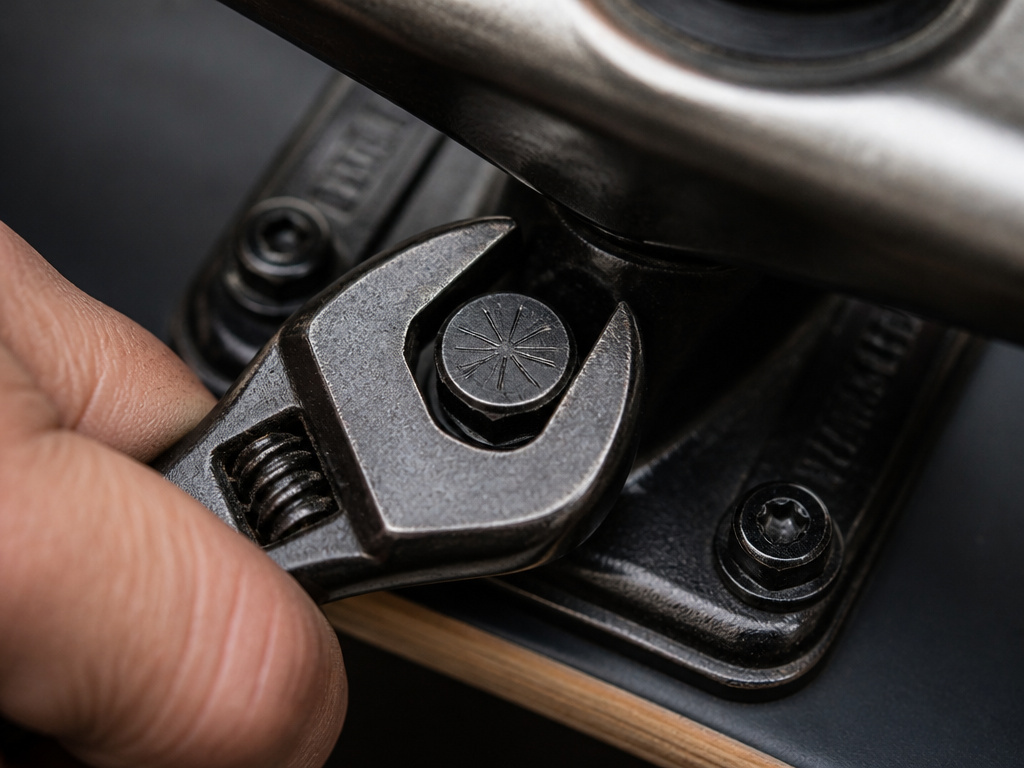
| Axle Nuts | 3/8 inch socket wrench | Universal. Needed for wheel changes. |
| Kingpin Nut | 9/16 inch socket wrench | Universal. Critical for bushing adjustment/replacement. |
| Seized Bearing | Rubber mallet + open-ended wrench | For tapping corroded bearings off tight-tolerance axles (like Sabre’s EN24T). |
| Axle Corrosion | 220 or 320 grit emery paper | Sabre recommends this fine grit to remove corrosion without oversizing the axle. |
| Mounting Bolts | 3/8 inch socket or skate tool | For installing trucks onto the deck. |
A basic skate tool covers most of this. The emery paper and mallet are for the edge cases, when corrosion has set in on a precision axle, or when a bearing is truly stuck. Having them means you can salvage a high-end truck instead of forcing a damaged bearing and scarring the axle.
For routine care, a rag and a drop of lubricant (like Sabre Bearing Lube) for the pivot point are enough. Sabre’s manual warns that too much lube attracts dirt and accelerates wear. A little goes a long way.
The Verdict: What Should You Buy?
If you want one answer for a standard street setup: buy Independent Stage 11 Standard trucks in the width that matches your deck. They use the benchmark A356 T6 aluminum and SCM435 chromoly steel. They are the default for a reason, proven, widely available, and serviceable.
If you are building a high-performance electric skateboard or want the absolute strongest, lightest option and budget is secondary, look at Parsec Aero Pro trucks milled from 7075-T6511 aluminum. The strength claims are significant for high-power applications.
If you value precision machining, a forged feel, and are willing to follow specific maintenance (oiling axles), Sabre Forged Precision MK3 trucks offer a distinct, high-quality alternative.
Skip magnesium unless you are a dedicated tech skater obsessed with shaving grams and understand the potential stiffness trade-off. The cost and niche benefit don’t justify it for most.
Having the right skateboard tools is as important as your truck choice. A seized bearing on a perfect truck is a paperweight without the right wrench.
How to Choose Truck Width Relative to Deck
Matching truck width to your deck is about wheel alignment and control. The goal is for the axle width to be very close to the width of your deck at its widest point. This positions the wheels directly under your feet for better control. If the trucks are too narrow, the board becomes less stable and can feel tippy. If they are too wide, the wheels may stick out past the deck, which can cause wheelbite and make the board harder to flip.
Truck Height Categories (Low, Mid, High)
High trucks provide more clearance between the deck and wheels, which is necessary when using larger wheels to prevent wheelbite. Your wheel size dictates which height you need. For mid-height trucks, a common wheel size range is recommended, while high trucks are paired with even larger wheels, sometimes requiring additional pads for clearance.
Frequently Asked Questions
What are most skateboard trucks made of?
Most mass-market skateboard trucks are made of A356 T6 aluminum for the hanger and baseplate, a chromoly or high-grade steel for the axle, Grade 8 steel for the kingpin, and polyurethane for the bushings and pivot cup. This combination offers the best balance of strength, weight, and cost for general street and park skating.
How long will skateboard trucks last?
The metal components (hanger, baseplate, axle) can last for many years, even a decade, with basic care. The consumable parts, urethane bushings and pivot cups, wear out much faster, often needing periodic replacement with regular use. Lifespan is heavily dependent on maintenance: preventing axle corrosion and not overtightening the kingpin are key.
Can you put any truck on any skateboard?
No. Trucks must match the deck’s width (axle width should be close to deck width), hole pattern (modern 6-hole is standard), and provide enough height to prevent wheelbite with your chosen wheel size. The truck’s material doesn’t affect compatibility, but its dimensions absolutely do.
How much will skate trucks cost?
Cost scales directly with materials and manufacturing. Standard cast aluminum trucks (Independent, Thunder) form the affordable core. Forged or precision-milled aluminum trucks (Sabre, high-end Independent) cost more. Trucks using exotic materials like titanium or magnesium command premium prices for marginal weight savings most skaters won’t notice.
Before You Go
One rule most guides skip: if you hear a persistent squeak from your trucks, it’s almost always the pivot cup, not the bushings. A single drop of bushing lubricant on the pivot point usually fixes it. Drenching it, as Sabre warns, attracts dirt and wears the cup out faster.
Everything above assumes you’re skating a standard street or park setup. The calculus changes if you’re into long-distance pumping, downhill racing, or electric skateboarding, in those worlds, truck geometry and material science become even more critical. For the vast majority, matching a proven truck to your deck width and maintaining it with two simple wrenches is the whole game. The metal can take it. It’s the urethane and the care that need your attention.
