What Happens Overcharged Hoverboard: The Real Fire Risk
This post contains affiliate links. As an Amazon Associate, we earn from qualifying purchases.
An overcharged hoverboard battery undergoes thermal runaway, an unstoppable chain reaction where internal heat builds past 500°C, rupturing the cell and igniting flammable electrolytes. This has caused fatal house fires, over 250 documented incidents, and more than $4 million in property damage according to the U.S. Consumer Product Safety Commission.
The gap between a full battery and a failing one is a cliff edge defined by a failed safety circuit. Government labs have tested what happens overcharged hoverboard, and the data shows why a simple rule, never charge unattended, is the line between a working toy and a house fire.
What follows breaks down the chemical and mechanical failure from the first overvolt to the final explosion. You’ll see the specific models that failed even with certifications, learn how to spot a battery on the brink, and get the diagnostic steps that most generic guides skip.
Key Takeaways
- Overcharging pushes a lithium-ion cell into thermal runaway, a chemical chain reaction where temperatures exceed 500°C and can ignite the entire pack.
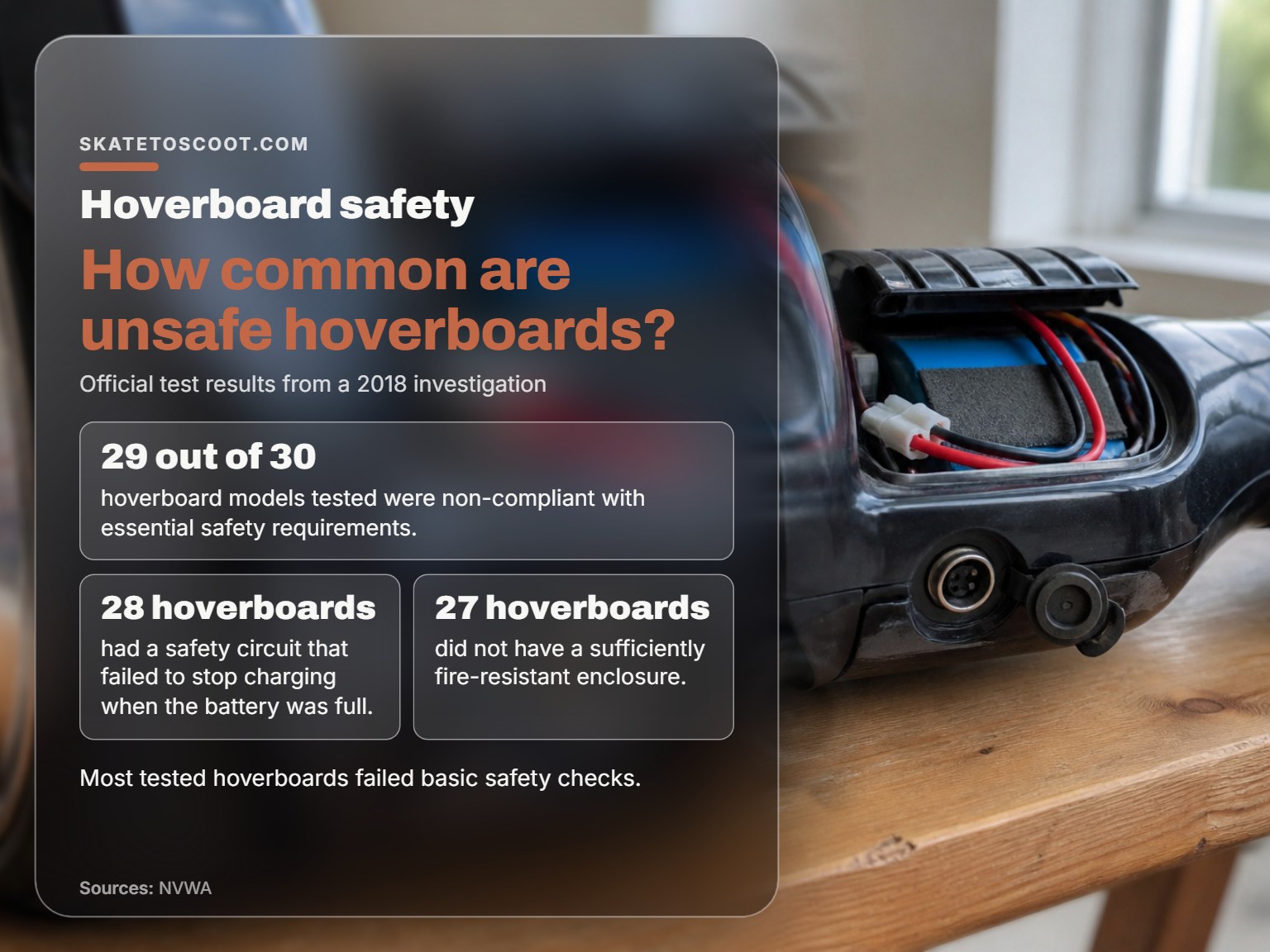
- A 2018 Dutch safety authority study found 28 out of the 30 investigated hoverboards had faulty safety circuits that failed to stop charging when the battery was full.
- UL 2272 certification is not a guarantee; the Razor Hovertrax 2.0‘s GLW battery packs were certified to ANSI/UL 2271 but were recalled after more than 20 overheating reports.
- The most critical sign of a compromised battery is swelling; a bulging case means internal gases are building and a rupture is imminent.
- If you suspect overcharging, stop using and charging the hoverboard immediately, move it to a non-flammable surface outdoors, and check the manufacturer’s website or the CPSC hoverboard safety alert PDF for recall information.
The Science Behind Overcharging: Thermal Runaway
A lithium-ion battery charged past its voltage threshold undergoes electro-chemical decomposition. The anode and cathode materials break down, releasing oxygen and generating intense heat. This heat accelerates further decomposition in adjacent cells, a feedback loop called thermal runaway. Temperatures recorded in U.S. Government testing exceeded 500°C, sufficient to melt plastics and ignite solvents.
You can’t see the problem until it’s too late. The failure isn’t a slow fade; it’s a switch that flips inside the battery cell. Think of it like stressing a welded joint past its yield point. It holds, holds, holds, and then it doesn’t, it catastrophically fails.
Lithium-ion cells are designed to operate within a strict voltage window, typically between 3.0V and 4.2V per cell. A charger and the board’s Battery Management System (BMS) are supposed to work as a team to cut off current the moment the pack hits 4.2V per cell. When that cutoff fails, the cell voltage creeps higher. Past about 4.3V, the stable chemistry inside the cell starts to unravel.
The anode, usually made of graphite, begins to react with the electrolyte. This reaction isn’t a clean burn; it’s a messy, heat-generating breakdown. That heat cooks the cell from the inside, which speeds up the reaction, which creates more heat. This is the runaway. Once it starts, you can’t stop it. The only question is how many of the neighboring cells in the pack get pulled into the chain reaction.
Government tests show how violent this gets. In a joint CPSC-NSWC hoverboard battery testing report, researchers forced a single cell into thermal runaway. In one commercial pack, the temperatures exceeded 500°C. That’s hot enough to instantly melt the plastic enclosure and ignite anything flammable nearby, a couch, a carpet, curtains.
The part nobody mentions: This can happen even if the board seems “off.” A faulty BMS or charger can trickle-charge a cell all night, pushing it silently past the threshold. By morning, the pack is a bomb waiting for a mechanical shock or the next charge cycle to set it off.
Why Hoverboards Are Uniquely Vulnerable
Not all lithium-ion devices are this dangerous. Your phone and laptop have rigorous, brand-protecting engineering behind them. The hoverboard market, especially in its early boom, was a Wild West of cost-cutting. The data proves it.
Digging into the NVWA’s investigation report reveals the root cause: for 28 of those hoverboards, the safety circuit failed to stop charging when the battery was full.
Let that sink in. The primary defense against overcharging was missing or broken in 93% of the sampled boards. That’s not a few bad apples; it was the orchard.
The failures didn’t stop there. The same report noted 27 of the investigated hoverboards had sharp edges near internal wiring (a short-circuit waiting to happen) and 27 lacked a sufficiently fire-resistant enclosure, compounding the what happens overcharged hoverboard risk. So even if a cell did catch fire, the box containing it would do little to slow the flames. This trifecta of flaws, bad BMS, bad construction, bad containment, creates the perfect storm for a charging-related fire.
This helps explain the incident count. The CPSC is aware of more than 250 self-balancing scooter/hoverboard incidents related to fires or overheating, including 13 burn injuries, three smoke inhalation injuries and more than $4 million in property damage.
| Failure Point | % of NVWA-Tested Models Affected | Consequence |
|---|---|---|
| Faulty Charge Cut-off Circuit | 96.5% (28/29) | Battery overcharges, initiating thermal runaway. |
| Sharp Edges Near Wiring | 90% (27/30) | Can chafe insulation, cause short circuit, and ignite cells. |
| Non-Fire-Resistant Enclosure | 90% (27/30) | Fire spreads rapidly outside the hoverboard, igniting surroundings. |
Signs Your Hoverboard Battery Is Compromised
Your hoverboard will talk to you if you know how to listen. The signs aren’t subtle; they’re urgent physical changes.
Swelling is the red flag. This is the most critical visual cue. The battery case, usually a hard plastic rectangle under the footpad, will bulge or warp. This happens because the chemical reactions during overcharging or failure produce gas. That gas has nowhere to go, so it presses outward. A swollen battery is under immense internal pressure and is actively failing. It is not safe to touch, charge, or store indoors.
Heat and odor are the secondary warnings. The board, especially near the battery compartment, may feel unusually warm to the touch even when idle. A failing battery or a malfunctioning charger can also produce a faint, sweet, or chemical smell, like burnt plastic or overheated electronics. That’s the smell of things breaking down.
Performance drops are the slow burn. You might notice your hoverboard doesn’t run as long on a charge, or the power cuts out unexpectedly even though the indicator shows battery left. This can mean individual cells within the pack are damaged and can’t hold voltage under load. While not an immediate fire warning like swelling, it’s a clear sign the battery is unhealthy and more susceptible to a catastrophic failure during the next charging a hoverboard cycle.
The charger itself can be the culprit. If the charger gets extremely hot, smells, or makes a high-pitched whining noise, unplug it immediately. Using a third-party or damaged charger is one of the fastest ways to bypass the BMS and force-feed voltage to the battery. Always use the manufacturer’s supplied charger, and if you need a replacement, buy it directly from the manufacturer or a verified retailer. For more on related electrical issues, see our guide on why a hoverboard won’t charge.
Where this goes sideways: Ignoring a slightly swollen battery because the board still turns on. The swelling increases with each charge cycle until the casing cracks, exposing the volatile cells to air. A single spark from the exposed terminals can then ignite the entire pack.
Certified Doesn’t Always Mean Safe: The Recall Reality
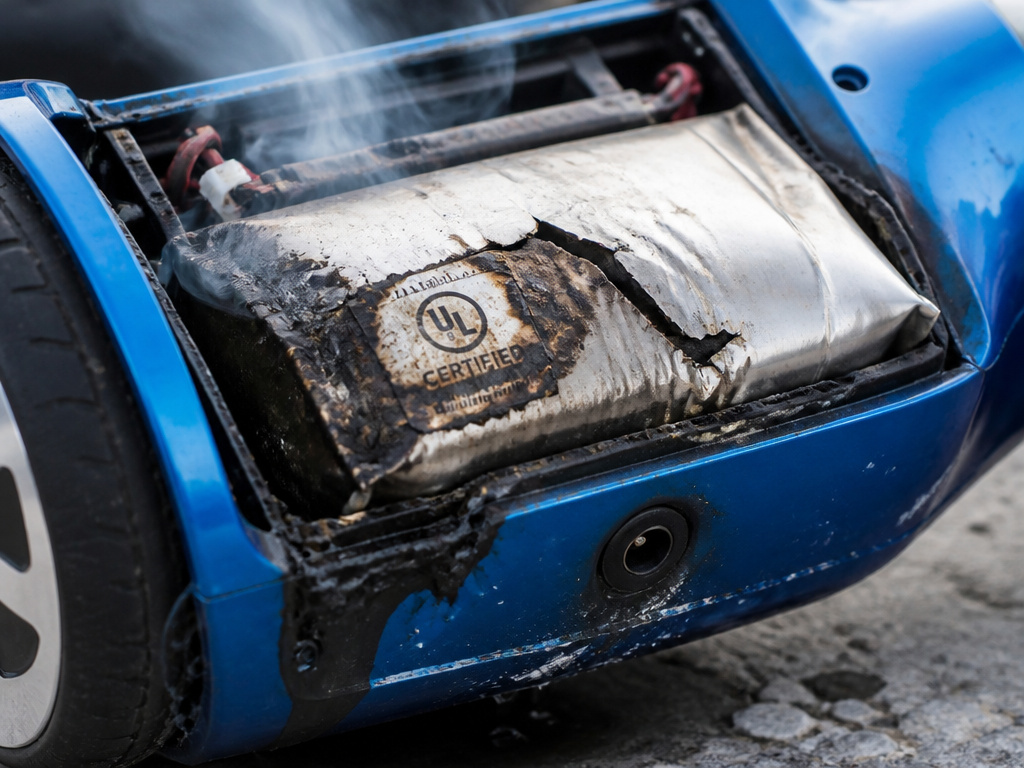
Looking for a UL mark is the standard advice. But real-world recalls show that certification, while crucial, is a layer of safety, not an impenetrable shield. There are two glaring examples.
First, the New High-Tech Enterprise Company Inc. X1-5 hoverboard. This model actually bore a UL mark on its label. But when the CPSC tested a sample, it did not conform to UL 2272. The mark was counterfeit. The CPSC had to issue a specific fire hazard charging alert warning consumers not to charge or use it. This is why regulators emphasize buying from reputable sources and not just trusting a sticker.
Second, and more telling, is the Razor Hovertrax 2.0. This isn’t a shady, off-brand product. Razor is a major name. The GLW battery packs used in these models from September 2016 to August 2017 were certified to ANSI/UL Standard 2271, the component standard for battery packs. They had all the right paperwork. Yet, Razor USA had to recall approximately 237,300 GLW battery packs in August 2021. Why? Because there were more than 20 reports of these certified packs overheating, smoking, or catching fire.
| Case Study | Certification Claim | What Actually Happened | Lesson |
|---|---|---|---|
| New High-Tech X1-5 | Bore a counterfeit UL mark. | CPSC test sample failed UL 2272. | A physical mark can be faked. Verification requires buying from authorized sellers. |
| Razor Hovertrax 2.0 (GLW Pack) | Battery packs certified to UL 2271. | Over 20 field reports of overheating/ fire led to a 237,300-unit recall. | Component certification doesn’t guarantee real-world performance or eliminate risk. |
The takeaway is uncomfortable but necessary. Certification like UL 2272 is the absolute baseline you must look for, it means the unit passed specific lab tests on the what happens overcharged hoverboard question. But the Razor recall proves that even certified systems can have latent flaws that show up months or years later in the field. This is a big part of why the CPSC hoverboard charging warning explicitly states: “even UL 2272 compliance cannot guarantee that a hoverboard will not overheat or catch fire.” Your vigilance is the final safety layer.
Immediate Actions If You Suspect Overcharging
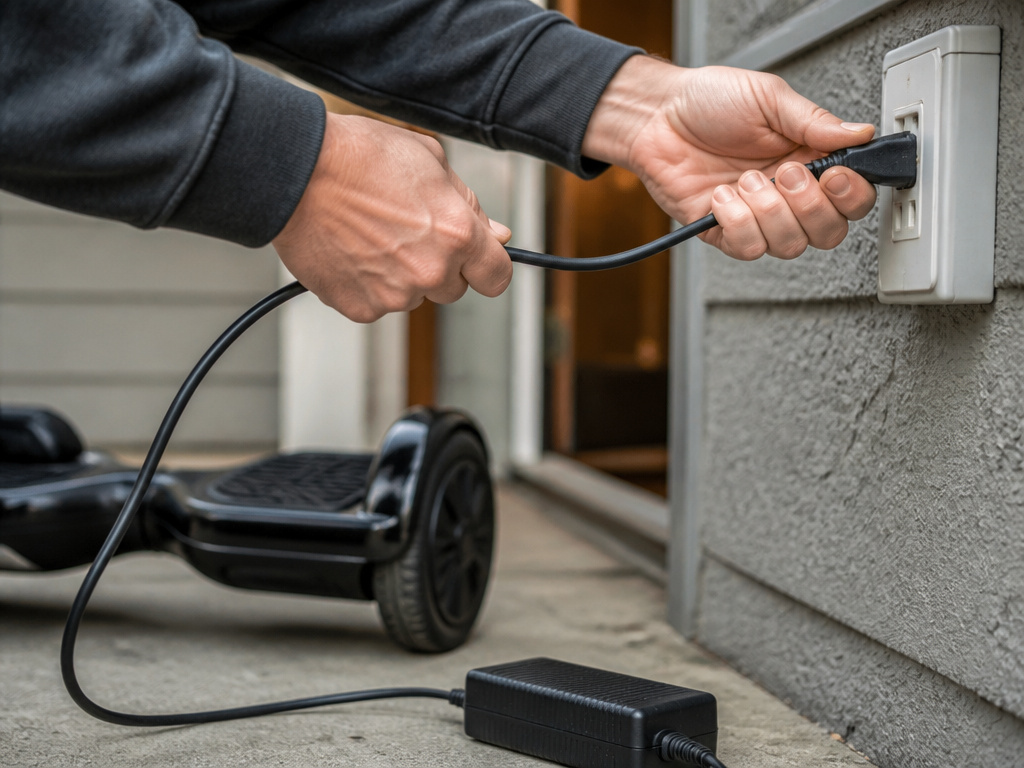
If your hoverboard shows any warning signs, swelling, extreme heat, or strange smells, the required action is urgent and mandatory.
- Stop Immediately. Power off the hoverboard and unplug it from the charger if it’s charging. Do not attempt to turn it back on to “test” it.
- Isolate the Hazard. Move the hoverboard to a safe, non-flammable location outside your home, like a concrete driveway or patio. Keep it away from structures, vehicles, and anything that can burn. Do not store it in a garage, shed, or near windows.
- Do Not Charge. Under no circumstances should you plug it in again. A damaged battery can fail catastrophically on the next charge cycle.
- Check for Recalls. Visit the CPSC website or the manufacturer’s website and enter your model number. If it’s under recall, follow the manufacturer’s instructions for a remedy, which is often a free repair or replacement. For historical context, the LayZ Board stop-use notice was issued after a fatal fire.
- Dispose Responsibly. If the hoverboard is old, damaged, or recalled, do not throw it in household trash. Lithium-ion batteries are a fire hazard in garbage trucks and landfills. The CPSC advises taking it to a local recycling center or household hazardous waste facility that accepts lithium-ion batteries. They have the equipment to handle and discharge them safely.
What about a board that just seems to have a shorter run time? That’s a grey area. It could be normal battery wear. But given the stakes, erring on the side of caution is cheap insurance. Start by checking its charging time against the manual. If it’s charging far too quickly (under an hour for a full charge), that can indicate a failing BMS that’s not reading capacity correctly. In that case, consider it a warning sign and consult a professional or the manufacturer before using it extensively.
How to Prevent Overcharging: A Realistic Protocol
Prevention is about respecting the physics of the battery and assuming the safety systems might fail. The official guidance from global agencies is remarkably consistent.
First, never charge unattended. This is the single most important rule. The CPSC advises: “Only charge a hoverboard when you are there to watch it. Do not charge unattended, especially overnight.” The Dutch NVWA similarly advises charging only when you are nearby and can intervene, for example not during sleep. Plug it in while you’re awake and in the same room. If you leave the room, unplug it. This simple habit removes the risk of a slow, unnoticed overcharge cycle.
Second, use only the supplied charger. Mismatched chargers can deliver the wrong voltage or current, bypassing the BMS entirely. If you lose the original charger, contact the manufacturer for a genuine replacement, not a generic one from a random online seller.
Third, unplug after charging. Once the charger light indicates “full” (usually green), disconnect the hoverboard. Don’t leave it plugged in indefinitely as a storage method. The NVWA specifically advises disconnecting it from the charger so it is “not unnecessarily connected to the electricity grid.”
Fourth, inspect regularly. Make a quick visual and physical check part of your routine hoverboard maintenance. Before and after charging, feel the battery area for unusual warmth. Look for any swelling or deformation. Check the charger and port for damage.
Fifth, know your board’s history. If you bought it secondhand or from a kiosk, be extra cautious. The CPSC explicitly warns against buying from these sources without proof of UL 2272 compliance. Older boards (manufactured before January 29, 2016) are not UL 2272 compliant. Assume they carry higher risk. For more on evaluating risk, see our analysis of hoverboard dangers.
These steps don’t guarantee safety, but they stack the odds heavily in your favor. They create a system of checks that compensates for the potential engineering flaws documented in the recalls and reports, like the official recall for overcharging risk for the Razor GLW packs.
How to fix an overcharged hoverboard
You cannot fix an overcharged hoverboard. Once a battery has been pushed beyond its limits by a faulty charging circuit, the internal damage is done and the risk of fire is permanently elevated. Regulatory testing found that for the vast majority of non-compliant models, the safety circuit failed to stop charging when the battery was full. If you suspect your board has been overcharged, stop using and charging it immediately. The only safe course is to discontinue use. Take it to a local recycling center that handles lithium-ion batteries for proper disposal. Do not attempt to open the battery compartment or repair it yourself, as this can trigger a thermal event.
Frequently Asked Questions
Can a hoverboard battery recover from overcharging?
No. The damage from overcharging is permanent chemical degradation inside the lithium-ion cells. Once the internal structures break down, they cannot be repaired. The battery’s capacity will be permanently reduced, and more importantly, its risk of entering thermal runaway is significantly increased. A battery that has been overcharged should be considered defective and hazardous.
How long is it safe to leave a hoverboard charging?
Only for the duration specified in the manufacturer’s manual, which is typically 2 to 4 hours for a full charge. The safe practice is to never let it charge beyond that point. The real danger isn’t just hitting 100%; it’s the continued trickle of current after the BMS should have cut off, which can happen with faulty circuits.
Is it safe to use a hoverboard while it’s plugged in?
Absolutely not. This is a serious misuse that can damage the charging circuitry, confuse the BMS, and create a significant electrical hazard. The board is designed to be either riding on battery power or charging while powered off. Using it while plugged in bypasses several safety protocols.
What should I do with a hoverboard that won’t hold a charge?
First, check if it’s under a recall like the Razor hoverboard battery recall. If not, a battery that won’t hold a charge is at the end of its life and is a potential fire risk if forced to charge. Your options are to have the battery professionally replaced (see our guide on how to replace a hoverboard battery) or to recycle the entire unit safely. Do not continue charging a battery that discharges immediately.
Are newer hoverboards with UL 2272 safer?
Yes, significantly. The UL 2272 standard includes rigorous overcharge testing. To pass, the battery must not catch fire or explode. While field incidents like the Razor recall show it’s not perfect, buying a UL 2272 certified board is the safest choice. Always verify the certification through official means, not just a printed logo.
The Bottom Line
The data from regulators is unambiguous. Overcharging a hoverboard isn’t a minor misuse; it’s the direct trigger for a high-temperature chemical fire that has killed people. The 2018 Dutch study found the safety systems were broken in almost every model they pulled off the shelf. The recall lists show even certified components from major brands can fail.
So the rule isn’t “be careful.” It’s mechanical. Never charge a hoverboard unattended. Ever. Plug it in only when you’re in the room to watch it, and unplug it the moment it’s full. Treat a swollen battery like a live spark, get it outside and contact the manufacturer immediately. Your awareness is the final, most critical component in the safety system. For all other common issues and repairs, our troubleshooting guide can help, but with battery swelling or extreme heat, stop use and isolate the hazard first.
This changes if you’re outside the U.S., of course. Standards and enforcement vary. For example, the Australian hoverboard safety warning from 2016 shows how other nations reacted to the same global risk. The core physics of a lithium-ion battery, however, are universal. Respect them, and you can enjoy the ride without the fear of what’s happening under your feet.
