What Is an Electric Longboard? Key Components Explained
This post contains affiliate links. As an Amazon Associate, we earn from qualifying purchases.
An electric longboard is a motorized version of a traditional longboard, powered by a rechargeable lithium-ion battery and controlled by a handheld wireless remote. It consists of five core components: the deck, the battery pack, the motor(s), the electronic speed controller (ESC), and the remote. This setup allows for hands-free propulsion at speeds up to 35 mph, transforming it from a recreational push-board into a practical personal electric vehicle for commuting and longer-distance travel.
The difference between a 36V battery and a 43.8V pack is a direct trade-off central to the what is an electric longboard question, affecting weight, range, and how the board feels under your feet on a hill. One university project chose a 12S2P configuration; a research study built a 10S4P pack. That’s the kind of decision that defines what an electric longboard actually is.
What follows is a breakdown of the parts that make it tick, answering what is an electric longboard through the real-world trade-offs between different motor and battery designs, and a frank look at who should, and shouldn’t, consider making the switch from pushing to powered riding.
Key Takeaways
- An electric longboard is defined by its five core components: deck, battery, motor(s), Electronic Speed Controller (ESC), and wireless remote.
- Hub motors are quiet and low-maintenance, while belt-drive systems offer more torque for climbing hills, a choice that directly impacts your riding experience.
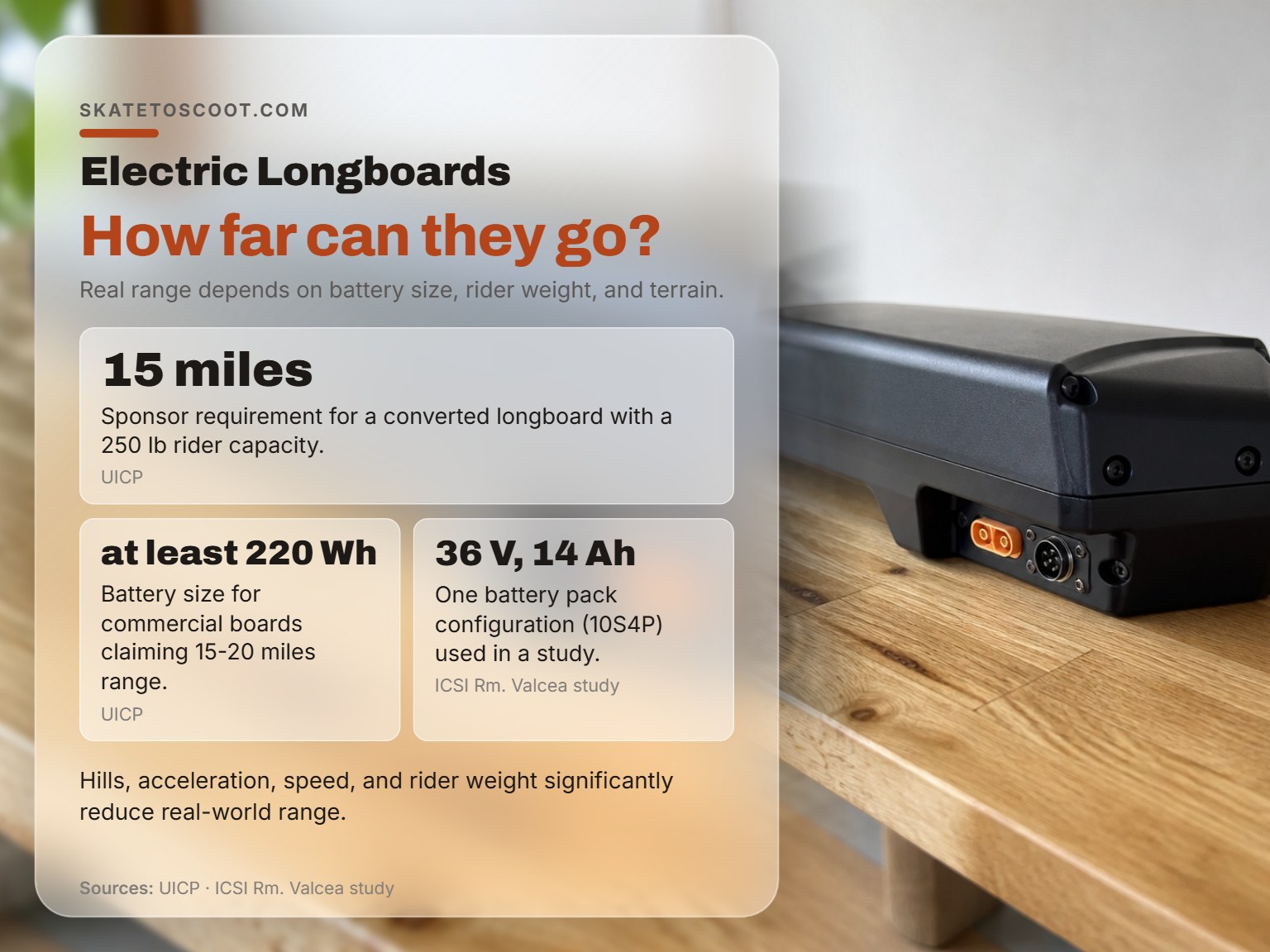
- Battery capacity, measured in watt-hours (Wh), dictates your range; real-world builds show you need at least 220 Wh for a 15-20 mile claim.
- Some riders and sources, like a Reddit user, argue learning is easier due to remote control and braking, while other sources, like Backfire, recommend non-electric boards for beginners.
- Long-term costs go beyond the purchase price; a premium board can last 3–5 years, but budget models may suffer from earlier battery degradation.
What Exactly Is an Electric Longboard?
Forget the idea of a toy. To understand what is an electric longboard, think of it as a tool. It’s a traditional longboard deck that has been engineered into a light electric vehicle. The deck is your platform. The battery, usually a lithium-ion pack housed underneath, is your fuel tank. The motor or motors, mounted on the trucks, are your engine. The Electronic Speed Controller (ESC) is the onboard computer that manages power flow. And the wireless remote in your hand is your throttle and brake.
This integration is what separates it from a simple skateboard with a motor bolted on. The center of gravity is carefully managed, often with the battery mounted low in a 3D-printed ABS enclosure, as seen in the UIC Engineering Expo project. The components are chosen for a balance of power, weight, durability, and ride quality. When you pick up a complete electric skateboard, you’re holding a designed system, not a hobbyist’s project.
An electric longboard is a integrated system comprising a deck, a lithium-ion battery pack (typically 36V–44V), one or more brushless DC motors, an Electronic Speed Controller (ESC), and a wireless handheld remote. The ESC interprets throttle/brake inputs from the remote and regulates power from the battery to the motors, providing propulsion without kicking.
Key Components of an Electric Longboard
Here are the five main parts that make it work. Knowing what each part does is the first step to understanding what you’re actually buying.
The Deck: This is your standing platform. While it looks like a standard longboard deck, it’s often reinforced to handle the extra weight and torque of the motor system. Materials like bamboo and maple are common for their blend of flex and durability.
The Battery: This is the single heaviest and most expensive part. It’s almost always a lithium-ion pack because of its excellent weight-to-power ratio. The capacity, measured in watt-hours (Wh) or milliampere-hours (mAh), dictates your range. Research from a university capstone project showed that boards claiming 15-20 miles of range typically had “at least 220 Wh.” Their final design used a 12S2P configuration rated at 350.4 Wh.
The Motor(s): Motors are rated in watts (W); more wattage generally means higher top speed and better hill-climbing ability. You’ll find single-motor and dual-motor setups. Dual motors double the driving power and improve traction, which is why the ICSI Rm. Valcea study used a dual-motor system capable of 2400 W (limited to 1800 W by the battery management system).
The Electronic Speed Controller (ESC): This is the brain. It takes your thumb’s movement on the remote and translates it into precise adjustments of power sent to the motors. An ESC with safety features like torque limiting is what makes acceleration and braking feel smooth, not jerky. It’s also where safety features like torque limiting are programmed.
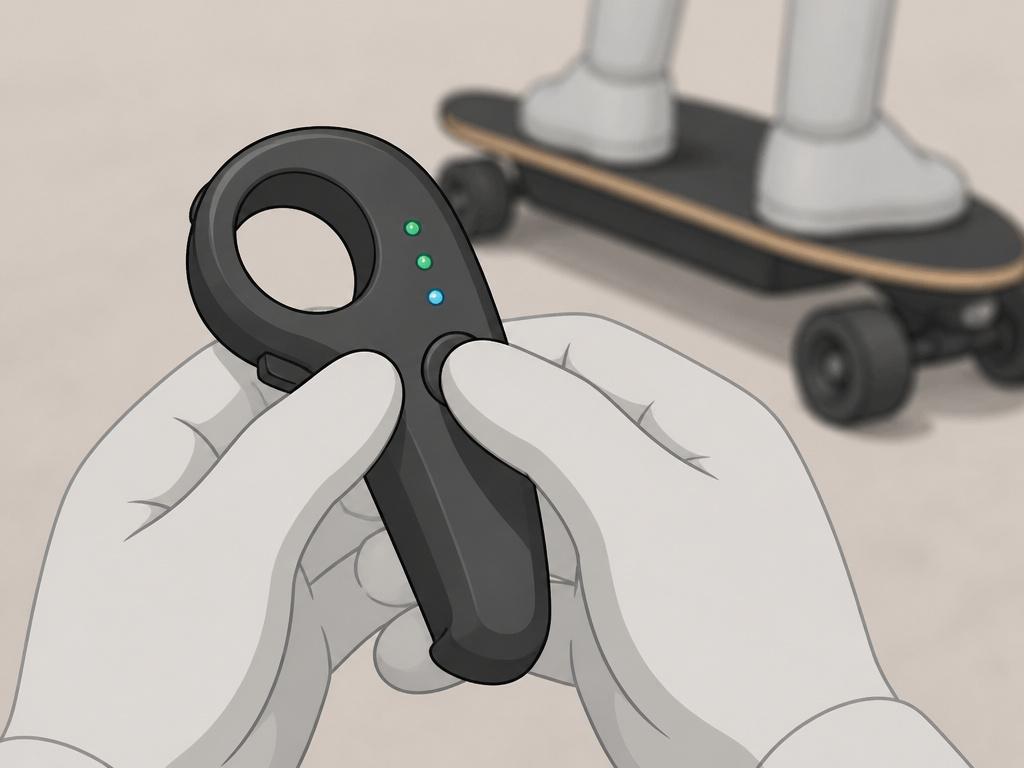
The Remote: This handheld device is your only physical control. A remote that maintains connection is responsive and reliable. You’ll use it to accelerate, brake, and often to switch between speed modes. Losing connection mid-ride is a failure you only want to read about, not experience.
How Does an Electric Longboard Work?
The sequence is simple but relies on precise electronics. You turn on the board and the remote. They pair wirelessly. When you press the throttle on the remote, a signal is sent to the ESC. The ESC calculates how much power to draw from the battery and delivers it to the motor. The motor spins, turning the wheel and propelling you forward.
Braking works in reverse. Press the brake trigger on the remote. The ESC commands the motor to act as a generator. Your forward momentum spins the motor, which generates electricity that flows back into the battery. This is called regenerative braking, and on models like the Ecomobl ET2 Pro, it can recover around 22% of the battery charge, extending your range.
The real magic is in the software tuning of the ESC. That’s what separates a choppy, unpredictable ride from a buttery-smooth one. It’s also why, as the ICSI study noted, theoretical motor power doesn’t always translate to real-world hill climbing, as a sliding phenomenon appeared on a 10% slope despite sufficient power.
Hub Motors vs. Belt Drive Motors
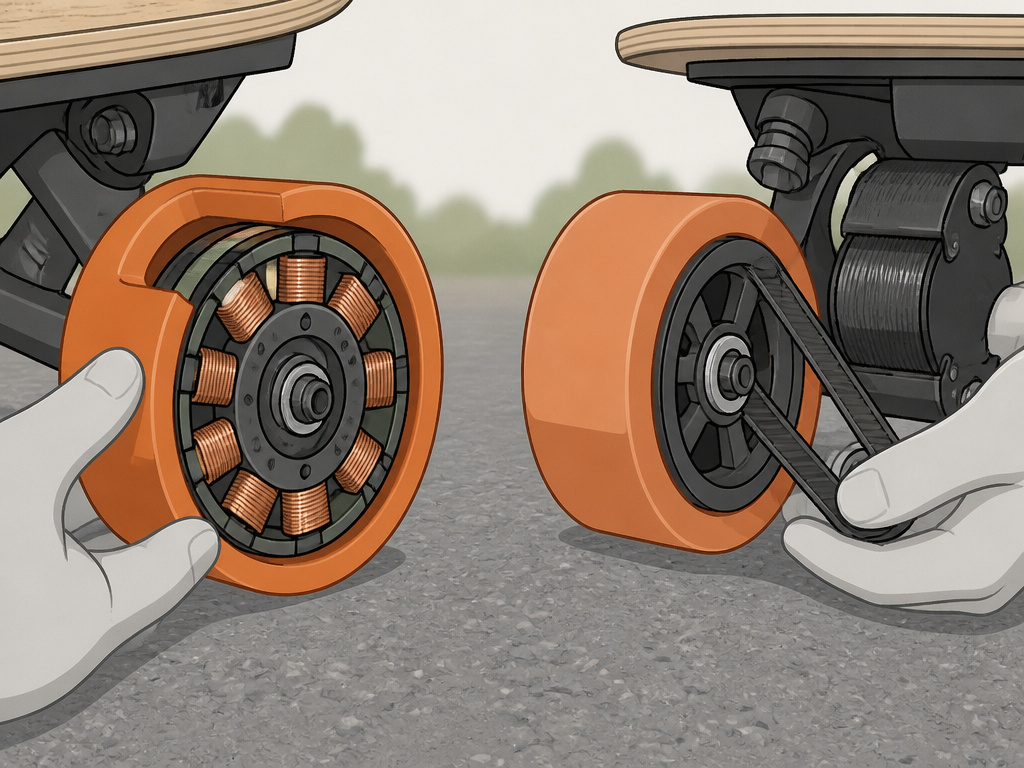
This is the first major fork in the road when choosing a board. The type of motor system changes the ride feel, maintenance, and cost.
| Motor Type | How It Works | Best For | Maintenance |
|---|---|---|---|
| Hub Motor | The motor is built inside the wheel hub. The outer urethane sleeve is the tire. | Commuters, beginners, riders who value stealth and simplicity. | Very low. No belts or pulleys to adjust or replace. The urethane sleeve wears down and eventually needs replacement. |
| Belt Drive | A separate motor mounted on the truck turns the wheel via a rubber belt and two pulleys. | Enthusiasts, hill climbers, riders who want to customize wheel size and type. | Moderate. Belts stretch and snap, pulleys need cleaning, and motor alignment matters. You gain torque and wheel choice. |
Hub motors are discreet and nearly silent, the wheel looks almost normal. But that built-in design means you can’t easily change wheel hardness or size, and they generally provide less torque. Belt drives are the opposite. They’re louder, more exposed, and require upkeep, but they provide higher torque for steeper hills and let you swap wheels for different terrain. It’s a classic trade-off: convenience versus capability.
Where this goes sideways: Choosing a hub-motor board for a hilly commute because it’s “maintenance-free.” The lack of torque means the motor will strain, overheat, and drain the battery rapidly, cutting your range in half and potentially burning out the motor over time.
Battery and Range: The Real Numbers
Range anxiety is the biggest mental hurdle for new riders. The number on the box is almost always a best-case scenario: a light rider on perfectly flat ground in ideal temperatures. Real range depends on your weight, hills, riding style, and wind.
The relationship between battery watt-hours (Wh) and range isn’t linear, but the data gives us guardrails. The UIC project linked a 350.4 Wh battery to a 15-mile target. The ICSI study achieved nearly 31 miles with a larger, heavier ~504 Wh pack (36V * 14Ah). More Wh usually means more range, but also more weight and cost.
Here’s what actually eats your battery:
- Hills: Climbing is the single biggest drain. The ICSI study observed a “sliding phenomenon” on a 10% grade despite sufficient power, indicating that insufficient torque can waste energy as wheel slip.
- Acceleration: Jackrabbit starts burn through electrons. Smooth, gradual acceleration preserves range.
- Speed: Higher constant speeds increase wind resistance exponentially.
- Rider Weight: More mass requires more energy to move.
If your daily commute is 5 miles round-trip, a battery with sufficient watt-hours is needed. If you’re planning 15-mile weekend tours, you’ll want a battery with sufficient capacity, such as the 350.4 Wh pack used in the UIC project which targeted 15 miles. And you always want a battery management system (BMS) to protect the cells from over-charging, over-discharging, and overheating.
Is an Electric Longboard Easier to Ride Than a Regular Longboard?
This is the most common question from curious longboarders. The answer is nuanced, but leans heavily toward “yes, for most purposes.”
For a complete beginner, the fundamentals of balancing, turning, and weight distribution are identical. You must learn to stand on a moving platform. Where the electric board wins is in control and safety. On a regular board, as speed builds, your only stopping options are foot-braking (a skilled technique) or bailing. On an electric board, your thumb on the remote delivers smooth, predictable braking force. This eliminates the panic that causes new riders to jump off.
A Reddit user put it perfectly: “1000x easier. I can’t explain how much of a difference brakes make… You can really accurately dial in exactly how fast you’re going.” That precise speed control allows you to focus on balance and carving without the fear of runaway acceleration.
However, there’s a caveat. The added weight and higher potential speeds (up to 35 mph) mean that when a fall does happen, it can be more consequential. An electric longboard demands more respect. This is why you must master how to ride on low speed settings in a safe, open area.
Key Considerations Before You Buy
Choosing an electric longboard is about matching a tool to your life. Use this checklist to narrow your focus.
Your Primary Use Case:
- Commuting (< 10 miles): Prioritize reliability, water resistance (IP rating), and portability. A hub motor board often fits well for commuting.
- Recreation & Carving: Choose a flexible deck, smooth ESC, and well-tuned trucks for a lively ride.
- Hill Climbing & Off-Road: Belt drive is almost mandatory. Look for high torque ratings and consider pneumatic (air-filled) tires.
The Legality in Your Area: This isn’t optional homework. At the federal level in the U.S., they are not motor vehicles, so no registration or insurance is required. But state and local laws vary wildly. California, Florida, and Texas explicitly permit them in bike lanes at limited speeds (15-20 mph). Other cities ban them from sidewalks or require helmets. Always check your local electric longboard laws before riding.
Budget and Total Cost of Ownership: Prices range from $500 for entry-level to $3,000+ for premium boards. The true cost includes maintenance: replacing hub motor urethane sleeves, swapping belt drive belts, and eventually, the battery. A well-maintained premium board can last 3–5 years, while a budget board’s battery may degrade noticeably within 6 months. Think of it as an investment, not a toy purchase. For a deeper dive, our buyer’s guide on electric longboards compares top models.
Pros, Cons, and Who It’s For
Be honest about where an electric longboard excels and where it falls short.
Pros:
- Efficiency: The cost per mile for an electric longboard is a fraction of a cent, compared to $0.50–$1.50 for rideshare. For a short urban commute, it can pay for itself.
- Fun & Agile: It turns a tedious trip into an enjoyable activity. You can navigate traffic and crowds where a bike or car can’t.
- Last-Mile King: It perfectly bridges the gap between public transit stops and your final destination.
- Low Barrier to Entry: The learning curve is gentler than for traditional skateboarding.
Cons:
- Weather Dependent: Rain and wet roads are a hard no for most boards and riders.
- Weight: At 40+ lbs, carrying it up stairs or onto a bus is a legitimate workout.
- Upfront Cost: A reliable board is a significant purchase.
- Regulatory Grey Areas: Laws are still catching up, which can lead to confusing encounters.
So, who is it for? It’s for the urban commuter with a 2-10 mile trip in fair weather. It’s for the tech enthusiast who appreciates how electric skateboards work. It’s for the longboarder who wants to explore further without getting tired. It is decidedly not for someone seeking an all-weather primary vehicle, or for a rider unwilling to wear safety gear and learn the rules of the path.
How does an electric longboard compare to a mini e-skate?
Electric longboards and their smaller cousins, mini e-skates, share core components like lithium-ion batteries and hub or belt motors, but their designs serve different purposes. The longer deck of an electric longboard provides a stable, comfortable platform for extended cruising and commuting, often supporting a larger battery pack for greater range. A mini board sacrifices some of that stability and range for superior portability and tighter maneuverability in crowded urban settings. While motor power, rated in watts, determines hill-climbing ability and top speed for both, the longer wheelbase of a longboard generally offers a smoother ride over varied pavement.
Frequently Asked Questions
How hard is it to ride an electric longboard?
If you have decent balance, you can learn the basics in an afternoon. The remote-controlled acceleration and brakes remove the hardest parts of traditional skating, pushing and stopping. Start in a flat, empty parking lot on the lowest speed setting. Focus on gentle starts and stops before you even think about turning. The weight and power demand respect, but the controls are intuitive.
How much does an electric longboard cost?
You can spend from $500 to well over $3,000. The price directly reflects component quality: battery cell brand, motor power, ESC sophistication, and deck materials. A $500 board gets you a basic commuter with limited range. The $800-$1500 range is the sweet spot for reliable, feature-rich boards. Above $2,000, you’re into premium, high-performance or specialty off-road territory.
Are electric longboards legal?
It depends entirely on your state and city. Federally, they are not classified as motor vehicles. Many states, including California, Florida, and Texas, have passed laws allowing them on bike paths with speed limits (often 15-20 mph). Some cities ban them from sidewalks. The only way to know is to check your local ordinances. Never assume it’s legal just because you bought it.
Is an electric longboard easier than a regular skateboard?
For cruising and commuting, yes, absolutely. The longer wheelbase of a longboard provides more stability than a short skateboard deck. Add in the powered propulsion and braking, and the electric longboard is a far more accessible and less physically demanding machine. It’s designed for travel, not tricks.
The Bottom Line
An electric longboard is a legitimate personal transport tool disguised as a skateboard. It’s a system where the battery’s watt-hour rating, the motor’s torque, and the ESC’s software must work in concert. Research from a university project linked a 350.4 Wh battery to a 15-mile target.
Your decision hinges on a simple test: do you have a frequent, short-distance trip in fair weather where walking is too slow and driving is frustrating? If yes, an electric longboard might not just be a fun gadget, it could be the most sensible way to get around. Start by understanding the components of an electric skateboard, then decide if you want the plug-and-play convenience of a complete board or the project-based satisfaction of a DIY conversion kit.
One final, essential rule: if you buy one, also buy a high-quality helmet. The remote gives you control, but physics still gets the final say.
