Are Electric Skateboards Waterproof?
This post contains affiliate links. As an Amazon Associate, we earn from qualifying purchases.
While brands like Evolve, Acton, and Parsec state their boards are not waterproof, others claim water resistance: Exway and Backfire boards carry an IP55 rating, and ONSRA claims IP65 for its Black Carve 3 Pro, Challenger, and Velar. These ratings protect against splashes and jets, not immersion. A common question riders have is are electric skateboards waterproof, and the answer is generally no. Crucially, water damage is not covered under warranty by brands like Evolve, Parsec, and ONSRA, regardless of marketed IP ratings or sealing features.
That gap between a marketing claim and the warranty fine print is where the real risk lives, especially when you compare a are electric skateboards waterproof claim to the actual coverage. An IP55 rating means your board might survive a puddle splash, but if moisture seeps into the battery management system over repeated wet commutes, you’ll be responsible for the cost of a replacement battery. The manufacturers have the data; they know where their seals fail.
This guide walks through the specs brands publish, the real-world failures they don’t advertise, and the one post-ride habit that actually extends your board’s life after a wet ride, all centered on the are electric skateboards waterproof question.
Key Takeaways
- Major brands like Evolve, Parsec, and ONSRA do not warranty water damage, even on boards with IP ratings or improved seals.
- An IP55 rating (Exway, Backfire) means protection from water jets, not immersion. IP65 (ONSRA) adds full dust protection but the same water-jet level.
- After any wet ride, dry the board immediately and inspect bearings. Sources offer different specific advice: Exway advises running the motors for two minutes to eject water, while Backfire advises disconnecting a water-damaged battery immediately and stopping its use.
- A water-damaged lithium battery is a fire hazard. Backfire’s protocol is explicit: disconnect it, do not charge, store it outdoors in a sealed bucket.
- The 2017 Boosted Board recall was due to water ingress short-circuiting batteries, proving real-world failure happens even with marketed resistance.
The IP Rating Reality Check
What does an IP55 rating actually promise? The “5” for water means protection against water jets from a nozzle (6.3mm) from any direction. It’s a lab test, not a real-world guarantee against a puddle kicked up by a car tire at speed.
The IP (Ingress Protection) code’s second digit specifies water protection: 3 = spraying water, 4 = splashing from any direction, 5 = water jets, 6 = powerful water jets, 7 = temporary immersion. No mainstream electric skateboard claims a rating above 6 for water.
Exway and Backfire boards are rated IP55. ONSRA claims IP65 for its Black Carve 3 Pro, Challenger, and Velar models, the “6” is for complete dust protection, not better water resistance. That “5” for water is the same level as IP55. This is a crucial detail shoppers miss when comparing specs.
The real-world gap is pressure and duration. A lab test sprays a stationary board for a specified duration. Your board hits puddles at speed, forcing water into seams under hydraulic pressure. It also vibrates, which can work microscopic gaps into seals over time.
| Brand & Model Examples | Claimed Protection | Key Limitation (From Manufacturer) |
|---|---|---|
| Exway (Various) | IP55 | “Moisture can seep in over time.” |
| Backfire (Various) | IP55 | “NOT waterproof, but water resistant.” |
| ONSRA Black Carve 3 Pro | IP65 | “Water damage is not covered under warranty.” |
| Evolve Hadean/GTR/Stoke | Dust seals, conformal coating | “Not waterproof.” |
| Evolve Diablo/Renegade | Additional lip seals, thicker sealing |
Trust the process, not just the marketing sheet. If a brand’s own support page follows an IP rating with a warranty exclusion for water damage, that tells you everything about their confidence in real-world conditions.
What “Water-Resistant” Really Means by Brand
Brands use different language and features. None promise waterproofing, but some build in more splash guards than others. We will examine each brand individually, based on their official specifications.
Evolve is blunt: “Evolve boards are not waterproof.” Their newer models add protection: Hadean, GTR, and Stoke have dust seals and conformal coating on electronics. The Diablo, Renegade, and Stoke X models add “additional lip seals” and “thicker sealing above the battery.” They state these measures “help protect against minor splashes.” The important line follows: exposure to water “can still cause damage… Which is not covered under warranty.”
Exway states its decks are “water resistant to IP55 standards.” They explicitly say riding over puddles is okay for the electronics but you should never submerge the board. Other brands, like Evolve, warn that riding in wet conditions is dangerous. Their most specific advice: “If the motors become wet, run the motors for 2 minutes to remove any water.” They add a universal truth: “water WILL damage your bearings.”
Backfire also claims IP55. Their FAQ carries a severe safety warning: if the battery is water-damaged, “disconnect the battery from the board immediately and stop charging or using it.” They advise storing it in a “sealed bucket outdoor” and explicitly say “do not ship a water-damaged battery for service.”
ONSRA claims an IP65 rating for its Black Carve 3 Pro, Challenger, and Velar, noting an O-ring seals the enclosure. Their support article ends with the standard industry disclaimer: “Water damage is not covered under warranty.”
Parsec states its Aero model is not waterproof. The warranty clause is identical to others: failures from water damage “are NOT covered under our 12-month warranty.”
The pattern is unmistakable. Improved sealing is a feature. Assuming it makes the board immune to water is a mistake that voids your warranty. This isn’t conspiracy; it’s these companies limiting liability based on their own failure data.
The Warranty Void
Here’s the bottom line every rider must understand: No major brand covers water damage under its standard warranty. This exclusion is consistent across Evolve, Parsec, and ONSRA, regardless of how they market water resistance.
This creates a direct financial risk. If your board’s electronic speed controller (ESC) fries after a wet commute, you are the one paying for the replacement part and labor. The brands have transferred the risk of their “water-resistant” design directly to you.
The precedent is clear. In January 2017, Boosted recalled its second-generation standard-range battery packs because water ingress was causing short-circuits and “venting.” Following that, Boosted “no longer market[ed] the board as water resistant.” That incident is a matter of public record via the U.S. Consumer Product Safety Commission.
When you see a brand touting IP ratings or lip seals, read the next sentence in the manual or FAQ. The warranty exclusion is always there. They are telling you, in legal terms, not to trust the feature with your money.
Post-Wet Ride Protocol
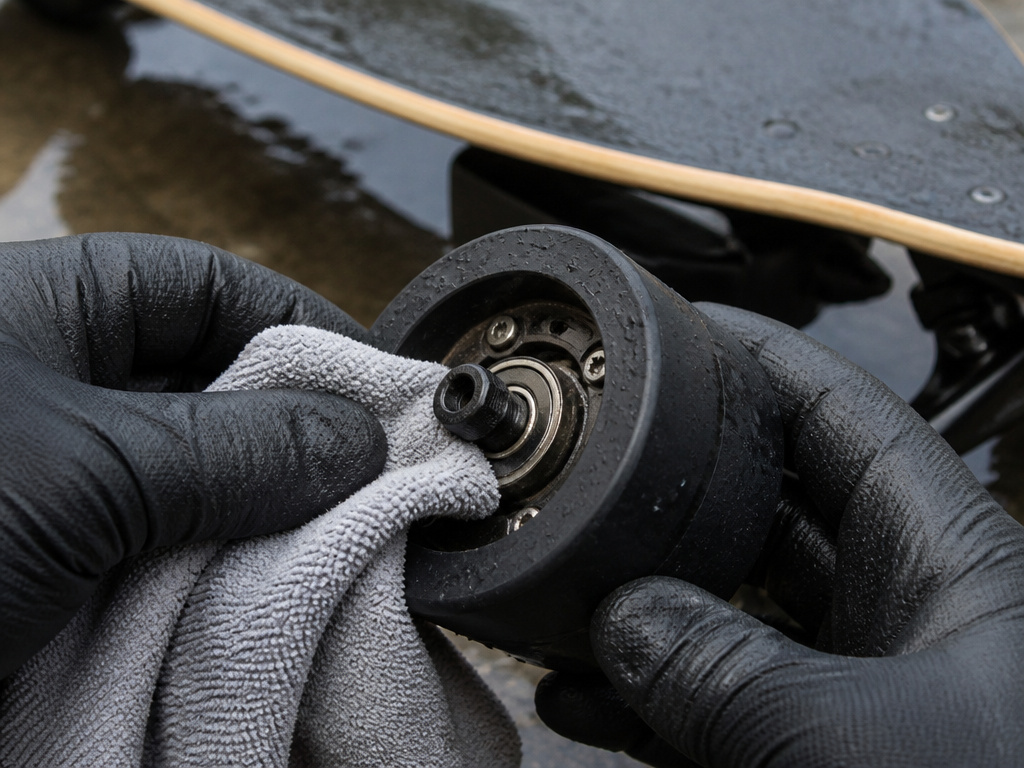
Your board got wet. Maybe you got caught in a sudden downpour or misjudged a puddle. What you do in the next 30 minutes dictates whether it’s a close call or a costly repair.
First, dry the board immediately. Use a towel to wipe down the deck, trucks, and wheels. Don’t just leave it in a damp trunk or basement. Next, remove the wheels if possible and wipe the bearings and axles. This step is essential for keeping your bearings in good condition over time.
Exway offers a unique step: “run the motors for 2 minutes to remove any water.” The idea is centrifugal force ejects moisture from the motor casing. If your board uses hub motors, this is a practical tip.
Now, the most critical component: the battery. If you suspect water has entered the battery enclosure (you rode through deep standing water, the board shut off), follow Backfire’s drastic protocol:
- Disconnect the battery from the board.
- Do not attempt to charge it.
- Do not use the board.
- Place the battery in a dry, fire-resistant container outdoors, like a sealed bucket.
Lithium-ion batteries and water create a risk of thermal runaway, a fire that is difficult to extinguish. This isn’t scare talk; it’s the inherent risk with lithium-ion batteries. Storing a compromised battery indoors is a genuine hazard.
For general cleaning after wet rides, a simple routine extends component life:
- Wipe down the deck and griptape to prevent debris buildup.
- Check screw heads and enclosure seams for corrosion.
- Listen for new sounds: grinding in the bearings or a whine from the motors are early failure signs.
A board that sees regular damp conditions will need bearing replacements as part of standard maintenance. Factor the cost of bearing replacements into your ownership budget.
Risks Beyond the Electronics
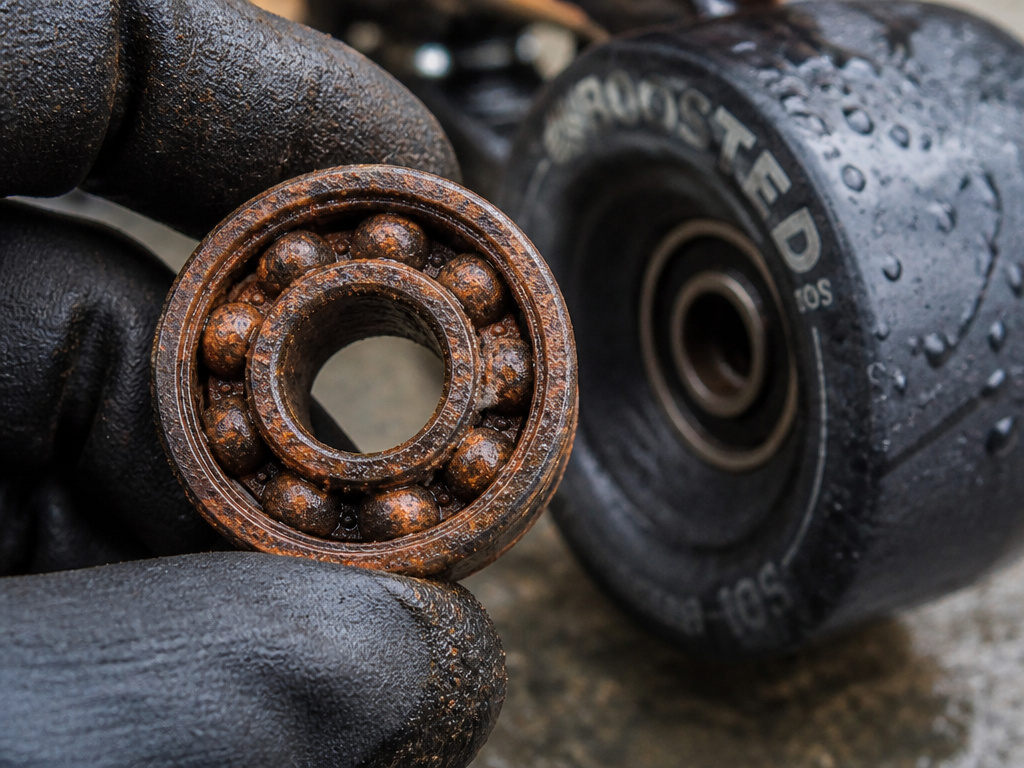
Water damages more than circuit boards. Your board’s mechanical parts fail predictably.
Bearings rust. This is the most common point of failure. Steel ball bearings corrode when exposed to water and road salt. The first sign is a gritty, grinding feel when you spin the wheels by hand. Left unchecked, rusted bearings seize, damaging the wheel core and motor axle. Replacing hub motor bearings, as Exway notes, “can be a pain” compared to standard skateboard bearings. Some hubs even require full motor replacement.
Griptape loses grip. When griptape gets soaked and dirty, its abrasive surface clogs. It becomes slippery, especially when your shoes are also wet. This directly impacts your control during acceleration and braking.
Trucks and hardware corrode. Aluminum trucks can oxidize, and steel kingpins and axle nuts will rust. This corrosion weakens the hardware and makes future adjustments or repairs difficult.
Deck delamination. While less common with modern composite decks, wooden cores in some boards can swell and warp if water penetrates the laminate, weakening the deck structure.
The repair costs add up. A set of quality bearings: $30. A new hub motor can be a significant expense. A new ESC can be costly. Compare that to the upfront cost of a board marketed as having better water resistance. The financial math rarely favors testing the limits of an IP55 rating.
Safety in Wet Conditions
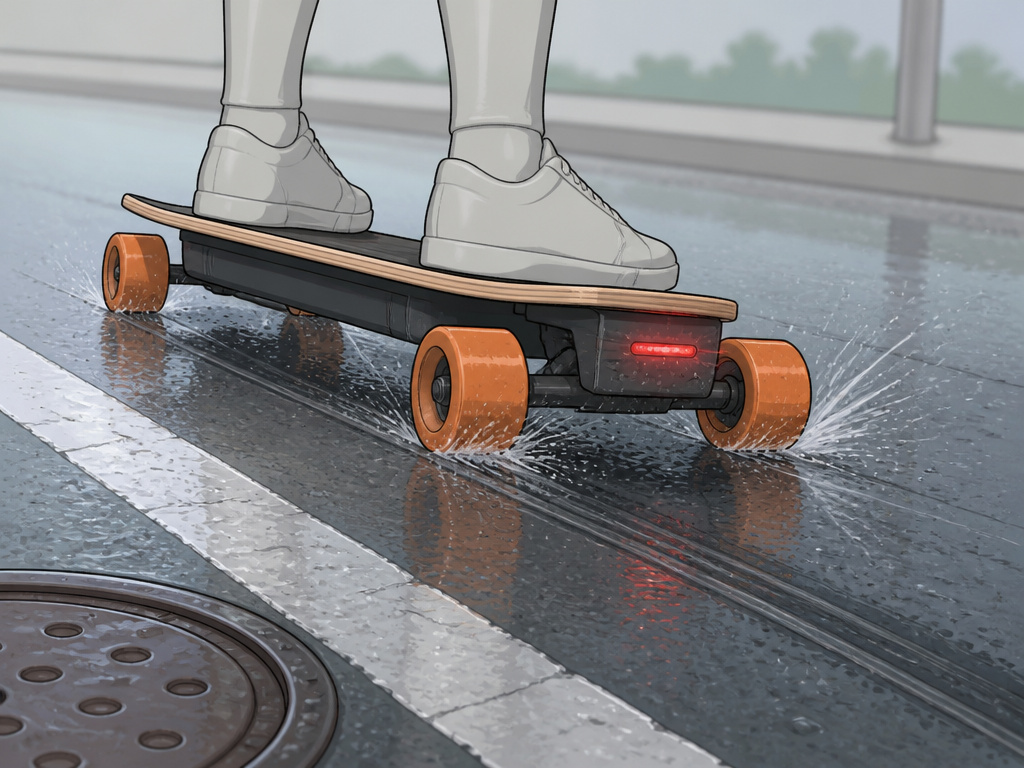
Traction is a serious concern. Electric skateboarding relies on friction. Wet roads, especially painted lane markings or metal surfaces like manhole covers, have drastically reduced grip. Your board’s acceleration and braking torque can easily overcome available traction, leading to a slide.
Evolve states this bluntly: “Wet roads reduce grip, making it easier to lose control, slide out, or struggle to stop properly. Riding in wet conditions is dangerous for you, your board, and those around you.”
Your safety gear is even more critical. A helmet is mandatory. Wrist guards, knee pads, and elbow pads mitigate the higher likelihood of a fall. Visibility is another concern, drivers may not see you as well in rainy conditions, and your own vision is impaired.
If you must ride on wet pavement, adjust your technique:
- Accelerate and brake gradually, not abruptly.
- Avoid sharp turns or carving.
- Watch for oil slicks, which create an especially slick surface when wet.
- Assume your stopping distance is at least double the dry-pavement distance.
These aren’t theoretical concerns. They are the documented physics of urethane wheels on wet asphalt. Trust the process, not just the trick.
DIY Waterproofing: Worth the Hassle?
Some riders use silicone sealant on enclosure seams, conformal coating on circuit boards, or aftermarket bearing seals. Forum threads are full of these DIY methods. Do they work?
Temporarily, yes. A well-applied silicone bead can block spray. But DIY waterproofing has significant downsides:
- It voids your warranty immediately. Opening the enclosures typically breaks warranty seals.
- It traps heat. Electronics need airflow to dissipate heat. A completely sealed enclosure can lead to overheating, especially in the ESC and battery, which reduces their lifespan and could create a new failure mode.
- It’s maintenance. Seals degrade, silicone cracks, and vibrations work gaps open. You must inspect and reapply regularly.
- It can cause collateral damage. Getting sealant on connector pins or in ventilation channels can create problems worse than water ingress.
Some DIY waterproofing methods discussed by riders online can be complex and may void warranties. For most riders, the cost-benefit analysis leans against a full DIY seal. Simpler, non-invasive measures make more sense: applying a water-repellent spray to the deck (avoiding electronics), using fenders to reduce wheel spray, and adhering to a strict drying routine after wet rides.
If you’re considering a DIY project, ask yourself: is the goal to extend the board’s life through occasional wet rides, or to create a truly submersible board? The first is achievable with careful maintenance. The second is a major engineering challenge that the brands themselves have not commercially solved.
What wheels give the best grip in wet conditions?
No specific wheel recommendations for wet grip are provided by the manufacturers in the fact sheet. However, they consistently warn that riding in wet conditions is dangerous due to reduced traction. Manufacturers do not provide specific wheel recommendations for wet conditions, only warnings about reduced traction. Remember, even with better grip, water will damage your bearings over time, and riding in the wet remains a significant safety risk.
Frequently Asked Questions
Can I ride an electric skateboard in the rain?
Manufacturers do not recommend it. While some boards have water-resistance features, riding in rain significantly increases the risk of water damage to electronics and bearings, reduces traction for unsafe riding conditions, and voids warranty coverage for any resulting damage.
What does IP55 mean on an electric skateboard?
IP55 means the board is protected against dust (first digit 5) and water jets from a nozzle (second digit 5). It is not protected against immersion or prolonged, high-pressure water exposure, like riding through deep puddles at speed.
Is water damage covered under warranty?
No. Brands like Evolve, Parsec, and ONSRA explicitly exclude water damage from their standard warranty coverage, even for models with advertised IP ratings or improved sealing.
What should I do if my electric skateboard gets very wet?
Dry it thoroughly immediately. Disconnect the battery if possible and do not charge it. Inspect for water ingress. Follow brand-specific advice, such as Exway’s tip to run the motors for two minutes. For any suspicion of battery compartment flooding, isolate the battery outdoors in a fire-safe container as Backfire advises.
Are bearings replaceable on hub motor electric skateboards?
Yes, but the difficulty varies. Exway notes that “hub motor bearing replacement can be a pain” and that some of their hub motors do not have user-replaceable bearings, potentially requiring a full motor replacement if they rust.
The Bottom Line
The industry’s position is unambiguous: electric skateboards are water-resistant, not waterproof, and water damage is your financial responsibility. An IP55 or IP65 rating is a measure of splash protection, not a license to ride in the rain.
If you live in a wet climate and need a reliable commuter, factor in the real cost of potential water damage versus the upfront price of a board. Sometimes, the smarter financial move is a cheaper board with the expectation of component replacement, rather than an expensive “water-resistant” model whose warranty won’t back the claim.
Your best protection is behavior. Check the forecast, avoid deliberate wet rides, and commit to a diligent dry-and-inspect routine if you get caught out. The board’s longevity depends more on that discipline than on any marketing claim printed on the box.
