Yume Scooter Review: Who Should and Shouldn’t Buy
This post contains affiliate links. As an Amazon Associate, we earn from qualifying purchases.
The Yume Raptor 2 is a high-performance electric scooter offering a claimed 54 mph top speed and 6,000W of peak power for a competitive price. It delivers exceptional acceleration and value on paper, but real-world testing reveals a significant thermal limitation that restricts sustained high-speed riding and a real-world range far lower than the manufacturer’s ideal test conditions.
That gap between the spec sheet and the street is where you decide if this scooter fits. The numbers are impressive, but they come with caveats a marketing page won’t spell out, as you’ll find in any thorough yume scooter review.
What follows: a breakdown of the Raptor 2’s verified performance, the exact point where it overheats, what the warranty actually covers (and what voids it), and how it stacks against more established brands. This analysis focuses on whether the speed is right for you and how long it lasts.
Key Takeaways
- The Raptor 2 hits a verified 52 mph and accelerates from 0-30 mph in under 5 seconds, but it cannot sustain 50+ mph for an extended period before the Smart Battery Protection system may cut power to cool the battery.
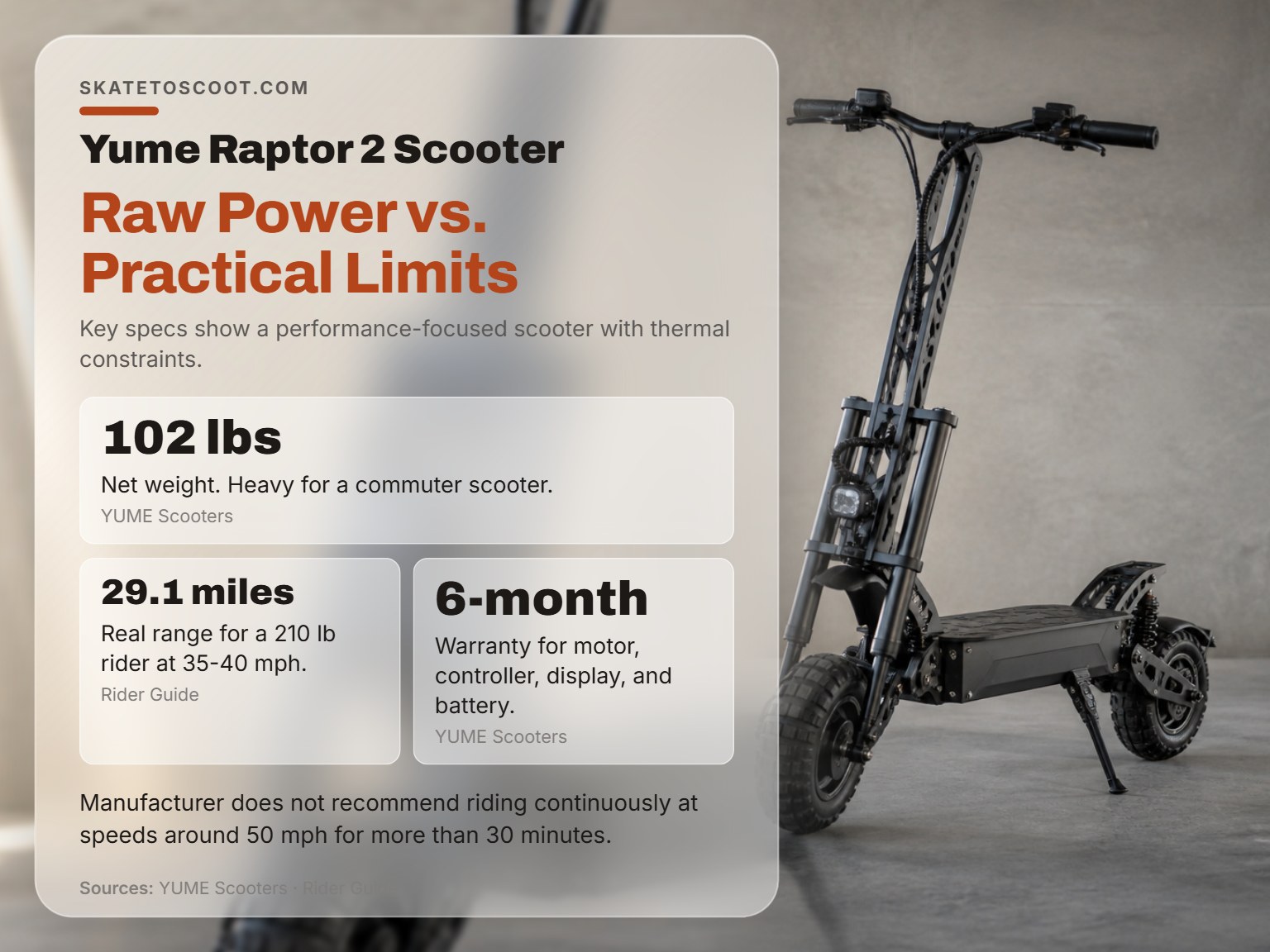
- Expect 29 miles of real range when riding aggressively at 35-40 mph with a 210 lb rider, not the range suggested by the manufacturer’s ideal test with a 155 lb rider at 15 mph.
- The warranty is split: 6 months for the motor, controller, display, and battery; 12 months for the frame, suspension, brakes, throttle, and charger; and only 1 month or 100 miles for tires, inner tubes, brake pads, kickstand, and fender, with strict exclusions for modifications and second-hand purchases.
- Customer support is US-based and offers scheduled 10-minute video calls for troubleshooting, a step above the purely email-based support of some direct-to-consumer brands.
- For the price, it outperforms scooters $500 more expensive on raw acceleration and top speed, but competitors like Apollo offer more refined software, better thermal management, and longer standard warranties.
The Yume Raptor 2’s Official vs. Real-World Performance
You look at the spec sheet and see a 54 mph rocket. You read the yume scooter review and see 51 or 52. That three-mile-per-hour difference isn’t the point. The point is what happens when you try to hold that speed.
The acceleration is where it truly shines. RK9 Rides clocked a 0 to 30 mph time of 4.96 seconds. For the money, that’s exceptional.
The Yume Raptor 2 utilizes dual 3,000W hub motors for a combined 6,000W peak power output. It is offered with either a 60V 27Ah battery or a 60V 30Ah upgrade featuring Samsung 21700 cells. The scooter carries an IP66 water-resistance rating, weighs 102 lbs, and supports a maximum load of 330 lbs.
The problem is sustained speed, not peak speed. The scooter’s “Smart Battery Protection” system monitors cell temperature and intervenes when it hits 70°C (158°F). YUME frames this as a protective feature. Reviewers frame it as a thermal wall.
During extended high-speed runs, the Smart Battery Protection system can engage, requiring you to pull over to a safe location and let the scooter rest for 3–5 minutes. YUME’s own advice states they “do not recommend riding continuously at speeds around 80 km/h (50 mph) for more than 30 minutes without a break.” Think about that. A performance scooter marketed for 50+ mph speed has a built-in time limit for using that performance. It’s a scooter whose sustained high-speed performance is limited by its thermal management.
The real-world range tells a similar story. YUME’s range figures are measured with a 155 lb rider at a constant 15 mph. A real-world yume scooter review with a 210 lb rider maintaining 35-40 mph yielded 29.1 miles. If you ride it hard, the range nearly halves. That’s not a defect; it’s physics. But it’s a gap between expectation and reality that buyers need to see.
Build Quality, Features, and Everyday Use
At 102 lbs with a 42-inch wheelbase, the Raptor 2 feels planted. The 11-inch tubeless tires (available in street or knobby off-road versions) and adjustable suspension soak up bumps. The switch to a half-twist throttle is controversial—some prefer the control of a thumb throttle, especially at high speed where a firm grip matters.
The inclusion of two 2A chargers in the box is a standout value. Doubling them up for 4A charging cuts recharge time significantly. The handlebars are wide at 29 inches, offering good control, and the deck provides ample room at 22.5 inches (29 inches if you use the kicktail).
Where this goes sideways: Relying solely on the NFC key to power on. There is no backup PIN pad. Lose the key and you’re locked out, save for a mechanical emergency key that only activates a limited “limp-home” mode.
The scooter uses an NFC key for ignition, and a mechanical emergency key is included for a limited ‘limp-home’ mode.
The build is solid for the price point. It uses hydraulic brakes with 160mm rotors for solid stopping power, and the addition of a steering damper is a genuine safety upgrade for high-speed stability. The build is solid for the price point.
Reliability, Warranty, and the Fine Print
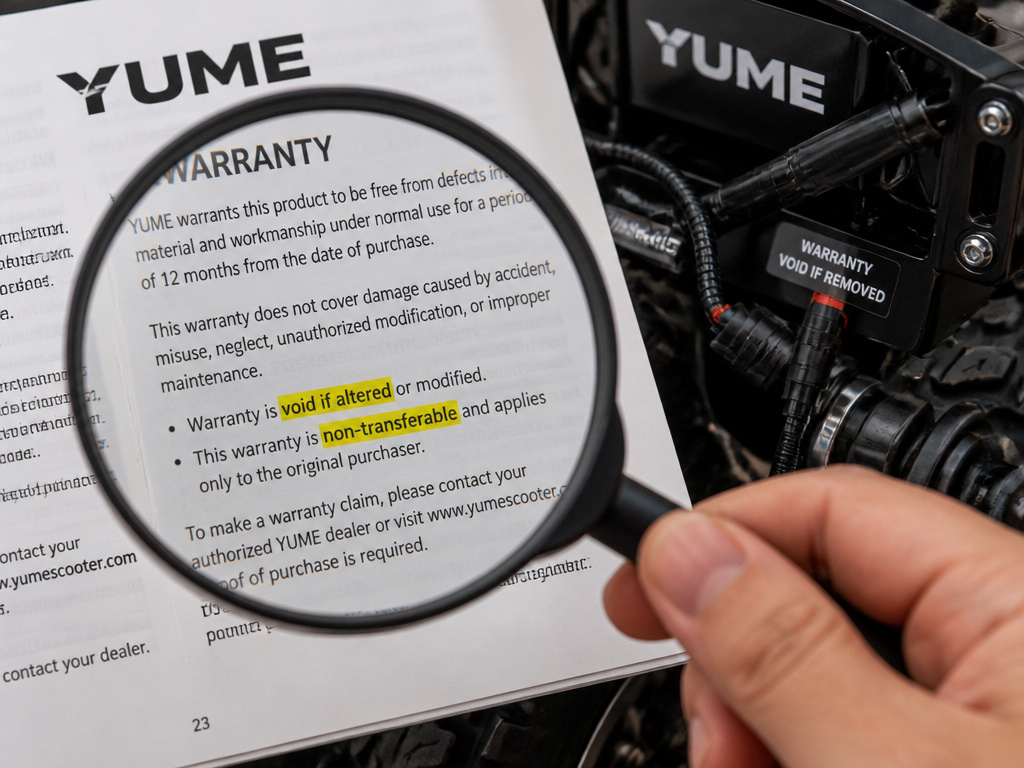
This is where the rubber meets the road on “value.” YUME’s warranty is a tiered system with very specific exclusions. It’s crucial to understand what’s covered, for how long, and what instantly voids it.
| Component | Warranty Period | Notes |
|---|---|---|
| Motor, Controller, Display, Battery | 6 months | The core electrical system. |
| Frame, Suspension, Brakes, Throttle, Charger | 12 months | Structural and mechanical parts. |
| Tires, Inner Tubes, Brake Pads, Kickstand, Fender | 1 month or 100 miles | Consumables with very short coverage. |
The warranty is for the original owner only and is not transferable. Buying a used Raptor 2 means you have no warranty coverage at all. Any unauthorized modification or alteration of the internal wiring immediately voids the entire warranty. This is a critical point for tinkerers.
Damage resulting from normal wear and tear, including fatigue, is not covered. Fatigue damage is a symptom of the frame being worn out through normal use. It is one kind of normal wear and tear, and it is the owner’s responsibility to inspect his/her scooter.
Collision damage is also excluded. If you crash it, you fix it. The warranty covers manufacturing defects, not accidents or the gradual wearing out of parts. This is fairly standard, but YUME’s explicit listing of “fatigue” as uncovered wear and tear is a clear warning: this is a high-stress vehicle, and parts will wear out.
Support-wise, YUME offers email and live chat, plus scheduled 10-minute video support calls through their website. They are developing a network of service centers and offer US-based repair hubs. For a direct-to-consumer brand, this structured support is a positive sign compared to the opaque, email-only support of some rivals.
Yume vs. The Competition: Where Does It Stand?
The Raptor 2 exists in a crowded field. Its main draw is simple: more raw power and higher top speed for your dollar than almost anything else near its price. But that advantage comes with trade-offs a brand like Apollo scooters doesn’t ask you to make.
A comparison shows the differences. An Apollo scooter at a similar price might have a slightly lower peak speed but will likely offer more sophisticated software (like regenerative braking), a more robust app ecosystem, and better thermal management for sustained performance. Apollo’s standard warranty is often 12 months across the board, not split into 6-month and 1-month tiers. You’re paying for refinement and peace of mind.
The Raptor 2 is for the rider who prioritizes peak metrics above all else and is willing to manage the thermal limitations. It’s the hardware-focused option. It’s like building a gaming PC with the fastest GPU you can afford, knowing it will run hot and loud, versus buying a polished, integrated console. Both play the game; one requires more hands-on management.
For commuters who need reliability and all-day comfort, the value calculation shifts. The Raptor 2’s weight (102 lbs) and its thermal behavior make it less ideal for long, fast commutes. A lighter, more thermally stable scooter from our list of best all-around scooters might be a smarter daily driver, even if its top speed is 10 mph lower.
Who Should (and Shouldn’t) Buy a Yume Raptor 2
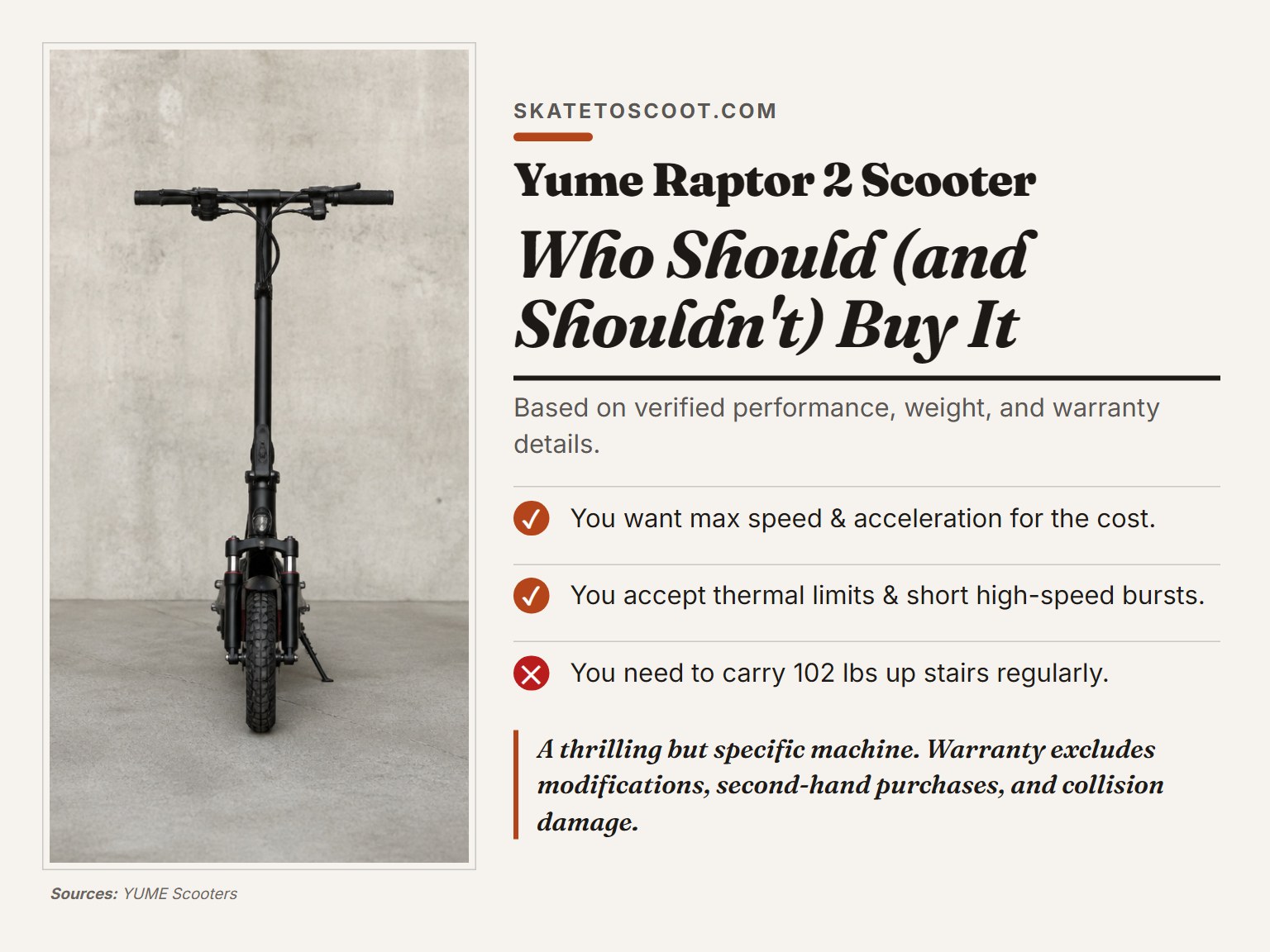
This scooter serves as a specific tool for a specific job, not a general-purpose vehicle.
Buy the Yume Raptor 2 if:
- Your primary goal is maximum speed and acceleration for the lowest possible cost.
- You understand and accept the thermal limits, using top speed in short bursts rather than sustained highway-style riding.
- You are technically inclined and comfortable with basic maintenance and troubleshooting.
- You value raw hardware (motors, battery capacity, hydraulic brakes) over software polish and app integration.
Skip the Yume Raptor 2 if:
- You need to travel long distances at consistently high speeds (over 40 mph).
- You want a hassle-free, set-and-forget riding experience with long warranty coverage.
- You plan to modify the scooter or buy it second-hand.
- You need to carry it up stairs regularly—102 lbs is no joke.
For the right rider, it’s a thrilling machine that makes other electric scooter reviews in its price range look sluggish. For the wrong rider, it’s a frustrating lesson in the difference between marketing specs and real-world engineering.
Frequently Asked Questions
Are Yume scooters any good?
Yes, for the right rider. Yume scooters, particularly the Raptor 2, offer exceptional power-to-price ratios. They are good for performance-focused riders on a budget who are aware of limitations like thermal throttling and shorter component warranties. They are not the best choice for those seeking premium build quality, extensive software, or worry-free long-term reliability.
What is the most reliable brand of electric scooter?
There is no single “most reliable” brand, as it depends on price and type. In the high-performance sector, brands like Dualtron and Rion have reputations for robustness but command premium prices. In the mainstream market, companies like Segway-Ninebot and Apollo have established track records for build quality and customer support.
Where are Yume scooters made?
YUME Scooters is a Chinese manufacturer. Their scooters are designed and built in China, though the company markets internationally and has been developing US-based support and repair hubs to improve customer service for North American buyers.
How does the Yume Raptor 2 handle in the rain?
The Raptor 2 carries an IP66 water-resistance rating, which means it is protected against powerful water jets and dust ingress. This makes it suitable for riding in rain and through puddles. However, no electric scooter is fully waterproof, and submerging any part of it is not advised. Always dry the scooter after a wet ride and avoid charging it while it’s still wet.
What safety gear is recommended for a scooter this fast?
A DOT-certified full-face helmet is essential. At 50+ mph, a bicycle helmet is insufficient. You should also wear motorcycle-grade gloves, a riding jacket (or at minimum, elbow and shoulder pads), and knee pads. Wrist guards are also highly recommended, as wrist fractures are a common injury in high-speed falls. The faster you go, the more gear you should wear.
The Bottom Line
The Yume Raptor 2 is a fascinating case study in value engineering. It gives you breathtaking acceleration and a genuine 50+ mph top speed for hundreds less than the competition. That achievement is real.
But the cost of that achievement is also real: you must manage its heat, you must accept its short warranty on key components, and you must live with its software quirks. It’s a scooter that demands a technically aware owner.
For the performance enthusiast on a tight budget who reads manuals and understands amp draw, it’s a compelling, almost unbeatable option. For the casual rider looking for a fast, carefree commute, the compromises might outweigh the savings. Check your priorities, check the best scooters in your budget, and then decide if you want to chase the numbers or buy the system. The Raptor 2 is for the number chasers.
