Chamonix Snowboard Review: What You Need to Know
This post contains affiliate links. As an Amazon Associate, we earn from qualifying purchases.
Chamonix snowboards are the in-house brand of The-House online retailer, offering budget-friendly boards with basic construction. They are a reasonable choice for true beginners on a tight budget, but their production halted in 2023, and most intermediate riders will find better performance and value in a used board from a mainstream brand like Salomon, Rossignol, or Nitro.
That price tag, as low as $200, is the main story. It’s what gets people clicking. The boards look complete: they have camber profiles, triaxial glass laminates, and sintered bases on paper. The disconnect starts when you ride one back-to-back with anything from a known brand. The feel is different. Flat is the word that comes up. Lifeless and sloppy follow. This is a common theme in any Chamonix snowboard review.
What follows is a breakdown of where that feeling comes from, who might not mind it, and the one question you should answer before you spend any money: is saving a few hundred dollars now worth missing out on the feedback and progression a better board provides?
Key Takeaways
- Chamonix is a defunct in-house brand; production stopped in 2023, so you’re only buying leftover stock or used boards.
- These are mass-produced, low-to-mid spec boards best suited for absolute beginners who prioritize lowest cost over ride feel and progression.
- A used board from Salomon, Rossignol, or Nitro in the same price range will almost always offer better construction, more predictable performance, and higher resale value.
- Pay close attention to specific model specs, community reports suggest some published numbers, like the Chemin’s 17m sidecut, may be inaccurate.
- The brand’s connection to The-House retailer means there is no independent manufacturer warranty or support network.
Who Is Chamonix? The House Brand Story
Chamonix wasn’t a snowboard company in the traditional sense. Founded in 2017, it was created as the in-house brand for The-House snowboard store. Their stated mission was to make snowboarding more affordable. By cutting out the middleman and designing boards to hit a specific low price point, they succeeded on cost.
Chamonix snowboards are the proprietary brand of The-House online retailer. Founded in 2017, the brand aimed to reduce the cost barrier to entry by offering a full lineup of boards, often featuring specs like sintered bases and camber profiles, at prices sometimes half the industry average.
The business model has a clear upside and a major downside. The upside is obvious: you could get a board with a sintered base and a Genuine Camber profile for as low as $200. The downside is that as a retailer brand, Chamonix had no independent research, development, or team of pro riders refining the product. The boards were designed to a cost, not to a performance standard. This became unequivocal in 2023 when The-House nearly closed down, and Chamonix production halted entirely. No new models are being made.
This origin story is crucial for setting expectations. You’re not buying a board from a company with a snowboarding legacy. You’re buying a retailer’s house brand, which is now discontinued. This matters for warranty support, community knowledge, and long-term parts availability.
Construction & Build Quality: What $200 Actually Buys
On paper, the specs for models like the Beartooth read well. The 156cm version lists a Response Plus core (FSC), a Retri Plus laminate (triaxial glass with carbon stringers), a sintered base, and that Genuine Camber profile.
The reality of mass-produced, low-margin gear is that the quality control and material grades are where corners are cut. A sintered base is a feature, but the specific polyethylene formula and its grind finish affect speed and durability. Triaxial glass is a standard laminate, but the resin quality and layup precision impact the board’s liveliness and damping.
The community history backs this up. On forums and Reddit, discussions from 5-6 years ago frequently mentioned complaints about total delaminations or other significant failures. More recent anecdotes include a Reddit user noting that as of 2019, Chamonix boards were made in the same factories as Nitro and Rome boards. Another pointed out that some Chamonix bindings were identical to M3 bindings. This implies the boards are built on generic, outsourced manufacturing lines, which can be consistent but rarely excel.
The takeaway isn’t that they fall apart immediately. It’s that the build is designed for adequacy, not excellence. For a beginner who might outgrow the board in a season or two, that can be acceptable. For someone looking for a reliable, predictable plank that will last for years, it’s a gamble.
Performance & Ride Quality: The “Flat” Feeling
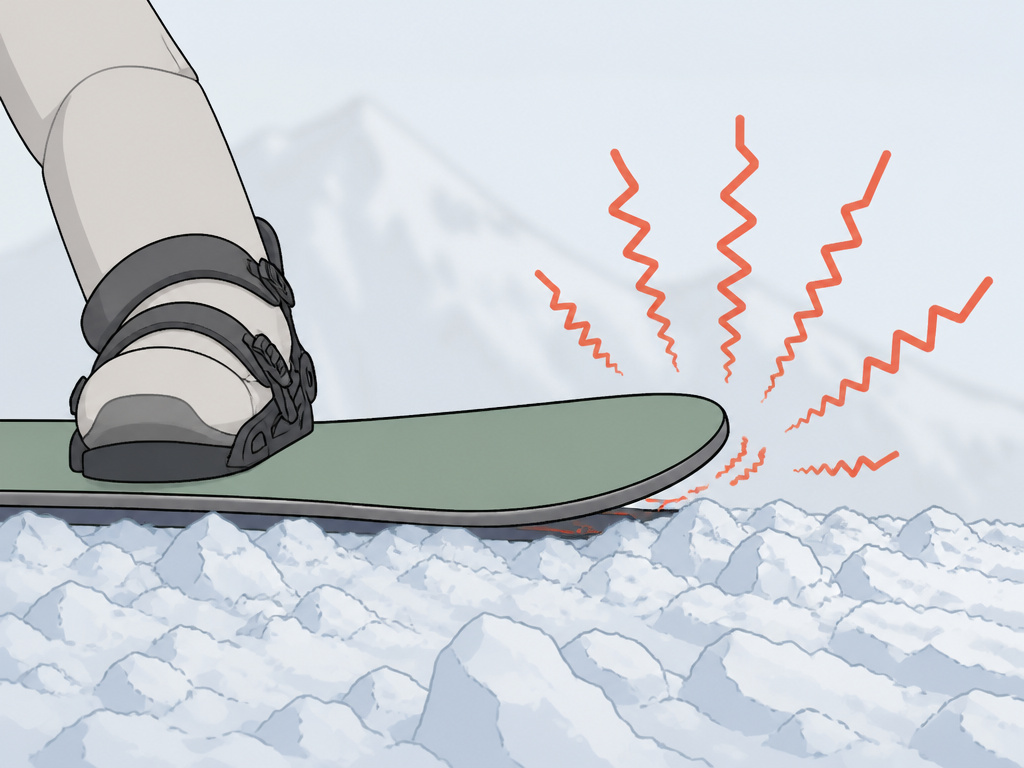
Here’s where the rubber meets the road, or rather, the edge meets the snow. A qualified instructor with 16+ years of experience tested several Chamonix models over approximately 5 days in October 2022, using Rome Katana bindings. His summary was blunt: after riding top-tier all-mountain boards, the difference was immediately apparent. The boards felt flat, lifeless, and sloppy.
That’s the commodity review. The non-commodity, granular details come from owners. Take the Chamonix Chemin, a powder-specific swallowtail with an 8/10 flex rating. One owner reported a slight chatter on the nose when simply stomping the board on the ground. On snow, riding over choppy “chunder” made that nose chatter noticeable. Yet, the same rider found the board fun for carving, with great edge hold, and excellent in crusty powder. The short swallowtail was ‘weird at first’ for riding bumps but the rider said it actually helped turning more easier.
This contradiction is the Chamonix experience, a common theme in any Chamonix snowboard review. The boards work. They will turn, they can float, and you can have fun. But they lack the refined, connected, and energetic feedback that allows for precise control. They feel inert. You move the board, not the other way around.
The Sidecut Spec Disagreement
This leads to a critical technical caveat. The Chemin 156cm is listed with a sidecut radius of 17 meters. In a forum discussion, experienced riders collectively questioned this spec. The consensus among forum users was that the other board dimensions didn’t support such a large sidecut, and if the official 17m spec were true, the board simply wouldn’t turn as it did. This is a rare, clear example of a published manufacturer spec that the riding community doubts based on performance.
When you’re comparing boards, geometry is everything, as highlighted in any Chamonix snowboard review. A discrepancy this fundamental makes direct comparisons with other brands nearly impossible. This shows the “budget brand” reality: even the basic numbers you’re using to make a decision might not be reliable.
Chamonix vs. The Used Board Alternative
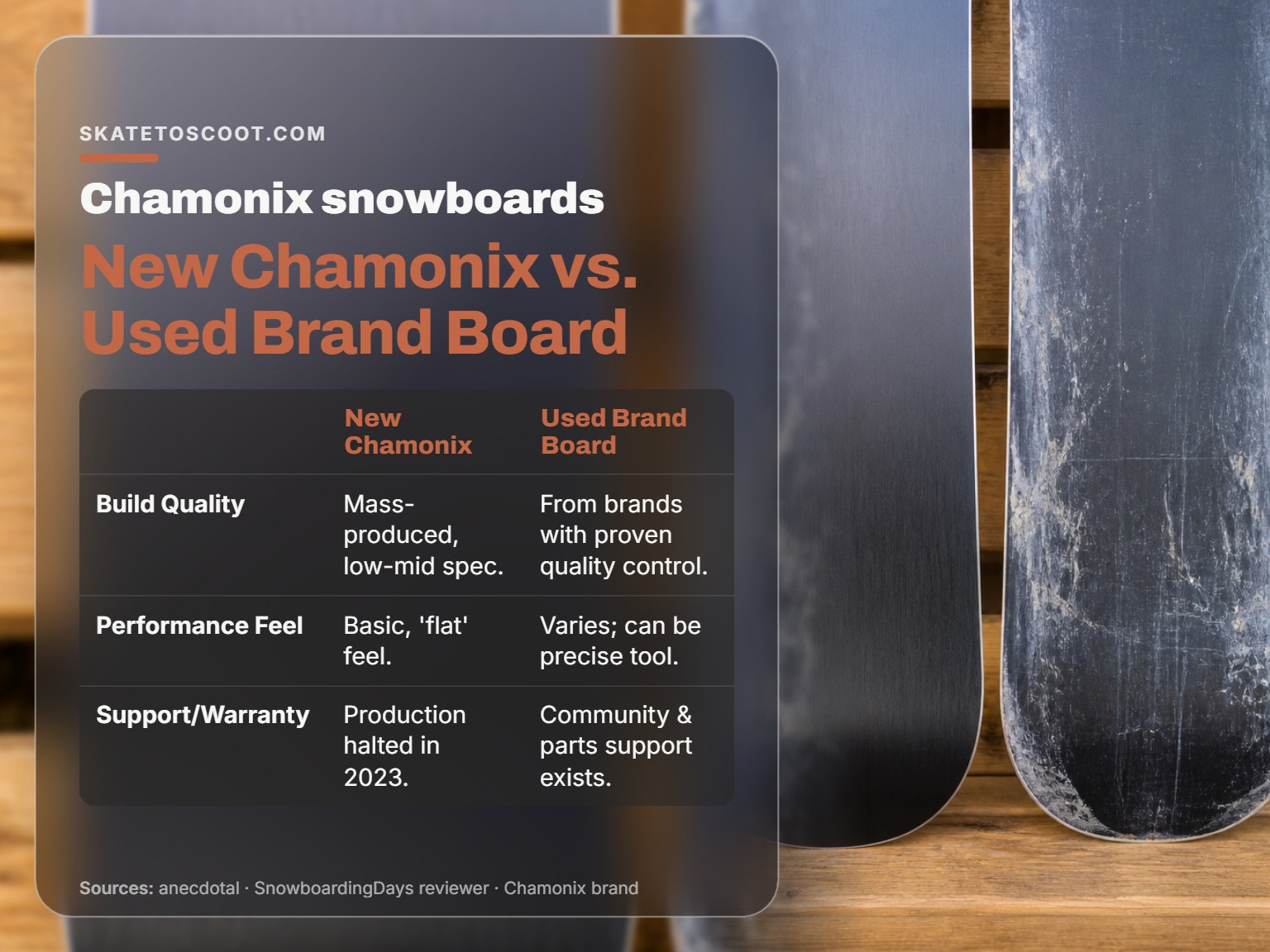
This is the most important comparison in this review. Suppose you have $300 to spend. You can buy a new Chamonix board, or you can buy a used board. Community advice from sources like Reddit often favors the latter, with one user stating, “any board that is $300 new let alone $120 new is not a good board. I’d rather buy a used board from an established brand.” However, the SnowboardingDays review presents Chamonix as a reasonable beginner choice while also recommending checking out entry-level boards from Salomon, Rossignol, or Nitro.
| Consideration | New Chamonix Board | Used Brand-Name Board |
|---|---|---|
| Initial Cost | ~$200 – $300 | ~$150 – $300 |
| Build Quality | Mass-produced, low-mid spec. History of delamination complaints. | Varies, but from brands with proven quality control (Burton, Salomon, Nitro, etc.). |
| Performance | Basic, “flat” feel. Gets you down the mountain. | Can range from beginner-friendly to high-performance, depending on model. |
| Technology | Often older, generic tech implementations. | May include specific, proven tech from that brand’s R&D (e.g., Burton’s Channel, Bataleon’s 3BT). |
| Resale Value | Very low. Difficult to sell as a discontinued brand. | Higher. Maintains some value based on brand reputation and model desirability. |
| Support/Warranty | Effectively none post-2023. | Original warranty may be void, but brand community and parts support exist. |
A used board isn’t without risk, you need to inspect it for core shots, delamination, and edge integrity. But the potential upside is massive. For the same money, you could get a 2-3 year old board from a company that invests in engineering. The difference in how it communicates with you, holds an edge, and absorbs vibration isn’t subtle. It’s the difference between learning on a precise tool and learning on a blunt instrument.
Specific Model Breakdown
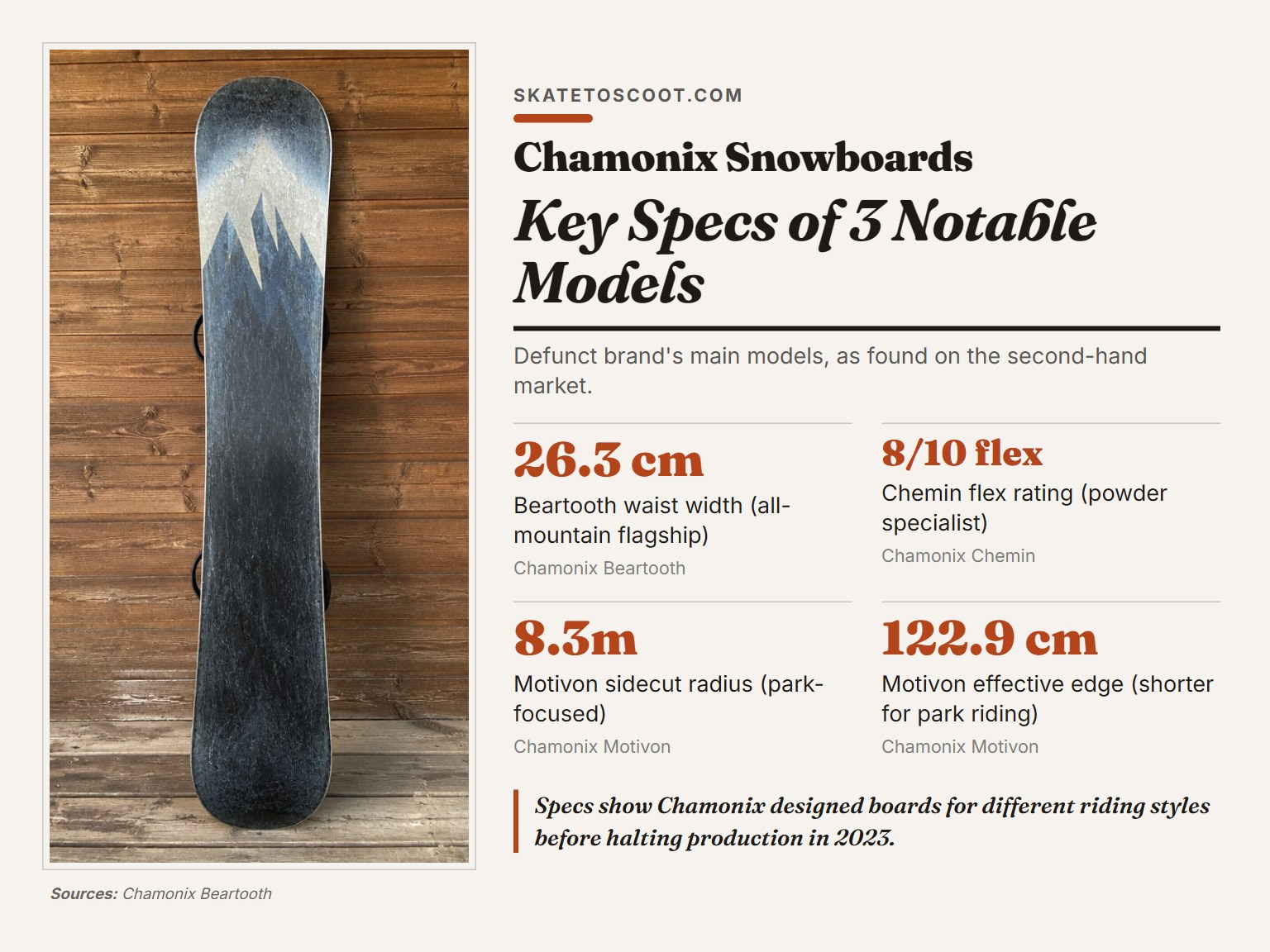
While Chamonix is defunct, you may encounter specific models on the second-hand market. Here’s what the specs tell us about three notable ones:
- Chamonix Beartooth (156cm): The all-mountain flagship. It boasts a full camber profile, a 26.3cm waist width, and a 16m sidecut radius. The Response Plus core and Retri Plus laminate with carbon stringers suggest it was their performance play. This would be the model to look for if you want a traditional, directional charger from the lineup.
- Chamonix Chemin (156cm): The powder specialist. Its swallowtail shape and stiff 8/10 flex are designed for deep snow. The claimed 17m sidecut is disputed, as discussed. Owner reports praise its float and carving edge hold, but note the initial chatter.
- Chamonix Motivon (156cm): A park-focused option. The specs show a shorter effective edge (122.9cm), a tighter 8.3m sidecut radius, and a -15mm set back. The 26.2cm waist is slightly narrower than the Beartooth.
These specs matter because they show Chamonix did try to cover different riding styles. If you’re looking at a used board, identifying the model helps you understand its intended purpose.
The Verdict: Who Should Buy a Chamonix Board?
One point is certain. I would not buy one for myself or recommend one to a skating student moving to snow. The feedback loop between you and the board is too vague. In skating, if your frame is misaligned or your wheel durometer is wrong, you feel it instantly and correct it. A dead-feeling snowboard teaches you nothing except how to wrestle with gear.
However, I have to concede a narrow use case. If you are an absolute beginner, your budget is rigidly fixed at $200, you will only ride a few days a season, and the thought of navigating the used gear market is overwhelming, a Chamonix will function. It has edges, a base, and bindings mounts. You can learn to link turns on it.
For everyone else, especially the intermediate rider looking to progress, the math changes. The used board market is your best friend. A pre-owned Rossignol snowboard or Salomon from a few seasons ago will offer a dramatically better experience. The investment isn’t just in the board; it’s in the quality of your learning. A better board gives better feedback, leading to faster, more confident progression.
Where this goes sideways: Buying a Chamonix because the price is low, then getting frustrated when your skills plateau. You’ll blame yourself, but a big part of it is the equipment’s inability to communicate with you. That happens within the first season.
Your money goes further when it’s spent on proven technology from a company that exists to innovate, not just to hit a price point. Check out our guides on the best snowboards and deeper dives into classics like the Burton Custom to understand what that investment feels like underfoot. The difference isn’t just in the logo; it’s in the connection between the snow and your brain.
Chamonix Snowboard Graphics
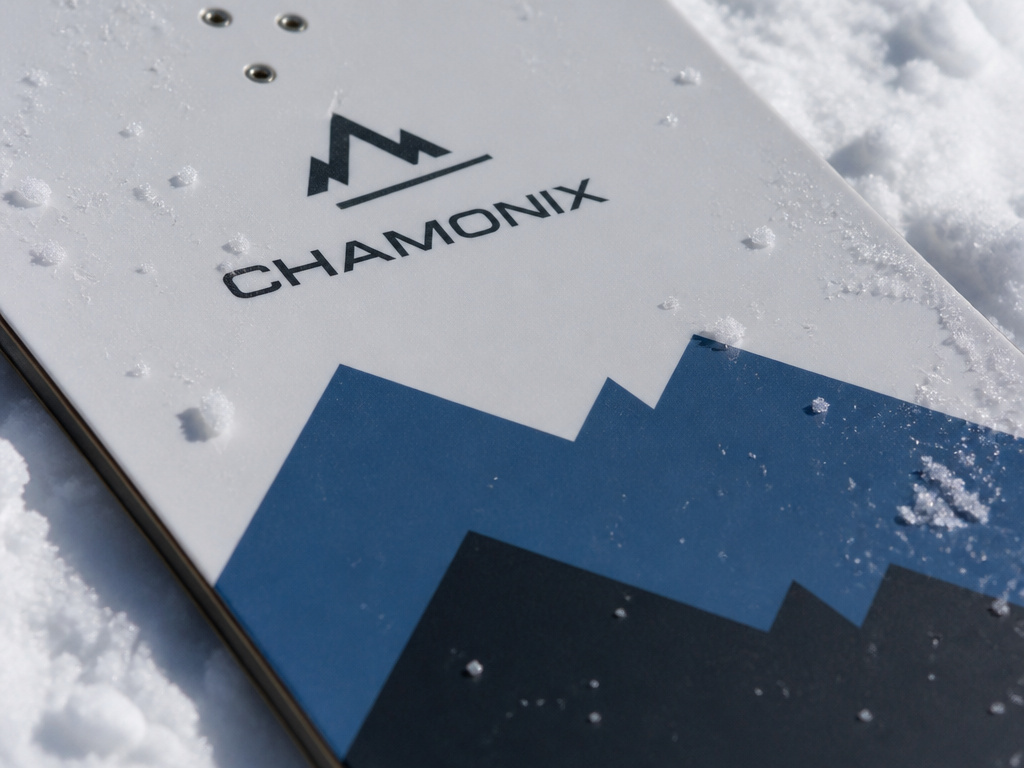
Chamonix boards were designed to hit a low price point, and this priority is reflected in their aesthetics. The graphics typically follow straightforward, mass-produced designs meant to appeal broadly rather than push artistic boundaries. You won’t find the intricate, brand-collaborated artwork common on premium boards. For a rider, this means the top sheet is purely functional. The focus was on delivering a rideable product at a specific cost, not on creating a visual statement on the mountain.
Frequently Asked Questions
Is Chamonix a good snowboard brand?
Chamonix is an average, budget-oriented brand. Their boards are functionally sound for beginners but lack the performance refinements, consistent quality control, and technological innovation of established brands. With production halted, they cannot be considered a current or good brand for new purchases.
What are the top alternatives to Chamonix?
For budget-conscious beginners, look at entry-level models from Salomon (e.g., Huck Knife), Rossignol, or Nitro (e.g., Prime Raw). These brands offer similar prices with the backing of serious research and development. For a higher-performance alternative in the all-mountain category, reviews of boards like the Burton Custom X show what a focused design philosophy achieves.
Is Chamonix good for beginners?
It can be, but with major caveats. The low price lowers the barrier to entry, which is a valid benefit. However, the board’s “flat” and unresponsive feel may hinder progression compared to a slightly more expensive beginner board from a mainstream brand, which will offer more predictable and forgiving performance.
Are Chamonix snowboards durable?
Older community reports (5-6 years ago) cited delamination issues. More recent anecdotes suggest quality may have improved, especially as they were reportedly made in the same factories as Nitro and Rome. However, as a discontinued budget brand, long-term durability and warranty support are significant concerns.
The Bottom Line
Progress beats perfection, but your gear shouldn’t hold you back. A snowboard is your primary interface with the mountain. If it feels vague and uncommunicative, every turn is a guess. Chamonix boards, by design, live in that vague space. They are a solved equation for low cost, not for high feel.
The one action to take this week: price out a used board. Look for previous-year models from Salomon, Rossignol, Nitro, or even a basic Burton. Set your budget to what you would have spent on a new Chamonix. You will almost certainly find a better, more capable board. The few hundred dollars you save upfront with a Chamonix is the exact amount you pay in lost feedback, slower learning, and zero resale value. In skating or snowboarding, that’s a trade-off that rarely pays off.
