How Long Should Roller Skate Laces Be: Step-by-Step
This post contains affiliate links. As an Amazon Associate, we earn from qualifying purchases.
How long your roller skate laces should be depends on three things: your boot’s height, its specific model, and your personal lacing style. Riedell states its R3 derby skate uses 72-inch or 81-inch laces, while retailer Lucky Skates suggests most low-cut derby skates generally take 60-inch or 72-inch laces. The only foolproof method is to measure your current laces.
That gap between a manufacturer’s spec and your actual boot is where most guides fail. They give you ranges, 72 inches for low-cut, 108 for high-top, but a Riedell 336 Black high-top boot officially uses 120-inch or 130-inch laces, and a stiff, wide boot in a large size might need that extra length too. A key question is how long should roller skate laces be, as your lacing preference, like skipping top eyelets or wrapping, changes the math completely.
What follows: a breakdown of official model-specific lengths, a step-by-step measuring guide that never misses, and the one decision, waxed or unwaxed, that changes how your laces feel and last. By the end, you’ll be able to pick a length from a chart or know exactly how to measure for a perfect fit.
Key Takeaways
- Check your skate’s model first. For Riedell skates, the official chart specifies lengths like 72″ for the Dart or 120″ for the 172 high-top, this overrides general size guides.
- Always measure your old laces if you’re replacing them. Lay them flat and measure end-to-end in inches; this is the only method that accounts for your exact boot and lacing pattern.
- Waxed laces stay tighter and are more durable, but can feel stiff. Unwaxed laces offer stretch and flexibility, which can help with foot pressure and break-in comfort.
- Personal lacing style drastically alters length needed. Skipping eyelets shortens the requirement; wrapping around the ankle adds several inches.
- If in doubt, buy longer. You can always cut and seal the ends of a lace that’s too long, but you can’t add length to one that’s too short.
The Manufacturer’s Blueprint: Model-Specific Lengths
Forget “one size fits most.” If you own a Riedell, Edea, or other major brand skate, the manufacturer has already done the math. Their published charts are the closest thing to a guaranteed answer, and they reveal how much variation exists even within the same brand.
Riedell’s official lace chart is a perfect example. It doesn’t just say “high-top skates use long laces.” It lists exact lengths for over twenty models, and the spread is wider than most retail blogs suggest. The Riedell Dart roller skate model uses a 90-inch lace. Their popular R3 derby model uses either a 72-inch or 81-inch lace, depending on the boot size. But look at their high-top boots: the 120 model uses between 81 and 108 inches, the 220 Black uses 108 or 114 inches, and the aggressive 336 Black uses 120-inch or 130-inch laces.
According to Riedell’s official lace length chart, their Criss Cross X Derby Laces are sold in 90-inch and 108-inch lengths, but the laces supplied with specific skate models vary from 68 inches to 130 inches depending on the boot.
This is your first stop. If you know your skate’s make and model, search for the manufacturer’s downloadable spec sheet or manual. Edea’s FAQ states their laces are “designed for skating, with the right balance of strength and elasticity and the necessary length,” and recommends using Edea laces. This data is essential for a proper fit. Using a lace shorter than the manufacturer specifies means you might not reach the top eyelets, compromising ankle support. Using one that’s too long leaves you with excessive lace to manage, which can be a tripping hazard or simply annoying.
The takeaway here is that the common retail advice of “72 inches for low-cut, 108 for high-top” is a useful starting point, but it’s a generalization; for example, RollerFit suggests 108 inches for sizes 10 and up, while Riedell’s 336 Black high-top model uses 120-inch or 130-inch laces. Your specific boot could easily fall outside those ranges. This is especially true for stiff, wide, or extra-tall boots, where even a retailer like RollerFit notes you “may even need a 120 inch lace.”
The Step-by-Step Method: Measuring Your Existing Laces
When you don’t have the manufacturer’s chart, or you’ve changed your lacing style, measuring is your only reliable tool. It’s a five-minute job that saves you the cost and hassle of buying the wrong length twice. You need a flat surface, a tape measure (or a piece of string and a ruler), and the laces currently in your skates.
First, fully remove one lace from your skate. Don’t just pull it partway out. You need the entire length, aglets (the plastic ends) included. Lay it flat on a table or the floor, straightening out any kinks or curls. Stretch it gently to take out the slack, but don’t pull so hard that you elongate the material. Place your tape measure at the very tip of one aglet and run it straight along the lace to the tip of the other aglet. Record the length in inches. That’s your number.
Common mistake: Guessing based on your shoe size or the number of eyelets. A size 8 in a sleek derby boot and a size 8 in a bulky artistic boot have completely different lace paths and will need different lengths. Measuring is the only way to know.
Why does this work when charts sometimes fail? Because your measurement captures your unique combination: the exact boot model, its size, the height you lace it (do you use the very top hook?), and whether you use any special lacing techniques. Maybe you skip an eyelet to relieve pressure on a bunion, or you use a “straight bar” lacing pattern across the middle of the boot. These choices consume more or less lace than the standard criss-cross method. Your existing laces already account for all of that. If they fit well and give you enough lace to tie a secure knot, their length is your perfect target for replacements.
Waxed vs. Unwaxed Laces: The Grip vs. Flexibility Trade-Off

Length is half the battle. The other half is material, and the choice between waxed and unwaxed laces affects performance, feel, and even the functional length you need. This isn’t just about aesthetics; it changes how your skates interact with your feet.
Waxed laces have a thin coating of wax that makes them slightly sticky and stiff. This coating serves a mechanical purpose: it increases friction between the lace and the eyelet, and between the strands of the lace themselves when tied. The result is that waxed laces stay tight without constant re-tightening during a session. As Nettracing notes, they don’t fray, they’re easier to grip and tie, they don’t hold water, and they generally last longer. For a skater who needs a locked-in feel, think aggressive park skating, roller derby, or artistic routines, the security of a waxed lace is often worth the trade-off.
Unwaxed laces are the standard polyester laces most skates come with. They are soft, flexible, and have a bit of inherent stretch. RollerFit points out this stretch can be a pro: it “can be nice to relieve foot pressure and help with skate moulding.” For a beginner breaking in stiff new boots, or someone with a high instep, that slight give can prevent painful pressure points. The flexibility also makes them easier to thread through tight eyelets or use in complex lacing patterns.
Your choice here can subtly influence the length you buy when you compare a how long should roller skate laces be guide. A stiff, waxed lace doesn’t compress or stretch as much when you pull it tight. An unwaxed lace will elongate slightly under tension. It’s a minor factor, but it’s one more reason to measure your existing laces, they’ve already settled into your preferred type’s behavior.
Lacing Style and Personal Preference: The Wild Cards
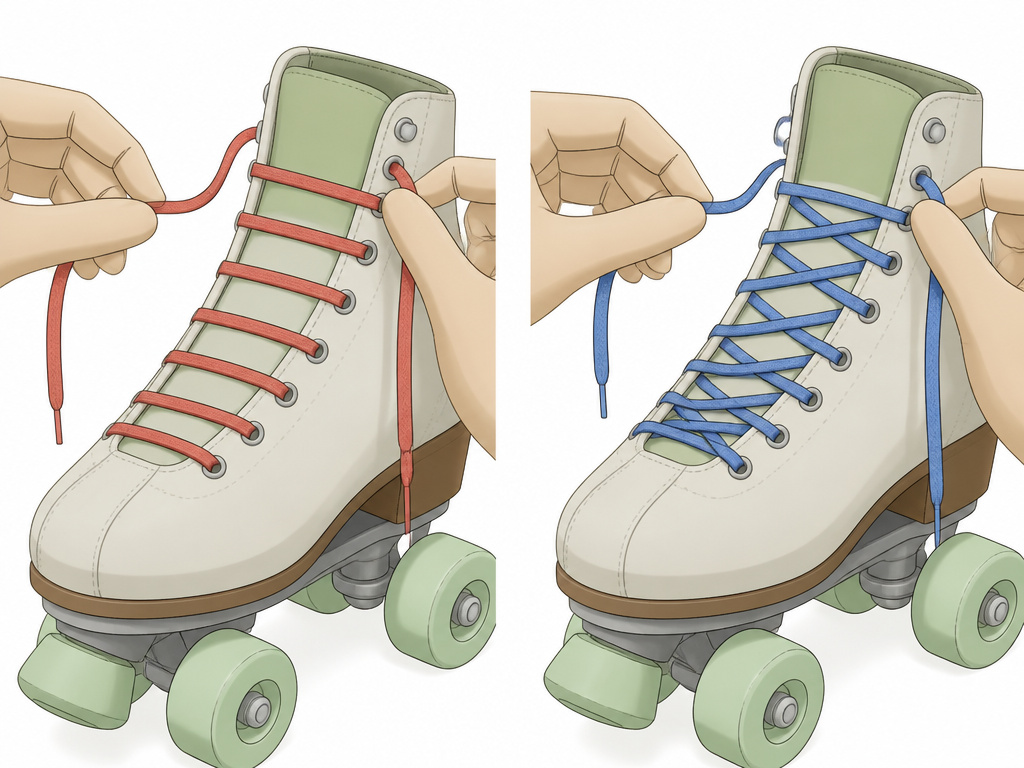
Manufacturer specs and measurements give you a baseline for how long should roller skate laces be, but the final arbitrator is you. How you lace your skates can add or subtract inches from the “required” length, and this is where many skaters get tripped up.
The most common variable is how high you lace. Do you use every single eyelet and hook, all the way to the top? Or do you stop one or two short for a freer ankle flex? Skipping eyelets reduces the lace length you need; the exact amount depends on boot height and eyelet spacing. Similarly, a “straight bar” lacing pattern, where the lace runs straight across between eyelets instead of diagonally, uses more material than the standard criss-cross.
Then there’s the controversial practice of wrapping the lace around the ankle. Some skaters, especially those with skinny ankles or in Bauer hockey skates, swear by wrapping for extra stability. Community discussions on Reddit show users choosing 108-inch or 120-inch laces specifically to allow for multiple wraps. However, other voices in the same forums strongly advise against it, arguing it “cuts into the boot ‘guts’ which weakens the boot” and can create a harmful pressure point on the ankle, while some users report wrapping for stability.
Where this goes sideways: Choosing a lace based solely on a size chart without considering your lacing habit. If you wrap your laces and buy a standard 84-inch length, you’ll run out of lace before you finish tying. If you skip eyelets and buy a 108-inch lace, you’ll have a foot of excess lace to deal with.
The solution is self-awareness. Before you buy, know how you lace. If you’re new and unsure, lean towards a slightly longer lace. It’s easier to manage extra length by double-knotting or trimming than it is to stretch a short lace to reach.
What To Do If Your New Laces Are the Wrong Length

You measured, you checked the chart, but the new laces you ordered are still a bit off. Don’t panic. A slight mismatch is fixable, and the fix depends on whether they’re too long or too short.
If the laces are too long, the remedy is simple: trim them. Put the laces on your skates, lace them up normally, and tie your preferred knot. Note how much excess lace is left dangling. Remove the lace and cut it, leaving enough length to tie a secure knot plus maybe an extra inch or two. The critical step is sealing the freshly cut end to prevent fraying. Use a lighter: briefly pass the flame near the tip until the synthetic fibers melt and fuse into a small bead. Don’t hold it in the flame so long that it catches fire; just a quick pass to melt the ends. Let it cool for a few seconds before touching it.
If the laces are too short, your options are more limited. You can try a different lacing pattern that uses less lace, like skipping the top hook or using a “ladder” pattern in the middle section. If you’re only an inch or two short, you can lace them normally and tie a less bulky knot. However, if they’re so short that you can’t apply even tension across the boot or tie any knot, they’re unusable. This is why the old advice “buy longer” exists. A lace that’s slightly long is functional; a lace that’s slightly short is often worthless.
This is also where the guide to cleaning roller skates becomes relevant. If your only pair of correctly sized laces is dirty and you need to wash them, having a spare pair of the right length is invaluable. Throwing your waxed or unwaxed laces in a gentle wash can extend their life, but you’ll need something to wear while they dry.
Lace length charts
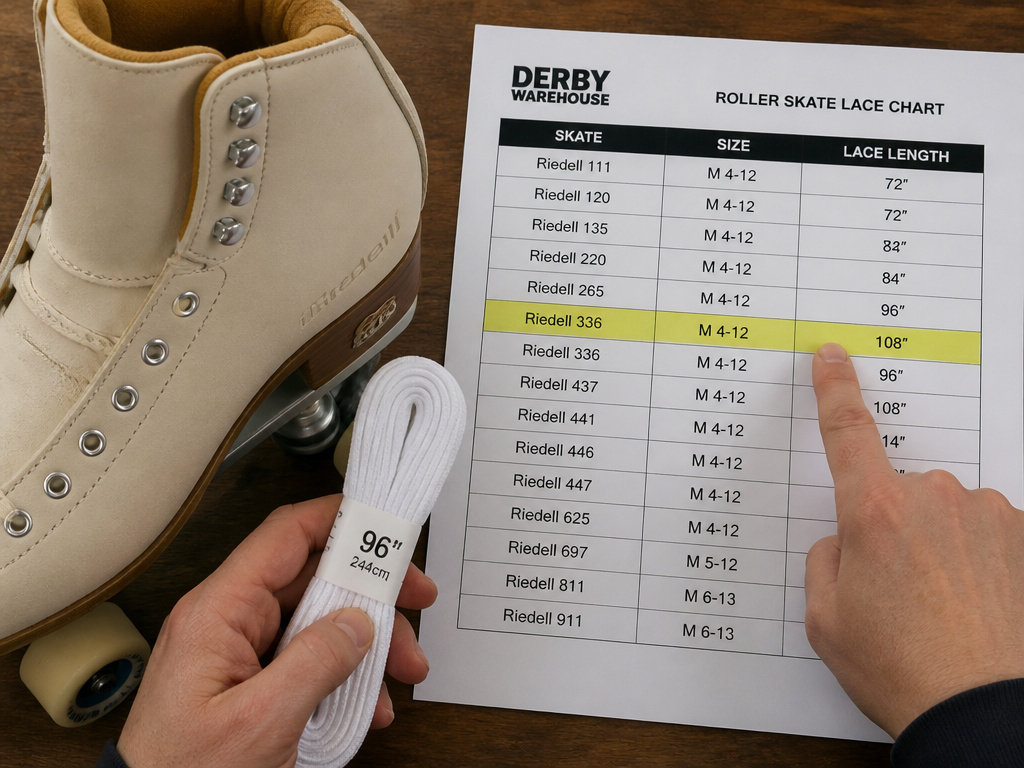
Manufacturer-specific charts are the most reliable source for finding the correct lace length. These charts account for the exact boot height, number of eyelets, and intended fit of each skate model. Consulting the official chart for your skate’s brand and model eliminates guesswork and provides a length designed for that specific boot’s construction and lacing pattern.
Where to buy replacement laces
Replacement laces are widely available from specialty skate shops, both online and in physical stores. Many retailers that sell roller skates also carry a selection of laces in various lengths and materials, such as waxed or unwaxed. Manufacturers often sell their own branded laces, which are designed to match the specific requirements of their skate models. When purchasing, knowing your required length and material preference will help you find the correct length and material. It’s also practical to measure your old laces before shopping to confirm the exact length you need.
Frequently Asked Questions
What is the standard roller skate lace length?
There isn’t one universal standard, but the most commonly available retail lengths are 72, 84, 96, and 108 inches. A default length often cited is 72 inches, but this is only a generalization; specific models like the Riedell Dart use 90-inch laces. The correct length is always specific to your boot model and size.
How do I convert lace lengths from inches to centimeters?
Multiply the inch measurement by 2.54. For example, a 72-inch lace is approximately 183 cm (72 x 2.54 = 182.88). A 108-inch lace is about 274 cm. Most international retailers list lengths in both units.
Can I use regular shoelaces for my roller skates?
No. As Nettracing states, “Regular shoelaces are usually not long enough to be used for roller skates.” Skate-specific laces are not only longer but are also designed for the higher tension and abrasion of skating. Using shoelaces that are too short or weak is a safety risk.
How often should I replace my skate laces?
It depends on how much you skate. Edea recommends that skaters who train regularly every day should change laces every 2 months as they lose elasticity. For recreational skaters, inspect them regularly for fraying, stretching, or weakened areas, and replace them at the first sign of significant wear.
Do I need different laces for inline skates vs. Quad skates?
The principles are the same, but inline skates, especially hockey or aggressive models, often have a different cuff design with more eyelets. Lucky Skates notes that Bauer or roller hockey skates generally take 108-inch or 120-inch laces. Always refer to your skate’s manual or measure your existing laces for the most accurate fit.
The Bottom Line
Start with the manufacturer’s spec if you can find it, that’s the blueprint. When in doubt, or if your lacing style is unique, the tape measure is your best friend. Remember that a waxed lace will hold its tightness but may feel rigid, while an unwaxed lace offers comfort and stretch at the cost of needing occasional re-tightening.
If you remember one thing, let it be this: it’s always safer to err on the side of a lace that’s slightly too long. You can cut and seal an end. You can’t add material. Once you have the right length, the rest is about dialing in your proper fit and comfort, which is the real foundation of good skating. Everything else, the tricks, the speed, the style, builds on that base.
