How to Charge a Hoverboard: The 3-Step Safe Charging Guide
This post contains affiliate links. As an Amazon Associate, we earn from qualifying purchases.
To charge a hoverboard safely, plug the OEM charger into the wall outlet first, then connect it to your board. Use only the charger supplied with your specific model, charge on a non-flammable surface under supervision, and disconnect it once the charger light turns green. Never leave it charging overnight.
That sequence—wall first, then board—isn’t just good practice. It’s the manufacturer’s direct instruction to prevent a power surge from damaging the battery management system. Get it backward, and you introduce a risk point that doesn’t show up until the board suddenly won’t hold a charge months later.
What follows is the full breakdown of how to charge a hoverboard: the three-step physical procedure, how to read every light pattern your specific model might throw, and the hard safety rules backed by incident reports from the Consumer Product Safety Commission.
Key Takeaways
- Plug into the wall first, then connect to your hoverboard. Reversing this sequence can damage the battery’s management circuitry.
- Never charge unattended or overnight. The CPSC documents over 250 fire or overheating incidents, including fatal house fires, linked to hoverboards.
- Use only the OEM charger for your specific model. Incompatible chargers lack the correct voltage profile and can cause overcharging, a failure found in 28 of 29 boards in a 2018 government investigation.
- Store a hoverboard fully charged if following OEM advice, but know that general lithium-ion best practice recommends a 40-60% charge for long-term battery health—a point of disagreement with OEM guidance.
- Do not charge in freezing temperatures if your model specifies it. The Jetson V8 Sport manual explicitly prohibits charging below 32°F (0°C) and recommends bringing the board above 50°F (10°C) first, while other sources do not mention this restriction.
The Non-Negotiable Safety Rules
Before you touch the charger, these rules are the difference between a functional toy and a documented fire hazard. The U.S. Consumer Product Safety Commission (CPSC) has reports of more than 250 incidents related to fires or overheating since 2015, including fatal house fires.
Before you start: The battery is a lithium-ion pack. Overcharging or using a faulty charger can cause thermal runaway—an uncontrollable self-heating reaction. This has led to 13 burn injuries, three smoke inhalation injuries, and over $4 million in property damage, per the CPSC. Charge on a hard, non-flammable surface like tile or concrete, away from curtains, beds, or anything that can catch fire.
First, the charger. Only use the charger that came with your hoverboard or a replacement specific to your model. This isn’t about brand loyalty; it’s about voltage compatibility. The official CPSC hoverboard safety alert lists this as its first recommendation for a reason. Third-party chargers might fit the port, but their output profile can slowly overstress the battery.
Second, supervision. Only charge a hoverboard when you are there to watch it. Do not charge unattended, especially overnight. Both the CPSC and the Netherlands Food and Consumer Product Safety Authority (NVWA) state this identically. A 2018 NVWA investigation of 29 hoverboards found that for 28 of them, the charging did not stop when the battery was full. If that safety circuit fails and you’re not there, the board keeps cooking.
Third, environment. Keep it away from flammables and ensure it’s on a stable surface. A cluttered garage floor or a carpeted bedroom is the worst possible spot.
Finally, verify compliance. Your hoverboard should be compliant with the UL 2272 safety standard. This certification covers the entire unit’s electrical system. Be warned: the CPSC states that even UL 2272 compliance cannot guarantee that a hoverboard will not overheat or catch fire. It’s a baseline, not a forcefield.
The Standard 3-Step Charging Procedure
Ever wondered why your board’s manual is so specific about plug order when you learn how to charge a hoverboard? There’s a mechanical reason.
Step 1: Plug the charger into the wall outlet. This powers up the charger’s internal circuitry first. The charger light may illuminate.
Step 2: Connect the charger to your hoverboard’s charging port. You should hear or feel a firm click. Now the circuit is complete, and power flows from the wall, through the conditioned charger, to the board’s battery.
Step 3: Watch for the charger’s indicator light. For most models, it illuminates red while charging. It will turn green when the battery is full. At that point, you disconnect the charger from the board first, then from the wall.
Skipping the wall-first step can damage the board’s charging port. It might work fine many times, but can eventually cause damage. The board might still charge, but it won’t balance the cells properly, shortening its overall battery lifespan dramatically.
A full rundown of charging time by brand is its own topic, but plan for a single session, not a quick top-up.
| Step | Action | Why It Matters | Risk If Skipped |
|---|---|---|---|
| 1 | Plug charger into wall. | Conditions the charger’s output. | Power surge can damage board’s charging port. |
| 2 | Connect charger to board. | Completes the safe charging circuit. | N/A – this is the charging action. |
| 3 | Disconnect board, then wall. | Breaks the circuit safely at the source. | Leaving charger plugged into live outlet wastes energy, poses a minor shock risk. |
Reading the Lights: Your Charger and Board’s Status
The lights are a direct diagnostic feed from the battery management system. Misreading them is how you end up riding on a critically low charge, which strains the battery and can trigger safety shut-offs.
Your hoverboard has two sets of lights: the charger’s and the board’s own battery indicators.
The Charger Light: This is your primary signal. For many Jetson models, the rule is red light means charging, green light means complete. However, for the Jetson Hali X, the charger light flashes green during charging and stops flashing when full. One exception is the Jetson Hali X, where the charger light flashes green during the charge and stops flashing when full. If your charger light doesn’t come on at all, you’ve got a starting point for troubleshoot a hoverboard that won’t charge.
The Board’s Battery Indicators: This is where models diverge wildly. You must know which system you have.
Most boards use one of two systems: a single multi-color light, or three separate indicator lights. The meaning of those lights, however, changes between product lines.
The part nobody mentions: A “green” light on one model can mean “full,” while on another it means “critically low.” Assuming all green lights are good is how you get stranded.
The table below decodes the major systems according to Jetson’s official support. If your manual contradicts this, trust your manual.
| Model Type | Light Pattern | Charge Level | Action |
|---|---|---|---|
| Single Light (Alpha L, Flash, Force) | Solid Green | ≥ 50% | OK to ride. |
| Solid Yellow | 20 – 49% | Plan to charge soon. | |
| Solid Red | < 20% | Charge now. | |
| Three Lights (Hali X, Sync, Rave) | Three Green Lights | ≥ 50% | OK to ride. |
| Two Green Lights | 20 – 49% | Charge after your session. | |
| One Green Light | < 20% | Charge immediately. | |
| Impact, Sphere, X10 | Three Lights | ≥ 30% | OK to ride. |
| Two Lights | 20 – 30% | Charge soon. | |
| One Light | < 20% | Charge immediately. | |
| Lumino, Pixel, Stereofly | Three Lights | ≥ 75% | Full. |
| Two Lights | 30 – 74% | Healthy range. | |
| One Solid Light | 10 – 29% | Charge soon. | |
| One Flashing Light | < 10% | Critical. Charge now. |
If your board is beeping or tilting upwards, it’s not broken. Some models, like certain Jetson hoverboards, have a built-in safety behavior that activates when the battery falls below 10% charge to prevent deep discharge, which can permanently kill a lithium-ion cell.
Storage, Temperature, and Edge Cases
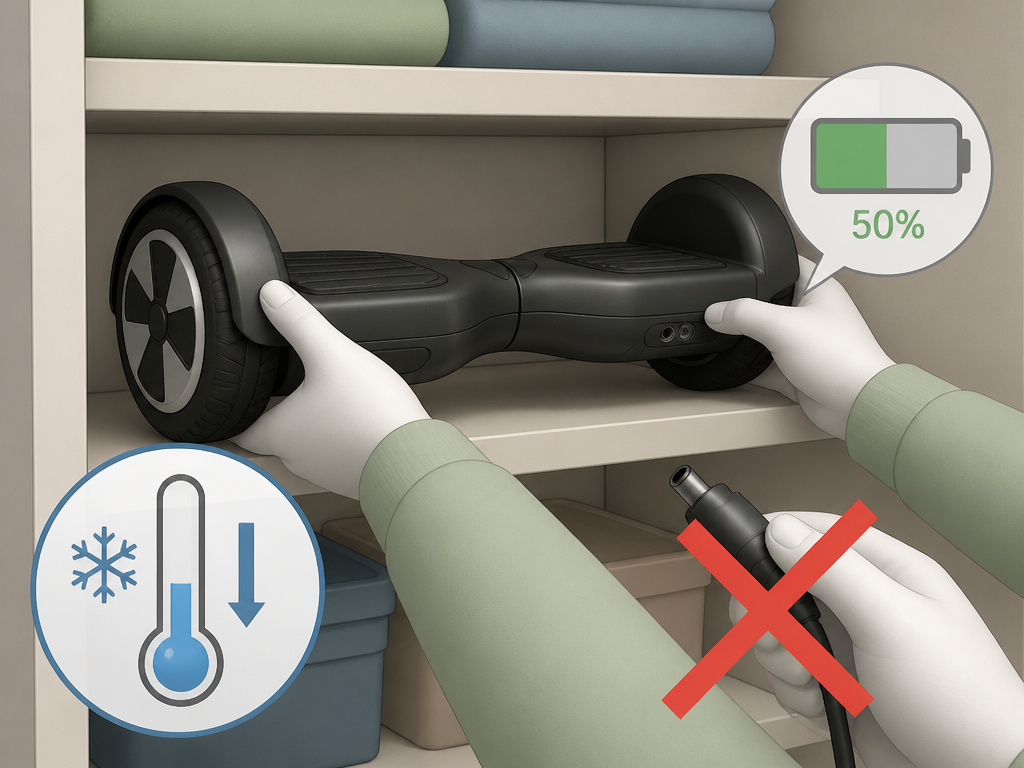
You won’t ride every day. How you store and occasionally top up your hoverboard matters as much as how you charge it. This is also where the manufacturer’s advice sometimes clashes with general battery science.
Storage Charge Level: Here’s a genuine contradiction. Jetson and the V8 Sport manual both say: “Fully charge the battery before storing.” However, the widely accepted best practice for long-term lithium-ion battery health (from battery cell manufacturers themselves) is to store at a 40-60% state of charge. The full-charge advice maximizes your chance of a ready-to-ride board after months in the closet, but it accelerates the battery’s long-term capacity fade. The 40-60% rule maximizes battery lifespan. You have to pick your priority.
Storage Charging Interval: The advice agrees in spirit but differs on timing. The goal is to prevent self-discharge from draining the battery to zero volts, which is a death sentence.
Low-Temperature Charging: This is a critical, often-overlooked spec. The V8 Sport manual is explicit: “If the ambient temperature is below 32 degrees Fahrenheit, do not charge. You should bring the vehicle into a warm environment (above 50 degrees Fahrenheit) for charging.” Lithium-ion batteries cannot safely accept a charge when frozen. Attempting to do so can cause lithium plating inside the cell, permanently reducing its capacity and increasing the risk of internal short circuits. If your board has been in a cold garage or car trunk, let it warm up to room temperature for a few hours before plugging it in.
These edge cases are where general maintenance tips separate from the basic charging script. They’re also what most quick guides miss.
What Happens If You Get It Wrong?
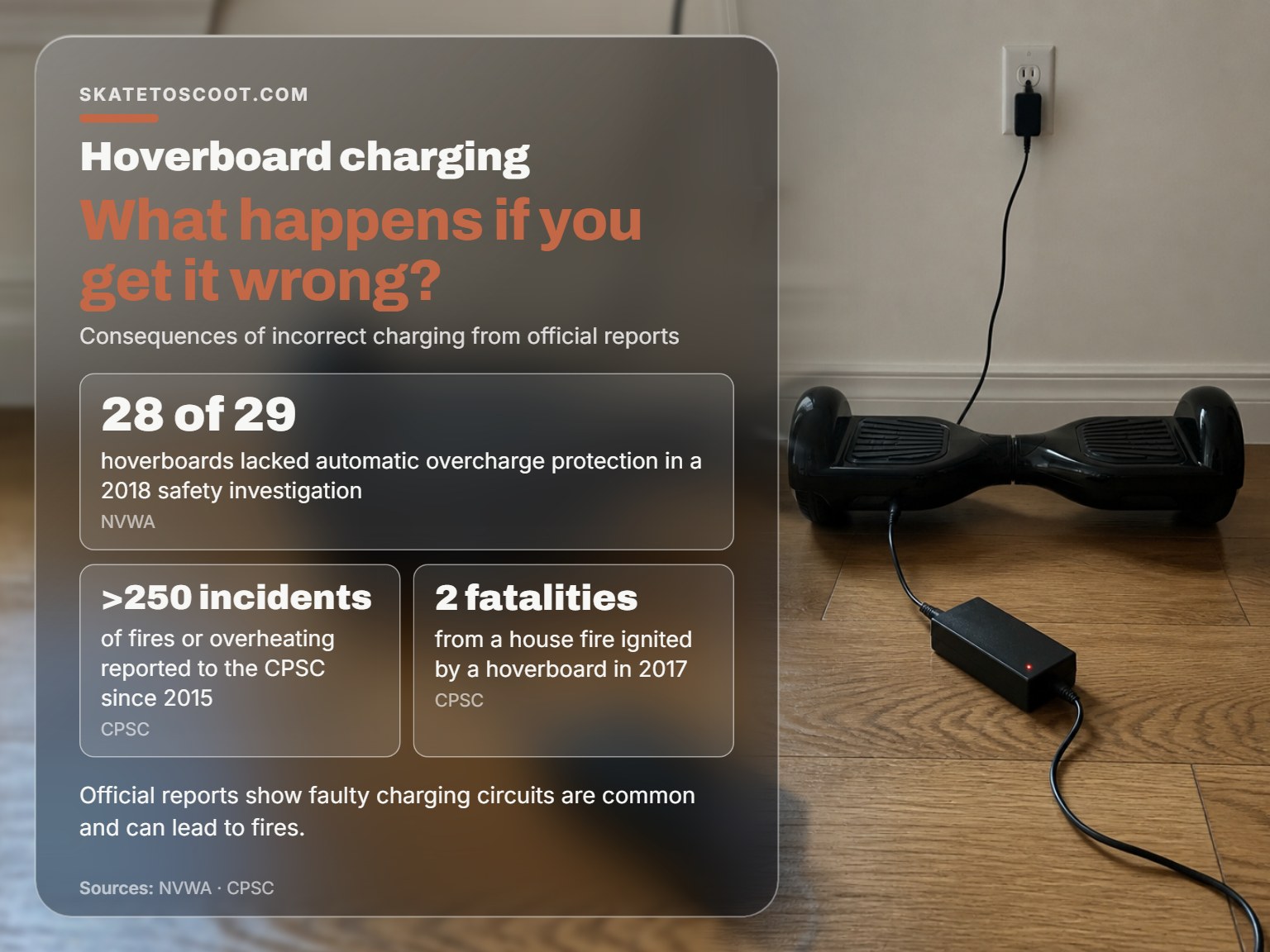
The consequences of bad charging habits are documented in regulatory reports with timelines and dollar figures.
Overcharging is the main villain. The 2018 NVWA report is a sobering read: 28 of 29 investigated boards lacked a functional circuit to stop charging when full. Leave a board like that plugged in overnight, and the battery cells are continuously stressed. Heat builds up. This leads to an increased risk of fire. For a detailed look at the specific failure modes, see our guide on what happens if you overcharge.
This is the chemical reaction sequence that led to the more than $4 million in property damage cited by the CPSC. Your fire safety habits are your last line of defense.
Using a non-OEM charger amplifies every one of these risks. A cheap replacement might deliver a slightly higher voltage, pushing the cells further into an overcharged state faster than the board’s own failing safety circuit can handle.
Troubleshooting Common Charging Problems
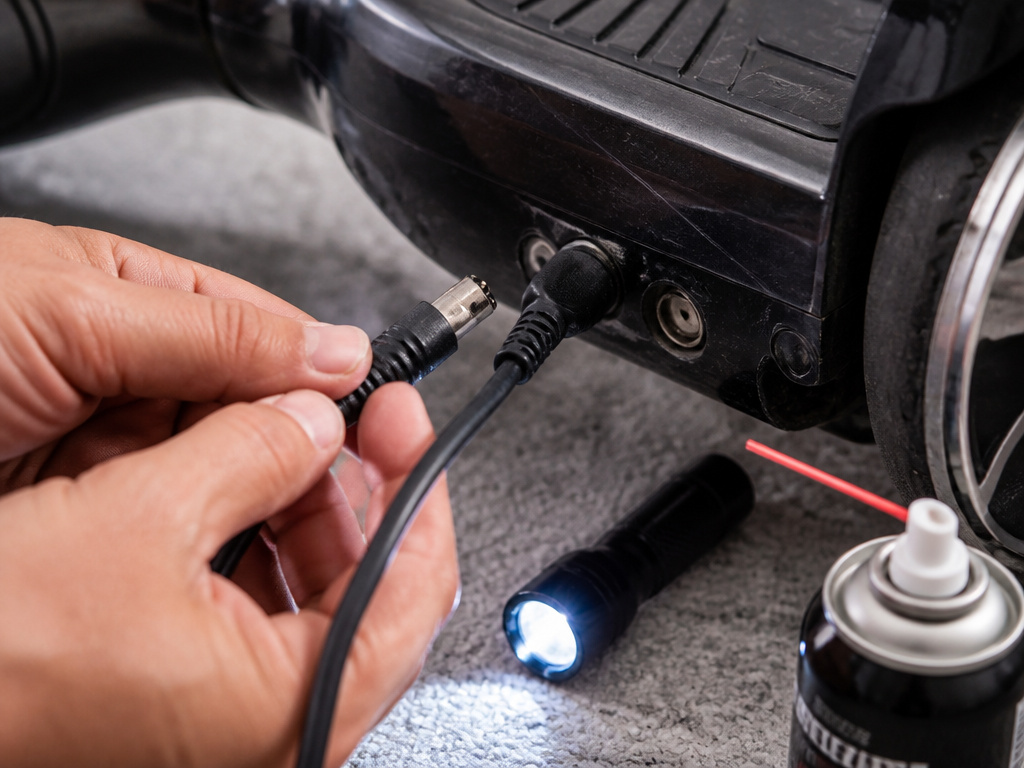
Sometimes, despite your best efforts, the board doesn’t charge. Before you assume the worst, run through this short diagnostic list.
- No charger light: Check the wall outlet with another device. If the outlet is live, try a different outlet. If still no light, the charger itself may have failed.
- Charger light is green immediately: This often means no connection is being made with the board. Inspect the charging port on the hoverboard for bent pins, debris, or corrosion. A can of compressed air can clear out lint.
- Board won’t power on after charging: This could indicate a deeply discharged battery that the charger can’t revive, or a failed battery management system.
- Board charges but dies very quickly: This is a sign of battery age or damage. The pack may have one or more dead cells. Its overall hoverboard lifespan might be reaching its end.
For more persistent power on issues, the problem may lie deeper in the wiring or control board.
How to charge a hoverboard for the first time
Your first charge is critical for battery health and safety. Start by using only the charger that came with your hoverboard. Before connecting anything to the board itself, plug the charger into a wall outlet. Then, connect the charger to your hoverboard. For some models, an initial charge of a specific duration is required; follow any provided instructions for this first cycle. Never leave it charging unattended, especially overnight, and always charge in a clear area away from anything flammable. Monitor the charger’s indicator light; it typically shows red while charging and turns green when complete. Once fully charged, disconnect the hoverboard from the charger immediately.
Frequently Asked Questions
How do I know if my hoverboard is charging?
Look at the charger’s indicator light. For most models, a solid red light means it’s actively charging. A solid green light means charging is complete. Also, the board’s own battery indicator lights may pulse or change pattern during charging.
Can I use a different charger if I lost the original one?
You should not. The CPSC and all manufacturers explicitly recommend using only the supplied charger. If you need a replacement, contact the manufacturer or purchase an official, model-specific charger from them. Using a generic “universal” charger risks incorrect voltage and amperage, which can lead to overcharging and fire.
How can I tell if my hoverboard is UL 2272 compliant?
Look for a holographic UL certification label on the bottom of the hoverboard itself. The label should mention “UL 2272” and “Personal e-Mobility.” Compliance of individual parts (like a “UL certified battery”) is not enough; the standard covers the entire unit’s electrical system. If you bought your board before January 29, 2016, it is almost certainly not compliant.
Is it bad to charge my hoverboard after every use?
No, it’s actually preferable. Lithium-ion batteries have no “memory effect,” so partial charges do not harm them.
The Bottom Line
Charging a hoverboard is simple, but the stakes for getting it wrong are uniquely high due to the lithium-ion battery chemistry. The procedure boils down to a mantra: OEM charger, supervised session, non-flammable surface.
The most important thing you can do after reading this is to physically check your hoverboard for the UL 2272 compliance label on its underside. If it’s not there, your baseline safety margin is missing, and every other rule becomes twice as critical.
Finally, trust the lights, but understand what they’re telling your specific model. A flashing green light on a Hali X charger is normal. That same flash on another model might be an error code. When in doubt, the manual is your first resource, not a YouTube tutorial. That little booklet has the only specs that actually apply to the board you own.
