Inmotion RS Scooter Review: Key Takeaways and Specs
This post contains affiliate links. As an Amazon Associate, we earn from qualifying purchases.
The INMOTION RS is a high-performance electric scooter with a manufacturer-claimed top speed of 68 mph (110 km/h) and a range of up to 100 miles, powered by dual 2000W motors. However, independent tests show real-world speeds closer to 56–59 mph and a tested range of 71.9 km, highlighting the gap between marketing claims and actual performance for this heavyweight, feature-rich machine.
That gap between claim and reality is where your buying decision lives. It’s not about whether the RS is fast—it undeniably is—but about which numbers you can actually trust, and what that means for maintenance, safety, and long-term ownership. For a detailed breakdown, see our inmotion rs scooter review.
What follows: a breakdown of the verified specs, the owner-reported failures you won’t find in the brochure, a step-by-step guide to its unique adjustable suspension, and the specific protective gear you need if you’re going to ride something this powerful.
Key Takeaways
- Independent tests put the real top speed between 56–59 mph, not the claimed 68 mph, with a tested range of just 71.9 km versus the claimed 100 miles.
- Long-term owners report significant reliability issues within 3500 miles, including failed motors, controllers, and battery packs, often linked to a now-revised motor cable design.
- Adjusting the four-level suspension is a 5-minute job with a hex key; the correct setting (front higher than rear) dramatically improves high-speed stability.
- Riding this scooter at its potential requires a full-face motorcycle helmet, armored jacket, gloves, and knee/elbow pads—a bicycle helmet is insufficient.
- For most riders seeking extreme performance, the RS is a compelling but high-maintenance choice; for casual commuting, its 128 lb weight and complexity make it overkill.
The Top Speed Reality Check
The INMOTION RS product page boldly states a top speed of 68 mph (110 km/h). That’s the headline. But when RiderGuide put a pre-production unit on their test equipment, it hit 99.9 km/h (about 62 mph). Another independent reviewer, ETPC, recorded a max of 56–59 mph in their inmotion rs scooter review. The manufacturer’s claim and real-world results don’t line up.
The INMOTION RS uses dual 2000W motors with a manufacturer-stated max power of 4200W per motor. This powertrain is capable of immense acceleration, but factors like rider weight, terrain, battery charge, and firmware settings all cap the achievable top speed in real-world conditions.
This discrepancy matters because speed governs everything else: the braking power you need, the protective gear you must wear, and the legal risks you take. A scooter that can genuinely touch 70 mph exists in a different category than one that taps out at 55 mph. The RS lives in the high 50s for most riders. It’s still terrifyingly fast, but you’re buying a 60-mph-class machine, not a 70-mph one.
The acceleration story has a similar split. INMOTION claims a 0-30 mph time of 3.5 seconds, while RiderGuide’s independent test clocked 1.6 seconds. That’s a massive difference, and it points to testing methodologies. The 3.5-second claim is likely a conservative, repeatable figure under standard settings. The 1.6-second result is what happens when you unleash the beast in its most aggressive mode. This duality is the RS’s personality: it can be a tame commuter or a dragster, depending on how you configure it in the app.
Battery, Range, and the “Up To” Problem
If top speed has a reality gap, range has a canyon. The marketing material promises “up to 100 miles” (approximately 160 km). Then you look at the RiderGuide test: 71.9 km. That’s less than half the advertised maximum.
| Range Claim Source | Claimed/Tested Range | Notes |
|---|---|---|
| INMOTION Marketing | Up to 100 miles (~160 km) | “Favorable test conditions” |
| ScooterRank Aggregator | 160.9 km | Compiled from various tests |
| RiderGuide Independent Test | 71.9 km | Real-world, performance-oriented test |
Which number is right? They all are, under different conditions. The 100-mile figure is a best-case scenario: a light rider on flat ground in eco mode at low speed. The 71.9 km (45-mile) figure is what you get when you use the scooter’s performance, which is why most people buy it, as detailed in any thorough inmotion rs scooter review. Your real range will depend entirely on how hard you push those dual motors. Expect 30-50 miles for spirited riding, and plan charging accordingly.
The 84V, 2880Wh battery pack itself is a serious piece of hardware. Ignore these rules, and damage caused by over-discharge will not be covered by the warranty.
Build, Portability, and the 128 lb Elephant in the Room
The INMOTION RS is not a scooter you pick up. At 58 kg (128 lbs), it’s a logistical problem. Either way, this is a “wheel it to its parking spot” vehicle, not one you carry up subway stairs.
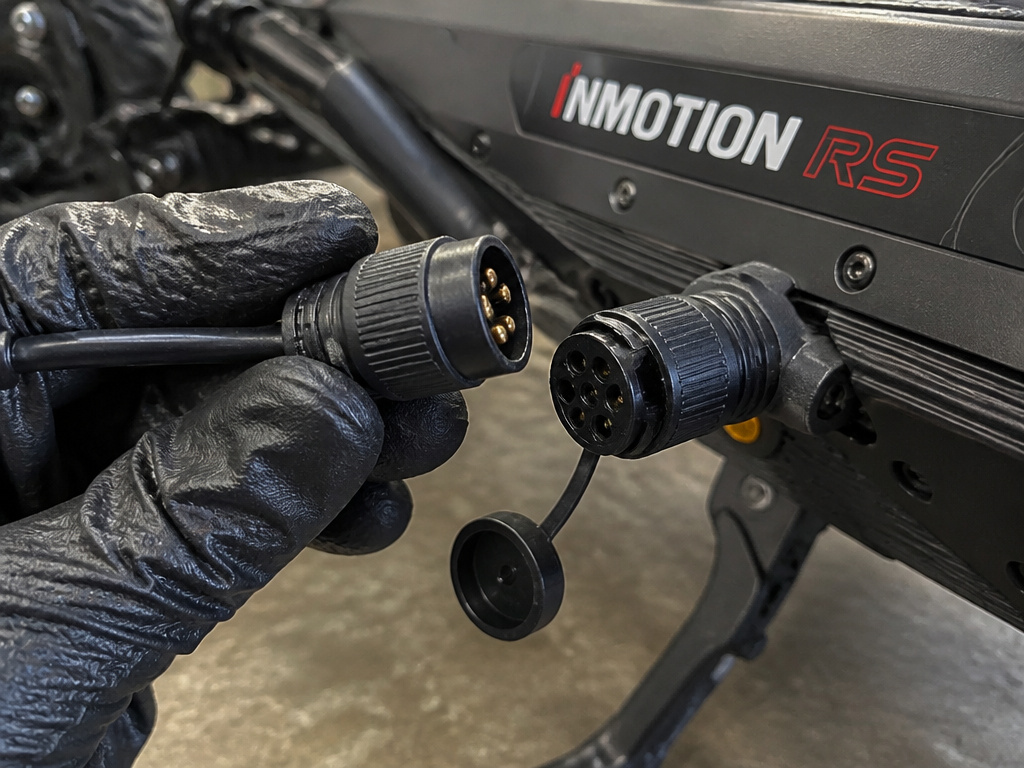
The build quality is a tale of two timelines. Early pre-production units, like the one RiderGuide tested in August 2023, had a rear fender that cracked off in under 10 miles. INMOTION stated this was fixed for production. More concerning are owner reports from long-term users. On Reddit, an owner with over 3500 miles on their RS reported replacing one battery, two motors, and a controller. A common culprit was the original quick-disconnect motor cable, which Voro Motors cited as a common cause of error codes 217 and 212, especially under heavy loads. Voro Motors, a major retailer, confirmed this was a known issue and that a 2025 revision changed the connection from a quick-disconnect plug to a direct cable connection.
Where this goes sideways: Assuming the RS is a “set and forget” machine. Owners pushing it hard report component failures within a few thousand miles. The revised motor cable is a fix, but it highlights the stresses this performance puts on the hardware.
Portability scores are its weak point. The folding mechanism works, but the sheer mass makes it a struggle to lift into a car trunk or carry any distance. This scooter is designed for riders who have secure, ground-level storage at both ends of their journey.
The Adjustable Suspension & Ride Height: A Step-by-Step Guide
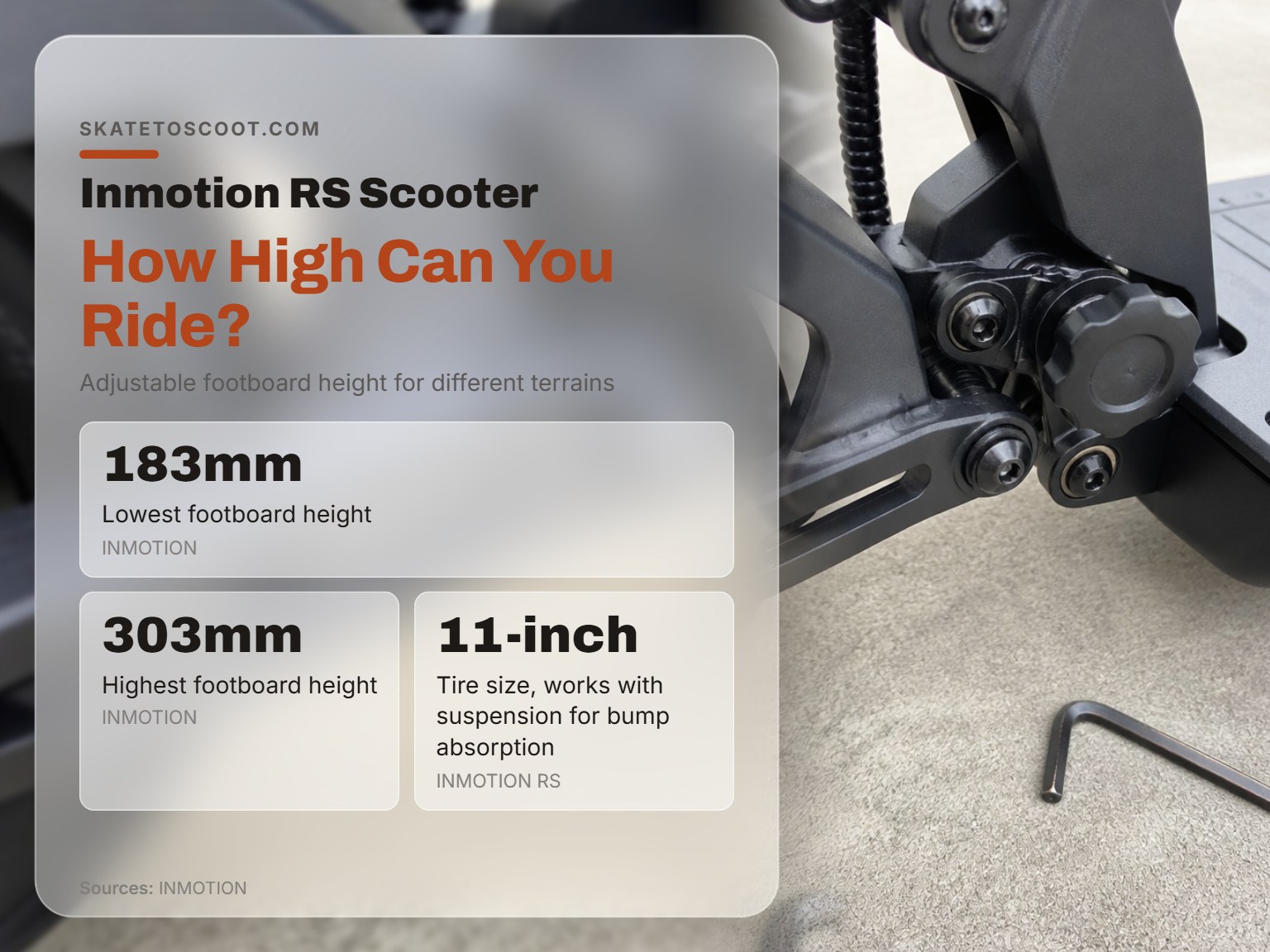
This is the RS’s party trick, and it’s genuinely useful. The four-level adjustable suspension lets you change the footboard height from 183mm to 303mm. What is the purpose of this? Lower height means a lower center of gravity for stability at high speed on pavement. Higher height gives you more ground clearance for off-road trails and helps the large 11-inch tires absorb bigger bumps.
Adjusting it is simple, but doing it right is key. Here’s how, and what happens if you get it wrong.
- Gather the Tool: You’ll need the included hex key (usually 6mm). Find the adjustment knobs on the front and rear swingarms.
- Loosen and Select: Loosen the knob, pull the pin, and move it to your desired hole (marked 1-4, with 1 being lowest). Tighten the knob firmly.
- The Stability Rule: For best high-speed street handling, set the front suspension higher than the rear. A common stable setup is front on a higher suspension position and rear on a lower one. This increases the rake angle, improving straight-line stability.
- The Consequence: Setting both front and rear to the same low position might seem logical for speed, but it can make the scooter feel twitchy and less planted above 40 mph. The front wants a bit more height to do its job.
This adjustability is what INMOTION calls its “transforming system.” This feature is practical, not decorative, and allows you to adjust the scooter for your riding surface. A five-minute adjustment changes the ride from a street-focused machine to one ready for trails.
Brakes, Waterproofing, and App Control
The RS comes equipped with Zoom hydraulic brakes and 160mm discs. In practice, they provide strong, progressive stopping power essential for a vehicle of this weight and potential speed. They are a critical safety component and an essential upgrade from mechanical brakes.
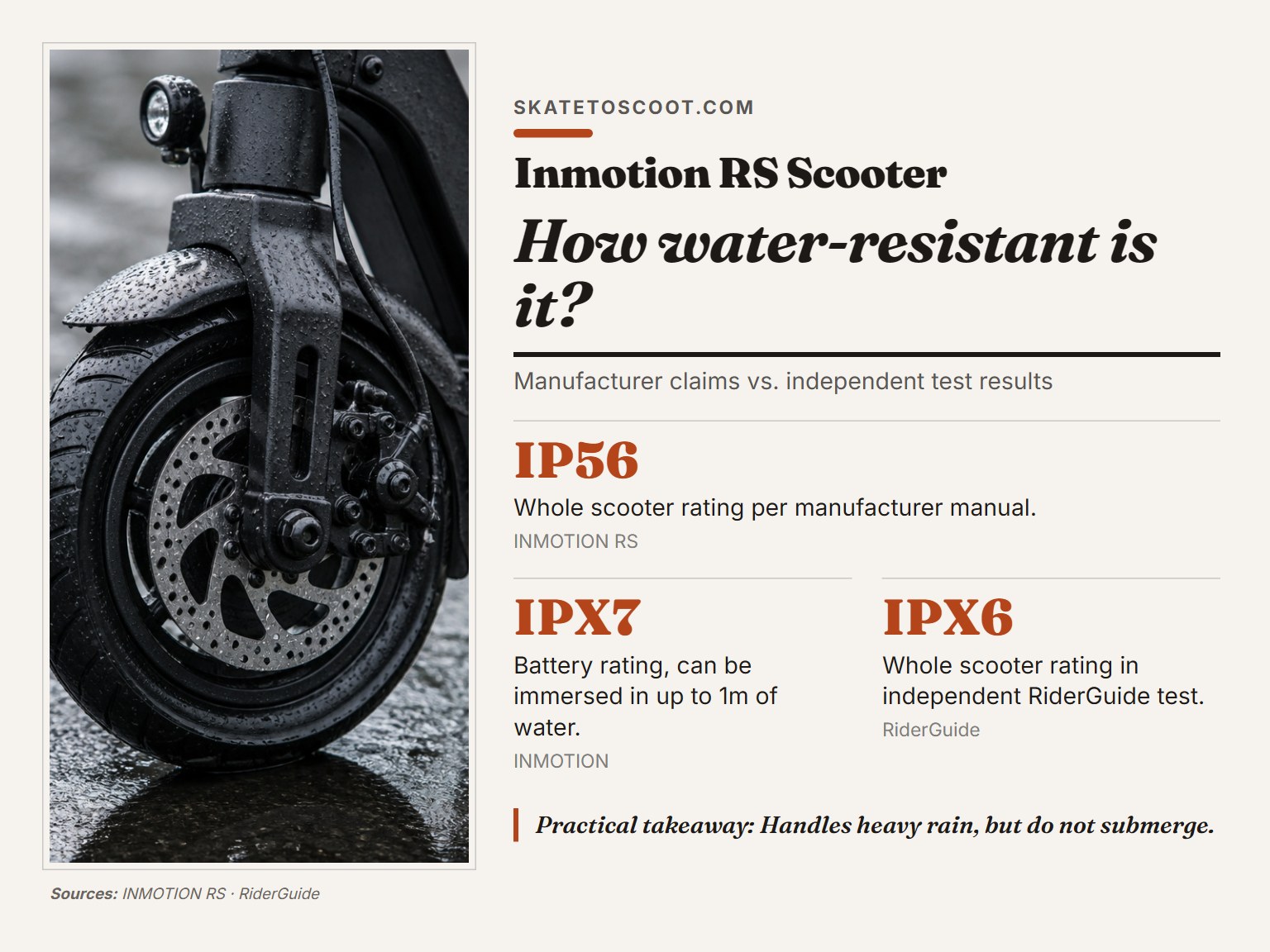
The waterproofing story is confusing because there are two ratings.
| Component | Claimed Rating | What It Means |
|---|---|---|
| Whole Scooter (Manual) | IP56 | Protected from limited dust ingress and powerful water jets from any direction. |
| Battery (Manufacturer) | IPX7 | Can be immersed in up to 1m of water for up to 30 minutes. |
| Whole Scooter (RiderGuide Test) | IPX6 | Protected from powerful water jets (12.5mm nozzle) from any direction. |
The practical takeaway? The RS can handle heavy rain and wet roads. You should not submerge it, but the battery is well-protected against a deep puddle.
The INMOTION app is where you access the scooter’s character. The INMOTION app provides access to various scooter settings and performance data. This is vital for pushing the scooter hard; if you see temps climbing, you know to back off before thermal throttling kicks in.
Who Is the INMOTION RS Really For?
This scooter is for advanced enthusiasts, not for beginners or intermediate riders. It’s a specialized tool for a specific type of enthusiast.
The Ideal RS Rider:
- Has significant experience riding powerful electric scooters or other high-speed personal electric vehicles.
- Has a secure, ground-level place to store and charge a 128 lb machine.
- Is technically inclined, willing to perform basic maintenance, and understands that high performance can mean higher maintenance.
- Values customizable performance and adjustable geometry over simple plug-and-play convenience.
- Rides primarily in areas where high-speed operation is safe and legal, such as private property or designated tracks.
Who Should Look Elsewhere:
- Commuter seeking simplicity: The weight, complexity, and maintenance reports make it a poor choice for daily urban commuting compared to lighter, more reliable commuter-focused scooter models.
- New Rider: The power is dangerously excessive, and the weight is unmanageable for someone learning basics.
- Budget-Conscious Buyer: At its price point, ongoing potential repair costs and the initial investment demand a high tolerance for cost of ownership.
Safety Gear: Non-Negotiable Equipment for 60 MPH
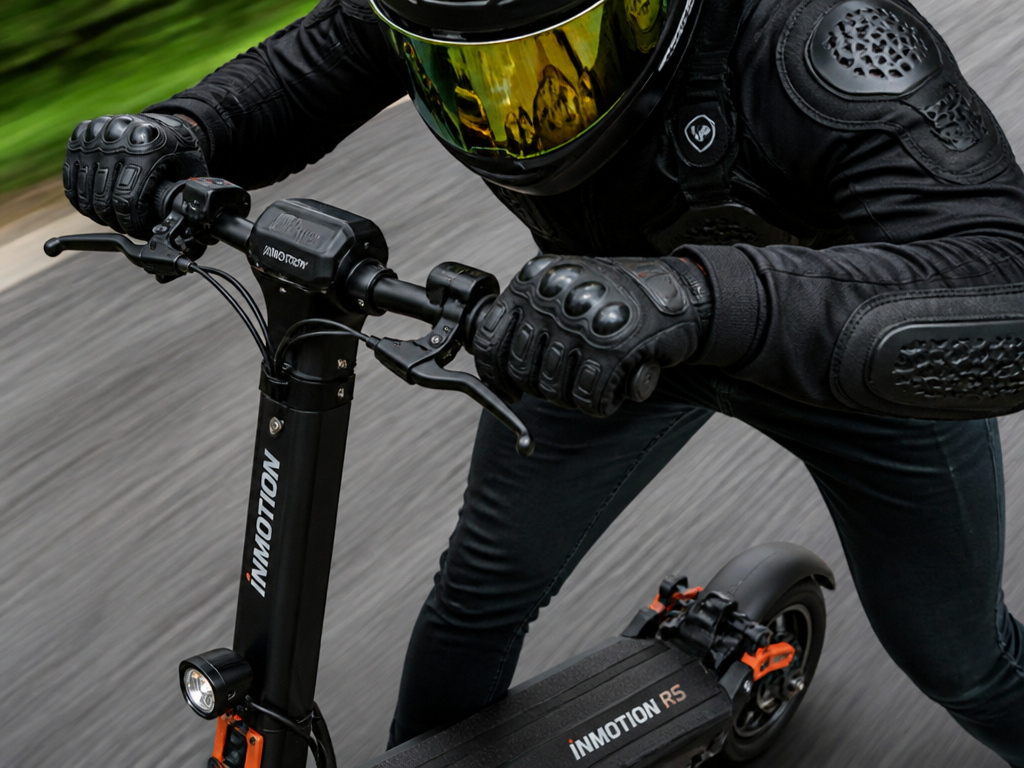
Riding a scooter at 60 mph is a motorcycle activity, not a bicycle activity. The gear you wear must match that reality. A standard bicycle helmet is designed for impacts at far lower speeds.
The mandatory kit for pushing the RS’s limits includes:
- Full-Face Motorcycle Helmet (DOT/ECE Certified): This protects your jaw and face in addition to your skull. A bicycle helmet offers zero facial protection.
- Armored Jacket or Separate Armor: Look for CE-rated armor at the shoulders, elbows, and back. A motorcycle jacket with abrasion-resistant material (like leather or Cordura) is ideal.
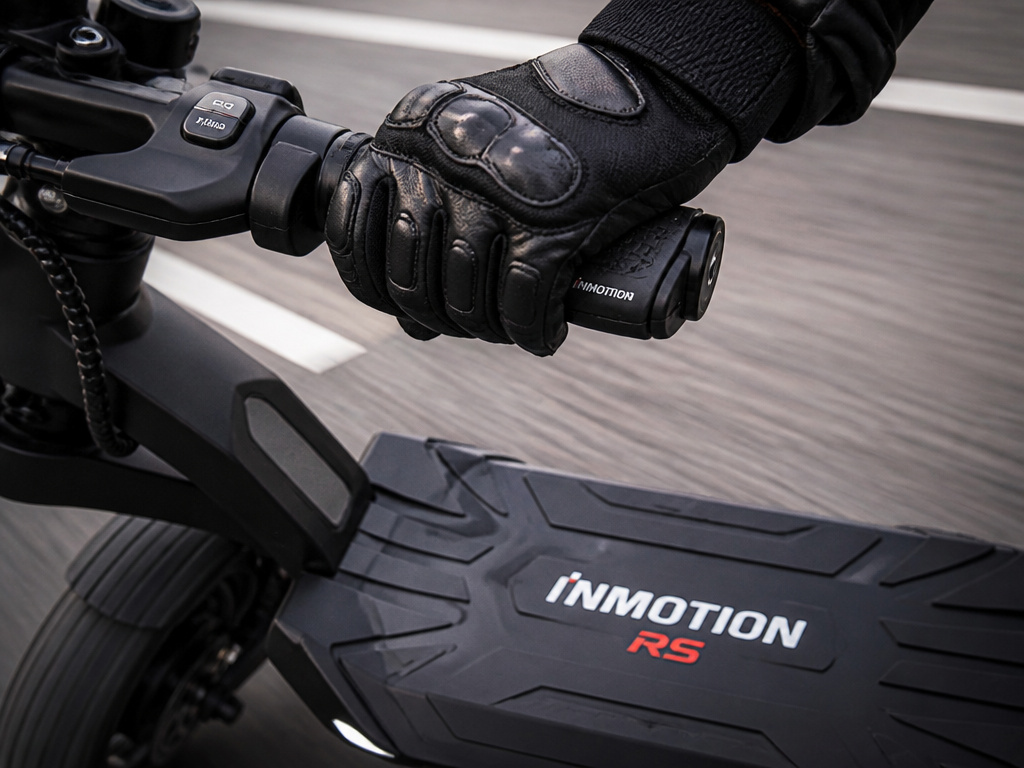
- Motorcycle Gloves: Your hands are the first thing to hit the ground. Gloves should have palm sliders and knuckle protection.
- Knee and Elbow Pads: Dedicated hard-shell pads are far superior to the soft caps in some clothing. For ultimate protection, consider motorcycle pants with integrated armor.
This is a matter of physics, not scare talk. The energy in a crash scales with the square of your speed. A 60 mph fall is a life-altering or life-ending event without proper equipment, not simply a more intense version of a 20 mph fall. Investing in this gear is the single most important accessory purchase you can make—more important than any performance upgrade for the scooter itself.
How Does the RS Compare to Other RS Models?
The Inmotion RS sits at the top of its own series as the flagship performance model. While other variants like a ‘Jet’ or ‘Lite’ might be offered, the standard RS defines the platform with its dual 2000W motors and substantial 2880Wh battery. The core design, with its 11-inch tires and hydraulic brakes, is built around this high-power configuration. If you encounter other RS models, they will typically be versions of this scooter with different performance tiers, battery sizes, or feature sets, often trading raw power for a lower price or reduced weight. The RS’s heavy build and high load capacity make it a distinct choice within the family, aimed squarely at riders seeking maximum output and range.
Frequently Asked Questions
Is the INMOTION RS a good scooter?
It’s an excellent scooter for a very specific rider: the performance enthusiast who values power, adjustability, and is prepared for potential maintenance. Its dual motors, adjustable suspension, and hydraulic brakes deliver a thrilling, high-end experience. However, its heavy weight, mixed reliability reports from long-term owners, and the gap between some claimed and real-world specs mean it’s not the best choice for general commuters or those seeking a low-hassle vehicle.
How fast does an INMOTION RS go?
The manufacturer claims a top speed of 68 mph (110 km/h). Independent tests show real-world speeds are lower, typically in the 56–59 mph (90–95 km/h) range. Factors like rider weight, terrain, battery level, and firmware settings all affect the final number. It is unequivocally a very fast scooter, but expect real-world performance to be in the high 50s, not the high 60s.
Is INMOTION a reliable brand?
INMOTION has a strong reputation in the electric unicycle world and generally provides good customer support, as noted by some owners who had parts replaced under warranty. However, the RS model has shown some reliability growing pains. Documented issues from early adopters include failures of motors, controllers, and batteries within a few thousand miles, often linked to specific components like the original motor cable design which has since been revised. They are responsive, but the product’s long-term durability under hard use is still being proven.
What are the top scooter brands?
The high-performance “hyper-scooter” segment includes brands like NAMI, Dualtron, Kaabo, and INMOTION. For more general commuting, brands like Segway, NIU, and Apollo are major players. Each brand serves a different niche, from ultra-portable commuters to all-terrain beasts. Comparing the INMOTION RS to scooters from Segway or a NIU scooter highlights how specialized it is.
Before You Go
The INMOTION RS is an engineering statement. It proves that electric kick scooters can deliver motorcycle-adjacent performance. But that performance comes with a manual.
If you read the owner reports and your first thought is “I can handle that maintenance,” and you have the secure storage and proper safety gear, the RS offers a level of power and customization that’s hard to match. You’re buying into a platform, not just a vehicle.
If your first thought is “I just want to ride,” then look at the proven, lower-maintenance options in the performance category. The thrill of the RS is real, but so is the spreadsheet of replaced parts some owners are keeping. Your choice isn’t just about speed—it’s about what you’re willing to manage to get it.
