NIU Scooter Review: Warranty and Reliability Explained
This post contains affiliate links. As an Amazon Associate, we earn from qualifying purchases.
NIU scooters offer a solid, well-engineered ride for urban commuters, but long-term ownership reveals a split between reliable hardware and inconsistent customer support. The brand builds scooters with good specs, like the KQi3 Pro’s 486.7Wh battery and ≤4.4 meter braking distance, and has avoided the catastrophic stem failures plaguing some competitors. However, a 2022 NHTSA recall on 38 MQiGT EVO units for motor firmware and handlebar vibration, coupled with widespread owner complaints about tire replacements and support delays, means your experience hinges heavily on getting a problem-free unit and having a local dealer.
That gap between the engineering on paper and the support experience on the ground is what most niu scooter review gloss over. They list the motor wattage and the IP ratings, which NIU gets right, but skip the part where a simple flat tire can turn into a multi-week ordeal if you’re not handy with tools.
What follows is a breakdown of NIU’s scooter lineup, grounded in their own service manuals and federal recall documents, plus a clear-eyed look at what happens when things go wrong. You’ll get the specs, the real-world performance numbers from third-party tests, and a step-by-step guide for navigating warranty claims. By the end, you’ll know exactly which NIU model fits your needs, and exactly how to protect your investment if it doesn’t work out of the box.
Key Takeaways
- The KQi3 Pro and Max models represent NIU’s best balance of power, range, and proven reliability for most riders.
- A 2022 NHTSA recall affected only 38 high-performance MQiGT EVO scooters (VIN range HA6MET5A3N3000031 to HA6MET5A4N3000068) for motor and vibration issues, broader reliability is strong.
- Braking and water resistance specs are excellent on paper (IP54 scooter, IPX7 battery), but owner forums reveal back tire changes are notoriously difficult due to short motor cables.
- NIU’s 2-year battery and chassis warranty is standard, but the claims process often requires you to ship the scooter at your own expense, a critical detail buried in the fine print.
- For hill climbing and range, always derate the manufacturer’s claim by 30-40% if you weigh over 175 lbs or ride in eco-mode; the battery management system aggressively limits power below 15% charge.
NIU Scooter Reliability and Warranty: The Mixed Record
NIU positions itself as a tier-one brand alongside Segway, and for the most part, the hardware backs that up. You don’t see the same flood of “stem snapped” horror stories that follow cheaper parts-bin scooters. The construction feels substantial. But reliability isn’t just about whether it breaks on day one; it’s about what happens on day 300 when a wear part fails.
The most concrete data point is a federal recall. In 2022, Genuine Scooters LLC filed NHTSA recall report 22V-597 for 38 NIU MQiGT EVO scooters. The cause was “excessive handlebar vibration” traced to radial and axial loading on the steering stem bearings. The fix involved new motors and a revised triple tree assembly with part numbers TS-10201197, TS-8675309, and TS-8005882300. This was a targeted, early-production issue on a specific performance model, not a widespread flaw.
Where this goes sideways: The warranty itself. NIU offers a 2-year battery and chassis warranty (2 years parts, 1 year labour on the NQi GTS, plus a year of breakdown cover). The gap is in the process. Unlike a car dealership, there’s often no local repair network. The official technical service bulletin for the MQiGT EVO recall instructs dealers to submit claims, then ship parts. For an end-user, this frequently means you are shipping your entire scooter to a service center at your own cost, a fact that only surfaces when you need help.
Trustpilot and Reddit threads are filled with reports echoing this. One owner of a KQi3 Pro with 1200 miles needed a back tire replacement and described it as “a total pain in the ass.” Another, with a KQi 100F, was quoted $50 just for mailing a replacement tire, with the install left to them. The pattern is clear: the scooters are robust until they need routine maintenance, then you’re on your own unless you’re mechanically inclined.
| Aspect | The Promise | The Reality |
|---|---|---|
| Build Quality | Durable frames, good component integration. | Generally met; no systemic frame failures. |
| Warranty Coverage | 2 years on battery and chassis. | Valid, but claims often involve customer-paid shipping and long wait times. |
| Part Availability | Original parts available through dealers. | True, but third-party parts are scarce, and some repairs (tire changes) are complex. |
| Customer Support | Accessible via email, chat, and regional hotlines. | Inconsistent resolution speed; heavy reliance on user-initiated shipping. |
Breaking Down the NIU Lineup: Which Model is For You?
You don’t buy a “NIU scooter.” You buy a KQi3 Pro for longer commutes, a KQi2 Pro for budget-conscious runs, or a U-Series model for strict single-person use. The differences matter more than the shared logo.
The KQi3 series is their mainstream workhorse. According to the KQi3 service manual, the Pro variant packs a 46.8V, 486.7Wh (10.4Ah) battery, while the Sport uses a 46.8V, 365Wh (7.8Ah) pack. The Pro’s extra capacity translates to more real-world range, especially for heavier riders. Both share the same IP54 weatherproof rating for the finished scooter, with the battery and controller rated IPX7 individually. That means they can handle a rain commute, but don’t submerge them.
The U-Series is a distinct, lighter-duty line. The manual explicitly states “U scooter is designed for only 1 person,” and its braking distance is rated at ≤4.5 meters from 30 km/h. It’s for solo riders who prioritize portability over dual-ride capability.
Then there’s the niche KQi Air, which the eRideHero review notes uses a frame that’s “70% carbon fiber and 30% magnesium” for drastic weight savings, boasting an IP55 rating. This is for the rider who carries their scooter onto a train or up stairs daily.
For most people, the decision tree is simple:
- Need max range and power for a commute? KQi3 Pro.
- On a tighter budget for short trips? KQi2 Pro.
- Always riding solo and want something lighter? U-Series.
- Is carrying weight your absolute top priority? KQi Air (if your budget allows).
The KQi3 Sport, as one long-term Reddit reviewer pointed out after two years, often falls into an awkward middle ground, not as affordable as some budget models, not as capable as the KQi3 Pro. In our own ranking of the best NIU scooters, we usually recommend skipping it unless it’s on a deep discount.
Real-World Performance and Range: Trust, but Verify
Manufacturer specs are a starting point, not a guarantee. The NIU NQi GTS Standard Range, for example, has a manufacturer-claimed range. The Bennetts review tested it in real-world conditions and got 30-40 miles. That 30-40% derating is typical, especially if you use the higher-performance modes or face hills.
The performance curve isn’t linear. One of the most consistent pieces of feedback across electric scooter reviews is about NIU’s battery management. Some niu scooter review highlight a “limp home” mode that engages at low battery, forcing the scooter into a slow eco-mode. This protects the battery’s long-term health but effectively means the last 15% of your range is for emergencies only, cruising at around 20 km/h (12 mph).
Hill climbing exposes another gap between peak and sustained power. Some user tests suggest hill climbing performance can be limited on steeper grades. The scooter’s motor might handle a mild incline, but sustained climbs can heat up components, potentially triggering thermal protection. If your route has serious hills, you may need a higher-powered model.
| Use Case | Recommended NIU Model | Key Spec / Reality Check |
|---|---|---|
| Flat City Commute (5-10 miles) | KQi2 Pro, U-Series | Expect 12-15 miles real range. Adequate power for flat terrain. |
| Longer Commute / Hills (10-20 miles) | KQi3 Pro, KQi3 Max | Derate claimed range by 35%. Max model better for moderate hills. |
| Ultimate Portability | KQi Air | 70% carbon fiber frame; IP55 rating. Premium price for weight saving. |
| Two-Person Riding (where legal) | NQi GT/GTS Series | Explicitly designed for two. Requires higher license in many regions. |
Braking and Water Resistance: Where the Engineering Shines
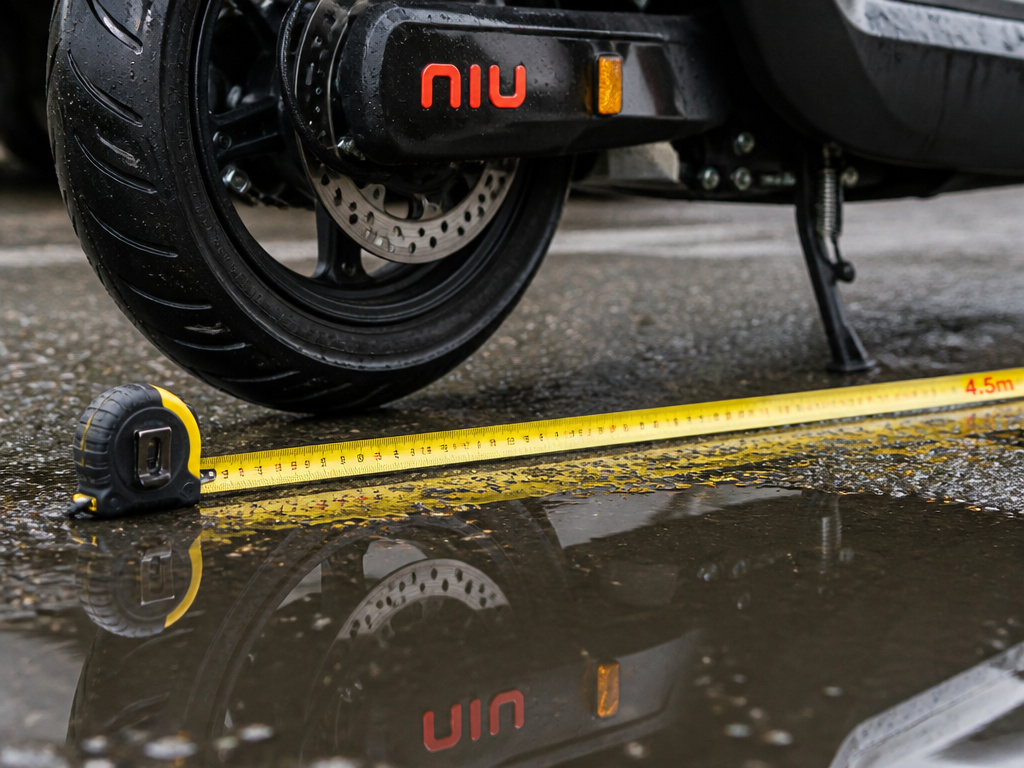
Here, NIU’s background in electric motorcycles shows. The braking specifications in their service manuals are precise and impressive. The KQi3 series is rated to stop in ≤4.4 meters from 20 km/h using both brakes. The U-Series is rated for ≤4.5 meters from 30 km/h. These are short distances that inspire confidence in city traffic.
The water resistance ratings are equally well-defined. The complete KQi3 scooter is IP54: protected against dust and water splashes from any direction. The internal battery pack and controller are rated IPX7, meaning they can withstand immersion in up to 1 meter of water for 30 minutes. The motor is IPX5, resistant to low-pressure water jets.
The technical snippet: IP ratings define ingress protection. The first digit (5) indicates dust-protected; the second (4) means protection from water splashes. IPX7 indicates the component can survive temporary immersion. This layered protection is more thoughtful than a single scooter rating.
This is one area where NIU often outshines competitors like Xiaomi. However, a strong IP rating is a warranty against manufacturing defects, not a license to ride through deep puddles. The NQi Series manual itself warns: “It may cause rusting or failure of the motor, battery or other parts if water level reaches wheel axle.” Trust the rating for rain, not floods.
Battery Care and Long-Term Ownership Costs
This is the biggest long-term gap in most scooter reviews. The upfront cost is one thing; the cost of ownership over two or three years is another. NIU’s manuals provide excellent, if slightly conflicting, guidance.
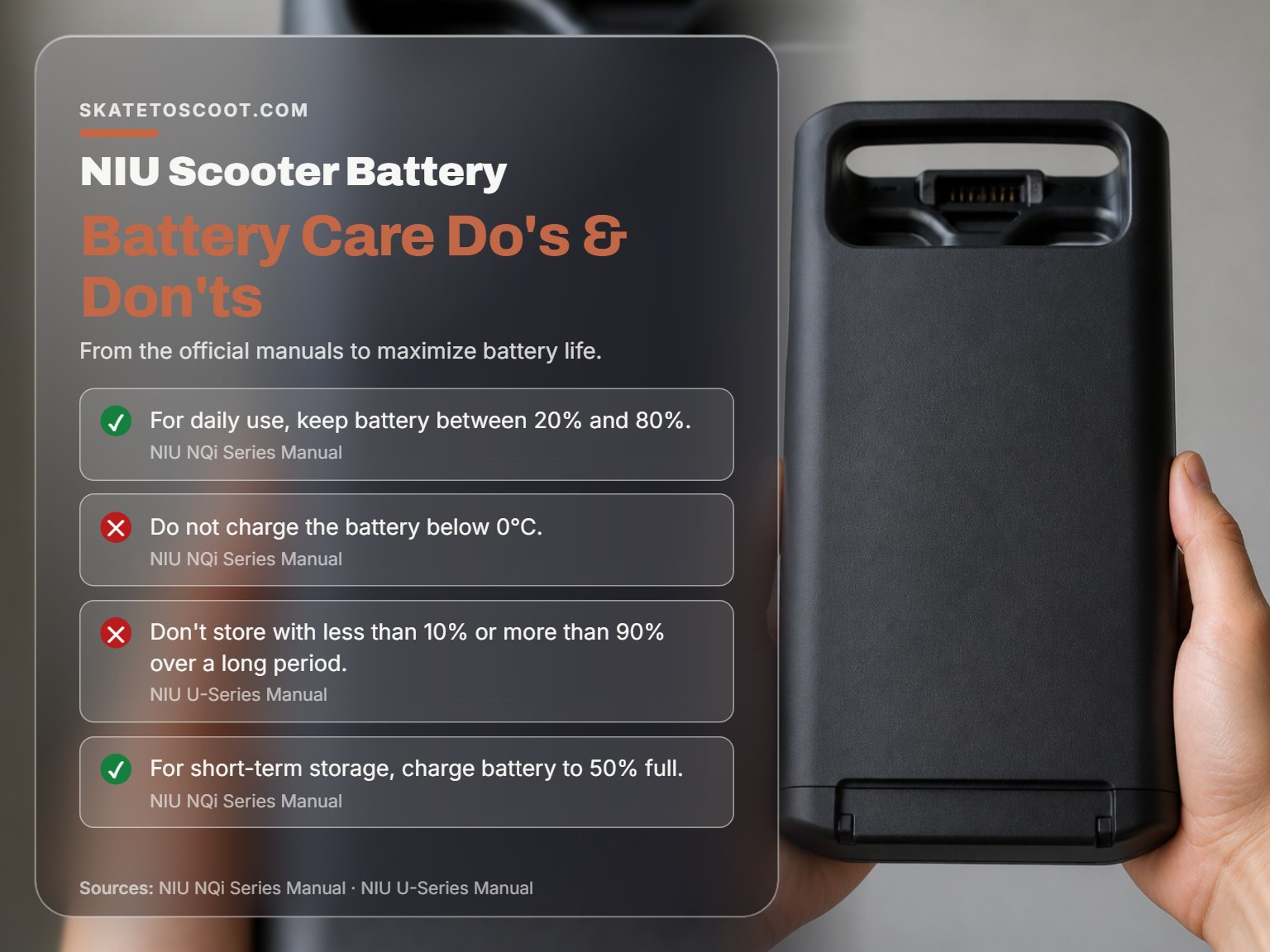
For daily use, the NQi Series Manual states: “To maximize the battery life, please keep the battery percentage within 20% to 80%.” Avoid full 100% charges and deep discharges below 20% for daily cycling.
For storage, the advice varies by model and duration. For short-term storage, the NQi Series Manual advises charging to 50% full, while the U-Series Manual also advises charging to 50% full. For long-term storage, sources disagree on the ideal charge level: the NQi Series Manual states the best battery capacity performance for storage is 50%, but also says to charge the battery to 100% full after storage. The U-Series Manual advises storing at 30-70% capacity, performing a cycle every 2 months and charging to 50%, and also to charge to 100% full after storage.
Common mistake: Storing a scooter with a dead battery over winter. The U-Series manual warns that “storing battery with less than 10% or more than 90% over a long period of time will cause irreversible capacity loss.” Come spring, your range might be permanently cut.
The cold is a battery’s enemy. The manual specifies usable capacity drops to 70% at -10°C, 85% at 0°C, and only hits 100% at 25°C. More critically, it warns: “Do not charge the battery below 0°C.” Doing so can damage the cells.
Now, the real costs. The battery itself is under warranty for two years, but after that, a replacement is a major investment. The Bennetts review of the NQi GTS noted that long-term ownership costs, including eventual battery replacement, should be considered. Then there are wear items: tires (a known difficult DIY job), brake pads, and eventually, the deck battery if you keep it beyond the warranty. Factor in ongoing costs for maintenance items like tires and brake pads.
NIU vs. The Competition: Segway and Xiaomi
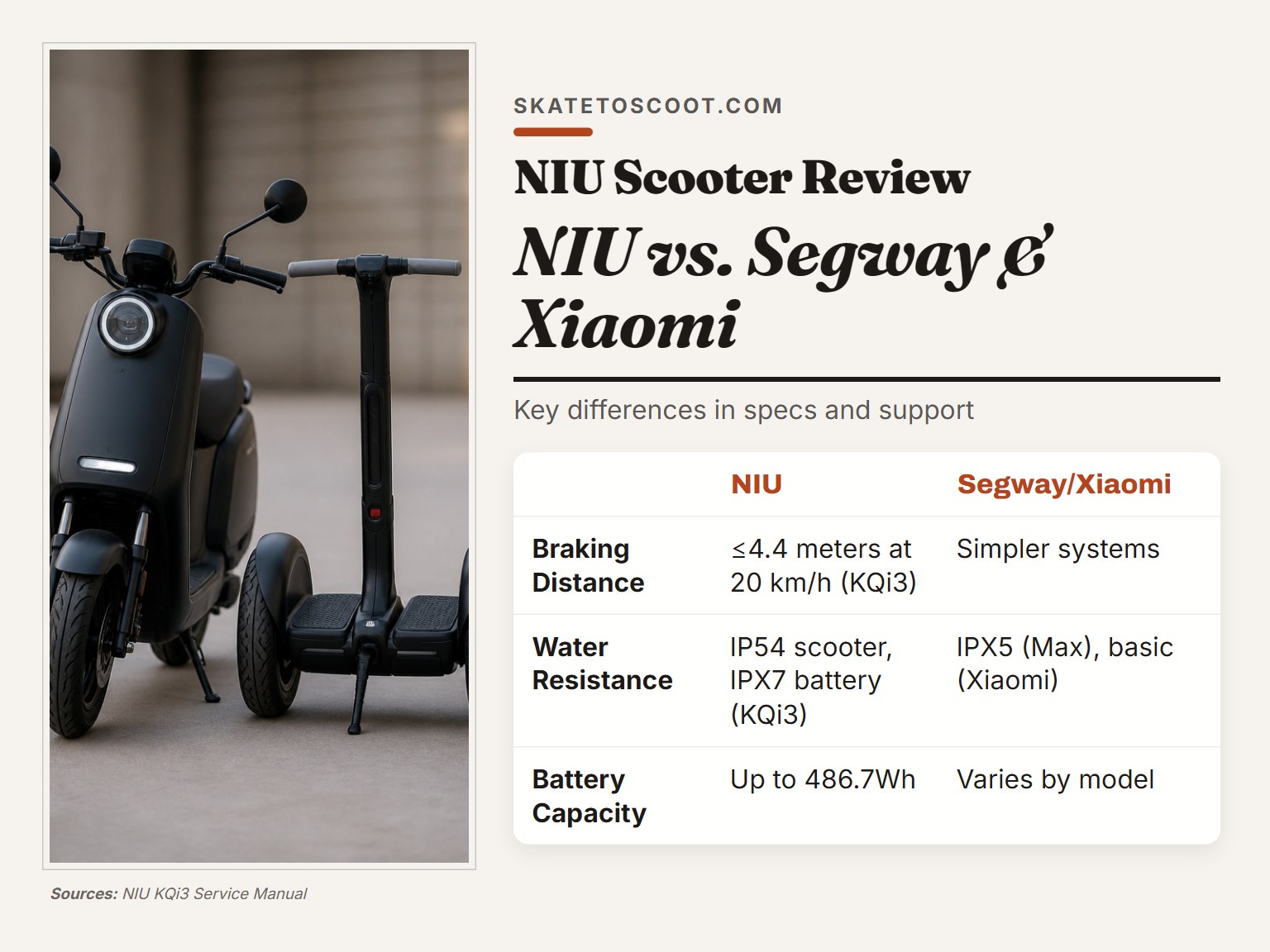
Any NIU scooter review has to answer the inevitable comparison. Against Segway (specifically the Ninebot Max series), NIU often offers better specs for the money, slightly more power, sometimes more range. The trade-off is in the ecosystem. Segway has a larger dealer network in many countries, making in-person support easier. Segway’s water resistance claims (IPX5 on the Max) are sometimes lower, but their real-world reputation for durability is arguably stronger due to sheer market volume.
Against Xiaomi, the difference is starker. Many Xiaomi scooters are built by Ninebot (Segway’s parent), but they often use simpler, single braking systems and less robust folding mechanisms. NIU’s dual braking and more solid feel justify its typically higher price. However, as our Xiaomi Electric Scooter 4 review notes, Xiaomi wins on pure value and widespread third-party parts availability.
The choice comes down to priorities:
- Choose NIU for a better-equipped scooter out of the box and are comfortable with potentially managing repairs remotely.
- Choose Segway for proven, tank-like durability and a higher chance of local support.
- Choose Xiaomi for the lowest upfront cost and don’t mind simpler components and more basic ride quality.
The Bottom Line
NIU builds good scooters. The KQi3 Pro is a compelling package, and their attention to detailed specs like braking distance and layered water resistance is commendable. For a rider in a flat urban area who buys from a local dealer and understands basic maintenance, a NIU scooter can be an excellent choice.
But you must go in with your eyes open. The warranty is a paper shield, it exists, but activating it is often slow and costly. The KQi3 Pro is the model I’d point most people toward, with the caveat that you should watch a tire replacement video before you buy. If your local dealer offers in-warranty service labor, that changes the calculus dramatically.
For everyone else, especially those in hilly areas or who value hassle-free support, the competition is fierce. A Segway Max G2 or G30P might be the less exciting but ultimately more reliable long-term partner. NIU has the engineering; now it needs to match that with its customer experience to truly compete at the top tier.
Specific model reviews (e.g., KQi 100P, NQi GT)
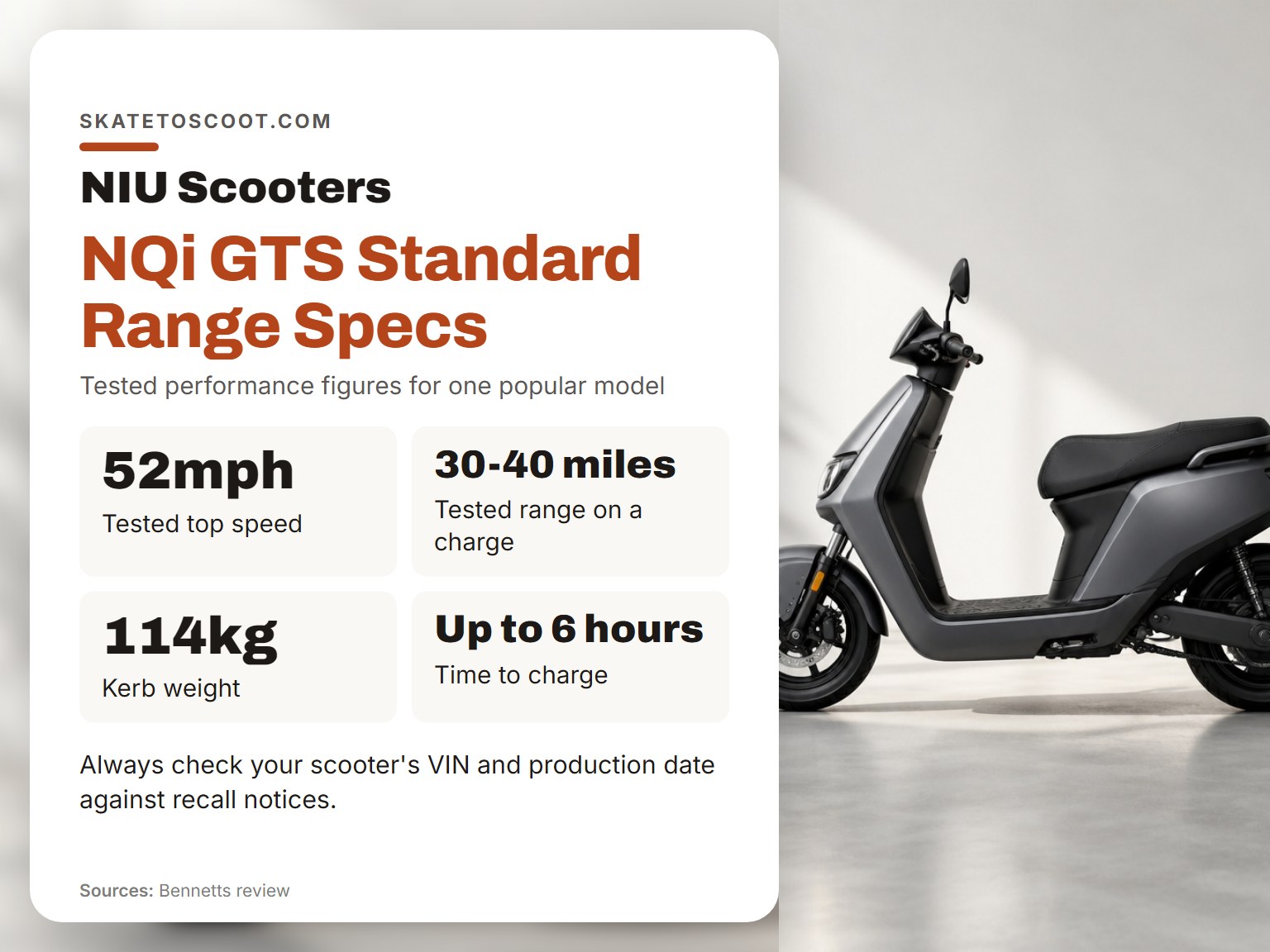
Looking at specific models reveals a range of performance and potential issues. The NQi GTS Standard Range, for instance, was tested to deliver a top speed of 52mph and a range of 30-40 miles on a charge, with a kerb weight of 114kg. Charging can take up to 6 hours. Some models have faced recalls; a 2022 recall for the MQiGT EVO affected 38 units built within a specific week, citing a steering stem bearing issue from radial and axial loading. For battery care across models, manuals advise keeping the charge between 20% and 80% for daily health, and storing it at a partial charge in a cool place for long-term health. Always check your scooter’s VIN and production date against recall notices.
Frequently Asked Questions
Are NIU scooters good quality?
Yes, the build quality is generally very good. Their detailed engineering specs (braking distances, IP ratings) suggest solid design. They avoid the cheap, failure-prone parts found on generic brands. However, quality control isn’t perfect, as evidenced by a targeted NHTSA recall in 2022, and some design choices (like short motor cables) make user maintenance harder than it should be.
Which is better, Segway or NIU?
It depends on what you value. NIU often offers slightly better performance specs (power, braking) for a similar price. Segway (Ninebot) has a longer track record, a larger user base, and often a more extensive support network. If you prioritize specs and are technically savvy, NIU can be better. If you prioritize proven durability and easier access to service, Segway is often the safer bet.
Is NIU a Chinese brand?
Yes, NIU Technologies is a Chinese company founded in 2014 and listed on the NASDAQ. Their scooters are designed in China and manufactured there. This is typical for the industry. Segway, Xiaomi, and most other major e-scooter brands also have their manufacturing based in China. The more relevant point is that NIU had an existing reputation for electric motorcycles before entering the kick-scooter market, which informs their engineering approach.
How long does a NIU scooter last?
With proper care, a NIU scooter should last 3-5 years or more. The mechanical parts (frame, wheels, brakes) are durable. The main limiting factor is the lithium-ion battery, which is typically warrantied for 2 years and will gradually lose capacity over time. Following the manual’s care instructions, avoiding extreme temperatures, not draining it to 0%, and storing it at a partial charge, will maximize its lifespan. Many owners report scooters with over 2,000 miles still running well, albeit with reduced range.
