Jetson Omega Electric Scooter Review
This post contains affiliate links. As an Amazon Associate, we earn from qualifying purchases.
The Jetson Omega is a 10 mph electric scooter for riders 8 and up, with a 5-mile range, three speed modes, and a 120–132 lb weight limit. Its official specs conflict across sources, it has a known wiring fault that can cut power, and it serves best as a first-time scooter for kids on flat, smooth paths where an adult can manage the charging routine.
That 5-mile range is a hard ceiling. The scooter isn’t built for heavy use or rough treatment, and its long-term reliability hinges on avoiding one specific design flaw and sticking to a strict charging routine. This is the core finding of the Jetson Omega electric scooter review.
What follows: a breakdown of every conflicting spec, the one physical weak point you must check before buying, and the battery care steps that actually preserve range. By the end, you’ll know whether the Omega is a solid starter scooter or a disposable toy.
Key Takeaways
- The Omega’s official specs disagree on motor power (100W vs 150W), weight limit (120 lb vs 132 lb), and deck size, making direct comparisons to other scooters difficult.
- A common wiring fault under the folding mechanism can sever the throttle cable, causing a total loss of power that requires soldering to fix.
- For maximum battery life, charge fully before storage and once a month thereafter, using only the included 25.2V 0.5A charger, and never leave it plugged in overnight.
- This scooter fits riders ages 8+ on flat, smooth terrain; its 10 mph top speed and solid tires make it unsuitable for hills, rough pavement, or heavier teens.
- Build quality is lightweight and toy-grade, prioritizing portability (15.5 lb) over durability, so it’s a candidate for gentle, supervised use rather than daily commuting.
The Conflicting Specs That Define This Scooter
You can’t evaluate the Jetson Omega without a map of where its own documentation disagrees. The brand’s website, product manuals, and retailer listings tell different stories about its core capabilities. This isn’t a minor discrepancy, it’s the difference between a scooter that barely meets expectations and one that falls short.
Start with the motor. The product page calls it a 100-watt motor. Both the official user manual and a detailed spec sheet from a major retailer list it as a 150W hub motor. That’s a significant power difference on paper. In practice, the 150W figure is more believable for hitting the advertised 10 mph top speed with a rider on board, but the conflict means you can’t be sure which performance tier you’re actually buying.
The rider weight limit swings between 120 pounds (the current manual and product page) and 132 pounds (an older Lowe’s manual). The deck length is listed as 31 inches in one source and 23.6 inches in another. Even the scooter’s own weight is 15.5 pounds on the site and 14.5 pounds in the manuals.
Where this goes sideways: Buying based on one set of specs only to find your child has outgrown the scooter’s real capacity within a year. The lower, more recent weight limit of 120 lb is the one to plan around.
| Specification | Source A (Product Page) | Source B (User Manuals) | Which To Trust? |
|---|---|---|---|
| Motor Power | 100W | 150W hub motor | Manuals (more detailed) |
| Weight Limit | 120 lb | 132 lb (older), 120 lb (newer) | 120 lb (current) |
| Product Weight | 15.5 lb | 14.5 lb | Manuals (consistent across both) |
| Deck Size | 23.6″ L x 4.80″ W | 31″ L x 4.5″ W | Unclear — measure if possible |
This table isn’t just academic. If you’re comparing the Omega to another Jetson Omega electric scooter review or looking at other Jetson models, you need to know which numbers are real. My advice? Trust the manuals for mechanical specs like motor power and the product page for marketing claims like target age. And always assume the most conservative capacity, plan for the 120 lb limit, not the 132.
The charger, however, is consistently documented. It’s model FY0132520500 (also labeled PJOMEGA-CH), outputting 25.2 volts at 0.5 amps. That’s a slow, trickle-style charger. It’s why a full charge takes up to five hours. You must use this specific charger. Substituting a faster charger risks damaging the 21.6V, 2.5Ah lithium-ion battery.
Performance on the Ground: Speed, Range, and Ride
The Omega delivers exactly what its name suggests: a basic, beginner-friendly experience. It won’t surprise you with hidden power, but it also won’t intimidate a first-time rider.
The three speed modes are the scooter’s best feature for learning. Mode E (Beginner) caps speed at 5 mph. It’s a walking pace, perfect for a nervous rider getting a feel for the thumb throttle and foot placement. Mode N (Intermediate) reaches 8 mph, adding a little excitement. Mode S (Advanced) hits the full 10 mph. The transition between modes is smooth, and the LCD screen clearly shows which mode is active and the battery level in four segments.
That battery indicator is more useful than most. Four bars means 71-100% charge. Three bars is 41-70%. Two bars (21-40%) triggers a “charge now” warning. One bar (1-20%) says “really, time to charge!” This granularity helps avoid the panic of a sudden shut-off.
The rated range is 5 miles. You will never get 5 miles.
The manual itself lists the conditions: a smooth, flat surface, a light rider, temperate weather (50-90°F), no frequent stopping, and a timely charge. Change any one variable and the range drops. A rider on a sidewalk with a few inclines and stops will see less than the maximum range. The motor is just powerful enough to maintain speed on flat ground; any hill, even a gentle slope, saps power and cuts range dramatically.
The ride quality is firm, as noted in every Jetson Omega electric scooter review. The solid tires don’t absorb bumps, they transmit every crack and pebble straight to the deck. This isn’t a scooter for rough pavement or dirt paths. It’s for smooth concrete, blacktop, or indoor use. The two-way braking, a rear foot brake and an electronic brake on the handlebar, is adequate for its speed. It stops predictably, but don’t expect aggressive, sudden halts.
Charging, Battery Care, and Storage
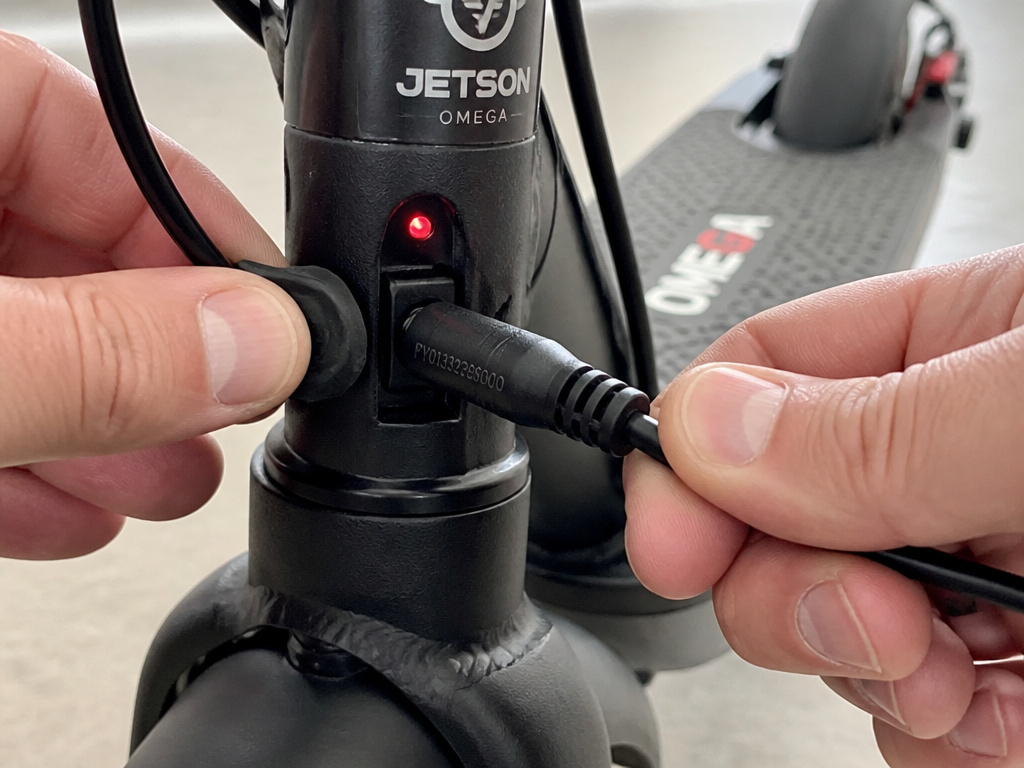
How you charge and store the Omega decides whether it lasts one season or three. The battery is the most expensive part to replace, and the procedures are essential.
First, locate the charging port. On most Jetson scooters, it’s on the deck. On the Omega, it’s on the handlebar stem. This is a specific design choice, so you’re not searching for it.
The official steps are sequential:
- Only use the included FY0132520500 charger.
- Plug the charger into the wall outlet before plugging it into the scooter.
- Do not turn the scooter on while charging.
- Charge until fully complete, the charger light goes from red to green. This takes up to 5 hours.
- Unplug from the scooter, then the wall.
- Replace the rubber cover over the charging port before riding.
The part nobody mentions: The charger’s green light can be misleading. If the battery is deeply discharged or faulty, the light may stay green, indicating the charger sees a full battery even when it’s not. This is a common failure mode reported by owners.
Here’s where the sources give conflicting advice. Sources give conflicting advice: the manual says “charge the battery until it is fully charged,” while the official support article warns “do not leave your scooter charging overnight or for extended periods” but also states “to maintain long-term battery capacity, keep your scooter plugged in until its battery reaches full charge.”
The resolution is a timing compromise. Don’t just plug it in and walk away for 12 hours. Set a timer for 5 hours. When the light turns green, unplug it within an hour or two. Overnight charging stresses the small battery’s management system.
For storage, the rule is absolute:
- Fully charge the battery before putting the scooter away.
- Store it indoors, in a dry place, and cover it to keep dust out.
- Once a month, take it out, plug it in, and give it a full recharge cycle.
Miss that monthly charge, and the battery will self-discharge below a safe voltage. A “dead” battery that won’t take a charge is almost always a battery that was stored flat for too long. This is the most common killer of seasonal toys like this.
A Common Physical Fault and What It Means for Reliability
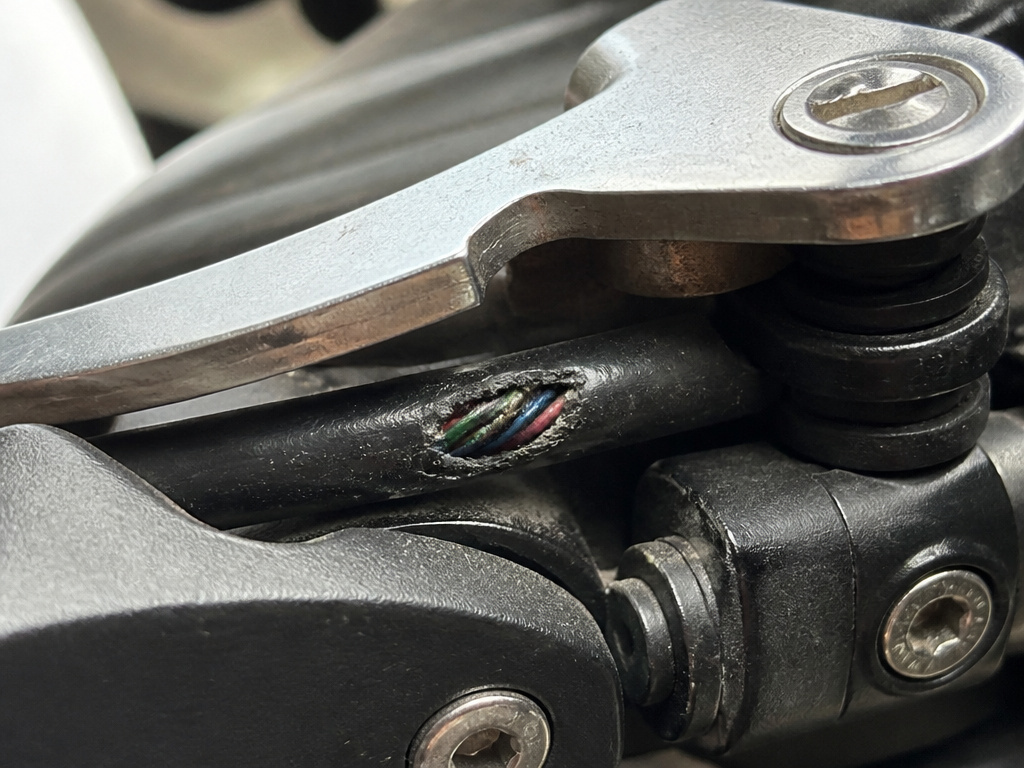
The Omega has a known, design-level weak point. It’s not a matter of if it will affect some units, but when.
The throttle, power button, and wiring run from the handlebar down the stem in a cable. This cable routes directly under the metal latch of the folding mechanism. Every time you fold and unfold the scooter, that latch moves across the cable. Over time, dozens or hundreds of cycles, it can wear through the cable’s insulation and eventually cut the wires inside.
When this happens, the scooter is dead. No power, no throttle response, no lights. The charger may still show a green light because the battery is intact, but the circuit is broken.
I’ve patched the 8 wires back together and added a couple of extra inches to give it a little more ‘give’… But when that cable is ripped in half, the scooter is bricked. . Reddit user repair report
This isn’t a simple plug-and-play fix. It requires disassembling the stem, identifying the eight small-gauge wires, soldering them back together, and adding strain relief. For most parents, this means the scooter is a write-off once the warranty expires.
You can mitigate this. When folding and unfolding, be gentle. Try to avoid letting the latch pinch or pull the cable. Visually inspect the cable where it passes under the latch every few weeks for signs of fraying. But know that this flaw is baked into the design. It’s the single biggest reason I hesitate to recommend the Omega for heavy, daily use. For a kid who rides once a week on smooth paths and has an adult handle the folding, it might never be an issue. For anyone else, it’s a ticking clock.
Who Is the Jetson Omega Actually For? (And Who Should Skip It)
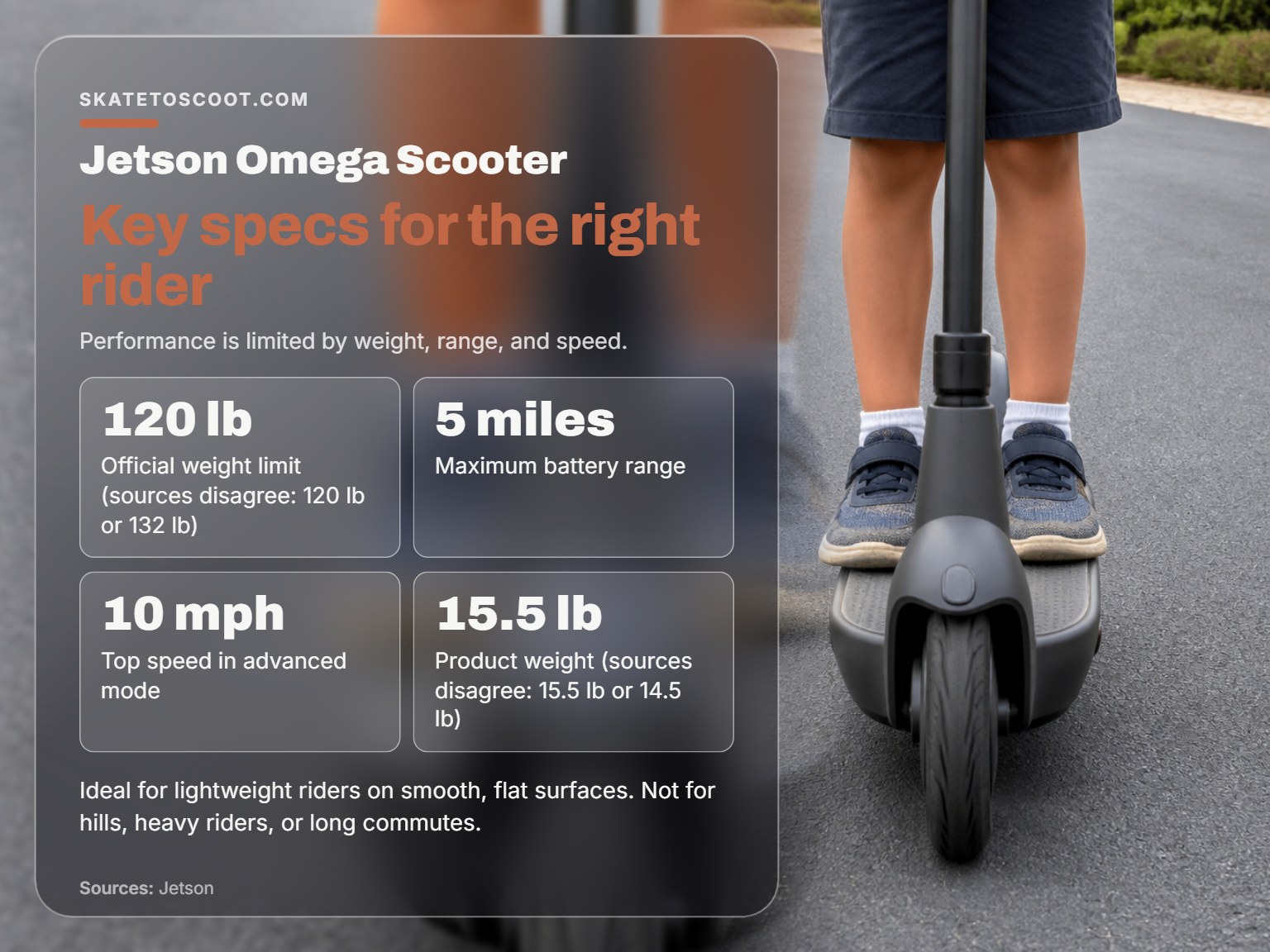
This isn’t a scooter for everyone. Its narrow use case is its greatest strength and its most significant limitation.
The Omega is a good fit for:
- First-time riders ages 8–11 who need to learn throttle control, balance, and braking in a controlled, low-speed environment.
- Lightweight riders under 120 pounds who will use it on flat, smooth surfaces like driveways, paved trails, or gym floors.
- Situations where portability is key. At 15.5 pounds, it’s easy for a parent to carry, and the folding mechanism works well for car trunks or storage.
- Supervised, occasional use. Weekend rides, trips to the park, casual fun where the charging routine can be managed carefully.
Look elsewhere if:
- Your rider is over 120 pounds or is a teenager wanting more speed.
- Your neighborhood has hills or rough roads. The motor and solid tires can’t handle it.
- You need a daily commuter or a rugged scooter that can take bumps and weather.
- You want to compare it directly to more powerful e-scooters from brands like Segway or NIU.
Compared to other entry-level options, the Omega’s value is in its simplicity and light-up deck LEDs, which are a huge hit with kids. It’s less expensive than many popular Jetson models designed for older riders. But that lower cost comes with trade-offs in durability and performance clarity, thanks to the spec conflicts.
Maintenance, Troubleshooting, and Making It Last
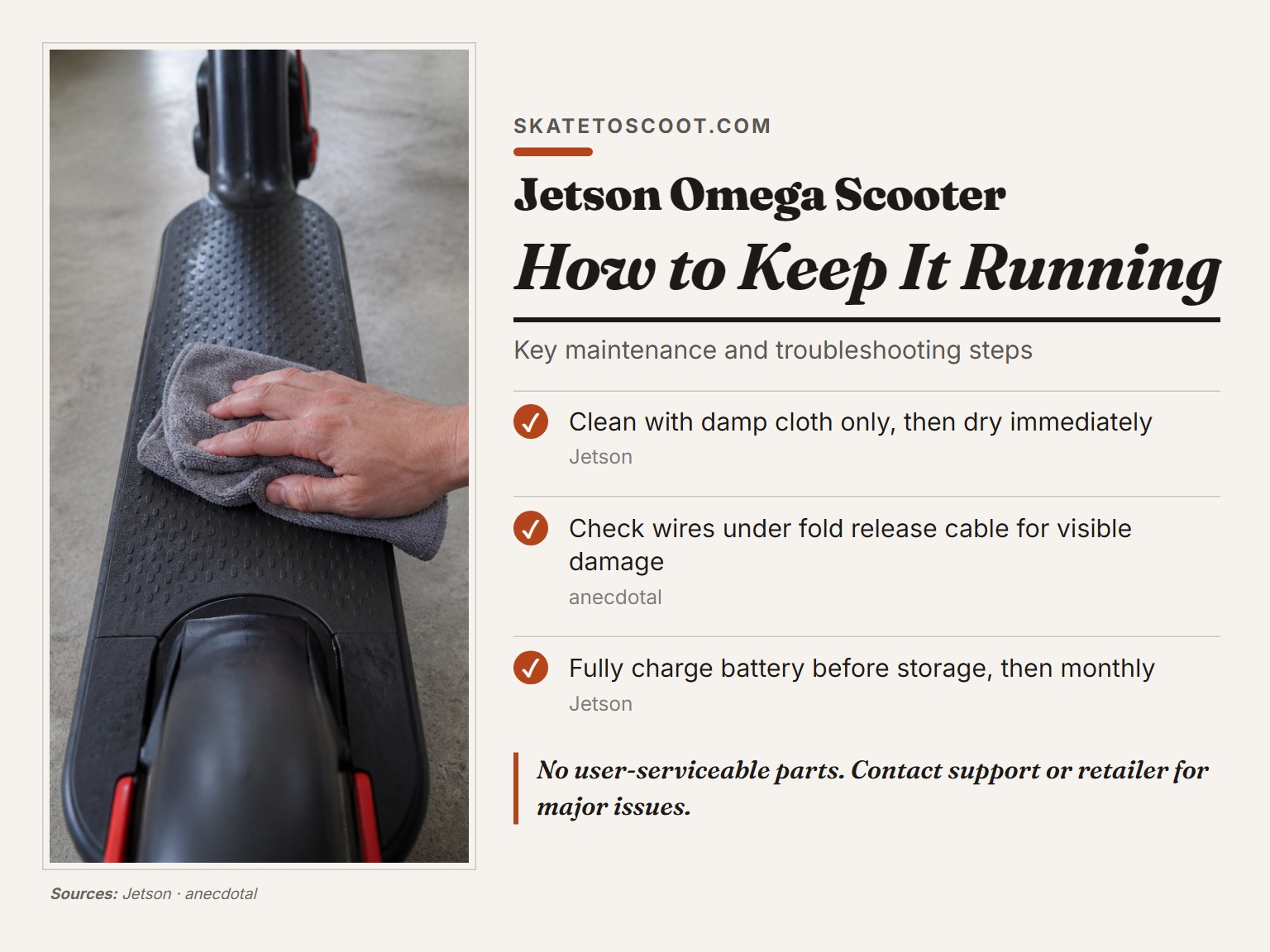
Keeping the Omega running requires a light touch and attention to a few specific failure points.
Cleaning: Use a damp cloth only, then dry it immediately. Do not spray it with water, hose it down, or ride it in the rain. Water ingress around the deck or stem can short the electronics, and repairs are rarely cost-effective.
Tire Care: The solid 6-inch tires never go flat, but they wear down. Check for smooth spots or excessive wear, especially if the scooter is used on abrasive concrete. They are replaceable, but it’s a disassembly job.
If It Won’t Charge:
- Confirm the wall outlet works with another device.
- Check that the charger light turns red when plugged into the wall and the scooter. A steady green light with no scooter power often points to the cut-wire fault or a deeply discharged battery.
- Inspect the cable under the folding latch for visible damage.
- If the scooter turns on but dies immediately under load, the battery may have aged out. Lithium-ion batteries have a finite lifespan.
If It Won’t Turn On:
- Ensure the battery is charged (check the LCD if possible).
- Press and hold the power button for 3-5 seconds.
- Check all connections, especially the problematic cable under the fold latch.
- Contact Jetson support if under warranty. Their official stance, as noted in a support thread, is that there are no user-serviceable parts and no authorized repair network, they often point owners back to the retailer (like Costco) for replacement.
For a deeper look at common problems across the brand, our review of Jetson electric scooters covers broader reliability patterns.
How much does the Jetson Omega cost?
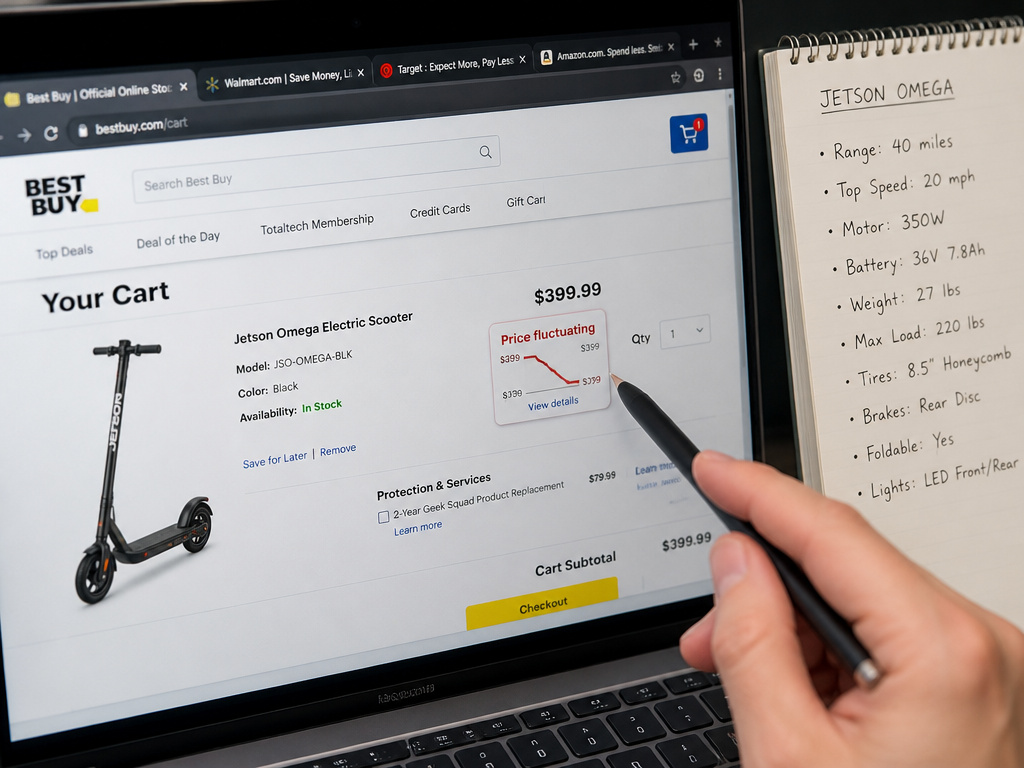
Finding a single, fixed price for the Jetson Omega is difficult as it fluctuates based on retailer and seasonal promotions. This model is positioned as an entry-level electric scooter, so its price typically reflects that. When shopping, compare the final cost against the scooter’s core specs, like its range and speed, to gauge its value. Since prices can change, checking multiple outlets at the time of purchase is the best way to ensure you’re getting a fair deal.
Where can you buy the Jetson Omega?
The Jetson Omega is available through various major retailers, both online and in physical stores. It’s commonly found at large home improvement chains and general merchandise stores. To find current stock, search for the specific model number online. Availability can vary by location and time of year, so checking a retailer’s website for local pickup or shipping options is the most reliable method. Always verify you are purchasing the correct Omega model, as specifications may differ between versions.
Frequently Asked Questions
Is the Jetson Omega a good first electric scooter for a 10-year-old?
For a 10-year-old on flat ground, yes. Its speed modes let them start safely at 5 mph, and the 10 mph top speed is exciting but not dangerous. The 5-mile range is enough for most neighborhood adventures. Just be prepared to manage the charging routine and inspect the folding mechanism regularly.
How long does the battery last on a single charge?
Officially, 5 miles. Realistically, 3 to 4 miles for a typical 80-100 pound rider on pavement with a few stops. The range falls quickly with more weight, hills, or cold temperatures. The battery indicator is helpful, but when it hits two bars, plan to head home.
Can the Jetson Omega be used by adults?
No. The weight limit is 120 lb (or 132 lb in an older manual), and the deck size is small. The motor struggles with more weight, and the experience would be uncomfortable and potentially unsafe. Adults should look at scooter comparisons for models with higher weight capacities.
What is the most common problem with the Jetson Omega?
Wiring fault where the throttle cable passes under the folding latch. Friction can cut the wires, causing a complete loss of power. This design flaw is the scooter’s biggest reliability issue and is difficult for most owners to repair themselves.
Where is the charging port on the Jetson Omega?
Unlike most Jetson scooters where the port is on the deck, the Omega’s charging port is on the handlebar stem. Look for the small rubber cover on the handlebar stem.
The Bottom Line
The Jetson Omega is a beginner’s scooter with a strict set of rules. Follow them, and it can provide a season or two of fun for a young rider. Break them, and it becomes a frustrating paperweight faster than you’d think.
Its value is in simplicity and low-speed training. The light-up deck is a winner with kids, and the three speed modes build confidence. But the conflicting specs mean you’re never quite sure what you’re getting, and the wiring fault is a tangible risk.
If you buy one, do this first: before the first ride, inspect the cable under the folding latch. Then, set a calendar reminder for a monthly battery top-up charge. Those two steps alone will extend its life more than any other.
For a rider under the weight limit, on flat terrain, with an adult handling the maintenance, the Omega can work. For anyone else, or for those comparing it to more robust options like Jetson hoverboards or other electric rideables, the limitations quickly outweigh the flickering LEDs.
